Internet of Things: LoRa vs. UNB. Part 3: technical details
The third of a series of articles devoted to the description of the main differences between low-power long-range radio technologies, which is now gaining ground in the Internet of things: LoRa broadband from narrow-band (UNB, Ultra Narrow Band) systems such as Sigfox and Strizh, as well as their practical application .
Hello GT.
After the first two articles, as well as live stories on this topic, I was asked several times to tell in more detail about the basic technical aspects of the work of LoRa and UNB networks in more detail than I told in the first article:
Well, let's get started. Below will be, as usual, a lot of text and few pictures.
One of the advantages of UNB-systems is their effective use of the radio frequency spectrum - in Russia with minimal restrictions, only a modest band with a width of 500 kHz (868.7-869.2 MHz) is available, but even with a working channel width of a UNB-system of only 100 Hz, such channels it can fit thousands.
However, frequency separation (FDMA) exists only insofar as there is a carrier frequency - which different channels differ. In the usual radio receiving path, after the input amplifier, there is a demodulator, the task of which is to isolate the low-frequency component of the signal by removing the high-frequency carrier. Obviously, after such a demodulator, several frequency channels will merge into a single mess, so no FDMA will work.
Even the most difficult problem has a simple and obvious wrong solution. Such a solution in the UNB-system will be the use of several radio channels tuned to different frequencies. It would seem that ten channels will allow ten subscribers to be received simultaneously, and everyone will be happy. Alas.
One of the serious technical problems of UNB systems is the instability of the frequency of quartz resonators that specify the operating frequency of a subscriber device. A typical good quartz has a total error of ± 25 ppm, that is, at a carrier frequency of 869 MHz, the actual deviation from it can reach 21.725 kHz. As a result, it’s completely pointless to indicate the exact frequency of the channel on which the subscriber’s device is broadcasting - in reality it will be a plus or minus bast shoe. There are no ways to specify this frequency in advance - except for using expensive thermocompensated oscillators (TCXO) instead of quartz resonators, which can reduce the error by a factor of ten.
Therefore, in a BS with multiple radio reception channels, these channels will have to be separated from each other by an amount determined by the error of the resonators of the subscriber devices. Technically, this can be done, but a beautiful picture of how effectively UNB uses every available hertz of the spectrum will have to be thinned out somewhat.
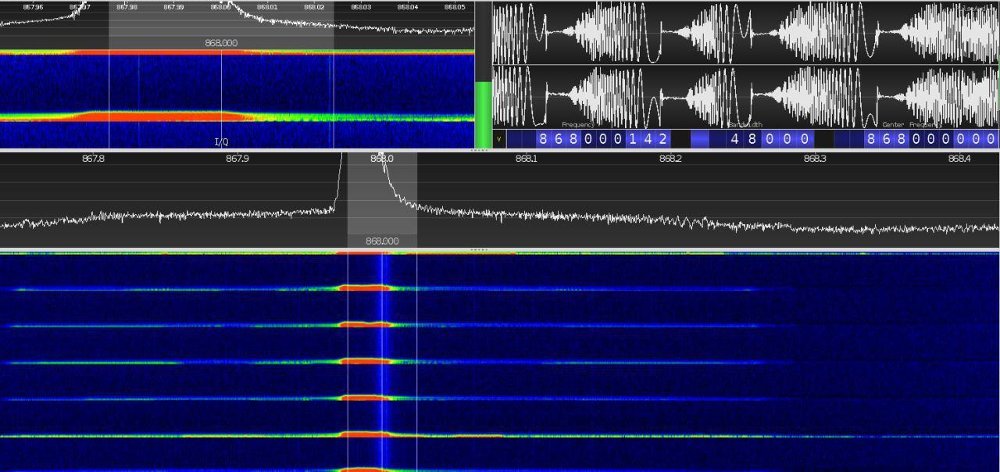
A more advanced option, which is used in practice in serious BSs, is the digitization and subsequent spectral analysis of a wide range of radio air (tens to hundreds of kilohertz) in real time. That is, for example, a BS receives a wide band of 100 kHz, digitizes it, finds in it individual signals of subscriber devices, somehow randomly scattered across this band, selects each of them and passes it on to signal decoders. In fact, the modern base station of the UNB-system is a very high-performance SDR receiver, paired with an equally efficient chip that grinds the data received from the receiver.
Such a system really allows you to receive a large number of subscriber devices at the same time, but this is digital signal processing at a frequency close to gigahertz in real time, that is, a difficult computing task that requires very serious resources from the BS. Lack of such resources will mean the need to trim either the bandwidth or the maximum data rate.
The practical consequence of this is the difficulty of creating low-cost and at the same time effective base stations for UNB systems. Sigfox BS costs around 3,000 euros, the cost of the Strizha BS is not reported on the site (but is unlikely to be less than 100 thousand rubles), one of the most popular LoRaWAN BS - Kerlink - costs 1,200 euros. At the same time, Kerlink can be considered an expensive solution, the price tag of which is largely due to not very high natural demand for base stations. The finished board with the SX1301 transceiver, to which you need to add a few brains to get a full-fledged BS, the interface for the uplink, case and power costs $ 180. In general, as the production of LoRa increases, there is much to fall in price - despite the fact that Sigfox now looks pale against its background.
In addition, it follows from the same that when you are offered some kind of cheap femtocell for a UNB system, you need to carefully study what it has inside and what its real performance is.
The large relative instability of the frequency of the frequency-setting quartz resonator is a direct cause of one of the most significant - from the point of view of practical application - problems of UNB systems: the technical impossibility of symmetric feedback, i.e., BS → subscriber communication.
For the subscriber to receive something from the BS, the BS must broadcast on its frequency. However, in the UNB-system we simply don’t know the subscriber’s operating frequency in advance - there is quartz in it, which gives a frequency spread hundreds of times greater than the channel width. We simply cannot increase the width of the reception channel on the subscriber either: this will lead to a deterioration in the signal-to-noise ratio, that is, to a decrease in the communication range (we collect noise power from the entire wide channel). It is impossible to implement spectral analysis on a subscriber unit, all the more impossible, too small computing power.
The only way to transfer something to the subscriber in the UNB system is to wait until he goes on the air himself, determine his actual operating frequency on the BS and answer him.
LoRa distinguishes three classes of subscriber devices:
These classes are the result of a trade-off between power consumption and feedback delay. For example, for many data collection devices, if feedback is implemented at all, then according to class A: they sent data to the BS, received confirmation of their receipt from it.
The other opposite is the outdoor lighting control system (ASUNO), and indeed any control system. In them, the need to transmit a command from the BS to the subscriber can arise at any time, therefore, they use class C devices that continuously listen to the air.
However, here we return to UNB-systems: since, as mentioned above, a BS cannot transmit anything to a subscriber until he himself has gone on the air, only Class A devices are technically possible for them. This is the reason that Sigfox and “Swift” are building various data collection systems, but if you try to find an ASUNO using a UNB radio, you will fail.
LoRa doesn’t have such a problem: the bandwidth is such that the system without any serious problems survives the subscriber’s device’s frequency drift by two to three tens of kilohertz to the side, therefore feedback works for all classes of devices without any tricks.
One of the important points that must be understood in relation to any communication system in IoT, be it LoRa or UNB systems, the use of feedback to confirm the delivery of packets from the subscriber to the BS greatly reduces the real capacity of the network.
The reason here is that, no matter how many BS receive channels, the transmission channel is always one. Moreover, the operation of the transmitter excludes any possibility of reception: one antenna is used for transmission and reception, and at the time of transmission, the radio path is disconnected from the receiver so as not to overload its input.
The situation is somewhat simplified by the absence of transmission collisions: even after receiving data, for example, from half a dozen subscribers, a BS can easily line up their answers so that they do not overlap and are transmitted without pauses.
In addition, as a rule, for typical systems, confirmation of data delivery to the subscriber is not required: for example, the meter in the housing and communal services can daily reset the current reading to the BS, and if today they do not reach due to interference on the air, well, they will be corrected tomorrow, there is little trouble. Nevertheless, if you plan to build a radio frequency network with guaranteed delivery of data from subscribers to the BS, you must consider that this greatly reduces its capacity.
Nevertheless, in local networks with not too many subscribers - up to several hundred pieces, for example, for which regularity of sending data is important, delivery confirmation has the right to life. If the delivery did not take place due to some short-term interference or conflict with another subscriber, the end device can try to repeat it several times - until it either receives confirmation from the BS, or does not make sure that the problem is permanent.
Technologically, LoRa is a very interesting invention: if Sigfox uses standard modulation mechanisms (differential phase modulation, DBPSK), due to which it can work on various chips with the corresponding software stack, then LoRa has developed its own modulation scheme implemented in hardware.
Actually, LoRa is the method of modulating the radio signal, although more often this word refers to a set of solutions based on this method.
LoRa is rooted in DSSS - broadband modulation with direct spreading of the spectrum, in which the original information signal is artificially smeared into a wide piece of the spectrum. The principle of operation of broadband systems directly follows from the Shannon limit (aka Shannon-Hartley theorem) for the maximum error-free data transfer rate in a channel with a limited bandwidth in the presence of noise:
S = W × log 2 (1 + P / WN 0 ) , where
S - maximum speed in the communication channel, bit / s
W - channel width, Hz
P - signal power at the receiver input, W
N 0 - average spectral noise power at the receiver input, W / Hz
P / WN 0- signal-to-noise ratio (SNR) at the input of the receiver
On the one hand, the use of a wide band ceteris paribus worsens the signal-to-noise ratio - since the noise is integrated by the receiver from the entire range it listens to, in the simplest case (in the absence of narrow-band interference and N (f) = const) the noise power is directly proportional to the signal bandwidth. On the other hand, the SNR in the equation is inside the logarithm, but the signal bandwidth is outside, therefore, in practice, increasing the band is beneficial from the point of view of increasing the transmission speed.
NB: One of the common misconceptions is that it is impossible to receive a signal that is below the noise level. As is obvious from the equation, this is not so - it is possible to receive any signal whose power at the transmitter input is non-zero, the only question is what data transfer rate you can achieve. All modern IoT-systems of long-distance communication are capable of receiving signals lying below the noise level.
The LoRa developers - by the way, in the original it was not Semtech, but a small company, later bought by Semtech - the task was to adapt DSSS so that it could be effectively implemented in an inexpensive system with low power consumption. Actually, they succeeded. At the same time, unlike UNB systems, LoRa, as I have repeatedly emphasized, is a completely symmetrical system, therefore any chip with LoRa support can equally well act as a receiver or a transmitter.
Strictly speaking, LoRa modulation can be used with a variety of signal parameters - for example, the SX1276 chips that we use in modems support the band from 7.8 kHz to 500 kHz, that is, they can generally work in the narrowband mode (though, with a band of 62, 5 kHz and less, they will face the same problem of frequency drift due to non-ideal quartz as in UNB-systems). However, in practice, as applied to LoRa, they usually talk about the band of 125 kHz and, more rarely, 250 kHz - because these bands are used in LoRaWAN networks (125 kHz as the main, 250 kHz as an additional high-speed channel). Younger chips, such as the SX1272, do not support a bandwidth of less than 125 kHz at all.
The second parameter of signal coding in LoRa is the spreading factor - as the name implies, SF determines how exactly the original signal spreads over a wide spectrum. It is SF that is the main means of channel separation in LoRa: all LoRa transceivers support 7 SF values orthogonal to each other; that is, speaking in human language, allowing to distinguish a transmission encoded with a specific SF, if there are simultaneous broadcasts encoded with other SF values on the air. In fact, SF is an implementation of code division multiplexing (CDMA) at the physical level of the system.
SF also has a second meaning - it determines the data transfer rate. Specifically, with a band of 125 kHz and seven SF used, it ranges from 300 bps to 5 kbps. What's the point of this? The fact is that CDMA separation itself is not very efficient - in addition to not too many orthogonal codes, for CDMA to work, it is necessary that the broadcast subscribers do not differ too much in power. In the task of isolating the signal of each specific subscriber, all the others who are broadcasting at the moment are noise that interferes with the solution of the problem; As a result, one powerful subscriber is able to clog signals from weaker ones.
However, in the case of LoRa, the base station can - and in LoRaWAN networks does so - to instruct subscribers with a more powerful signal to go to SF at a higher speed. And this means that they will simply release the air faster - and this is useful both in terms of avoiding collisions and in terms of energy consumption: the most gluttonous part of modern radio systems is the transmitter itself, which consumes several tens of milliamps, and the faster it turns off, the a battery is better.
As a result, LoRa is not always correctly compared with UNB systems in terms of subscriber capacity directly: if you take a set of devices equally equidistant to the maximum distance, then UNB systems will be ahead, but if you place the subscribers at different distances from the BS - as it actually happens - then LoRa due to higher transmission speeds of subscribers close to the BS can win.
As for the practical issues of implementing CDMA in LoRa, this requires several hardware demodulators on the receiving device. For full-fledged base stations, Semtech offers the SX1301 chip - there are immediately 49 “virtual” LoRa demodulators and one more GFSK in it, so you won't be bored. However, the SX1301 is quite expensive ($ 80), requires complex external wiring (it does not have an integrated radio path), and is sold only directly by Semtech itself - therefore, local projects usually use base stations on one or more chips of the SX127x series, officially designed for subscriber devices. One SX127x has one demodulator, but absolutely nothing prevents you from putting several of these chips in a micro-BS - in fact, if you put 8 at once, you’ll get a femtocell,
NB: by 49 virtual demodulators, Semtech means a complex scheme in which there are 9 physical demodulators, while one works on a fixed SF, and the remaining 8 can work with any SF arriving from the ether, and even at its own frequency. Considering them to be 48 demodulators is not always correct, because, obviously, if all eight of them are all on the same frequency, they will be able to pick up only seven simultaneous messages (according to the number of SFs) - but this is what Semtech points out.
The beauty of LoRa lies in the cheapness, simplicity and absolute symmetry of solutions for subscriber devices and BS. If in UNB systems on a BS we instantly plunge into the issues of using multi-GHz ADCs and digital processing of a radio signal in real time, then in LoRa anythe subscriber device can be used as a micro-BS when installing the corresponding firmware on it. If desired, a single-channel LoRa base station can be built in the evening from a finished LoRa modem and Raspberry Pi - which cannot be said about UNB systems. Such a BS allows you to collect data from hundreds of subscribers on an area of several square kilometers - and this is more than enough, for example, for most monitoring tasks in agriculture and production facilities.
In addition, the presence of symmetric feedback in LoRa allows you to implement TDMA if you wish: having received data from the subscriber, you need to inform him when the next time he is allowed to get in touch. Such a scheme can be especially effective in local area networks of the size of an object, where a single base station maintains a register of existing subscribers and scatters them along a temporary grid so that they do not intersect each other on the air.
At the same time, FDMA in LoRa, as a rule, is not used, although technically nothing prevents to make a base station with 2-3 frequency channels. At the same time, each subscriber device will receive a fixed frequency channel - a scheme with fast pseudo-random frequency tuning in LoRa is inefficient due to the long preamble in the signal of the subscriber device. In large BSs on the SX1301, such a scheme can be implemented on a single chip - 8 of the aforementioned LoRa physical demodulators in it allow you to tune to individual frequencies with a deviation of up to ± 2 MHz from the central one; but it must be understood that if one demodulator is configured on one frequency channel, then code division will not work in this channel: subscriber devices can broadcast with any SF, but at each particular moment in time, the demodulator can only process one specific SF.
If we are already talking about adaptive speed in LoRa, then it’s worth shedding light on the question of why adaptive speeds are not so popular in UNB systems. Of course, they - with sufficient computing power of the BS - have fewer problems with the separation of subscribers, but on the other hand, adaptive speed is not only more free air, but also less power consumption on the subscriber side.
Alas, in addition to the modest channel width, in UNB-systems, two circumstances make it difficult to increase the speed over a typical 100 bit / s.
The first is the processor performance of the base station. As we saw above, for efficient operation, a BS must do a spectral analysis of the received broadband signal in real time, extracting narrow-band signals from individual subscribers from it. The words “in real time” have a very specific quantitative meaning here: the frequency of the FFT calculation is the sampling frequency of the subscribers' signals. Therefore, any attempt to seriously increase the speed of communication with subscribers in the UNB system requires an equally serious increase in the performance of the digital signal processing system. And despite the fact that we are talking about DSPs with an initial frequency of almost gigahertz - there is little pleasant in such a requirement.
Secondly, there is another limitation that will not allow increasing the speed of UNB systems to the LoRa level while maintaining their other characteristics - this is the Shannon limit mentioned above:
S = W × log 2 (1 + P / WN 0 ) , where
If you substitute there are specific numbers in this equation - we will see that with an SNR of 60 dB the UNB system is limited by a speed of 2 kbps, LoRa goes into megabits (naturally, such speeds are not realized in practice, so in fact this result means that within the framework of the technologies used theoretical speed limits on this side we are in oRa do not have).
In practice, this leads to the fact that adaptive speeds in UNB are not implemented at all in the case of Sigfox, and in the case of Strizh it is traditionally impossible to understand what is being implemented there and how: representatives of the company here on GT write that adaptive speeds there is, but on the official website for devices, including the base stations themselves, a fixed speed of 100 bps is indicated, in the comparison plate with LoRa there, as much as 25600 bps, but here Shannon, Kotelnikov and Hartley clearly convey warm greetings and persistently asked to trim sturgeon.
The issue of noise immunity of ultra-narrowband and broadband systems deserves special attention, if only because this is the only area where UNB systems really have an advantage over LoRa.
In general, the main thing to understand is that any civilian radio communications can be relatively easily drowned out (generally speaking, military communications too, but usually without the word “easy” simply because of the other capacities and ranges used).
LoRa is quite sensitive to broadband interference: for example, two LoRa BSs operating side by side on the same frequency will interfere with each other quite strongly. At the same time, the sensitivity of LoRa to narrow-band interference is often exaggerated - in practice, LoRa has coding redundancy sufficient to calmly survive the neighborhood with narrow-band systems, including systems with pseudo-random frequency tuning. You can drown out LoRa with a narrow-band system streaming on air with a continuous stream of messages - and I even know some precedents like companies promoting such systems tried to arrange such jamming in comparative tests, but this was obviously not a regular casenarrow-band system, and should be considered primarily in the light of the Civil Code. Not to mention that such work of one UNB-system will create problems for other UNB-systems, if they work in the same range - even if you can not completely drown them out, the percentage of correctly delivered messages will drop sharply.
Nevertheless, if there is a strong interference on the air, LoRa has nowhere to get away from it. At the same time, the subscriber unit of the UNB system has the ability to tune up to fifty kilohertz in any direction - due to the general uncertainty described above with a specific operating frequency, the base station will still catch its signal. In particular, in UNB systems, you can effectively implement the listen-before-talk scheme: the device listens to the air before turning on the transmitter, if it is too noisy in its band, it switches to transmit to another band. This circuit will not work if the noise source is located far from the device and close to the BS, however, in many cases it can help. However, is this scheme implemented at all in the same Swift, and if so, how is it an open question, the company does not answer it on its website.
In general, it should be noted that the noise immunity of long-distance communication systems for IoT is not only a technical issue, but also a political one. The situation when large communication systems are built in a weakly regulated unlicensed range is attractive from the point of view of their early implementation, but cannot continue indefinitely - unlicensed ranges are effective only until there are not too many who want to take on air in them. It is very likely that over the course of several years, as global IoT networks develop, changes in the distribution of the spectrum will begin to be discussed in order to allocate licensed frequencies for such networks and thereby both simplify their deployment and avoid cases of direct sabotage by one operator their competitors.
Separately, the fact that UNB systems are considered to be very aggressive towards their neighbors on the air also adds fuel to the fire - with active work, they strongly affect the stability of any broadband communication systems. At the same time, the developers of UNB-systems prefer to turn a blind eye to this principle on the basis of "whoever didn’t hide is to blame."

This, of course, is a very crude tablet comparing only certain aspects of the three commercial technologies currently available. In reality, the topic of long-range IoT communications is as popular as it is immense - one can talk about its various aspects, from radio planning to software. At the same time, understanding of these aspects among system integrators, potential customers of such systems is still extremely low and is mainly based on the bravura press releases of some companies about how they already serve tens of thousands of square kilometers and entire million-plus cities (in fact in fact, not a single company in Russia currently has large live projects in this area).
I plan to cover these topics live at the upcoming Highload ++ 2016 conferencein which the IoT section appeared this year.
If your company is interested in educational program on modern wireless IoT technologies, as well as in cooperation in developing end devices for 6LoWPAN and LoRa networks and developing projects based on them, please contact . We can do this a bit.
Unwired Devices company develops and manufactures communication modules for 6LoWPAN mesh networks and LoRa long-distance networks, as well as sensors and other terminal devices for these networks, including both hardware and firmware supporting the necessary network technologies. In the case of LoRa networks, we are developing all possible topologies: mesh and static radio relay networks, star-type object networks from one BS, and devices for LoRaWAN global networks.
- Internet of Things: LoRa vs. UNB. Part 1: physics
- Internet of Things: LoRa vs. UNB. Part 2: business
- Internet of Things: LoRa vs. UNB. Part 3: technical details
- Internet of Things: LoRa vs. UNB. Part 4: LoRa Networks and Equipment
Hello GT.
After the first two articles, as well as live stories on this topic, I was asked several times to tell in more detail about the basic technical aspects of the work of LoRa and UNB networks in more detail than I told in the first article:
- Channel separation in UNB systems
- Feedback Problem in UNB Systems
- Channel Separation in LoRa
- Adaptive speeds in UNB and LoRa
- Interference immunity in UNB systems and in LoRa
Well, let's get started. Below will be, as usual, a lot of text and few pictures.
Channel separation in UNB systems
One of the advantages of UNB-systems is their effective use of the radio frequency spectrum - in Russia with minimal restrictions, only a modest band with a width of 500 kHz (868.7-869.2 MHz) is available, but even with a working channel width of a UNB-system of only 100 Hz, such channels it can fit thousands.
However, frequency separation (FDMA) exists only insofar as there is a carrier frequency - which different channels differ. In the usual radio receiving path, after the input amplifier, there is a demodulator, the task of which is to isolate the low-frequency component of the signal by removing the high-frequency carrier. Obviously, after such a demodulator, several frequency channels will merge into a single mess, so no FDMA will work.
Even the most difficult problem has a simple and obvious wrong solution. Such a solution in the UNB-system will be the use of several radio channels tuned to different frequencies. It would seem that ten channels will allow ten subscribers to be received simultaneously, and everyone will be happy. Alas.
One of the serious technical problems of UNB systems is the instability of the frequency of quartz resonators that specify the operating frequency of a subscriber device. A typical good quartz has a total error of ± 25 ppm, that is, at a carrier frequency of 869 MHz, the actual deviation from it can reach 21.725 kHz. As a result, it’s completely pointless to indicate the exact frequency of the channel on which the subscriber’s device is broadcasting - in reality it will be a plus or minus bast shoe. There are no ways to specify this frequency in advance - except for using expensive thermocompensated oscillators (TCXO) instead of quartz resonators, which can reduce the error by a factor of ten.
Therefore, in a BS with multiple radio reception channels, these channels will have to be separated from each other by an amount determined by the error of the resonators of the subscriber devices. Technically, this can be done, but a beautiful picture of how effectively UNB uses every available hertz of the spectrum will have to be thinned out somewhat.
A more advanced option, which is used in practice in serious BSs, is the digitization and subsequent spectral analysis of a wide range of radio air (tens to hundreds of kilohertz) in real time. That is, for example, a BS receives a wide band of 100 kHz, digitizes it, finds in it individual signals of subscriber devices, somehow randomly scattered across this band, selects each of them and passes it on to signal decoders. In fact, the modern base station of the UNB-system is a very high-performance SDR receiver, paired with an equally efficient chip that grinds the data received from the receiver.
Such a system really allows you to receive a large number of subscriber devices at the same time, but this is digital signal processing at a frequency close to gigahertz in real time, that is, a difficult computing task that requires very serious resources from the BS. Lack of such resources will mean the need to trim either the bandwidth or the maximum data rate.
The practical consequence of this is the difficulty of creating low-cost and at the same time effective base stations for UNB systems. Sigfox BS costs around 3,000 euros, the cost of the Strizha BS is not reported on the site (but is unlikely to be less than 100 thousand rubles), one of the most popular LoRaWAN BS - Kerlink - costs 1,200 euros. At the same time, Kerlink can be considered an expensive solution, the price tag of which is largely due to not very high natural demand for base stations. The finished board with the SX1301 transceiver, to which you need to add a few brains to get a full-fledged BS, the interface for the uplink, case and power costs $ 180. In general, as the production of LoRa increases, there is much to fall in price - despite the fact that Sigfox now looks pale against its background.
In addition, it follows from the same that when you are offered some kind of cheap femtocell for a UNB system, you need to carefully study what it has inside and what its real performance is.
Feedback Problem in UNB Systems
The large relative instability of the frequency of the frequency-setting quartz resonator is a direct cause of one of the most significant - from the point of view of practical application - problems of UNB systems: the technical impossibility of symmetric feedback, i.e., BS → subscriber communication.
For the subscriber to receive something from the BS, the BS must broadcast on its frequency. However, in the UNB-system we simply don’t know the subscriber’s operating frequency in advance - there is quartz in it, which gives a frequency spread hundreds of times greater than the channel width. We simply cannot increase the width of the reception channel on the subscriber either: this will lead to a deterioration in the signal-to-noise ratio, that is, to a decrease in the communication range (we collect noise power from the entire wide channel). It is impossible to implement spectral analysis on a subscriber unit, all the more impossible, too small computing power.
The only way to transfer something to the subscriber in the UNB system is to wait until he goes on the air himself, determine his actual operating frequency on the BS and answer him.
LoRa distinguishes three classes of subscriber devices:
- Class A: after transmitting something on the air, the device briefly waits for a response from the BS, after which it turns off the receiver until the next communication session.
- Class B: the device turns on the receiver according to a predetermined schedule. The BS knows this schedule and can transmit data to the device in accordance with it.
- Class C: the receiver is always on, the BS can transmit data at any time.
These classes are the result of a trade-off between power consumption and feedback delay. For example, for many data collection devices, if feedback is implemented at all, then according to class A: they sent data to the BS, received confirmation of their receipt from it.
The other opposite is the outdoor lighting control system (ASUNO), and indeed any control system. In them, the need to transmit a command from the BS to the subscriber can arise at any time, therefore, they use class C devices that continuously listen to the air.
However, here we return to UNB-systems: since, as mentioned above, a BS cannot transmit anything to a subscriber until he himself has gone on the air, only Class A devices are technically possible for them. This is the reason that Sigfox and “Swift” are building various data collection systems, but if you try to find an ASUNO using a UNB radio, you will fail.
LoRa doesn’t have such a problem: the bandwidth is such that the system without any serious problems survives the subscriber’s device’s frequency drift by two to three tens of kilohertz to the side, therefore feedback works for all classes of devices without any tricks.
Feedback and real network capacity
One of the important points that must be understood in relation to any communication system in IoT, be it LoRa or UNB systems, the use of feedback to confirm the delivery of packets from the subscriber to the BS greatly reduces the real capacity of the network.
The reason here is that, no matter how many BS receive channels, the transmission channel is always one. Moreover, the operation of the transmitter excludes any possibility of reception: one antenna is used for transmission and reception, and at the time of transmission, the radio path is disconnected from the receiver so as not to overload its input.
The situation is somewhat simplified by the absence of transmission collisions: even after receiving data, for example, from half a dozen subscribers, a BS can easily line up their answers so that they do not overlap and are transmitted without pauses.
In addition, as a rule, for typical systems, confirmation of data delivery to the subscriber is not required: for example, the meter in the housing and communal services can daily reset the current reading to the BS, and if today they do not reach due to interference on the air, well, they will be corrected tomorrow, there is little trouble. Nevertheless, if you plan to build a radio frequency network with guaranteed delivery of data from subscribers to the BS, you must consider that this greatly reduces its capacity.
Nevertheless, in local networks with not too many subscribers - up to several hundred pieces, for example, for which regularity of sending data is important, delivery confirmation has the right to life. If the delivery did not take place due to some short-term interference or conflict with another subscriber, the end device can try to repeat it several times - until it either receives confirmation from the BS, or does not make sure that the problem is permanent.
Channel Separation in LoRa
Technologically, LoRa is a very interesting invention: if Sigfox uses standard modulation mechanisms (differential phase modulation, DBPSK), due to which it can work on various chips with the corresponding software stack, then LoRa has developed its own modulation scheme implemented in hardware.
Actually, LoRa is the method of modulating the radio signal, although more often this word refers to a set of solutions based on this method.
LoRa is rooted in DSSS - broadband modulation with direct spreading of the spectrum, in which the original information signal is artificially smeared into a wide piece of the spectrum. The principle of operation of broadband systems directly follows from the Shannon limit (aka Shannon-Hartley theorem) for the maximum error-free data transfer rate in a channel with a limited bandwidth in the presence of noise:
S = W × log 2 (1 + P / WN 0 ) , where
S - maximum speed in the communication channel, bit / s
W - channel width, Hz
P - signal power at the receiver input, W
N 0 - average spectral noise power at the receiver input, W / Hz
P / WN 0- signal-to-noise ratio (SNR) at the input of the receiver
On the one hand, the use of a wide band ceteris paribus worsens the signal-to-noise ratio - since the noise is integrated by the receiver from the entire range it listens to, in the simplest case (in the absence of narrow-band interference and N (f) = const) the noise power is directly proportional to the signal bandwidth. On the other hand, the SNR in the equation is inside the logarithm, but the signal bandwidth is outside, therefore, in practice, increasing the band is beneficial from the point of view of increasing the transmission speed.
NB: One of the common misconceptions is that it is impossible to receive a signal that is below the noise level. As is obvious from the equation, this is not so - it is possible to receive any signal whose power at the transmitter input is non-zero, the only question is what data transfer rate you can achieve. All modern IoT-systems of long-distance communication are capable of receiving signals lying below the noise level.
The LoRa developers - by the way, in the original it was not Semtech, but a small company, later bought by Semtech - the task was to adapt DSSS so that it could be effectively implemented in an inexpensive system with low power consumption. Actually, they succeeded. At the same time, unlike UNB systems, LoRa, as I have repeatedly emphasized, is a completely symmetrical system, therefore any chip with LoRa support can equally well act as a receiver or a transmitter.
Strictly speaking, LoRa modulation can be used with a variety of signal parameters - for example, the SX1276 chips that we use in modems support the band from 7.8 kHz to 500 kHz, that is, they can generally work in the narrowband mode (though, with a band of 62, 5 kHz and less, they will face the same problem of frequency drift due to non-ideal quartz as in UNB-systems). However, in practice, as applied to LoRa, they usually talk about the band of 125 kHz and, more rarely, 250 kHz - because these bands are used in LoRaWAN networks (125 kHz as the main, 250 kHz as an additional high-speed channel). Younger chips, such as the SX1272, do not support a bandwidth of less than 125 kHz at all.
The second parameter of signal coding in LoRa is the spreading factor - as the name implies, SF determines how exactly the original signal spreads over a wide spectrum. It is SF that is the main means of channel separation in LoRa: all LoRa transceivers support 7 SF values orthogonal to each other; that is, speaking in human language, allowing to distinguish a transmission encoded with a specific SF, if there are simultaneous broadcasts encoded with other SF values on the air. In fact, SF is an implementation of code division multiplexing (CDMA) at the physical level of the system.
SF also has a second meaning - it determines the data transfer rate. Specifically, with a band of 125 kHz and seven SF used, it ranges from 300 bps to 5 kbps. What's the point of this? The fact is that CDMA separation itself is not very efficient - in addition to not too many orthogonal codes, for CDMA to work, it is necessary that the broadcast subscribers do not differ too much in power. In the task of isolating the signal of each specific subscriber, all the others who are broadcasting at the moment are noise that interferes with the solution of the problem; As a result, one powerful subscriber is able to clog signals from weaker ones.
However, in the case of LoRa, the base station can - and in LoRaWAN networks does so - to instruct subscribers with a more powerful signal to go to SF at a higher speed. And this means that they will simply release the air faster - and this is useful both in terms of avoiding collisions and in terms of energy consumption: the most gluttonous part of modern radio systems is the transmitter itself, which consumes several tens of milliamps, and the faster it turns off, the a battery is better.
As a result, LoRa is not always correctly compared with UNB systems in terms of subscriber capacity directly: if you take a set of devices equally equidistant to the maximum distance, then UNB systems will be ahead, but if you place the subscribers at different distances from the BS - as it actually happens - then LoRa due to higher transmission speeds of subscribers close to the BS can win.
As for the practical issues of implementing CDMA in LoRa, this requires several hardware demodulators on the receiving device. For full-fledged base stations, Semtech offers the SX1301 chip - there are immediately 49 “virtual” LoRa demodulators and one more GFSK in it, so you won't be bored. However, the SX1301 is quite expensive ($ 80), requires complex external wiring (it does not have an integrated radio path), and is sold only directly by Semtech itself - therefore, local projects usually use base stations on one or more chips of the SX127x series, officially designed for subscriber devices. One SX127x has one demodulator, but absolutely nothing prevents you from putting several of these chips in a micro-BS - in fact, if you put 8 at once, you’ll get a femtocell,
NB: by 49 virtual demodulators, Semtech means a complex scheme in which there are 9 physical demodulators, while one works on a fixed SF, and the remaining 8 can work with any SF arriving from the ether, and even at its own frequency. Considering them to be 48 demodulators is not always correct, because, obviously, if all eight of them are all on the same frequency, they will be able to pick up only seven simultaneous messages (according to the number of SFs) - but this is what Semtech points out.
The beauty of LoRa lies in the cheapness, simplicity and absolute symmetry of solutions for subscriber devices and BS. If in UNB systems on a BS we instantly plunge into the issues of using multi-GHz ADCs and digital processing of a radio signal in real time, then in LoRa anythe subscriber device can be used as a micro-BS when installing the corresponding firmware on it. If desired, a single-channel LoRa base station can be built in the evening from a finished LoRa modem and Raspberry Pi - which cannot be said about UNB systems. Such a BS allows you to collect data from hundreds of subscribers on an area of several square kilometers - and this is more than enough, for example, for most monitoring tasks in agriculture and production facilities.
In addition, the presence of symmetric feedback in LoRa allows you to implement TDMA if you wish: having received data from the subscriber, you need to inform him when the next time he is allowed to get in touch. Such a scheme can be especially effective in local area networks of the size of an object, where a single base station maintains a register of existing subscribers and scatters them along a temporary grid so that they do not intersect each other on the air.
At the same time, FDMA in LoRa, as a rule, is not used, although technically nothing prevents to make a base station with 2-3 frequency channels. At the same time, each subscriber device will receive a fixed frequency channel - a scheme with fast pseudo-random frequency tuning in LoRa is inefficient due to the long preamble in the signal of the subscriber device. In large BSs on the SX1301, such a scheme can be implemented on a single chip - 8 of the aforementioned LoRa physical demodulators in it allow you to tune to individual frequencies with a deviation of up to ± 2 MHz from the central one; but it must be understood that if one demodulator is configured on one frequency channel, then code division will not work in this channel: subscriber devices can broadcast with any SF, but at each particular moment in time, the demodulator can only process one specific SF.
Adaptive speeds in UNB and LoRa
If we are already talking about adaptive speed in LoRa, then it’s worth shedding light on the question of why adaptive speeds are not so popular in UNB systems. Of course, they - with sufficient computing power of the BS - have fewer problems with the separation of subscribers, but on the other hand, adaptive speed is not only more free air, but also less power consumption on the subscriber side.
Alas, in addition to the modest channel width, in UNB-systems, two circumstances make it difficult to increase the speed over a typical 100 bit / s.
The first is the processor performance of the base station. As we saw above, for efficient operation, a BS must do a spectral analysis of the received broadband signal in real time, extracting narrow-band signals from individual subscribers from it. The words “in real time” have a very specific quantitative meaning here: the frequency of the FFT calculation is the sampling frequency of the subscribers' signals. Therefore, any attempt to seriously increase the speed of communication with subscribers in the UNB system requires an equally serious increase in the performance of the digital signal processing system. And despite the fact that we are talking about DSPs with an initial frequency of almost gigahertz - there is little pleasant in such a requirement.
Secondly, there is another limitation that will not allow increasing the speed of UNB systems to the LoRa level while maintaining their other characteristics - this is the Shannon limit mentioned above:
S = W × log 2 (1 + P / WN 0 ) , where
If you substitute there are specific numbers in this equation - we will see that with an SNR of 60 dB the UNB system is limited by a speed of 2 kbps, LoRa goes into megabits (naturally, such speeds are not realized in practice, so in fact this result means that within the framework of the technologies used theoretical speed limits on this side we are in oRa do not have).
In practice, this leads to the fact that adaptive speeds in UNB are not implemented at all in the case of Sigfox, and in the case of Strizh it is traditionally impossible to understand what is being implemented there and how: representatives of the company here on GT write that adaptive speeds there is, but on the official website for devices, including the base stations themselves, a fixed speed of 100 bps is indicated, in the comparison plate with LoRa there, as much as 25600 bps, but here Shannon, Kotelnikov and Hartley clearly convey warm greetings and persistently asked to trim sturgeon.
Interference immunity in UNB systems and in LoRa
The issue of noise immunity of ultra-narrowband and broadband systems deserves special attention, if only because this is the only area where UNB systems really have an advantage over LoRa.
In general, the main thing to understand is that any civilian radio communications can be relatively easily drowned out (generally speaking, military communications too, but usually without the word “easy” simply because of the other capacities and ranges used).
LoRa is quite sensitive to broadband interference: for example, two LoRa BSs operating side by side on the same frequency will interfere with each other quite strongly. At the same time, the sensitivity of LoRa to narrow-band interference is often exaggerated - in practice, LoRa has coding redundancy sufficient to calmly survive the neighborhood with narrow-band systems, including systems with pseudo-random frequency tuning. You can drown out LoRa with a narrow-band system streaming on air with a continuous stream of messages - and I even know some precedents like companies promoting such systems tried to arrange such jamming in comparative tests, but this was obviously not a regular casenarrow-band system, and should be considered primarily in the light of the Civil Code. Not to mention that such work of one UNB-system will create problems for other UNB-systems, if they work in the same range - even if you can not completely drown them out, the percentage of correctly delivered messages will drop sharply.
Nevertheless, if there is a strong interference on the air, LoRa has nowhere to get away from it. At the same time, the subscriber unit of the UNB system has the ability to tune up to fifty kilohertz in any direction - due to the general uncertainty described above with a specific operating frequency, the base station will still catch its signal. In particular, in UNB systems, you can effectively implement the listen-before-talk scheme: the device listens to the air before turning on the transmitter, if it is too noisy in its band, it switches to transmit to another band. This circuit will not work if the noise source is located far from the device and close to the BS, however, in many cases it can help. However, is this scheme implemented at all in the same Swift, and if so, how is it an open question, the company does not answer it on its website.
In general, it should be noted that the noise immunity of long-distance communication systems for IoT is not only a technical issue, but also a political one. The situation when large communication systems are built in a weakly regulated unlicensed range is attractive from the point of view of their early implementation, but cannot continue indefinitely - unlicensed ranges are effective only until there are not too many who want to take on air in them. It is very likely that over the course of several years, as global IoT networks develop, changes in the distribution of the spectrum will begin to be discussed in order to allocate licensed frequencies for such networks and thereby both simplify their deployment and avoid cases of direct sabotage by one operator their competitors.
Separately, the fact that UNB systems are considered to be very aggressive towards their neighbors on the air also adds fuel to the fire - with active work, they strongly affect the stability of any broadband communication systems. At the same time, the developers of UNB-systems prefer to turn a blind eye to this principle on the basis of "whoever didn’t hide is to blame."
Instead of an afterword
This, of course, is a very crude tablet comparing only certain aspects of the three commercial technologies currently available. In reality, the topic of long-range IoT communications is as popular as it is immense - one can talk about its various aspects, from radio planning to software. At the same time, understanding of these aspects among system integrators, potential customers of such systems is still extremely low and is mainly based on the bravura press releases of some companies about how they already serve tens of thousands of square kilometers and entire million-plus cities (in fact in fact, not a single company in Russia currently has large live projects in this area).
I plan to cover these topics live at the upcoming Highload ++ 2016 conferencein which the IoT section appeared this year.
If your company is interested in educational program on modern wireless IoT technologies, as well as in cooperation in developing end devices for 6LoWPAN and LoRa networks and developing projects based on them, please contact . We can do this a bit.
Unwired Devices company develops and manufactures communication modules for 6LoWPAN mesh networks and LoRa long-distance networks, as well as sensors and other terminal devices for these networks, including both hardware and firmware supporting the necessary network technologies. In the case of LoRa networks, we are developing all possible topologies: mesh and static radio relay networks, star-type object networks from one BS, and devices for LoRaWAN global networks.