June 15, 2016 at 20:17
At the dawn of gravitational wave astronomy: a second observation of black hole fusion
Today, the LIGO-Virgo scientific collaboration announced the discovery of gravitational waves from a second source and released the results of the first scientific observation cycle (three events in four months of observation). Article published in Physical Review Letters .
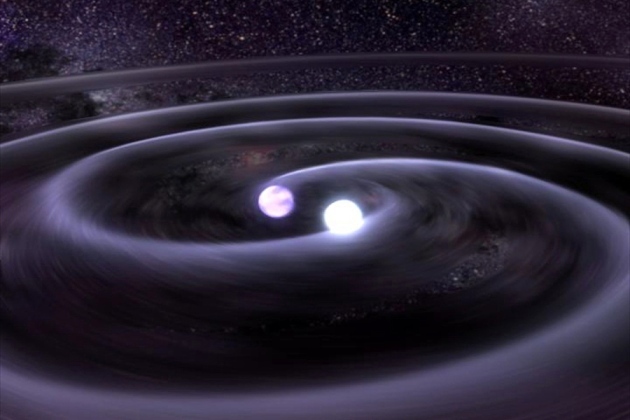
In February, scientists announced the first direct observation of gravitational waves, and now the results of the second event, which happened on December 26, 2015 and is called GW151226, are published. This time the signal turned out to be not so clear (signal-to-noise ratio 13), but the reliability is still more than 5σ. The signal arose when two black holes with a mass of 14.2 and 7.5 solar merged into one - with a mass of 20 solar. The difference in mass (in 2 solar) was converted into the energy of gravitational waves.

A big difference compared to the previous discovery is the need for an additional matched filterto extract a signal from noise. As you can see in the picture, it is difficult to see the signal directly in noise, so scientists use knowledge about the noise of detectors and models for the process of black hole fusion.
The second difference is the signal itself - the mass of the black hole system is much smaller, and the merger takes longer: about 1 second and 45 black holes rotate around each other (for comparison, in the previous event, the merger lasted only 0.2 seconds).
As before, a signal was sent to both detectors (Livingston and Hanford), which made it possible to eliminate local errors, as well as to estimate the distance to the object - about 440 MPc (triangulation).
In January 2016, the first scientific cycle of the detectors was completed and now they are undergoing an update procedure - the laser power will be increased and other changes will be made, which will significantly increase the sensitivity. In just four months of the detector’s operation, three events were recorded corresponding to the merger of two black holes: two with a confidence greater than 5σ, and one with a low reliability (87%). Both main events are in excellent agreement with the predictions of the General Theory of Relativity.
These discoveries make it possible to test the set of predictions that GTR gives, as well as give estimates for the parameters of the systems that we observe, and thereby test certain extensions of GTR (and other gravitational theory).
How do we know that we really discovered gravitational waves

In fact, the signal must meet many criteria, so that we can say that this is really a gravitational wave. Firstly, the amplitude of the signal should be significantly more noise in the system. The detector itself is extremely sensitive, and many different sources of noise interfere with measurements: these are seismic noise, and electronic, and laser, and thermal, and many others. Detectors are carefully characterized for their susceptibility to these noises, and the noises themselves are measured continuously. This data is then used to filter the signal.
Secondly, you need to make sure that nothing else could cause such a signal. There are many non-stationary phenomena (glitches) that occur occasionally and for a short time and can have a shape very similar to grave. the wave. Scientists are looking for possible sources of such phenomena, study them, reproduce, check the response of the system to them and classify them. This makes it possible to compare the recorded signal with known sources and conclude that it is similar to glitch. By the way, you can contribute to the search for glitches!
Finally, measurements are made on two independent detectors spaced several thousand kilometers. Any local phenomenon would manifest itself only in one of them, and a gravitational wave acts immediately on both.
As a result, the key to success is to know very well both the detector itself and all possible sources of noise around it, and make independent measurements on several channels.
Opening gravel. waves. was undoubtedly one of the most important events in modern physics. Over the past few months, the founders of LIGO have already received 4 awards, including the Milner Prize for a breakthrough in science , and the Nobel prize is just around the corner. But the second observation in a sense is even more important - this means we can really observe dozens of events a year. This is not just luck, but scientific progress. The detectors will be updated, a new one built in India , launched after the Virgo upgrade in Italy, and the underground cryogenic KAGRA in Japan - and we can observe not only the merging of black holes, but also paired neutron stars, and supernova explosions ... Recent successesin the test space interferometer - LISA Pathfinder - give us hope for the construction of giant space detectors to observe low-frequency signals - supermassive black holes in the center of galaxies.
Now it remains to wait a bit - and hope that the results of these observations do not coincide with any of our theories, and make us move forward again and look for a deeper understanding of the laws of nature.
UPD And here is a good video in time:
GW151226 in detail
In February, scientists announced the first direct observation of gravitational waves, and now the results of the second event, which happened on December 26, 2015 and is called GW151226, are published. This time the signal turned out to be not so clear (signal-to-noise ratio 13), but the reliability is still more than 5σ. The signal arose when two black holes with a mass of 14.2 and 7.5 solar merged into one - with a mass of 20 solar. The difference in mass (in 2 solar) was converted into the energy of gravitational waves.
A big difference compared to the previous discovery is the need for an additional matched filterto extract a signal from noise. As you can see in the picture, it is difficult to see the signal directly in noise, so scientists use knowledge about the noise of detectors and models for the process of black hole fusion.
The second difference is the signal itself - the mass of the black hole system is much smaller, and the merger takes longer: about 1 second and 45 black holes rotate around each other (for comparison, in the previous event, the merger lasted only 0.2 seconds).
As before, a signal was sent to both detectors (Livingston and Hanford), which made it possible to eliminate local errors, as well as to estimate the distance to the object - about 440 MPc (triangulation).
First science cycle
In January 2016, the first scientific cycle of the detectors was completed and now they are undergoing an update procedure - the laser power will be increased and other changes will be made, which will significantly increase the sensitivity. In just four months of the detector’s operation, three events were recorded corresponding to the merger of two black holes: two with a confidence greater than 5σ, and one with a low reliability (87%). Both main events are in excellent agreement with the predictions of the General Theory of Relativity.
These discoveries make it possible to test the set of predictions that GTR gives, as well as give estimates for the parameters of the systems that we observe, and thereby test certain extensions of GTR (and other gravitational theory).
How do we know that we really discovered gravitational waves
In fact, the signal must meet many criteria, so that we can say that this is really a gravitational wave. Firstly, the amplitude of the signal should be significantly more noise in the system. The detector itself is extremely sensitive, and many different sources of noise interfere with measurements: these are seismic noise, and electronic, and laser, and thermal, and many others. Detectors are carefully characterized for their susceptibility to these noises, and the noises themselves are measured continuously. This data is then used to filter the signal.
Secondly, you need to make sure that nothing else could cause such a signal. There are many non-stationary phenomena (glitches) that occur occasionally and for a short time and can have a shape very similar to grave. the wave. Scientists are looking for possible sources of such phenomena, study them, reproduce, check the response of the system to them and classify them. This makes it possible to compare the recorded signal with known sources and conclude that it is similar to glitch. By the way, you can contribute to the search for glitches!
Finally, measurements are made on two independent detectors spaced several thousand kilometers. Any local phenomenon would manifest itself only in one of them, and a gravitational wave acts immediately on both.
As a result, the key to success is to know very well both the detector itself and all possible sources of noise around it, and make independent measurements on several channels.
Now what?
Opening gravel. waves. was undoubtedly one of the most important events in modern physics. Over the past few months, the founders of LIGO have already received 4 awards, including the Milner Prize for a breakthrough in science , and the Nobel prize is just around the corner. But the second observation in a sense is even more important - this means we can really observe dozens of events a year. This is not just luck, but scientific progress. The detectors will be updated, a new one built in India , launched after the Virgo upgrade in Italy, and the underground cryogenic KAGRA in Japan - and we can observe not only the merging of black holes, but also paired neutron stars, and supernova explosions ... Recent successesin the test space interferometer - LISA Pathfinder - give us hope for the construction of giant space detectors to observe low-frequency signals - supermassive black holes in the center of galaxies.
Now it remains to wait a bit - and hope that the results of these observations do not coincide with any of our theories, and make us move forward again and look for a deeper understanding of the laws of nature.
More about gravitational waves
- First detection article and excellent overview with details
- Official LIGO website about the first event, and details of detection
- A recent interesting interview with Kip Thorne
UPD And here is a good video in time:
Simulation of the binary black-hole coalescence GW151226The video shows a numerical simulation of a binary black-hole coalescence that could have produced the gravitational-wave event GW151226. Simulation: S. Ossokine, A. Buonanno (Max Planck Institute for Gravitational Physics) and the SXS project, Scientific Visualization: T. Dietrich, R. Haas (Max Planck Institute for Gravitational Physics)
Published by LIGO Scientific Collaboration June 15, 2016