November 29, 2017 at 18:14
A new variation of Facebook captcha: upload a photo showing your face
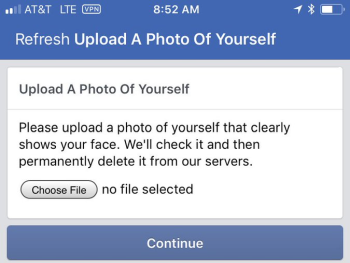 Facebook began testing the advanced CAPTCHA system. To check whether a robot or a person is trying to perform a certain action in the system, a social network asks to send your photo. Today, one of the users said on Twitter that the official Facebook mobile application had made such a request to him. Other users have confirmed that they also encountered this message.
 The screen says: “Please upload your photo, which clearly shows the face. We’ll check it and then permanently delete it from our servers. ” Nearby is a button for selecting a file, as if it were a desktop computer, not a mobile phone. From the phone it would be more logical to offer to make a self portrait.
It looks pretty weird. What versions can be?
In the comments on his tweet, the user says that he did not provoke such actions of the system. That is, a proposal to upload a photo appeared without any apparent reason. The user has a single Facebook account.
The comments also discussed the words of one of the developers who works on Facebook. He admitted that the company has no environment for testing new features. Absolutely everything they experience on real users. In fact, why waste your energy on some special testing system if you have a huge army of real users at hand: just indicate the sample size and test anything.
True, in this case it would be logical to assume that the verification function is first tested on those who are suspected of owning multiple accounts. But there is an opinion that such a check may be initiated for you if someone complains that you have a fake account. Then Facebook will check.
Paranoids can express the opinion that the function is checked for those who do not have a face on the profile photo, but have some kind of abstract picture and maybe there are not enough photos in the photo album. The idea is that Facebook wants to have a biometric database with faces of absolutely all users in the world, so now it fills in the blanks.
In any case, they also report about numerous cases when Facebook required the user to provide documents proving his identity (according to the rules, the user must indicate his real name in the system). It happened that a social network blocked an account even after a person provided all the necessary documents .
The version that Facebook is testing a new biometric authentication system - face recognition - looks very plausible. Of course, they already have numerous photographs of the faces of almost all users. Accordingly, for authentication in the system, they may ask you to make a self-portrait - and the AI system will reconcile with the photos in the profile and photo album. At least if Apple is allowed to do this on Face IDthen why not Facebook? True, in the case of Face ID, biometric data for face recognition (mathematical representations of the face) do not leave the device and are not transferred to the cloud, and in the case of Facebook, the company only promises to remove them from its servers. So this is a completely different situation.
In comments for Wireda Facebook representative gave the following wording: the photo test “helps us catch suspicious activity at various points of interaction on the site, including creating an account, sending requests to add to friends, setting up advertising payments and creating or editing ads.” The company representative assured that the process is fully automated, including registration of suspicious activity and verification of the user's photo. Facebook only verifies that the photo is unique .
Facebook did not say when it started using a similar technique, but on the Reddit forum one of the users reported it back in April. Characteristically, he did send a photo with his face as it should, but the photo still failed to be verified (picture is invalid). It is probably not very pleasant to receive such an answer.
By the way, Instagram, which belongs to Facebook, has been checking users in other ways for some time. For example, asks to send a photo where you are holding a piece of paper in which the code indicated by them is written :
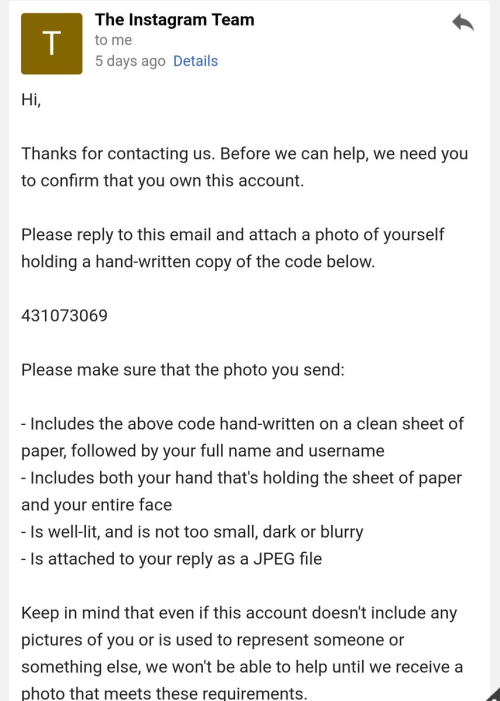
Checking such photos, too, in principle, can be done automatically.