February 8, 2017 at 13:27
Can a computer think for an architect, or What is parametric design
Recently, there was an article on the parametric buildings of Zaha Hadid , but it is not very clear from the text what parametric architecture is in principle. Are parameters something related to the equations describing the “fashionable, stylish, youth” lines of modern buildings? No, everything is more interesting. In fact, parametric design is not so much beautifully curved three-dimensional objects, but genetic algorithms, polymorphism, mobility, analysis of complex systems and other matan. If you are interested in what is happening at the intersection of architecture and information technology, read on.
Add intrigue: the architects themselves call a "parametric" a lot of very different things. As usual, only the past can be put on the shelves, and in the present - continuous boiling and confusion.
0. Parametrism is a visual style.
On the styling of smooth lines and curved surfaces and the corresponding design tools, one must speak either a lot or nothing. They simply exist and give that recognizable result that you all have seen more than once.
By the way, what you just read is just a stereotype. In fact, a parametric building can look like anything, even with a strict parallelepiped without windows. So there will be no pictures in this section. What is hidden behind beautiful renderings is much more interesting than themselves.
1. Parametrism is when a form is created by analyzing the processes that will occur inside it
Information modeling takes functionalism to a new level, when the processes taking place in a building are considered as a separate entity, like a “four-dimensional carrot” by Hawking, and the building wraps itself around it, without introducing too much.
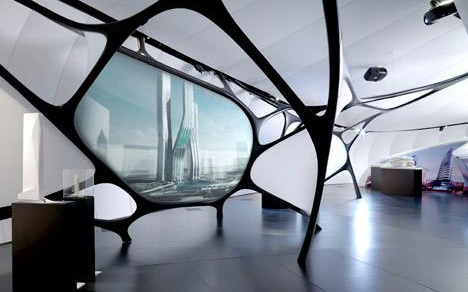
The list of buildings by Zaha Hadid has a mobile exhibition pavilion , the load-bearing structures of which are both walls, and roofing, and furniture, and interior decoration, and direct the movement of visitors between the exhibits along the desired trajectory. As much as possible corresponds to the function, and even understands when not needed - credit! Large buildings differ in materials and construction, but the principle is laid in the basis of the same.
Among traditional buildings, such examples also exist, for example, an antique amphitheater in the natural depression of the relief, where the bottom is the stage, and the slopes are the seats, steps, the supporting structure, and the acoustic surface that controls the sound distribution. Neither add nor decrease.
However, in the pursuit of space optimization, architects are able to forget about the psychological comfort of users of their creations, so far from all “parametric” creations are loved by citizens.
2. Parametrism is when an object changes in response to environmental properties or new functional requirements.
Transformability, mobility, and the ability to interact with the environment are an important reference point for all modern architects, but this is of particular importance for avant-garde artists.
Do you know that in a normal cone, the flakes are firmly pressed together in rainy weather and spread out to dry due to the cycle of swelling and drying of the wood fibers? This is what advanced architects are now striving for: so that the structure responds to changes with its basic elements, and not with complex and expensive technical devices.
Installation "HygroScope - Weather Sensitive Morphology" at the Center Pompidou, Paris.
The “smart” building, stuffed with sensors and controlled by the program has already become mainstream, now researchers are looking for non-electronic methods and non-standard materials. For example, the use of thermocouples, so that heating up in the sun, the element is deformed as needed.
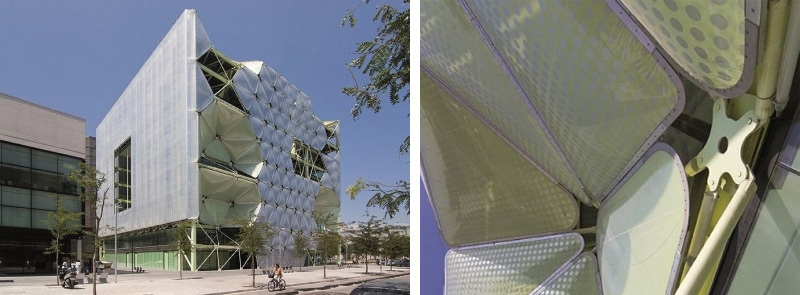
“Inflatable” office building Media-ICT .
Modern buildings breathe, move, open and close their “eyes” with the help of diaphragms, generate clouds of nitrogen inside, dynamically change the optical and thermal insulation properties of the glass itself, and so on - in general, live a rich and interesting life.
I will not list countless examples, turning the post into a Kunstkamera. Overview of several famous parametric buildingscan be seen here . Let's take a look at the computers of designers.
For projects where the object exists in dynamics, the usual CAD-s are not enough, and it is necessary to apply BIM (information modeling of buildings) . The world is gradually moving to the “virtual building” technology, but so far on our land area they are lagging behind this trend (if you wonder why, read the analysis with graphs here ).
3. Parametrism - this is when an object is created according to a previously developed algorithm based on a large amount of input data
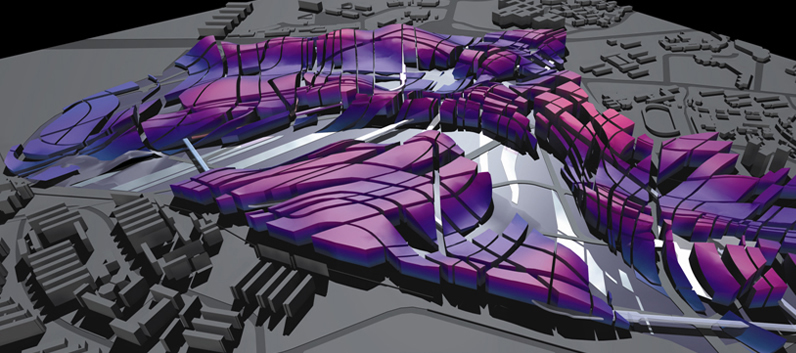
Using BIM programs, you can parameterize design literally, turn it into a “3D equation”. That is, to create a model that, thanks to the given dependencies, will itself adapt to the circumstances. Or create a set of rules that, based on the available information, will generate something new. Algorithmic morphogenesis is applicable both in minimal objects, such as bus stops, and in large-scale ones, at the level of urban planning. By the way, the bureau of Zaha Hadid and Patrick Schumacher is “widely known in narrow circles” with parametric general plans of cities formed using scripts (KDPV shows one of them, this is Singapore).
Here's a curious video that illustrates parametric polymorphism. The text is not in Russian, so I’ll explain a little what is happening in the frame.
The main object is a block of several buildings. The number of its sides, their lengths and angles between them can be changed. Buildings themselves adjust their number of storeys, the number of apartments and rooms, depending on these parameters. Interlocking with each other, the quarters form a network, which, depending on the number of residents and the activity of the traffic flow, changes the width of the streets, identifies the main ones and can replace part of the housing with public institutions, for example, shops on the ground floors. This is a research work, not a real design tool, but it is quite possible to understand the trend from it.
For a building, you can write an algorithm for morphogenesis, which for different source materials will produce different results, but they will be members of the same “population”. It turns out architectural polymorphism, a modern replacement for standard construction: it can also be typified so that there are no identical buildings, but there are the same technological and constructive techniques.
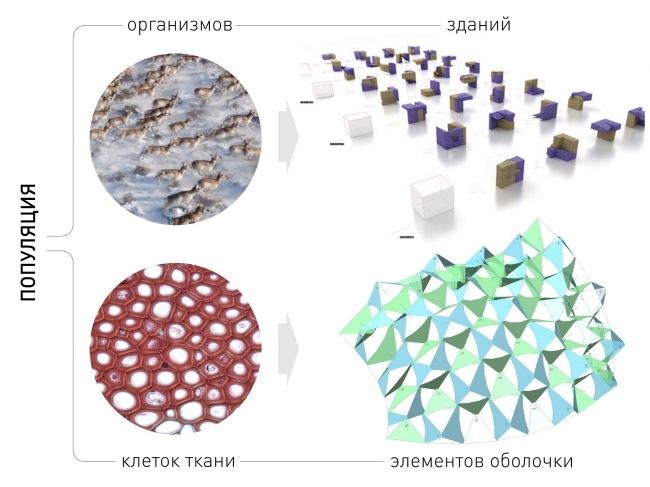
The picture is from here .
Using the task of dependencies, you can also generate objects that fit organically into an existing urban environment. It is in this context that architects use the concept of “genotype”, implying a set of basic parameters, properties, relationships that characterize a building or place. To determine these “genes” and the matrix of interactions between them, big data analysis and numerical analytical methods are increasingly being used. For example, in the 1970s, the structure of the city could be simultaneously analyzed by 2-3 signs, and that was cool, and the most modern example of analysis that I found out revealed the patterns of development of about 400 regions by 25 parameters.
And why architects are not at all satisfied with “normal human” design methods?
Not so long ago, any structure was created and was perceived as a solid static object: a residential building - one thing. Now a paradigm shift is taking place, each structure begins to be regarded as a dynamic system, the elements of which are not only material objects, but also invisible ones: connections, associations, points and axes of perception, and so on. The emergence of architectural systems sets a vast field for research, and parametric architecture is some of the result.
Abroad, both private firms and specialized laboratories of large universities work in the field of implementing system analysis, automation and algorithmization in design. In Russia, so far only the first shoots, for example, the educational initiative “Branch Point”engaged in the popularization of computational methods in architecture.
So can a computer think for an architect? Not yet. But the future is somewhere nearby.