September 24, 2016 at 22:23
Earth's atmosphere is slowly losing oxygen
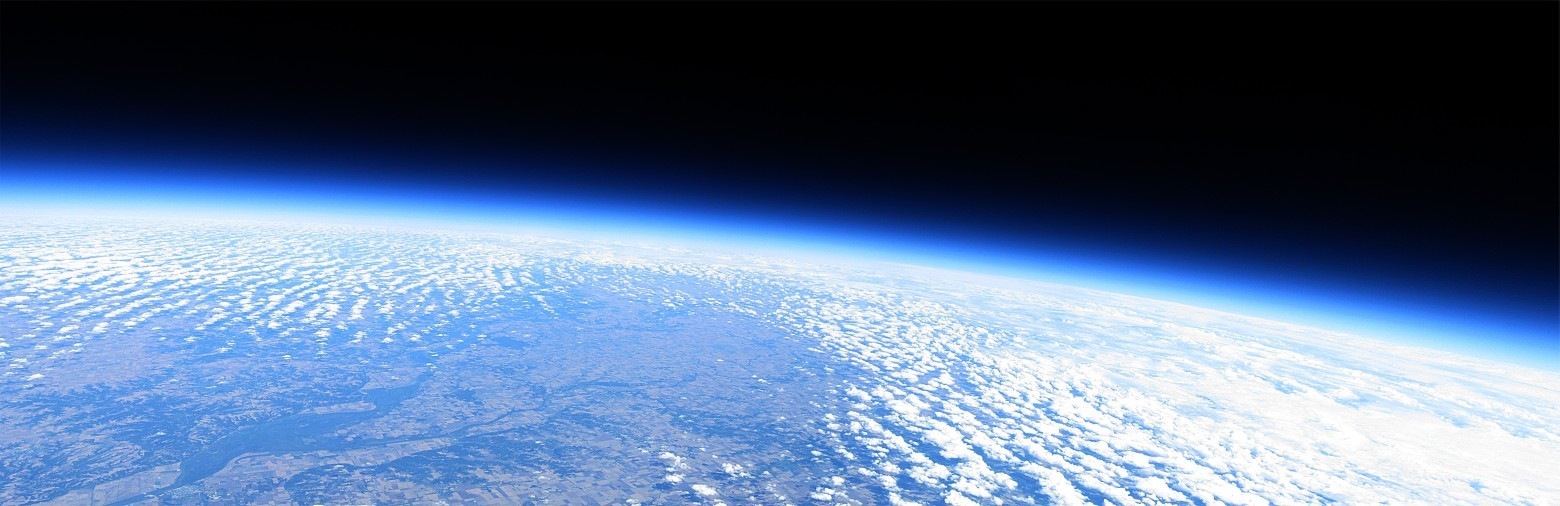
The troposphere is the lower very thin layer of the atmosphere 8–18 km high, in which 80% of the Earth’s
atmosphere is concentrated. The importance of atmospheric O 2 for biological and geochemical processes on Earth is extremely high. Therefore, scientists have long been studying how the oxygen content in the history of our planet has changed. This can be understood from the calculation of the partial pressure of O 2 and N 2 in the total atmospheric pressure.
Despite the long history of the issue, experts still have no consensus on changes in atmospheric pressure over the past 500 million years. Calculations differ up to 0.2 atm (see diagram below). Even over the past few million years, there is no clear picture of how atmospheric pressure, partial pressure, and, consequently, the concentration of O 2 have changed .
The question is not simple, because the oxygen from the atmosphere is constantly consumed by animals, plants and even stones. A group of scientists from Princeton University clarified this issue by studying the concentration of air bubbles in the ice cores of Greenland and Antarctica .

Ice core from a depth of 1837 m with visible annual layers
Today, ice cores are the most reliable and accurate source of atmospheric pressure data. The maximum ice age in the cores is 800 thousand years, therefore, studies are limited to this time interval.
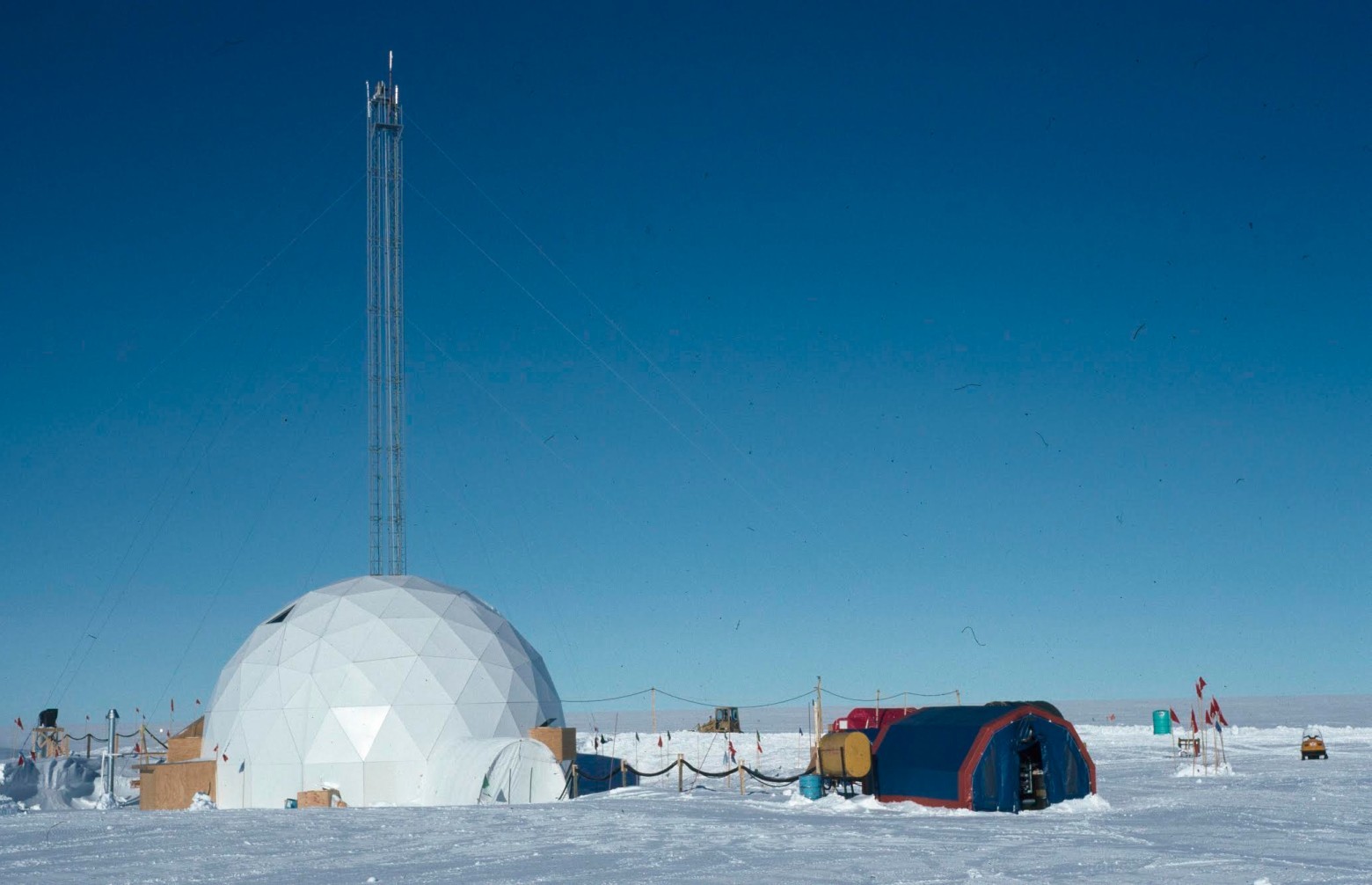
Extraction of ice cores at the Vostok scientific station in Antarctica
It turned out that during this time a fairly stable oxygen leak occurred from the Earth at a rate of approximately 8.4 ppm per million years. In particular, over the past 800,000 years, the atmosphere has become about 0.7% less oxygen.

The diagram on the left shows how the results of scientific modeling of the O 2 / N 2 ratio differin the atmosphere and partial pressure. The diagram on the right shows the partial pressure change according to the results of measuring air bubbles in ice cores for 800 thousand years.
“We made these measurements more out of interest than to confirm the theory,” said Daniel Stolper, one of the authors of the scientific work. “We did not know what would happen: oxygen will increase over the years, decrease or remain at a constant level.”
The decrease in the amount of oxygen in the atmosphere is quite slow. Probably in the coming millions of years it does not threaten human life. But information on the nature of such cycles is very important for science. We need to know under the influence of what factors changes occur. This information can be used, inter alia, for terraforming Mars, when people begin to populate the Red Planet. We will probably have to increase the amount of oxygen in the Martian atmosphere.
There was no oxygen on Earth in the first couple of billion years. According to the most probable theory, about 2.4 billion years ago, the oxygen level jumped sharply due to the activity of cyanobacteria, also known as blue-green algae. This period of a sharp change in the composition of the atmosphere with the subsequent restructuring of the biosphere and global Huron glaciation in the history of the Earth is known as an oxygen catastrophe .
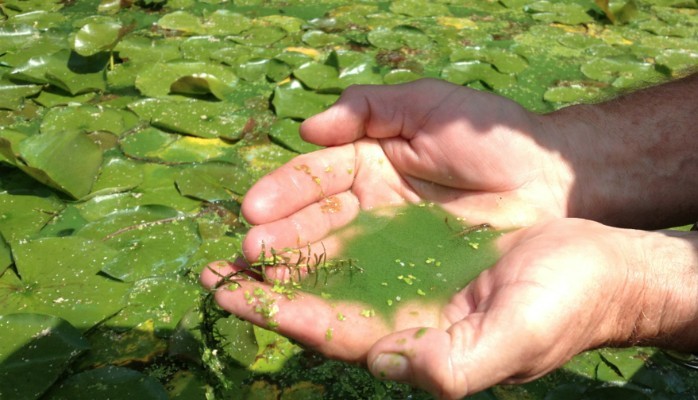
Blue-green algae - the reason why 2.4 billion years ago on Earth appeared in large quantities of oxygen and a more advanced life arose.
The same oxygen catastrophe can be arranged on Mars.
Scientists have not yet agreed on why the Earth’s atmosphere is slowly losing oxygen. There are two hypotheses. One of them - this is due to an increase in the rate of erosion, as a result of which more rocks are extracted from the soil, which are oxidized and bind more oxygen. Another theory is related to climate change: over the past few million years, temperatures have dropped slightly, despite sharp increases in recent decades. Due to the decrease in temperature, a chain of environmental reactions could be initiated, as a result of which more oxygen began to dissolve and bind in the oceans.
So far, all these are just hypotheses that should be checked.
At present, the Earth’s atmosphere contains 78.09% nitrogen, 20.95% oxygen, 0.93% argon, 0.039% carbon dioxide and small impurities of other gases. It also constantly changes the concentration of water vapor, which is considered one of the main greenhouse gases. At ocean level, the concentration of H 2 O in the atmosphere is about 1%, and on average about 0.4%. The total mass of the atmosphere is 5.5 × 10 18 kg, i.e. 5.5 zettagrams or 5.5 petatons.
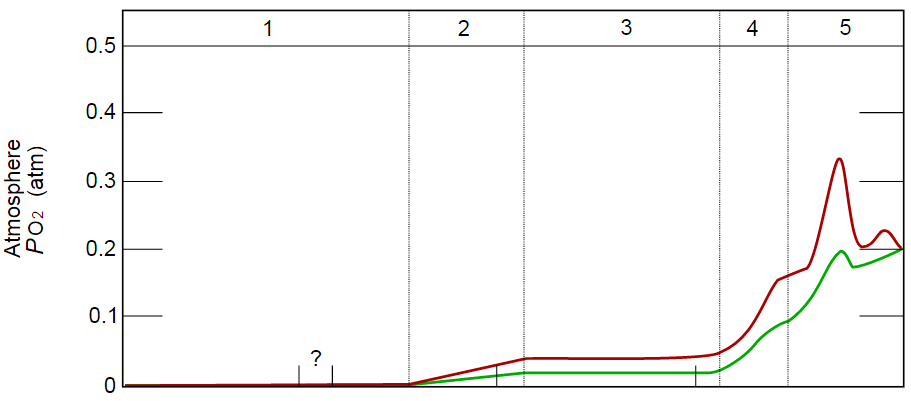
The accumulation of oxygen in the Earth’s atmosphere. The green graph is the lower estimate of the oxygen level, the red is the upper estimate. 1. 3.85-2.45 billion years ago. 2. 2.45-1.85 billion years ago: the beginning of the production of oxygen and its absorption by the ocean and rocks of the seabed. 3. 1.85-0.85 billion years ago: the oxidation of rocks on land. 4. 0.85-0.54 billion years ago: all rocks on land are oxidized, the accumulation of oxygen in the atmosphere begins. 5. 0.54 billion years ago - present
The leakage of oxygen from the earth's atmosphere is slow. But scientists emphasize that in their study there is no data on changes in oxygen levels over the past 200 years after the start of the Industrial Revolution, when people began to actively oxidize hydrocarbons from the bowels of the earth, receiving energy from this chemical reaction and binding a large amount of oxygen from the atmosphere. “We consume oxygen a thousand times more actively than before,” says Daniel Stolper. “Mankind has completely closed the [oxygen] cycle, burning thousands of tons of carbon ... This is another evidence that, through joint efforts, people can significantly accelerate the natural processes on Earth.”
The scientific work was published on September 23, 2016 in the journal Science (doi: 10.1126 / science.aaf5445).