June 16, 2016 at 17:40
Ask Ethan No. 56: Are Black Holes Made of Dark Matter?
- Transfer
There is five times more dark matter in the Universe than usual. But how does this affect black holes?
One day is enough for us to grow, or, conversely, to decrease.
- Paul Klee
Believe it or not, but the quote applies to both black holes and people. Sometimes a black hole can grow indescribably, and sometimes it can lose more mass-energy than it gained. This week, the article is devoted to the question of Michael Booth, which affects not only this aspect of black holes, but also their darker side:
Since dark matter interacts with baryonic only through gravity, and since dark matter exists 5 times more than baryonic, 5 / 6 black holes should contain dark matter. Does this information tell us anything useful about black holes?
Answering this question, it is necessary to consider many aspects, so we will begin with a description of what a black hole is and the fact that our planet is not.

If you take a planet like Earth, it has a huge amount of gravitational energy that keeps us on the surface. To escape from the gravitational field of the planet, we need to achieve huge speeds of the order of 11,200 m / s. The gravitational field in the photosphere of the Sun is much stronger, there you need to move at a speed of about 618,000 m / s in order to break out of its gravitational field. These are great speeds, but achievable.
But if we place enough mass in a sufficiently small volume of space, the runaway speed can exceed 299 792 458 m / s, which is equal to the speed of light in vacuum. And since nothing can move faster, nothing can escape from such a gravitational field, not even light. And we get a black hole.
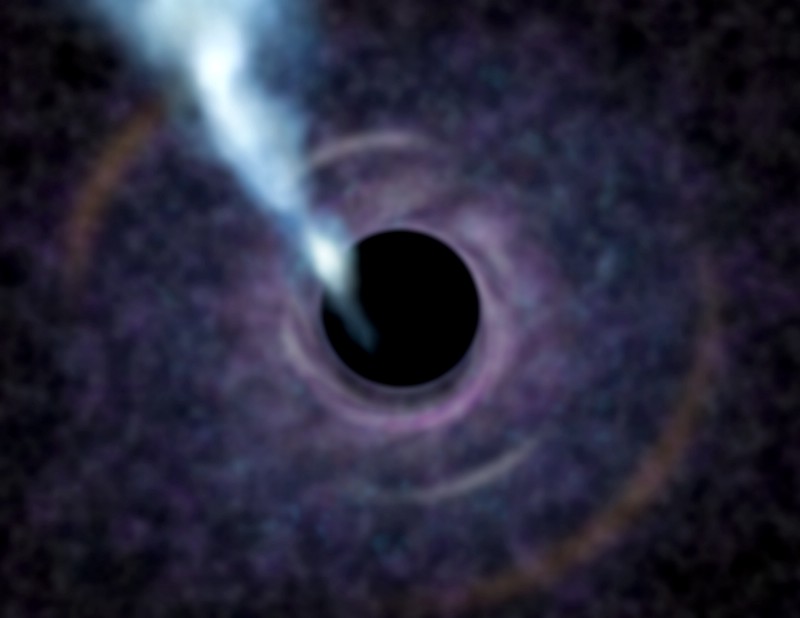
It cannot be said outside whether the black hole was originally created from protons and electrons, neutrons, dark matter, or even antimatter. There are, as far as we can judge, only three characteristics of a black hole that we can determine by observing it: mass, electric charge, and angular momentum describing its rotation speed. Therefore, if we need to find out whether a black hole initially consists of ordinary, baryonic, matter, or whether it consists of dark matter, we need to look at:
An astrophysic of how black holes are formed;
The scientific picture of how they, once formed, gain and lose weight
Let's start with their origin.
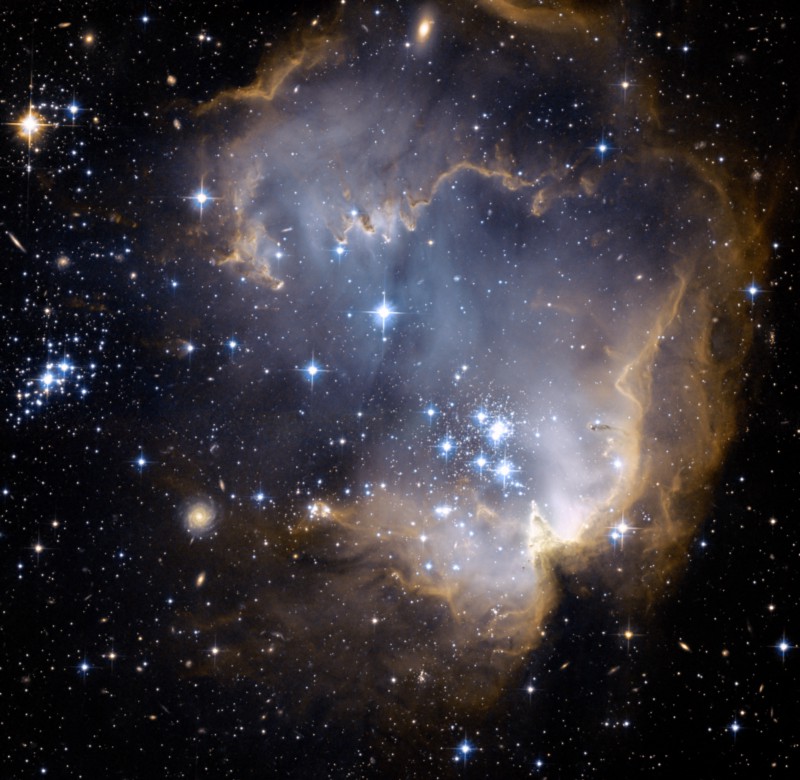
When you look at a young star cluster in the sky, you will most likely see a set of very noticeable blue stars. Looking closer, you would find that although these stars are the hottest and brightest, they are not representatives of the majority. For every blue giant, there are hundreds of ordinary stars, such as the Sun, or dimmer. In general, only 5% of the stars that have ever formed in the Universe are bigger and brighter than our star!
But it is the biggest, hottest and brightest stars that are related to black holes, although they are the rarest. The reason for their brightness is that they burn their nuclear fuel very quickly. A star like the Sun can live 12 billion years until it spends all the fuel in the core, but a star 10 times more massive will live only 0.1% of this period. Consider that the most massive stars known to us are hundreds of times more massive than the Sun, and imagine how much less these giants live.
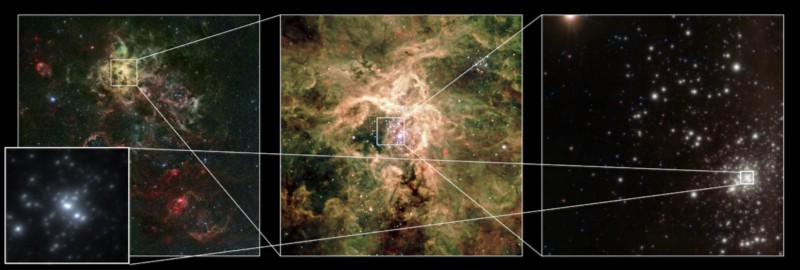
Of course, they can burn the elements synthesized by them, they can turn helium into carbon, then carbon into oxygen, neon and magnesium, then oxygen into silicon, and then silicon into iron - and each time the star’s core will shrink and heat up.
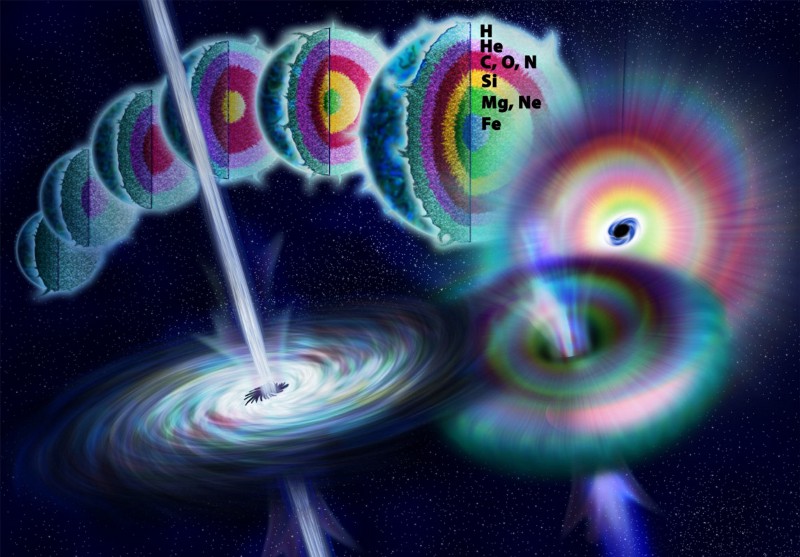
It is these combustion processes that hold back the star and prevent it from collapsing due to gravity, but iron is the last straw. After this last step, it is no longer possible to get energy from the transformation of iron into something heavier, so the star’s core collapses. Neither atoms nor nuclei can restrain gravitational forces, and while the outer shell of the star explodes beautifully and turns into a supernova, the inner part collapses into a black hole.
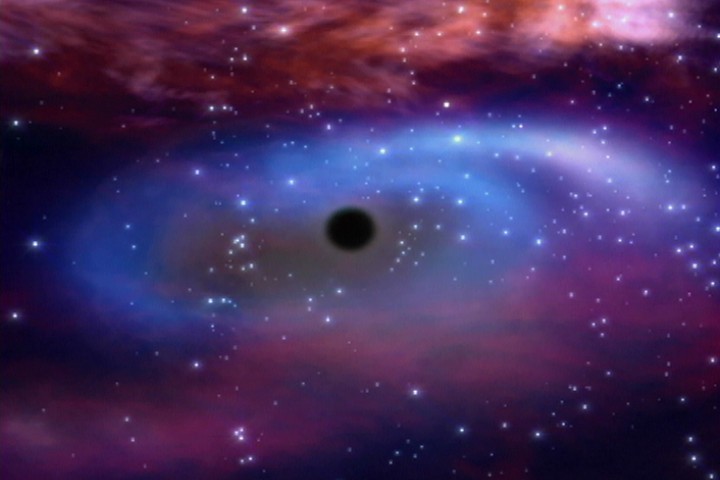
Therefore, at first, when they appear, black holes are 100% composed of normal, baryonic matter, and 0% of dark matter. Dark matter interacts only through gravity, in contrast to ordinary, which interacts through gravity, weak, electromagnetic and strong interactions. All this is a difficult way to explain that when ordinary matter interacts with another ordinary, it can stick together, clump, exchange impulses and collect more matter. Dark matter does not cling to ordinary matter, nor to itself. Therefore, representing galaxies and clusters, we see spiral or elliptical galaxies, where ordinary matter is collected in a relatively small volume, but they are included in the halo of dark matter, which extends, possibly, to thousands of volumes of ordinary.
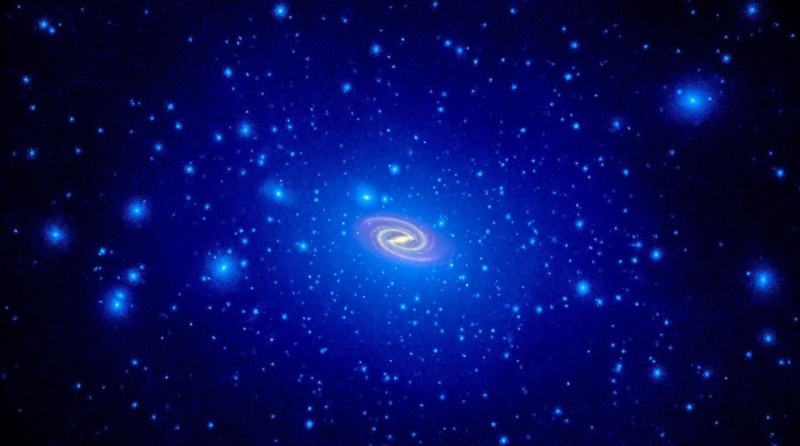
Yes, in large galaxies and clusters of dark matter, perhaps there are five times more than ordinary. But all this is considered only inside the entire huge halo. In the regions of space that we are talking about, ordinary matter prevails over dark. Consider our area near the sun. If we draw a sphere with a radius of 100 AU (a.e. is the distance from the Earth to the Sun) around the solar system, we will include all the planets, moons, asteroids, almost the entire Kuiper belt in it, but the baryon mass (of ordinary matter) of what will be inside the sphere will mainly belong The sun, and will be about 2 * 10 30 kg. On the other hand, the mass of dark matter in this area will be 1 * 10 19 kg - approximately 0.0000000005% of the mass of ordinary.

For comparison, about as much mass is concentrated in the asteroid Juneau, which in the picture below goes under the number "3", and is drawn against the background of the moon for comparison.

Whether we are talking about individual black holes located thousands of light years from the centers of the galaxy, or supermassive, resulting from the merger of many black holes near the galactic nucleus, they all began to exist with the content of approximately 100% of ordinary and 0% dark matter.
But over time, they absorbed both types of matter.
Despite the common misconception, black holes do not suck everything in, they simply spread gravitational attraction. Dark matter, which otherwise would fly by, being dragged by gravity into the event horizon, will be eaten by a black hole, which will increase its mass. But ordinary matter, located near a black hole, will emit waves, decay and lose momentum. It will also interact with the accretion disk, experience friction, lose momentum and increase the amount of swallowed matter. In other words, even when ordinary matter just flies past, part of it is eaten by a hole - this does not happen in the case of dark matter.
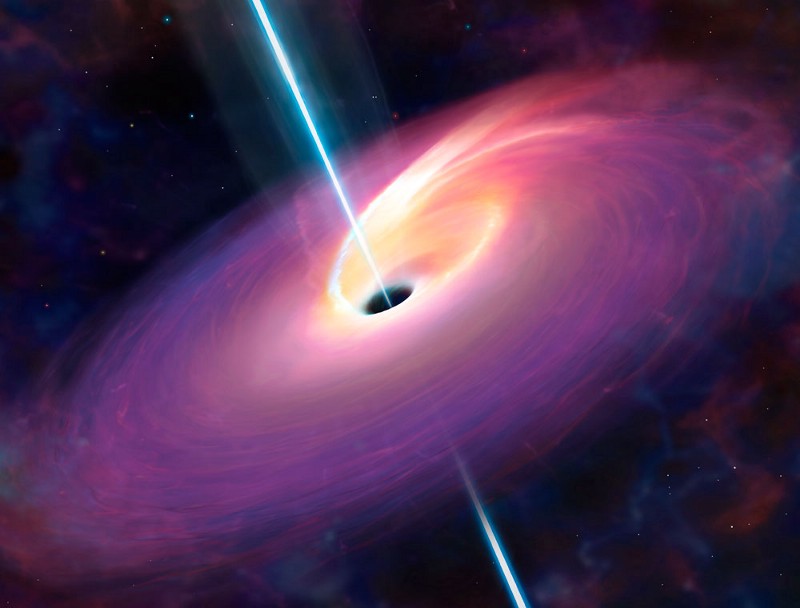
If you need to grow a black hole, it will be easiest to calculate the proportions of ordinary and dark matter eaten by it, taking the proportional density of ordinary and dark matter in this region. For our location, the density of ordinary matter is 1.2 * 10 28 kg per cubic light year, and the density of dark matter is 2.5 * 10 27 kg per cubic light year, or 20% of normal. Not bad!
We must remember that we are on the periphery of the Milky Way, and in the center of the galaxy everything is completely wrong.
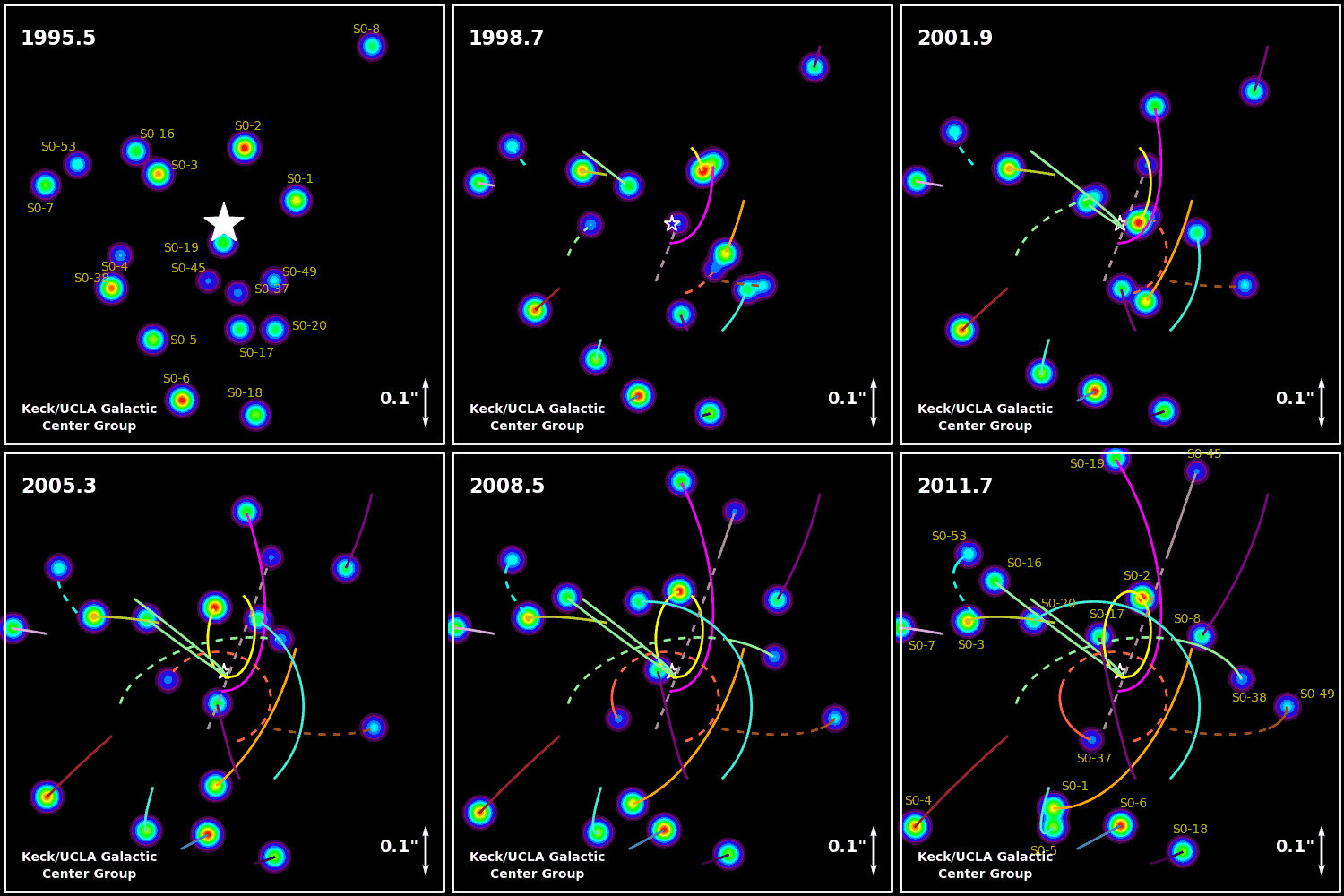
It contains even more dark matter, since the density of the halo of dark matter should increase as it moves toward the center of the galaxy. However, it will not grow so much. There are a lot of uncertainties, but even the most optimistic increase will give us a factor in the region of 10,000. With a pessimistic or more isothermal factor, it will be from 10 to 100. On the other hand, the density of normal matter in the galactic center is 50 million times higher than here we have. And although in our region the contribution of dark matter to a black hole can reach 16%, in the galactic center this number can be no more than 0.004%.
Such a cruel reality:
- black holes form almost entirely from ordinary matter, no matter where this happens
- those that are formed in regions with a low density of matter - such as ours - will have a decent portion of dark matter in their composition, but on average, their contribution will be much less than the contribution of ordinary
- those that are formed in regions with a high density of matter - such as the center of the galaxy - will grow strongly in mass, but 99.996% of this mass will be obtained from ordinary matter
So the sad truth is that dark matter is too small a component involved in the formation of a black hole to influence something, and therefore we don’t learn anything special about it.

For those interested in black hole mass loss: this is due to Hawking radiation. And although it definitely happens, it goes so slowly that it can be neglected in these time periods. A black hole with a mass of the Sun would take 10 67 years to evaporate, that is, it loses mass of less than one electron per year. The largest supermassive black holes in the universe would require 10,100years for evaporation, while they lose a mass comparable to an electron when the same amount of time has passed as has passed since the beginning of the existence of the Universe. Therefore, those who hope to see the loss of mass will have to wait for the moment when the Universe is empty due to dark energy, and black holes will be ejected from our galaxy due to gravitational interactions before the rate of decrease of black holes equals the rate of their growth due to for the absorption of matter.
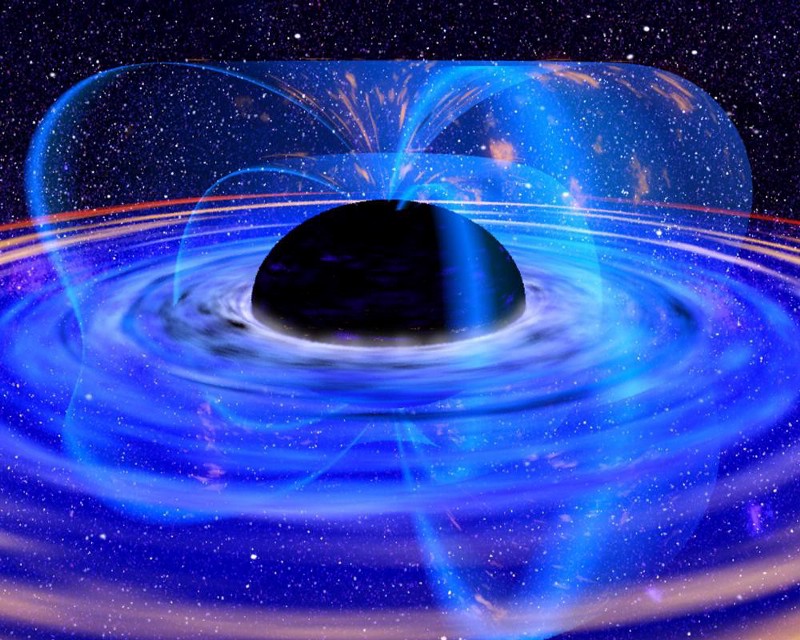
And here's the answer to the question of whether black holes are made of dark matter. They can consist of a maximum of 0.004%, and this is the most optimistic estimate for the most massive of them. Thanks for the great question, Michael, and those of you who want to ask a question for the next column can send them to me!