December 21, 2015 at 16:18
Mikronik is an electronic designer for children. And for adults like me
This weekend I got myself a thing that many would find very simple, but I have not spent the weekend with such childish excitement. We are talking about the electronic designer " Mikronik ", which was invented in Amperka by Kirill Korotkov and Vasily Basalaev.
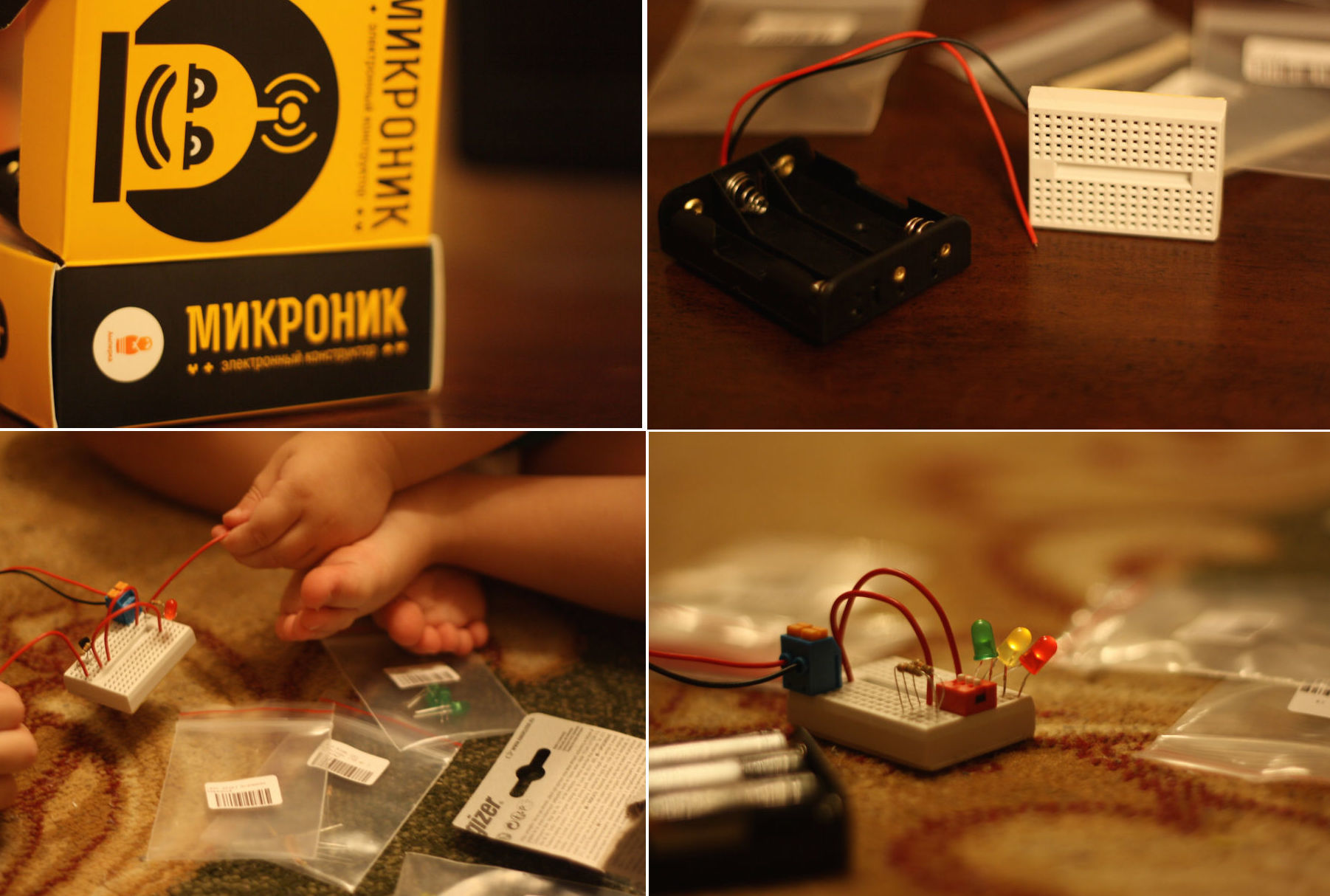
A small box includes a lot of elements, the name of which I still have not learned, and this has a peculiar charm: stick unknown miniature parts into small holes in the circuit board, which miraculously respond with sound or light.
A set is addressed to young inventors who, with its help, will discover simple physical laws for themselves, as well as be able to master the basic concepts of electronics. Despite the educational and developing components of this kit, he does not have creative leadership. I will explain.
Along with the kit, instructions for assembling 20 “models” are offered, and some even offer advanced features, but how to assemble something “from scratch” using only your own imagination is not explained. But this is not a minus of Mikronika, but a chance for creative geek parents to prove themselves!
The category of “designer” was not chosen by chance and very accurately: indeed, in order to assemble a particular device, it is necessary to quite accurately compare the holes where the resistors, wiring, piezo-sound emitters and other details are placed. At the same time, from device to device, structures are noticeably more complicated, overgrown with an increasing number of wiring.
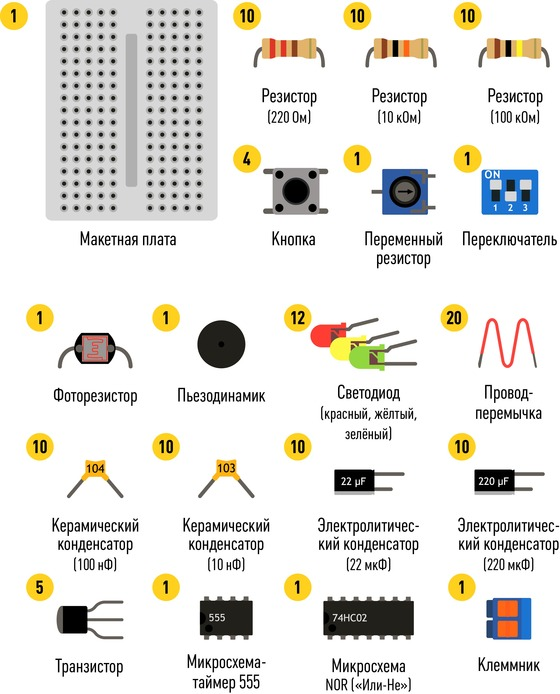
In total, the set contains about 100 components, many of which are duplicated.
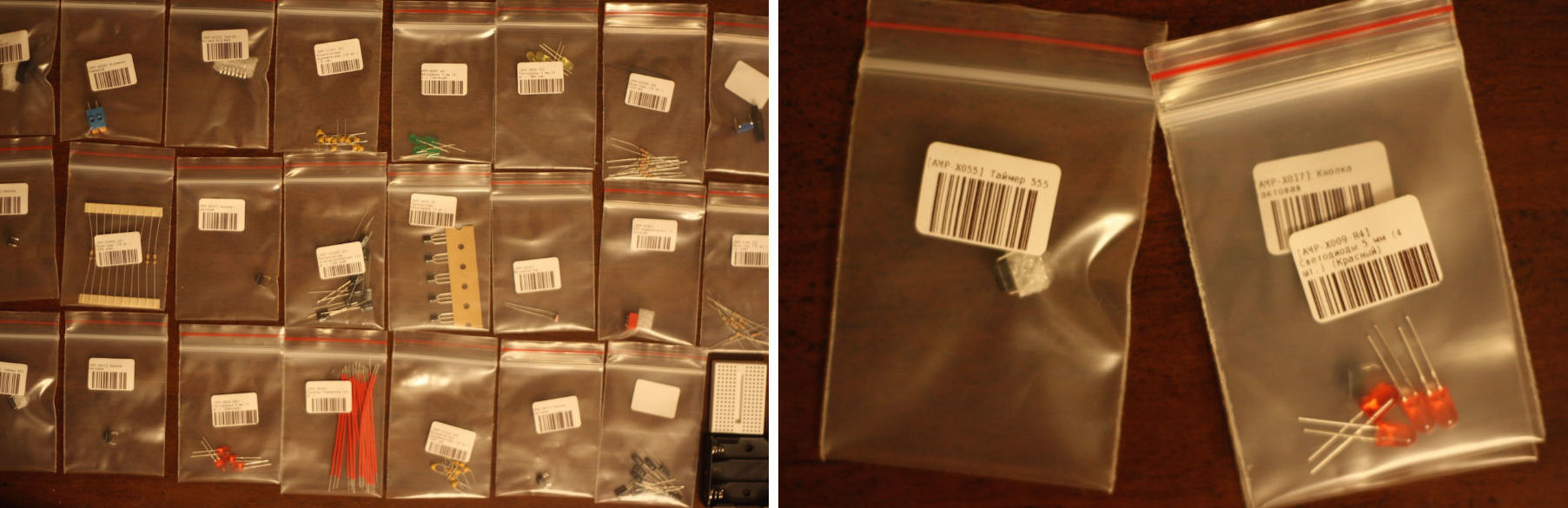
At the same time, for people who, by external signs, are not able to identify each of them, all the details are kindly collected in separate signed bags.
You need to design it on a special board, which is connected to the power source using the terminal block, and it, in turn, runs on three “finger” batteries, however, they already need to be purchased separately !

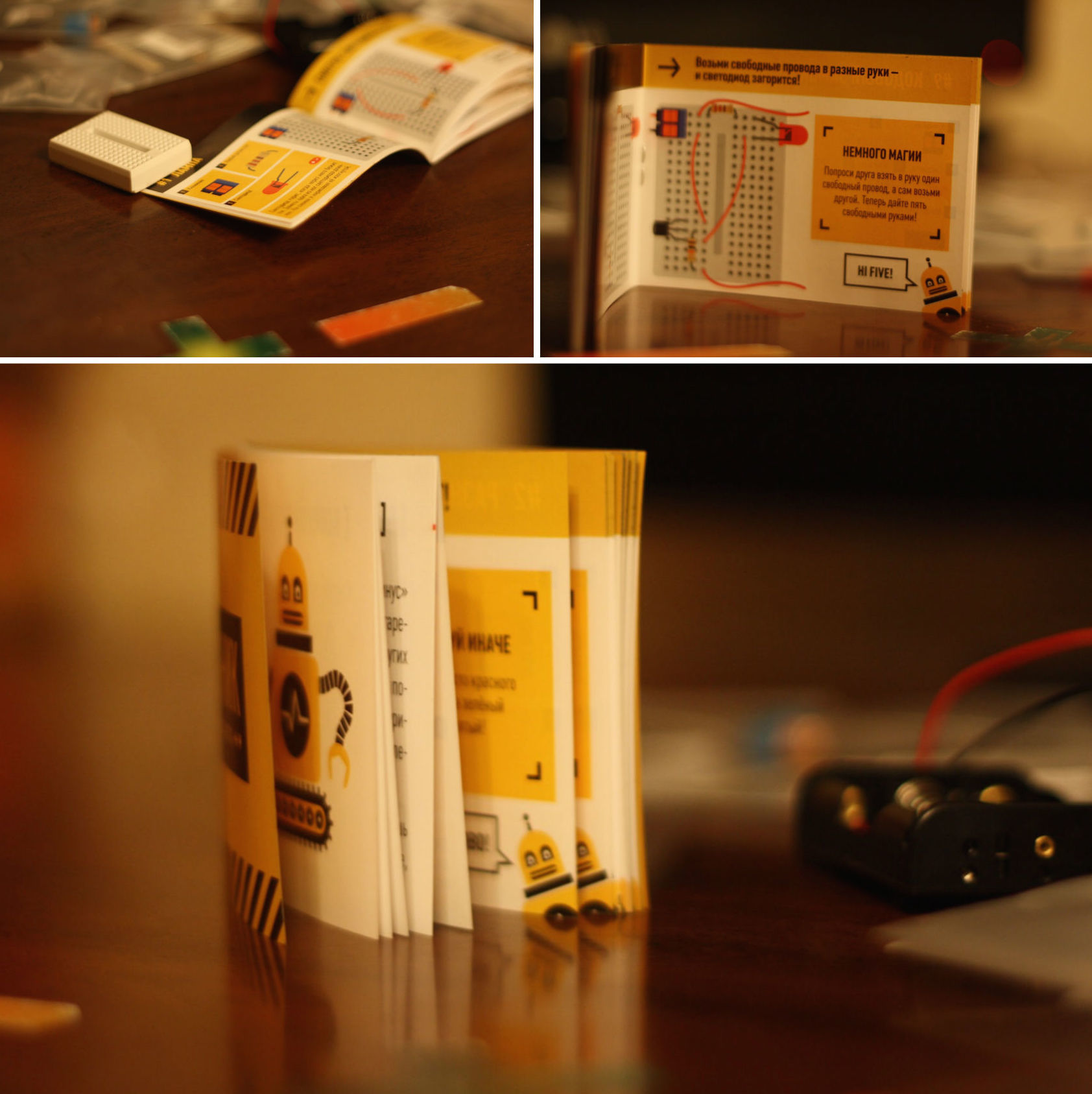
The instructions for creating are offered in a beautifully illustrated brochure, but throughout the entire workflow, you are accompanied by the fictional hero Micronik, who gives advice on how to improve some models. The designs themselves are in a strict hierarchy: from simple to complex.
In total, 20 options for crafts are given:
Despite the impressive number of devices that can be created, and a considerable number of components, the box itself, in which all this fits, is extremely compact, and - I do not want to hint at anything - it fits even under a small Christmas tree:

My baby isn’t yet age, but in principle, light a lamp, holding hands, and extinguish it, disengaging, they learned, although I have already made repeated attempts to surprise them with gadgets .
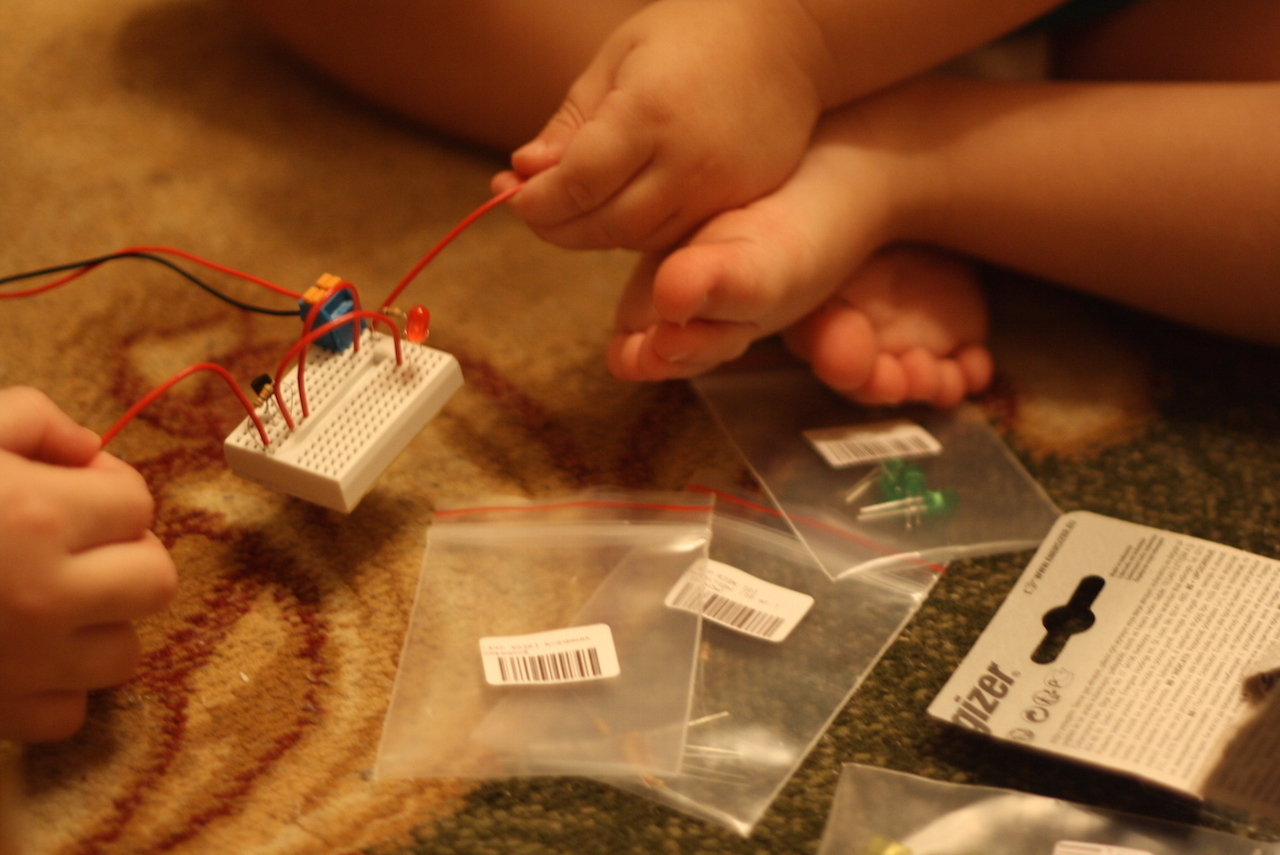
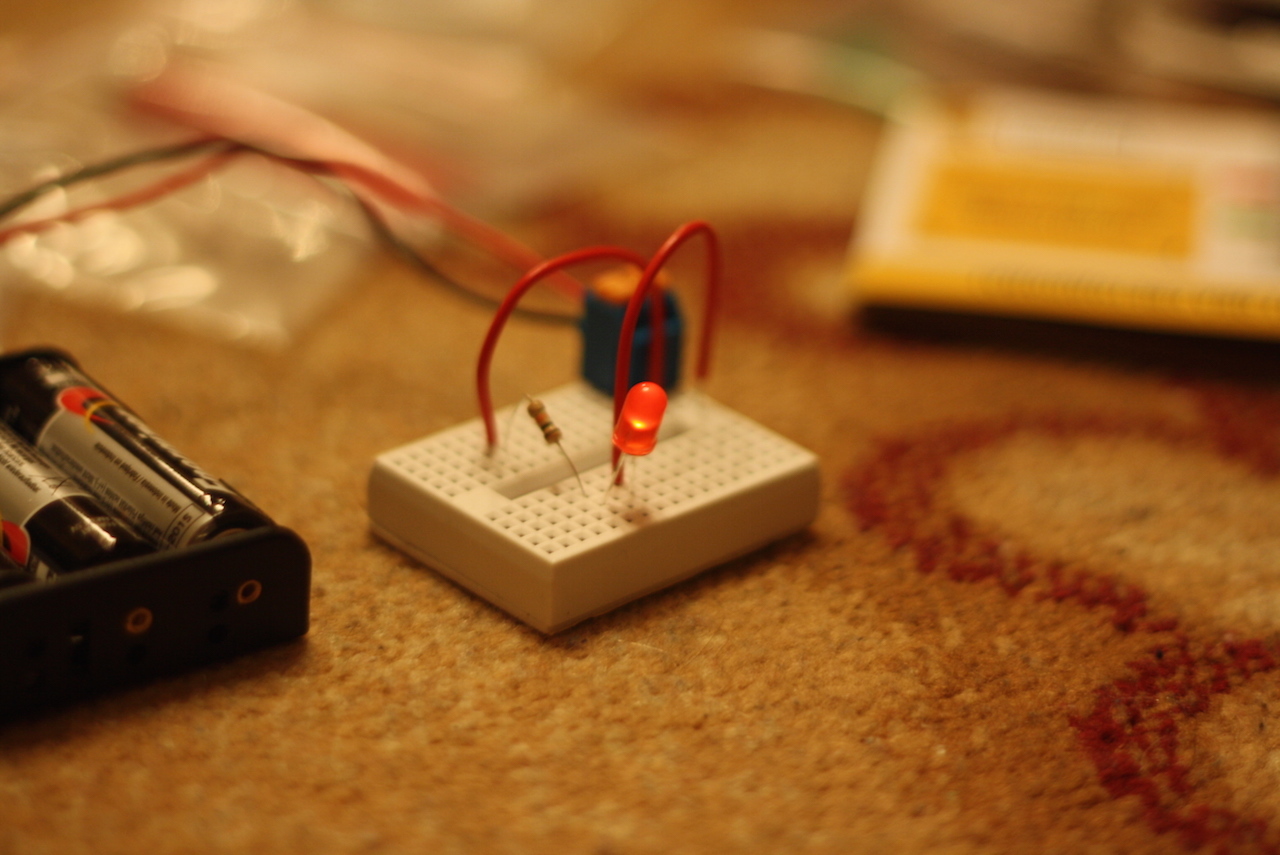
At my 28 years old, I’m probably ashamed to admit that I spent several evenings collecting all kinds of luminous and buzzing constructions, having mastered the lamp:
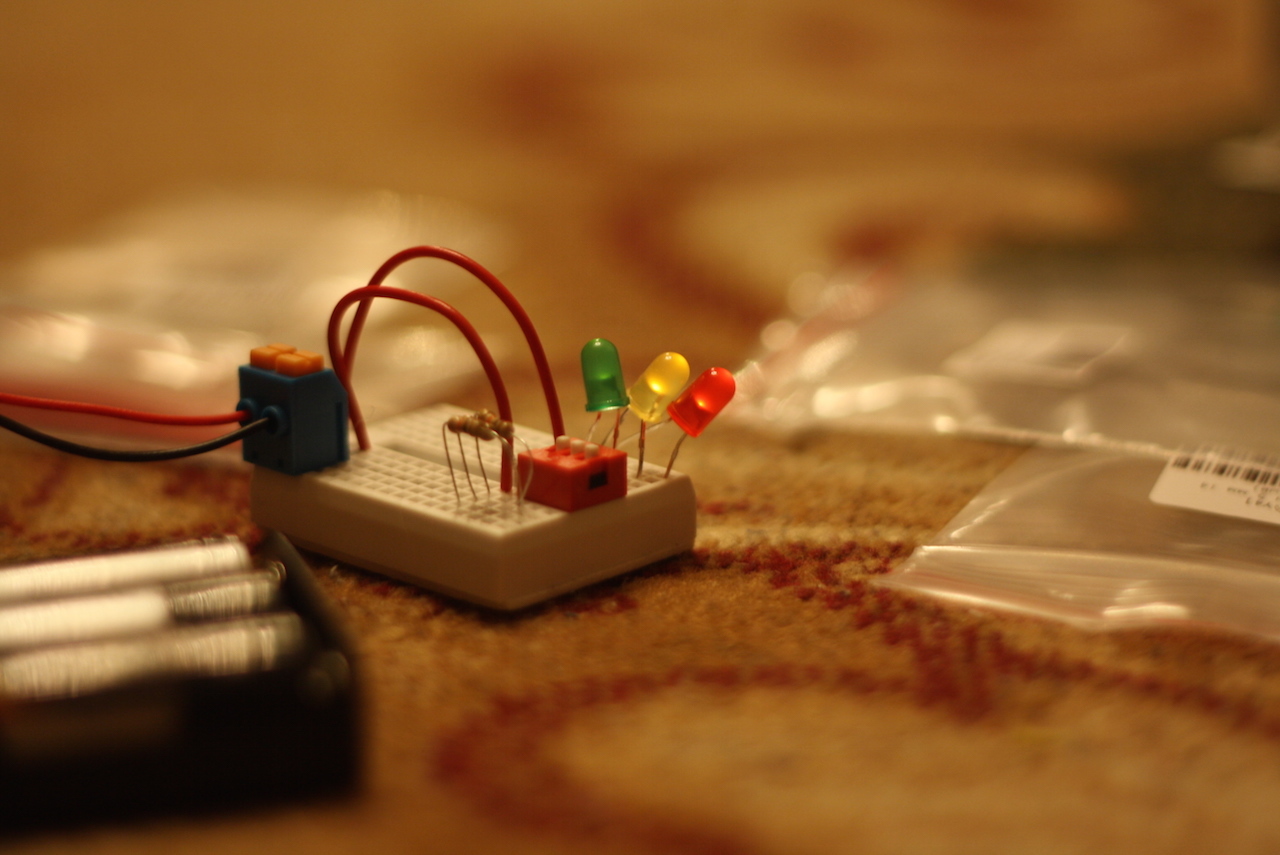
Traffic light:
And an audio light sensor with a photodiode. He attracted me to the fact that from a similar pie picker I recentlymade headphones with bone conduction technology at home .
Everything is much simpler here: the sensor beeps if there is light, and it stops silent if the light does not enter. True, the sound is already embedded in the element, which means that it will not work as a headphone emitter ... Having listened, you will hear crackling sounds in children's voices:
( as usual, sorry for the quality ) The
price tag is also humane - 990 rubles , which again makes Mikronik an excellent gift and good educational and demonstration material.
A small box includes a lot of elements, the name of which I still have not learned, and this has a peculiar charm: stick unknown miniature parts into small holes in the circuit board, which miraculously respond with sound or light.
A set is addressed to young inventors who, with its help, will discover simple physical laws for themselves, as well as be able to master the basic concepts of electronics. Despite the educational and developing components of this kit, he does not have creative leadership. I will explain.
Along with the kit, instructions for assembling 20 “models” are offered, and some even offer advanced features, but how to assemble something “from scratch” using only your own imagination is not explained. But this is not a minus of Mikronika, but a chance for creative geek parents to prove themselves!
The category of “designer” was not chosen by chance and very accurately: indeed, in order to assemble a particular device, it is necessary to quite accurately compare the holes where the resistors, wiring, piezo-sound emitters and other details are placed. At the same time, from device to device, structures are noticeably more complicated, overgrown with an increasing number of wiring.
In total, the set contains about 100 components, many of which are duplicated.
- three tens of resistors, a variable resistor, a photoresistor
- twelve multi-colored leds
- four buttons and switch
- piezodynamic
- twenty jumper wires
- two dozen ceramic capacitors and as many electrolytic capacitors
- transistor
- terminal block
- two ready-made microcircuits (timer 555 and NOR)
At the same time, for people who, by external signs, are not able to identify each of them, all the details are kindly collected in separate signed bags.
You need to design it on a special board, which is connected to the power source using the terminal block, and it, in turn, runs on three “finger” batteries, however, they already need to be purchased separately !
The instructions for creating are offered in a beautifully illustrated brochure, but throughout the entire workflow, you are accompanied by the fictional hero Micronik, who gives advice on how to improve some models. The designs themselves are in a strict hierarchy: from simple to complex.
In total, 20 options for crafts are given:
- lamp
- traffic light
- multi-colored lights
- strobe light
- smart lamp
- stupid lamp
- corridor switch
- lighthouse
- telegraph
- keg with electricity
- Dimmer
- combination lock
- magic fingers
- signaling
- horn
- almost a grand piano
- railway experiment
- timer
- musical instrument Theremin
- duck hunting device
Despite the impressive number of devices that can be created, and a considerable number of components, the box itself, in which all this fits, is extremely compact, and - I do not want to hint at anything - it fits even under a small Christmas tree:
My baby isn’t yet age, but in principle, light a lamp, holding hands, and extinguish it, disengaging, they learned, although I have already made repeated attempts to surprise them with gadgets .
At my 28 years old, I’m probably ashamed to admit that I spent several evenings collecting all kinds of luminous and buzzing constructions, having mastered the lamp:
Traffic light:
And an audio light sensor with a photodiode. He attracted me to the fact that from a similar pie picker I recentlymade headphones with bone conduction technology at home .
Everything is much simpler here: the sensor beeps if there is light, and it stops silent if the light does not enter. True, the sound is already embedded in the element, which means that it will not work as a headphone emitter ... Having listened, you will hear crackling sounds in children's voices:
( as usual, sorry for the quality ) The
price tag is also humane - 990 rubles , which again makes Mikronik an excellent gift and good educational and demonstration material.