May 16, 2016 at 06:17
Daedalus, Icarus and Milner with Hawking
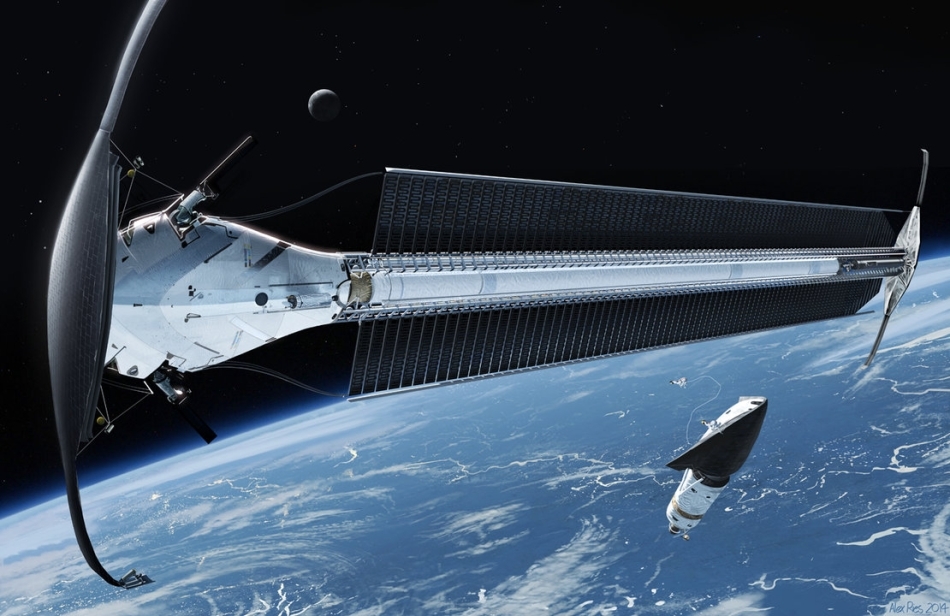
More than a month has passed since the announcement of the general public about the Breaktrough Starshot project - the idea of sending one-gram probes to Alpha Centauri. Now the dust has settled somewhat, many spoke out, some with support, some with criticism. I would like to compare this project with the already existing projects of interstellar probes, because they look, alas, much more rational than the proposal voiced by Milner and Hawking.
Formulation of the problem
Why has mankind not yet sent probes to nearby stars? In a very simple language, the distances between stellar systems are so great that at the speeds with which we can already launch unmanned vehicles, they will fly tens of thousands of years. For example, if the fastest of the vehicles launched outside the Solar System, Voyager-1, flew to Alpha Centauri, then 4.36 light years to the target with a current speed of 17 km / s, it would have flown in about 77 thousand years. And if we want to fly faster, then we will run into the limitations of the missile technologies used. Suppose we want to send a probe to Alpha Centauri weighing one ton (and this is very small) and we want it to reach 100 years (and this is very slow). To do this, we need to disperse it.up to 13,000 km / s (a total of 0.04 speeds of light). The figure does not seem scary, but if we accelerate the probe using chemical engines using a hydrogen / oxygen fuel pair with the maximum specific impulse currently in use, then according to the Tsiolkovsky formula, only fuel, not taking into account the mass of engines and tanks, will require 4.5 * 10 1277 kilograms. Problem - the mass of the visible Universe is estimated at 10 54kg That is, we will have to approximately twenty times replace each atom in the Universe with the entire visible Universe in order to obtain such an amount of matter. Why did this happen? The fact is that existing rocket engines emit matter too slowly for interstellar travel. Imagine you are standing on a skateboard. If you have only tennis balls in your pockets, then throwing them back will not leave you far. If you have a gun, or, even better, an automatic rifle, then throwing the substance away at a faster speed, you can move on.
Here I wanted to give an example from YouTube
Chemical engines allowed us to get into orbit, losing ~ 97% of the mass along the way, fly very far to the moon and launch small unmanned aerial vehicles to the outer planets of the solar system, reaching Pluto in just 10 years. But for interstellar travel, we need other engines that will allow us to throw out the matter more efficiently, a “free” sail pull or some other trick.
With such music, in the presence of large reserves of sarcasm, this video can be called an allegory of the current state of cosmonautics
Atomic Orion
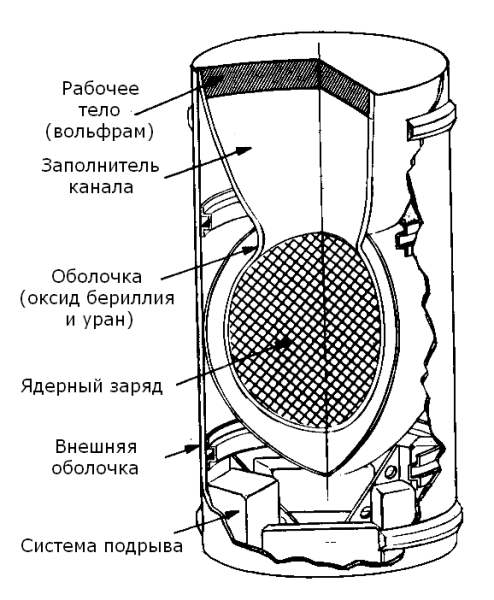
In the 1950s, the United States came up with the concept of the Orion pulse atomic detonator, which was supposed to be accelerated by the explosion of nuclear bombs behind the stern. The special bomb was a directed atomic charge, which was supposed to vaporize a tungsten disk, forming a cloud of high-speed plasma:
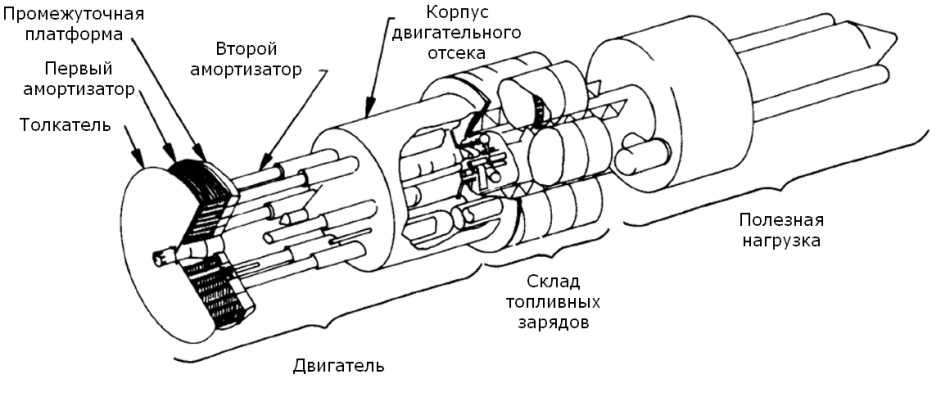
This cloud was supposed to hit a two-stage shock absorber, which would take on momentum and accelerate the ship:
A large-scale model with conventional explosives was successfully tested, but the agreement on the ban on atomic tests of 1963, the environmental problems of the project and the categorical rejection by President Kennedy of the military version of Orion led to the closure of the project in the 1965 area. Paradoxically, the Orion is the only interstellar ship that can be built on existing technologies. According to various estimates, with different equipment weights and propulsion system parameters, a ship with such thrust can fit into a mass of less than a million tons, cost less than the annual US GDP and fly to a neighboring star for a period of hundreds to thousands of years, which transfers it from the category of completely unrealizable into the category of possible for construction by the collective efforts of mankind.
You can read more about the project and fly virtually on it here .
Thermonuclear Daedalus
If you remember the myth of Daedalus and Icarus, you know that, unlike the dreamer Icarus, Daedalus did not violate the flight operation manual for the wings and reached the target quite successfully. This is where the name of the interstellar probe project grows, which could reach any of the nearest stars in a period not exceeding a hundred years, using existing or expected technologies in the near future. The project was developed by the British Interplanetary Society from 1973 to 1978, and the result was a ship weighing only 54,000 tons, of which 500 tons were occupied by scientific payloads, and 50,000 tons - fuel.
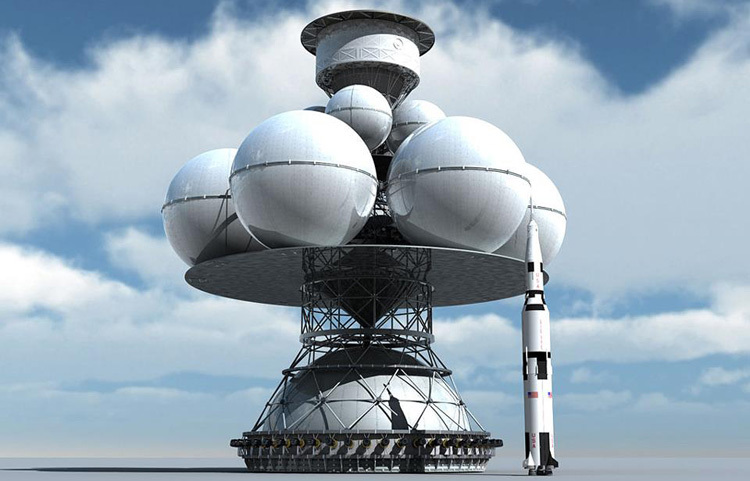
The propulsion system of the probe was supposed to use inertial fusion, one of the promising areas of controlled fusion. Fuel pellets from deuterium and helium-3 were to be ignited by electron beams, and the resulting plasma was to fly out through a magnetic nozzle, creating thrust. The Daedalus was supposed to fly for a total of 50 years, at a cruising speed of 36,000 km / s (12% of the speed of light). The calculation shows that a specific impulse in the region of 3 million seconds was expected from the engine, which is a thousand times more than that of existing engines. The engine efficiency was compensated by a small thrust - the two stages of the probe should have worked for a total of almost four years, creating an average acceleration of 29 cm / s 2 or 0.03 g.
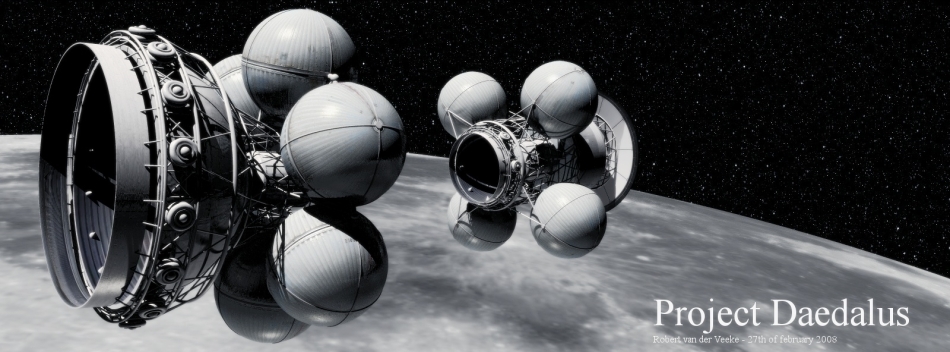
The second stage was a large and complex spaceship. To protect against micrometeorites, a collision with which would be dangerous at a speed of 12% light, there was a 50-ton beryllium disk in front. Larger particles that could penetrate the disk should have been encountered by autonomous robots that would fly 200 km ahead of the probe. The robot had to release a cloud of dust that would deflect or destroy a dangerous object at such a high speed. Behind the disk were a five-meter optical and twenty-meter radio telescope. In addition, Daedalus had to carry autonomous probes that would be dropped, starting seven years before the target, and would diverge to the sides. The probe and autonomous devices had to fly through the target system without stopping, and transmit the collected information, using the main probe as a repeater, and the forty-meter nozzle of the engine as an antenna. Another interesting feature was autonomous “watchmen” robots, which were supposed to fly on the main probe and repair it.
Despite the high elaboration of the project, the assessment of the availability of the main technology - the engine turned out to be too optimistic. Managed thermonuclear fusion is still not conquered by humanity, and it is not a fact that an inertial fusion engine will turn out to be the best choice in the end.
What would you build on the ISS?
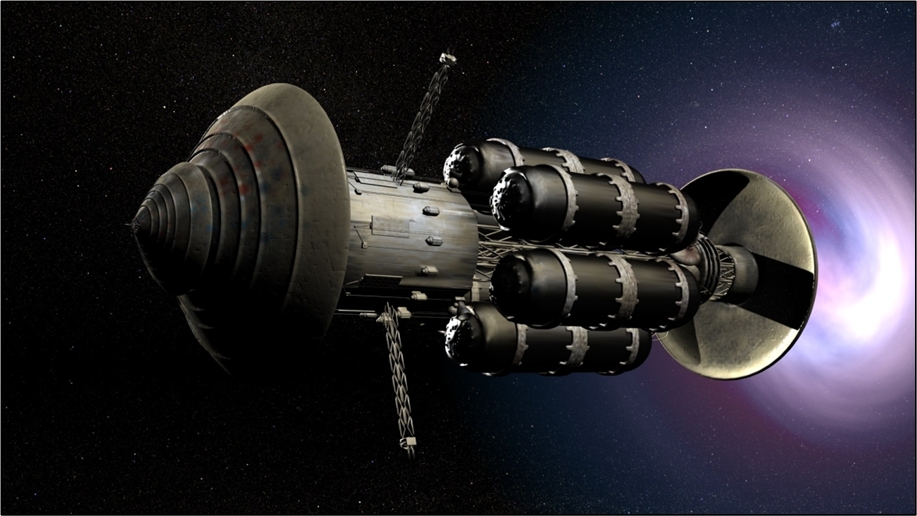
In the 1980s, when the United States was about to build its Freedom orbital station, the concept of an interstellar probe was born that could be built at that station. The Longshot project was smaller than the Daedalus and had to have an initial mass of 396 tons (for comparison, the ISS is now heavier). The propulsion system was similar to Daedalus, used the same fuel and also proceeded from the need to create an engine a thousand times more efficient than existing ones. Longshot was supposed to fly to Alpha Centauri B for 100 years, which allowed to reduce the speed by a factor of three relative to the Daedalus and convey to the target about 30 tons, almost ten times more in relative numbers than Daedalus. The need to minimize the accelerated mass led to another engineering solution - instead of two stages, Longshot dropped empty tanks.
Like Daedalus, Longshot is now waiting for the invention of a thousand times more efficient engine.
Icarus
British interplanetary society has not stopped developing interstellar probes. Since 2009, the Icarus project has been developed as a new version of Daedalus with possible improvements on new technologies. Some sources write about the closure in 2011, but this is not true - in 2015, Icarus Interstellar successfully raised $ 22,000 on Kickstarter for the Starship Congress conference. Development is not yet completed, so the final design has not yet been decided, but, according to available information, the developers retain reliance on the engine for inertial fusion.
Tin-tin
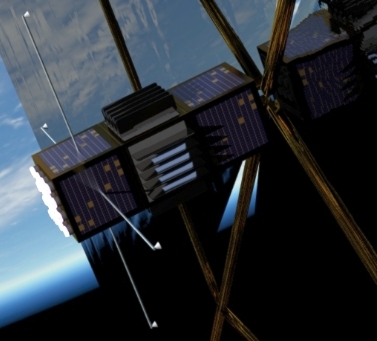
Of the many other little-known projects, I still want to highlight the “Tin-Tin” , in which it is proposed to send cubsats to the stars. An interstellar probe is placed in the 3U frame size (3 cubes 10x10x10 cm), which should be able to reach the nearest star in 25,000 years, three times faster than the Voyagers and Pioneers flying now. A term of 25,000 years can hardly be called acceptable, but the probe is based on existing technologies and, at least, may be useful for studying the vicinity of the solar system. The first cube, as conceived by the developer, will contain a propulsion system based on the field effect (FEEP, this one already stands on the LISA apparatus) Very low engine thrust is compensated by high specific impulse. The second cube contains a radioisotope generator and a Stirling engine, which together generate energy. And the third is a useful scientific workload. The probe is also equipped with a small solar sail, which adds “free” speed from the Sun and serves as an antenna.
Breakthrough starshot
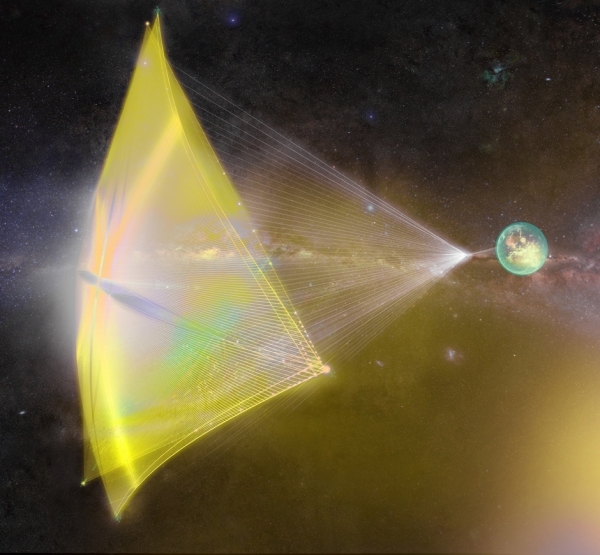
And finally, a fresh project from Milner and Hawking. A gigawatt-class laser system should accelerate a one-gram probe with an acceleration of 20,000 g for ten minutes, so that it reaches Alpha Centauri in 20-30 years. A physical analysis of the problems of the project was made in the article “Two in Physics for Milner with Hawking”If you have not read it yet, be sure to check out. Personally, I don’t like the seemingly almost intentional adventurism of the project. Why should I accelerate a one-gram probe with a gigawatt laser with an acceleration of 20,000 g for ten minutes, if it is much easier to accelerate a kilogram probe with an acceleration of 1 g by a megawatt installation for months, and, if necessary, for years? A slight acceleration will increase the accuracy of guidance, a kilogram probe is much easier to make, and against the background of a flight duration of 30 years, the acceleration time is still incomparably less.
In general, I get the feeling that there are more adventurous space projects. Maybe in vain there is no public condemnation of the failedMars One project? I won’t be surprised if in a few years crowdfunding will be raised for the project of assembling an interstellar probe in a garage, while they will not discredit astronautics and crowdfunding. However, there is another option that I imperceptibly became too conservative and am mistaken. But in this case, I will only be glad to make a mistake.