# Orion Heat Shield: Critical Vulnerabilities in the Artemis-2 Mission
The Orion capsule's heat shield exhibits critical defects uncovered during the Artemis-1 mission. Deep craters in the AVCOAT material, destruction of pyrotechnic bolts, and risks to the parachute system jeopardize the Artemis-2 crew's safety. Despite engineers' warnings and parallels to the Columbia and Challenger disasters, NASA is pushing ahead with a crewed launch, banking on adjustments to the atmospheric entry trajectory.
AVCOAT Material Issues: Physics of Failure
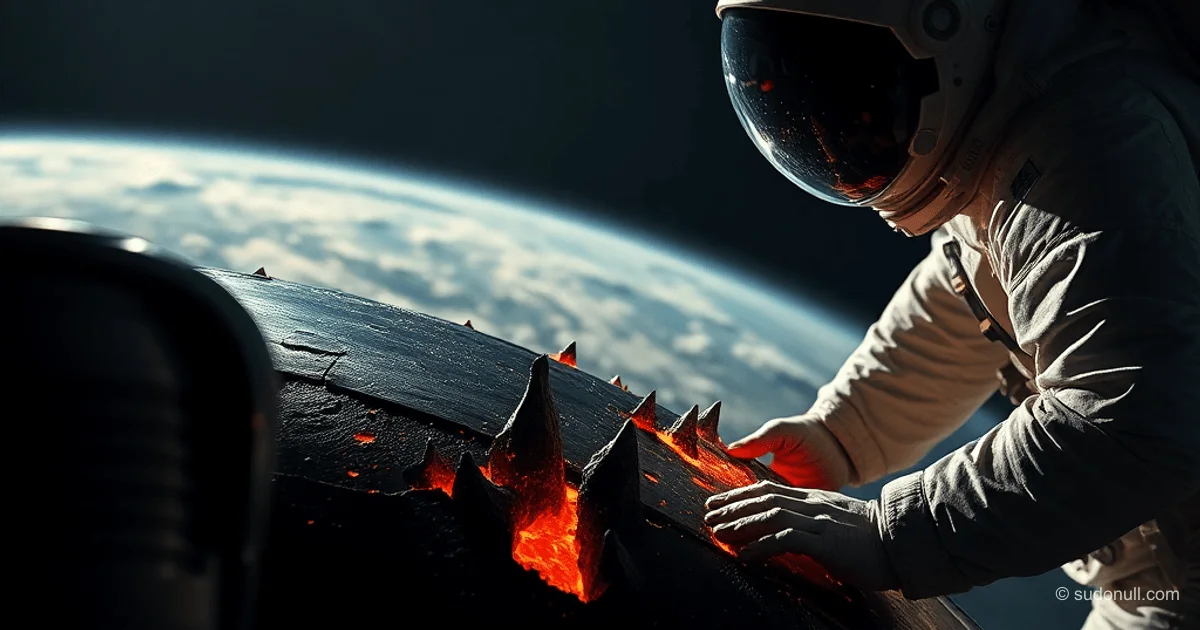
The AVCOAT material used in the Orion heat shield is designed for smooth ablative degradation—gradual charring without forming large craters. However, Artemis-1 data showed the opposite: at lunar return speeds (11 km/s), massive spalling of blocks occurred. Analysis by NASA's Office of Inspector General (OIG) revealed that insufficient permeability in AVCOAT led to gas buildup between layers. Upon heating, the gas expanded, tearing off shield fragments up to 10 cm in size.
A particular concern is the alteration of the capsule's aerodynamic profile. Craters create localized zones of elevated heat flux, where temperatures could exceed the projected 2200°C. Ground testing facilities can't replicate these conditions: as Jeremy Vanderkam (heat shield development lead in 2022) noted, "our test stands don't reach real atmospheric entry parameters."
Three Crew-Killing Threats According to the OIG
- Unpredictable spalling. Voids in the shield disrupt heat dissipation, risking hull burn-through. Modeling shows that losing 15% of material in critical zones would raise the capsule's internal temperature to 300°C in 12 seconds.
- Parachute system damage. Shield fragments detached at Mach 4 speeds could strike the compartment cover. For Artemis-1, NASA couldn't recover the parachutes from the Pacific Ocean, leaving the hypothesis unverified.
- Pyrobolt failure. Three of four separation system bolts melted due to errors in the thermal model. Their deformation allows hot gases to seep under the shield, leading to cascading structural failure.
NASA's Strategy: From Denial to "Calculated Safety"
Initially, NASA downplayed the damage scale, citing "localized loss areas." Only in 2024 did the OIG release photos of craters up to 5 cm deep. In response, the agency claimed the issue was resolved by changing the atmospheric entry trajectory—now delivering instantaneous heating rather than the two-phase profile of Artemis-1.
Critics point out the contradiction: Artemis-2 uses an AVCOAT shield with even lower permeability (to simplify supersonic tests), yet NASA insists trajectory tweaks offset the risks. Meanwhile, the new shield design won't debut until Artemis-3, casting doubt on the "safety" logic for the current mission.
Parallels to Historical Disasters
Astronaut Charles Camarda, who investigated the Columbia accident, sees a repeat of the 2003 scenario. Back then, engineers ignored heat shield damage data due to schedule pressures. Today, NASA relies on "toy models"—simplified simulations that ignore real delamination physics. As Camarda wrote in his statement: "We're replacing risk analysis with quantitative illusions."
Especially alarming is the refusal of an uncrewed Artemis-2 test. For commercial capsules (Dragon, Starliner), NASA demands redesigns after similar damage. But for its own program, the agency greenlights crewed flight based on a "statistical margin of safety."
Key Takeaways
- AVCOAT spalling defies models due to unique lunar return conditions.
- Pyrobolts were designed with thermal model errors, critical at speeds >10 km/s.
- No uncrewed Artemis-2 test violates NASA's safety standards for commercial programs.
- Trajectory adjustment lacks experimental proof—all calcs based on Artemis-1 data.
- Schedule pressures drive decisions: delaying the mission threatens the program's budget ($4 billion per SLS launch).
The Future of the Artemis Program
Starting in 2026, NASA added an interim Artemis-3 mission (Earth-orbit docking with the lunar lander), making a crewed Artemis-2 lunar flight redundant. It's safer to test risks in low orbit rather than deep space. Yet the agency is compromising: crewed launch in April 2026, with shield redesign only for Artemis-4.
This approach questions NASA's safety culture. As rocket engineer Daniel Marshall notes: "If you can't test a system on the ground, you shouldn't risk lives in space." If Artemis-2 succeeds, the issue will be swept under the rug. If it fails, it'll echo Columbia with human casualties.
— Editorial Team










No comments yet.