December 25, 2014 at 20:56
How we made our ice rink with ice mats and tubular mops
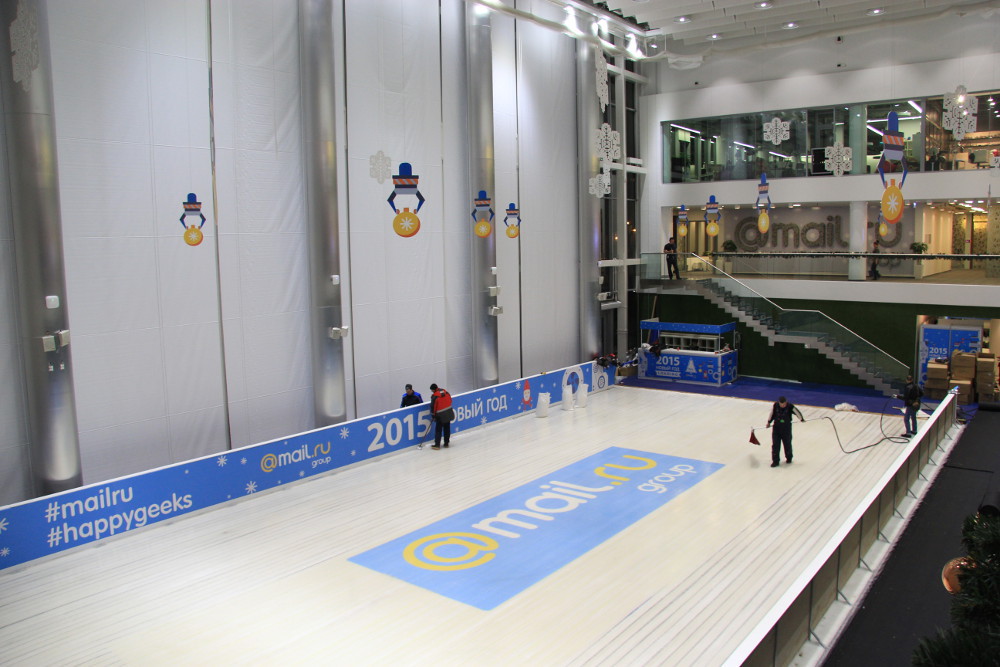
New Year's parties in the vast majority of cases are a feast with an entertainment program of varying degrees of ingenuity. But we at Mail.Ru Group decided to arrange something more interesting sports and technological. So in our gym a real ice rink appeared. Read how it is arranged, read under the cut.
Technology
The size of the mounted skating rink will be 12 x 23 m. For comparison, on average, “outdoor” skating rinks are 20 x 40 m in size. How can a full-scale skating rink be made in a normal room? First, the floor is covered with thermal insulation with a thickness of about 5 cm and a sealed film. Thermal insulation is needed not only to protect the floor, but also to prevent heat transfer. The room is warm, and if you do not make a protective layer, then the cold will go to the floor and you will have to use a much more powerful refrigeration unit.

The so-called ice mats are placed on top of the film, which are a kind of porous mattresses, in which long tubes of small diameter are laid in a row.

The total length of tubes in our ice rink is 8.7 km. At the ends of the ice mats, all the tubes are connected into a single closed loop, into which the refrigeration unit (aka chiller) is included. It cools the coolant (polypropylene glycol), which circulates through the pipes of ice mats. From above, ice mats are filled with water, which is gradually cooled and finally freezes.

The skating rink will freeze for three days, and during this time about 15.2 tons of ice will be created, that is, 276 square meters with a thickness of about 6 cm.

But the skating rink will have to be updated daily, because under the influence of the skates, the ice crumbles, bumps appear. The people who will update the ice are called ice makers. Their main tool is special devices, which are T-shaped tubular mops. A number of small holes were made in the transverse crossbeam about a meter wide, through which water at a temperature of +55 degrees is supplied to the attached strip of fabric. This fabric is pulled on ice, evenly wetting the surface. Water fills the recesses, melt the upper layer of ice, and then quickly freezes. The result is a perfectly smooth roller.
Refrigeration unit
The principle of operation of the chiller is briefly as follows: the compressor pumps freon vapor under pressure into the condensation compartment. As the name implies, here Freon condenses and is fed into the so-called thermal expansion valve and evaporator. The latter is, in fact, a heat exchanger in which the polypropylene glycol is cooled to -7 ... -12 degrees (freon boils at a temperature of -15 ... -18 degrees). Then the freon vapor from the evaporator is again fed into the compressor - the cycle closes. A refrigeration unit during the freezing of ice consumes about 100 kilowatts per hour, and its cooling capacity is 150 kilowatts per hour. About 50 kilowatts per hour are spent to maintain frozen ice.

By the way, despite the large area of ice, the temperature in the room will hardly drop due to the effective air ventilation system of the building. Instead, humidity will increase, as the ice will not melt so much as evaporate immediately.
Interesting Facts
- The sides of the skating rink are not attached to the floor, they are kept due to freezing in ice. Also, a net with the Mail.Ru Group logo is frozen in the ice thickness - it is clearly visible from the gallery surrounding the gym.
- A team of 8 people mounted the ice rink in a day, but dismantling will take about 30 hours, because you will have to carefully chop the ice and take it out of the building on carts. Before this, the ice is “heated”, that is, it is cooled to the lowest possible temperature. At the same time, ice becomes much more fragile and easier to break. In addition, cooling allows you to insure against premature melting of ice.
- By the way, an open skating rink in Gorky Park has now been made using the same technology. Ice mats are mainly used there in black. However, black ice mats are visible through the ice, and the surface of the ice rink turns out to be dark - accordingly, it absorbs infrared radiation better and heats up more intensively. Therefore, ice is simply painted with special white paint. In the room, you can get by with dark ice mats, since a noticeable fraction of infrared radiation will be delayed by glazing.
- On such artificial ice rinks, it is desirable to maintain the minimum possible ice thickness. The reason is purely practical: daily leveling of the surface with the help of the above “mops” leads to a gradual increase in the thickness of the ice. And since it is a good thermal insulator, to maintain the required temperature, one also has to gradually increase the capacity of the refrigeration unit. And this means an increase in the already very large power consumption. This can be avoided by using special “combines” for ice rinks, which first cut the top layer of ice and then fill in the bumps.
- If some excessively zealous user digs a hole in the ice (which is quite possible) and damages one of the tubes in the ice-mat, then the coolant will fall onto the ice. At first it will look like a puddle of water, and then it will begin to soak, turning ice into porridge. This area must be quickly localized and all spilled coolant collected. Since its freezing temperature is much lower than that of water, there will simply no longer be ice in this place.
- Different sports support different ice temperatures. For the same hockey, it is lower, so that the ice becomes tougher. For figure skating, in contrast, ice is maintained at a higher temperature. Although often the skaters themselves are asked to make the ice of the necessary rigidity. Skaters have their own temperature. All these differences affect not only the mechanical properties of ice, but also the speed of skating. The purity of the water used for pouring also affects this. The more impurities in it, the lower the sliding speed.
By the way, all the photos on ice skates that you take on New Year's Eve can be your ticket to the most geek skating rink in Moscow. Add the #happygeeks tag to the photo, for the funniest, coolest we will give skates and choose five who we invite to the Moscow office of Mail.Ru Group.