October 19, 2015 at 06:20
Missile "sausages" and "sausages" or the curse of non-universality
Superheavy lunar race launchers are wonderful. Saturn V looks so rational and engineeringly beautiful that you can understand the origin of the argument of the supporters of the “moon conspiracy” - it seems that such a wonderful rocket would have to fly to this day. But the problem with superheavy rockets is that they are unsuitable for ordinary space tasks, which require less payload. In simple terms, you have a Ural truck in which you carry fertilizers, bricks or boards to the cottage a couple of times a year. Will you go to work at the office every day on it? Theoretically, this is possible, but very irrational - a powerful engine “eats” tens of liters of diesel per hundred kilometers, not to mention the associated costs or problems with parking. The same thing with space - rockets with a payload of twenty tons in low Earth orbit began to be called "heavy", and now a rocket with a payload of more than 50 tons in LEO is now called "superheavy". But one does not need to think that inventive humanity easily abandoned the dream of getting a universal rocket that can launch small satellites every month, but once or twice a year to go to the moon or beyond.
Historical option - remove one step
Here are three stages of the Saturn V launch vehicle:

From left to right: the first stage of the S-IC, the second S-II, the third - S-IVB and the payload (Apollo ship)
The obvious option is to remove the first, most difficult and powerful step. But there was a problem - the second stage was designed to launch at a high altitude after separation from the first stage, and its engines simply could not tear the rocket from the launch pad. The Saturn INT-17 variant was supposed to replace five J-2 engines with seven promising HG-3 engines. However, the creation of the HG-3 was quickly abandoned, and the developments on this engine in a few years will be used to create the RS-25 engine for the Space Shuttle. In the Saturn INT-18 version, they wanted to add two or four solid fuel boosters from the Titan launch vehicle to the rocket. The maximum carrying capacity would reach 66 tons, and in some lighter versions it was supposed to remove the third stage S-IVB, and the rocket would consist only of the second stage of S-II and solid fuel boosters. The Saturn INT-19 variant was also supplemented with solid fuel stages, but smaller - it was supposed to use the first stages of the Minuteman intercontinental missiles. In the lightest version, they were going to deliver 4 TTUs, in the heaviest - 12, and four were supposed to turn on already in flight after dropping eight, launched together with S-II engines on the ground. In this embodiment, the rocket would have a carrying capacity of 34 tons. launched along with S-II engines on the ground. In this embodiment, the rocket would have a carrying capacity of 34 tons. launched along with S-II engines on the ground. In this embodiment, the rocket would have a carrying capacity of 34 tons.

From left to right: Saturn INT-17, INT-18, INT-19
The second, less obvious option is to remove the second step. In this case, the excessive thrust-weight ratio of the first stage became the main problem. A rocket with a first stage without any changes would experience very serious aerodynamic loads, and the payload would undergo unwanted overloads. The option of saving five F-1 engines and turning off some of them in flight did not look good - in this case, after only 88 seconds, three engines would have to be turned off, which became dead weight. But if you reduce the number of engines to four, then two of them would have to be turned off at 146 seconds, and the remaining two would be fully developed up to 212 seconds. In this embodiment, the rocket would launch approximately 60 tons into low Earth orbit. If you go even further and reduce the number of engines to three, then none of them would have to be turned off earlier. Although the payload would drop markedly - up to 35 tons.

Saturn INT-20
Well, the last option is to remove the third step. In a sense, this variant even flew once - instead of the third stage in 1973, the Skylab orbital station, weighing 77 tons, developed on its basis, was sent to space. For another payload, you would have to move the control system from the third stage to the second, but this would be a very small change. This option was received by the Saturn INT-21 index.

Photo of the launch of Skylab station
In the USSR, things were more streamlined. Initially, they wanted to lay such a modularity in the N-1 rocket project - the N-111 rocket was supposed to start from the third stage and would put five tons into orbit. The N-11 missile was supplemented by a second stage and would launch approximately 20 tons. And the full version, the N-1 rocket with a huge first stage, would launch 90 tons into orbit.

N-111, N-11, N-1
Unfortunately, these interesting projects on both sides of the ocean were waiting for the same fate - for political reasons they were closed. In the United States, they began to create the shuttle, and in the USSR, the new chief designer, Glushko, hatched the idea of his universal rocket, from which Energia later grew.
Modern option - modular stairs package
The mainstream of the twenty-first century was a different approach. But what if we make universal rocket modules and use different amounts of them to get the required carrying capacity? They wanted a light rocket - they put one module, the middle one - three, the heavy one - five or seven. By changing the upper stages, you can even more flexibly tune the rocket to a specific payload. In Russia, this, of course, is the Angara rocket with a range of two to 25 tons, with possible options for 35 tons (A5B with an upper hydrogen block) and 50 tons (version with 7 URMs, which will need a separate launch).

Various options for Angara
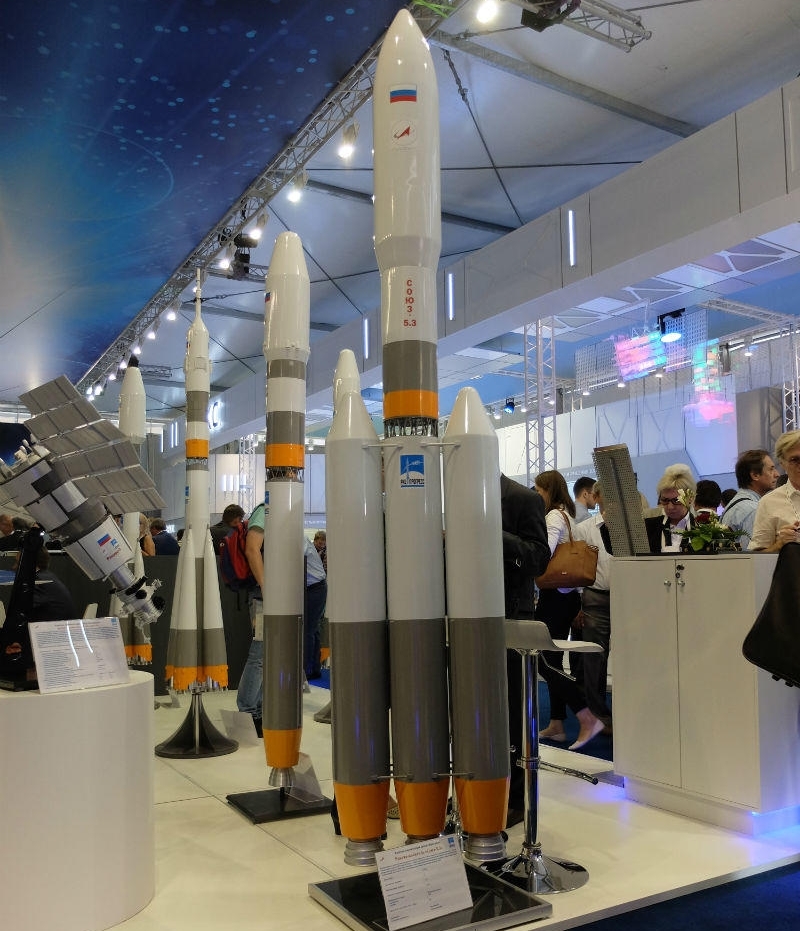
In addition, on an initiative basis, TsSKB Progress is developing a Soyuz-5 launch vehicle in versions from 8 to 22.5 tons of methane

In the USA, this is a Delta IV LV with a payload range of 8.5-25.9 tons of

Atlas V LV, for which in 2006 they proposed the option with three blocks. The carrying capacity in this case will be in the range of 9.7-29.4 tons.

A heavy single-block version with side solid fuel boosters
And Falcon 9 (13 tons) with a 53 tons Falcon Heavy variant starts , the first test flight of which moved off in 2016.

Single block version
An inquisitive reader will ask me, and where does the “sausage” and “sausage” in the title? The fact is that the option with modular blocks has its own difficulties. First of all, the fate of the rocket is determined by how well the size of the universal module is chosen. If you make it too small, the hard option will be irrational, because too many modules will be required. If you make it too large, you may lose the flexibility of customization for a specific payload. Of the existing missiles, Angara has the smallest blocks with a diameter of only 2.9 m. Therefore, the 25-ton option requires as many as five blocks, while the heavier ones have not yet been implemented in metal at all. The missile with the largest blocks will be the Falcon, where only three blocks promise as much as 53 tons of payload. Funny that for a long time the idea of "trizenite" - rockets with modular blocks based on the Zenit rocket - was discussed at forums of people who were keen on astronautics. Alas, the life of “Zenith” is actually over, but Falcon in terms of its characteristics is most similar to this option. Guessing about the future of these missiles now makes no sense - too much is unknown to us.
In addition to the global choice of module size, there are other technical challenges. For example, the central module is actually the second stage and should have an engine capable of throttling (changing the thrust level) over a wide range - so as not to be forced to be reset along with the side blocks. Modular missiles will greatly help the technology of fuel transfer from the side modules to the central one, which has not yet been implemented anywhere. Side blocks of the first stage can be tried to be made reusable and returned, and this is a completely new complication.
Now we are waiting for an interesting time - modular missiles are just starting to fly. Let's see how they will show themselves in the coming decades.
Similar items on the tag "Facilitating access to space . "