Hes inside
Theoretically, everything is clear with hydroelectric power plants - water flows from the upper pool to the lower one, turns the impeller of the turbine. The turbine rotates the generator, and it generates electricity ...
Interesting details.
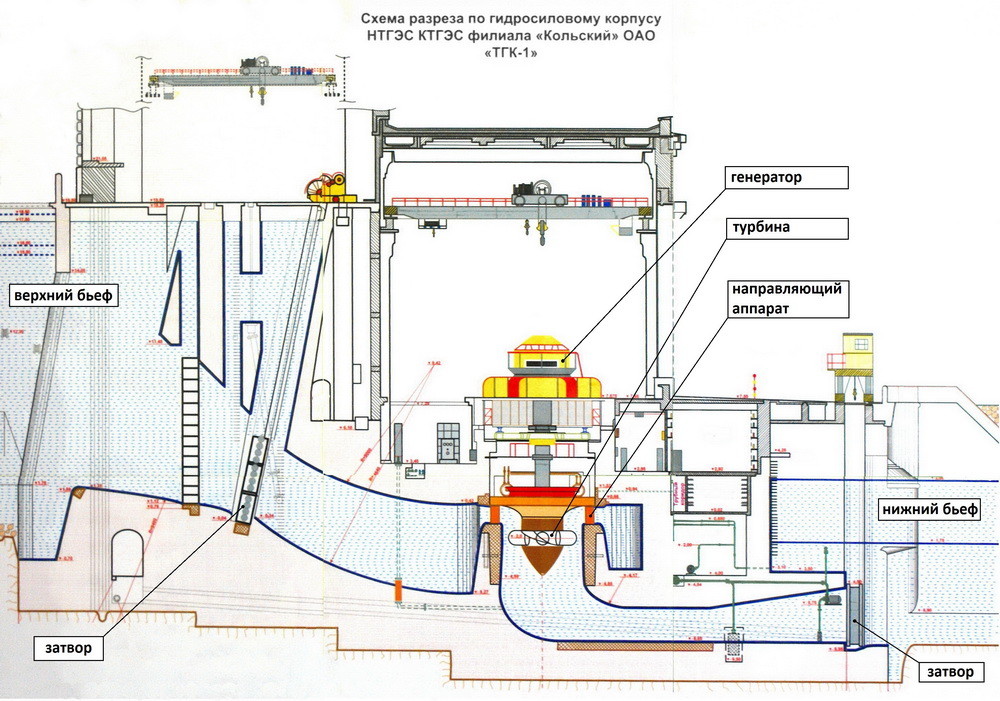
Note to the hostess: to get 1 kilowatt-hour of electricity, 14 tons of water must be lowered from a height of 27 meters.
(Details are spotted while visiting nine different hydropower plants).
To paraphrase the classic: all thermal power plants are similar to each other, each hydroelectric power station is arranged in its own way. In other words, there are no typical hydropower plants; all hydropower plants are different. Each has its own water flow, pressure, topography, soil, climate, proximity to the sea, the volume of the reservoir ...
For example, it seems to be the usual machine room of the station. Except that all the windows in it are artificial, with backlight.

That's because the engine room is located in a rock at a depth of 76 meters.
This is the first underground hydroelectric power station in the USSR, from the surface there are four water conduits with a diameter of 6 m. And this is a mine, also cut down in a rocky base, to extract equipment from the deep turbine room in case of repair / replacement:

Ideally, all water should go through the turbines and give energy. But this is not always possible.
Part of the water has to be dumped past the hydroelectric power station:
- during the repair of hydraulic units;
- during spring floods, if there is no reservoir of long-term regulation (and often it is not);
- it happens that in the cascade of hydroelectric power stations (stations standing on the same river) the capacity of the upper station is greater than the lower; then the lower one should let part of the water past the turbines, otherwise it will simply flood it;
- sometimes open a spillway at the request of fish farms to skip fry downstream;
- etc.
The idle spillway of the Belomorskaya hydroelectric station is three gates.

Quite a lot of attention is paid to the issue of reservation, because not being able to lower the level in the reservoir on time is fraught. Any of the shutters here can be lowered / raised with a gantry crane, two of the three - with electric winches. In extreme cases, it can also be done manually (with a speed of 3 cm / min).

The shutter is raised, there is an idle discharge for the water intake of the city of Belomorsk, located downstream:

Induction heating is used to combat icing of the gates. For heating this instance, for example, 150 kW are required:

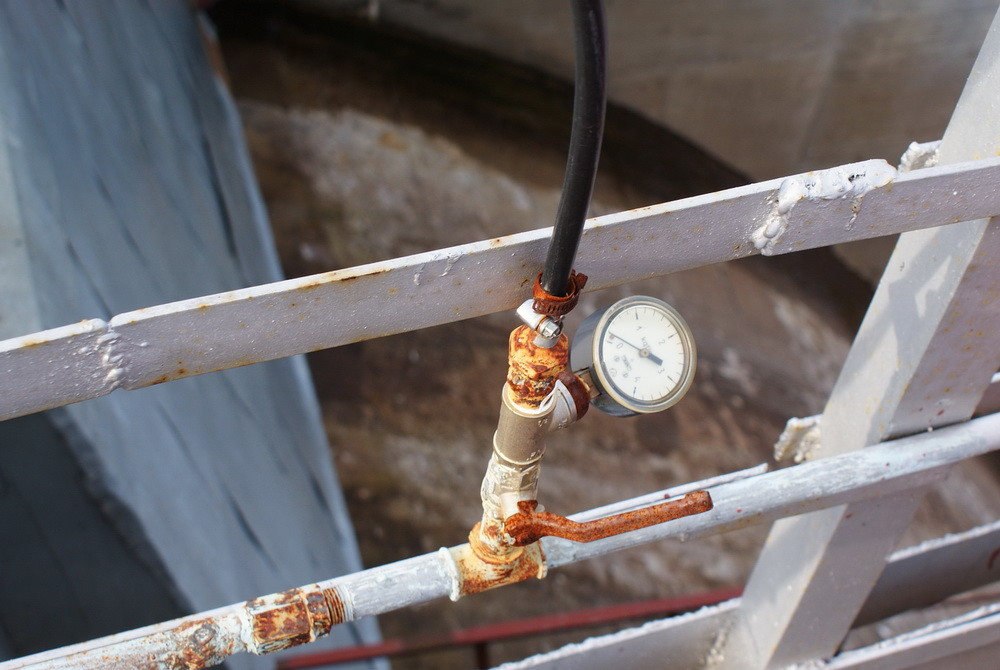
Sometimes for the same they do a bubbler - they let air from the depth along the shutter; see the hose of the compressed air system:
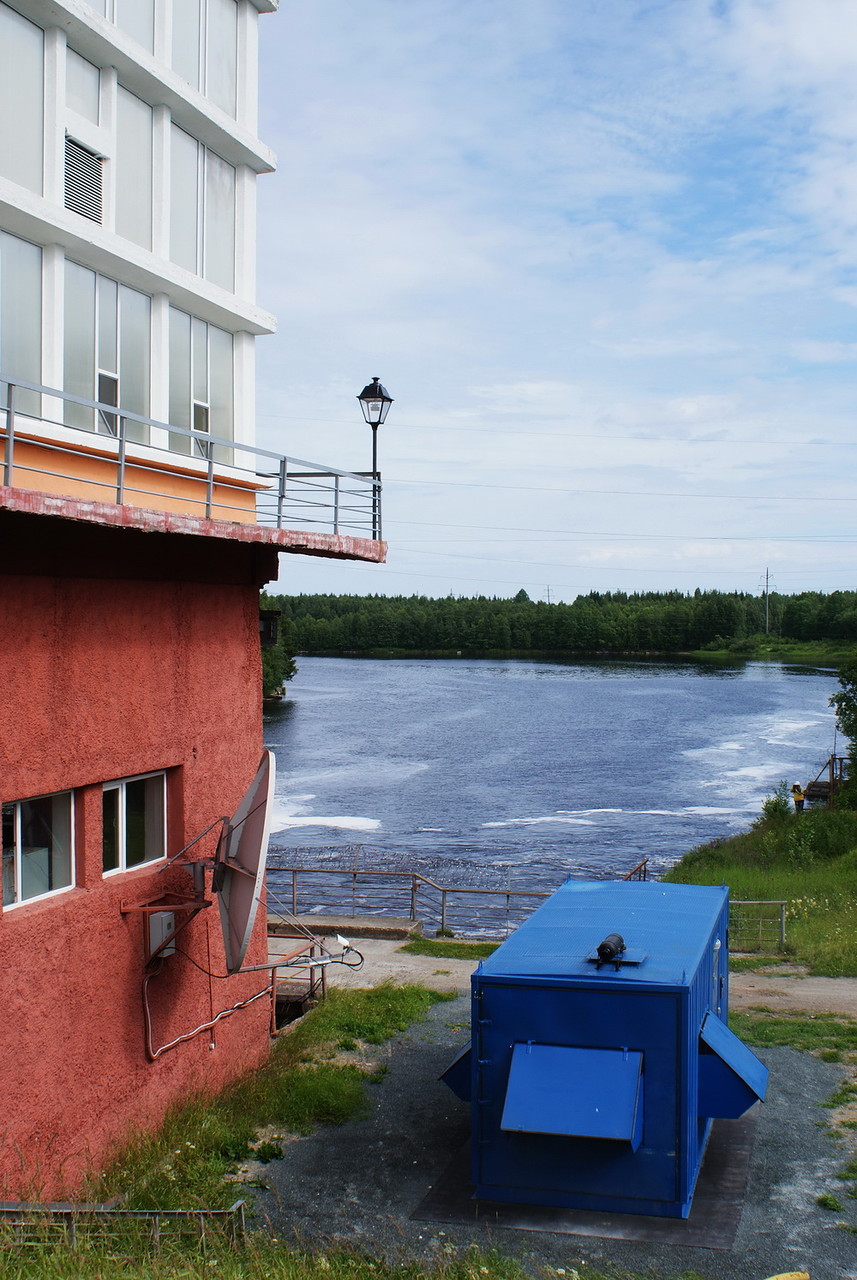
At the discharge, measures are provided for quenching the kinetic energy of the flow - water wells, collision of flows, steps or, as here, at the Volkhov hydroelectric power station - a water plate with dampers:

A special fish passage was made at the Nizhnetulomskaya hydroelectric station for salmon, which rises to spawn upstream. The design imitates a half-kilometer mountain stream with stones at the bottom, zigzag passages and places for fish to relax.


It is interesting that during the spawning period at the hydroelectric power station, the 4th hydroelectric unit closest to the fish passage is disconnected so that the salmon can hear the noise of the fish passage and go there.
At the Verkhnetulomskaya station, the fish passage was made in the form of a 2-kilometer backlit tunnel and a special fish lift, but this design was unsuccessful, the fish did not go. We got out of the situation - we turned the tunnel into a fish factory and let warm water into it from the cooling of the generators. Both fry are good and energy efficiency is evident. Where the warm water comes from in the generator - see below.
Let me remind you that in the 2009 accident at the Sayano-Shushenskaya hydroelectric power station, after breaking through water into the machine room, the power supply of the station’s own needs was quickly lost, as a result of which the gates at the water inlets had to be manually reset. Following the trail of this incident, hydroelectric power stations were actively engaged in backup power - emergency diesel generators, batteries.

This is also a safety feature - aeration pipes in the upper part of the water pipes of the Kondopoga hydroelectric station :
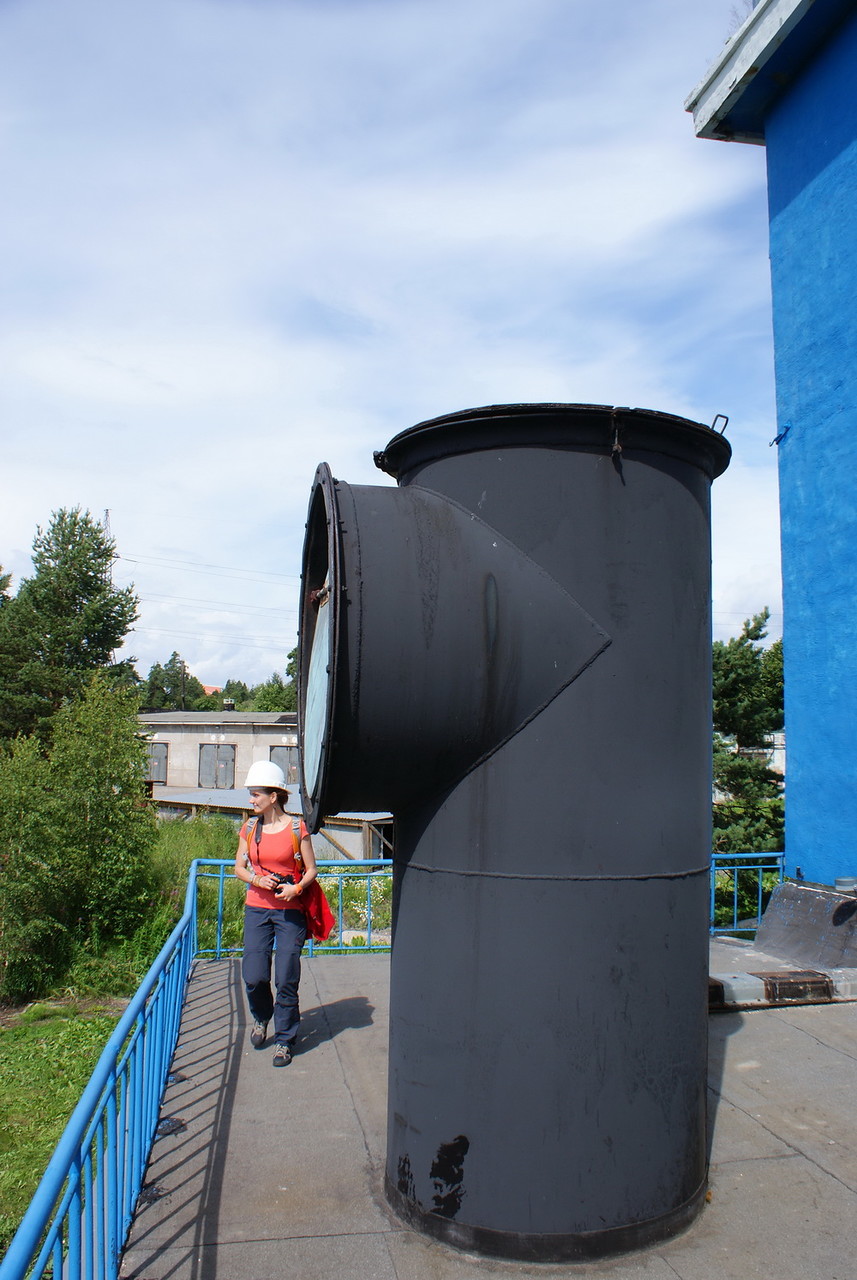
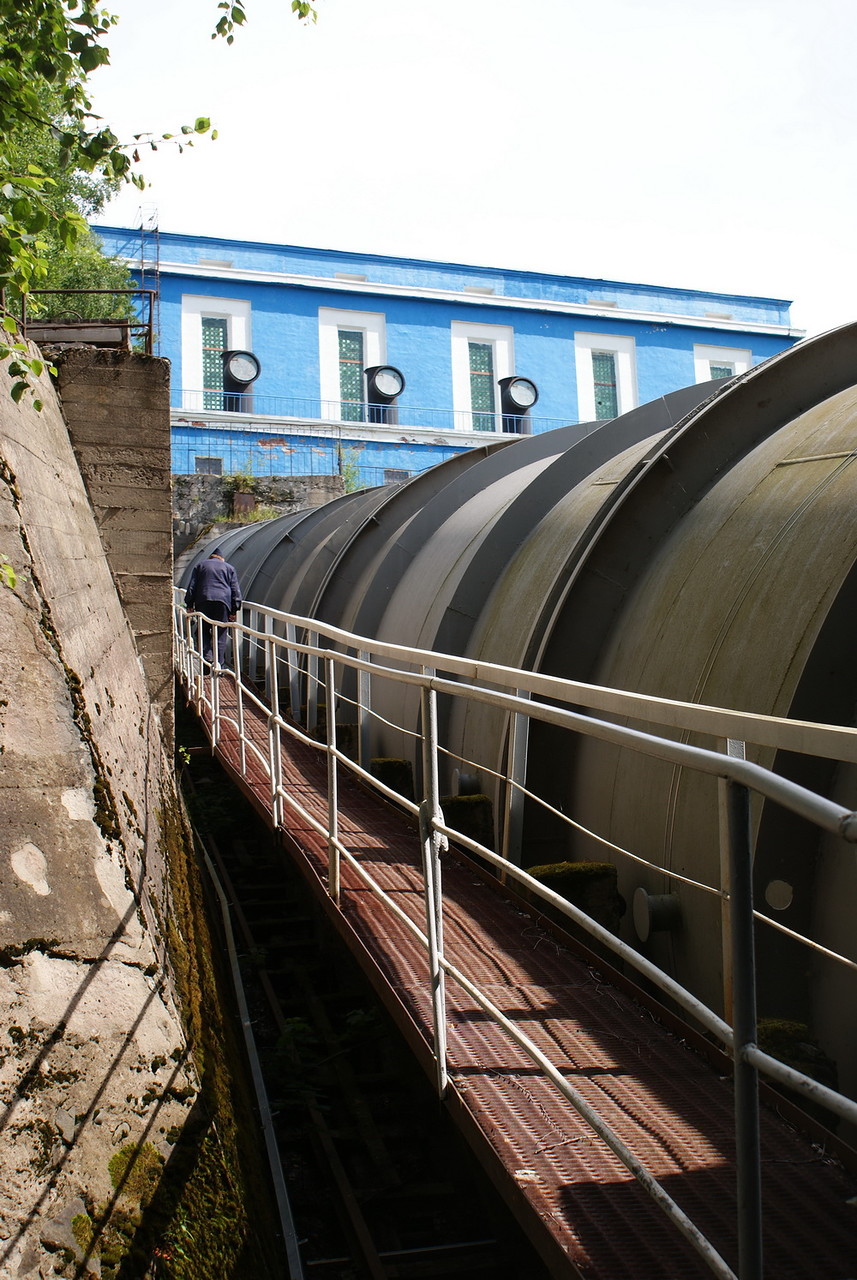
The thickness of the steel walls of the water pipes is relatively small - 12 mm. Water conduit rings are designed for high internal pressure or low vacuum. But if you close the upper gates and drains drastically, then a deep vacuum will appear inside them, and the pipes may become deformed. Aeration pipes will let in air when emptied and everything will be fine.
Remains of a wooden water conduit of the 1930s:

In case a turbine water conduit breaks during operation, a protective wall is provided (in the center of the frame):

Thanks to it, water will not go to the right - to the office building, but will bypass the station on the left and go into the recess into lower pool.
Now we are between the turbine and the generator and observe the shaft connecting them. On the left is a hydraulic unit diagram with manometers displayed on it, showing the pressure in the lubrication system.
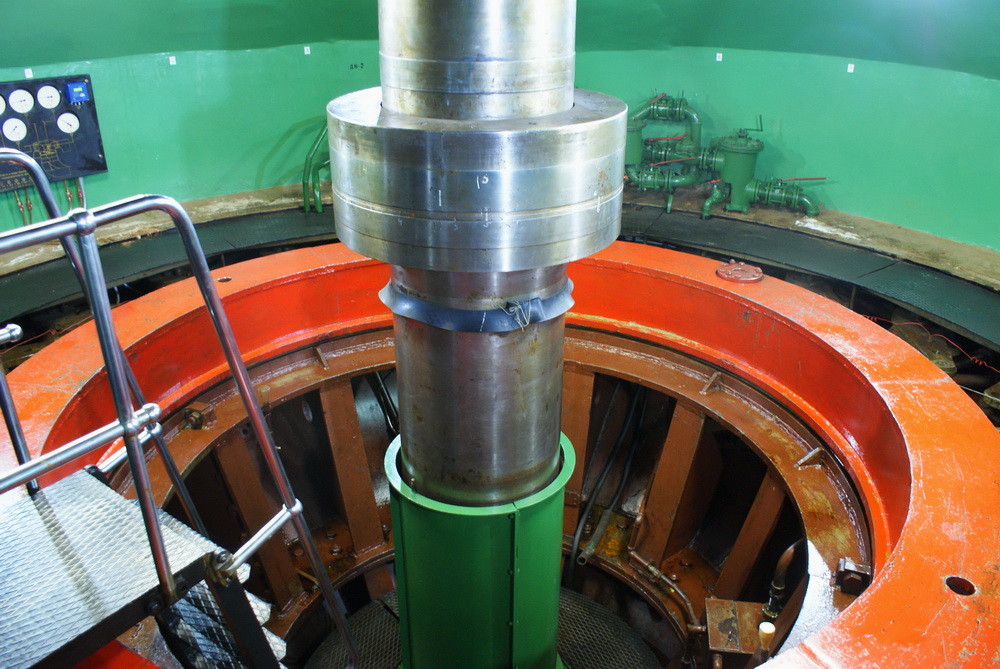
Underfoot - hydraulic drives of the guide vane:

More parameters can be seen in the engine room.
Water and air temperatures, water levels in the pool:

Mnemonic diagram on the display.
This hydraulic unit does not work (power 0 MW, guide vanes closed, rotor speed 0%).

It can be clearly seen how water is taken from the spiral chamber of the turbine (bottom) and fed to the generator coolers (it is in the center, red, coolers A and B) and to lubricate the thrust bearing, upper (VGP) and lower (NGP) generator bearings. Yes, yes, they are lubricated with water. From here, warm water is taken for the fish factory.
A red tank with oil is visible on the right side - this is the hydraulic control system of the guide vane. It also displays the pressures, flows and levels of all fluids.
Information about vibrations:

In parentheses: officially the cause of the destruction of the hydraulic unit on the same Sayano-Shushenskaya was the fatigue failure of the studs of the turbine cover fastening due to the vibrations that occurred when the hydraulic unit passed through the “forbidden zone” range (there are other opinionsbut not about that now).
Where is the "forbidden zone", we will see on the central control panel of the hydroelectric station:


Hydroelectric units G1, G3, G4 in operation, G2 stopped. On a black background is the power generated by 38.1 / 38/38 MW generators, respectively. G3 and G4 have red bars because they are operating at full capacity, G1 still has a reserve. A red zone is visible behind the columns - this is precisely the power range in which the hydraulic unit is undesirable to operate and which must be quickly skipped during start-up / shutdown.
By the way, a knowledgeable person even outside the building will say which of the hydraulic units does not work:

The second pair of counterweights is raised, which means that the gates on the turbine conduits of unit No. 2 are omitted.
They are actively implementing remote control.
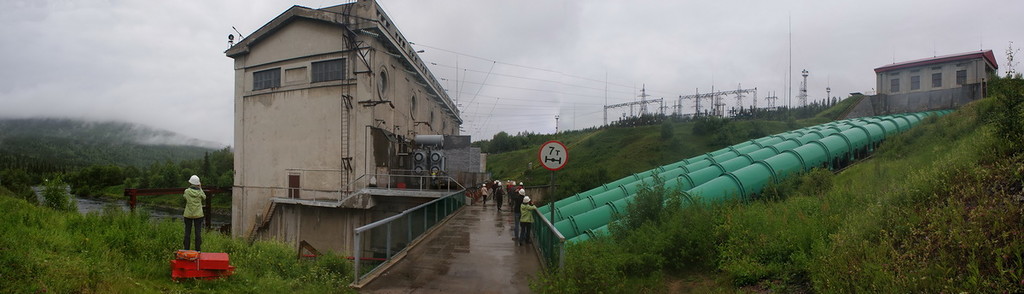
So, for example, this 60 MW station operates around the clock, but the staff at it only happens during the day and on weekdays, the rest of the time it is telemechanically controlled from the main hydroelectric station:
hydroelectric stations operate according to the so-called. dispatching regulation, which regulates when and how much the station to issue electricity. Since hydropower plants are the most maneuverable energy sources (quickly start and stop quickly), they serve to cover peak loads and their generation varies depending on the time of day and day of the week. Unlike thermal and nuclear power plants, which provide the basic part of consumption and operate in a relatively stable mode.
Dispatch order on the screen (sorry for the cosmic quality of the image; along the abscissa axis - hours, along the ordinate axis - power):

The dispatch task takes into account the mutual influence of the hydroelectric power station in the cascade, the water levels in their reservoirs, consumer requests for water and electricity, etc. and on the basis of this distributes the energy production between the stations. It is curious that on the Pasvik river on the border between Norway and Russia, 5 Russian and 2 Norwegian hydropower plants operate, and the river itself flows from the Finnish lake. And nothing, somehow agreed.
Interesting details.
Note to the hostess: to get 1 kilowatt-hour of electricity, 14 tons of water must be lowered from a height of 27 meters.
(Details are spotted while visiting nine different hydropower plants).
To paraphrase the classic: all thermal power plants are similar to each other, each hydroelectric power station is arranged in its own way. In other words, there are no typical hydropower plants; all hydropower plants are different. Each has its own water flow, pressure, topography, soil, climate, proximity to the sea, the volume of the reservoir ...
For example, it seems to be the usual machine room of the station. Except that all the windows in it are artificial, with backlight.
That's because the engine room is located in a rock at a depth of 76 meters.
This is the first underground hydroelectric power station in the USSR, from the surface there are four water conduits with a diameter of 6 m. And this is a mine, also cut down in a rocky base, to extract equipment from the deep turbine room in case of repair / replacement:
Gates and waste facilities
Ideally, all water should go through the turbines and give energy. But this is not always possible.
Part of the water has to be dumped past the hydroelectric power station:
- during the repair of hydraulic units;
- during spring floods, if there is no reservoir of long-term regulation (and often it is not);
- it happens that in the cascade of hydroelectric power stations (stations standing on the same river) the capacity of the upper station is greater than the lower; then the lower one should let part of the water past the turbines, otherwise it will simply flood it;
- sometimes open a spillway at the request of fish farms to skip fry downstream;
- etc.
The idle spillway of the Belomorskaya hydroelectric station is three gates.
Quite a lot of attention is paid to the issue of reservation, because not being able to lower the level in the reservoir on time is fraught. Any of the shutters here can be lowered / raised with a gantry crane, two of the three - with electric winches. In extreme cases, it can also be done manually (with a speed of 3 cm / min).
The shutter is raised, there is an idle discharge for the water intake of the city of Belomorsk, located downstream:
Induction heating is used to combat icing of the gates. For heating this instance, for example, 150 kW are required:
Sometimes for the same they do a bubbler - they let air from the depth along the shutter; see the hose of the compressed air system:
At the discharge, measures are provided for quenching the kinetic energy of the flow - water wells, collision of flows, steps or, as here, at the Volkhov hydroelectric power station - a water plate with dampers:
About fish
A special fish passage was made at the Nizhnetulomskaya hydroelectric station for salmon, which rises to spawn upstream. The design imitates a half-kilometer mountain stream with stones at the bottom, zigzag passages and places for fish to relax.
It is interesting that during the spawning period at the hydroelectric power station, the 4th hydroelectric unit closest to the fish passage is disconnected so that the salmon can hear the noise of the fish passage and go there.
At the Verkhnetulomskaya station, the fish passage was made in the form of a 2-kilometer backlit tunnel and a special fish lift, but this design was unsuccessful, the fish did not go. We got out of the situation - we turned the tunnel into a fish factory and let warm water into it from the cooling of the generators. Both fry are good and energy efficiency is evident. Where the warm water comes from in the generator - see below.
Security
Let me remind you that in the 2009 accident at the Sayano-Shushenskaya hydroelectric power station, after breaking through water into the machine room, the power supply of the station’s own needs was quickly lost, as a result of which the gates at the water inlets had to be manually reset. Following the trail of this incident, hydroelectric power stations were actively engaged in backup power - emergency diesel generators, batteries.
This is also a safety feature - aeration pipes in the upper part of the water pipes of the Kondopoga hydroelectric station :
The thickness of the steel walls of the water pipes is relatively small - 12 mm. Water conduit rings are designed for high internal pressure or low vacuum. But if you close the upper gates and drains drastically, then a deep vacuum will appear inside them, and the pipes may become deformed. Aeration pipes will let in air when emptied and everything will be fine.
Remains of a wooden water conduit of the 1930s:
In case a turbine water conduit breaks during operation, a protective wall is provided (in the center of the frame):
Thanks to it, water will not go to the right - to the office building, but will bypass the station on the left and go into the recess into lower pool.
Management and control
Now we are between the turbine and the generator and observe the shaft connecting them. On the left is a hydraulic unit diagram with manometers displayed on it, showing the pressure in the lubrication system.
Underfoot - hydraulic drives of the guide vane:
More parameters can be seen in the engine room.
Water and air temperatures, water levels in the pool:
Mnemonic diagram on the display.
This hydraulic unit does not work (power 0 MW, guide vanes closed, rotor speed 0%).
It can be clearly seen how water is taken from the spiral chamber of the turbine (bottom) and fed to the generator coolers (it is in the center, red, coolers A and B) and to lubricate the thrust bearing, upper (VGP) and lower (NGP) generator bearings. Yes, yes, they are lubricated with water. From here, warm water is taken for the fish factory.
A red tank with oil is visible on the right side - this is the hydraulic control system of the guide vane. It also displays the pressures, flows and levels of all fluids.
Information about vibrations:
In parentheses: officially the cause of the destruction of the hydraulic unit on the same Sayano-Shushenskaya was the fatigue failure of the studs of the turbine cover fastening due to the vibrations that occurred when the hydraulic unit passed through the “forbidden zone” range (there are other opinionsbut not about that now).
Where is the "forbidden zone", we will see on the central control panel of the hydroelectric station:
Hydroelectric units G1, G3, G4 in operation, G2 stopped. On a black background is the power generated by 38.1 / 38/38 MW generators, respectively. G3 and G4 have red bars because they are operating at full capacity, G1 still has a reserve. A red zone is visible behind the columns - this is precisely the power range in which the hydraulic unit is undesirable to operate and which must be quickly skipped during start-up / shutdown.
By the way, a knowledgeable person even outside the building will say which of the hydraulic units does not work:
The second pair of counterweights is raised, which means that the gates on the turbine conduits of unit No. 2 are omitted.
They are actively implementing remote control.
So, for example, this 60 MW station operates around the clock, but the staff at it only happens during the day and on weekdays, the rest of the time it is telemechanically controlled from the main hydroelectric station:
hydroelectric stations operate according to the so-called. dispatching regulation, which regulates when and how much the station to issue electricity. Since hydropower plants are the most maneuverable energy sources (quickly start and stop quickly), they serve to cover peak loads and their generation varies depending on the time of day and day of the week. Unlike thermal and nuclear power plants, which provide the basic part of consumption and operate in a relatively stable mode.
Dispatch order on the screen (sorry for the cosmic quality of the image; along the abscissa axis - hours, along the ordinate axis - power):
The dispatch task takes into account the mutual influence of the hydroelectric power station in the cascade, the water levels in their reservoirs, consumer requests for water and electricity, etc. and on the basis of this distributes the energy production between the stations. It is curious that on the Pasvik river on the border between Norway and Russia, 5 Russian and 2 Norwegian hydropower plants operate, and the river itself flows from the Finnish lake. And nothing, somehow agreed.