Winter City Astronomy
Autumn is ending. Rain, mud and slush are a thing of the past, and continuous cloud cover gets a chance to be torn by a cold atmospheric front or anticyclone. The days are short and stars can be seen in the morning and evening. You just need to look up. What will be interesting in the sky this winter?
Moon

Photo by ansiivan Astroforum .
The moon is a holiday that is always with you. Well, almost always, given the new moon. Or even “sometimes” if we take the weather correction into account. It is all the more interesting to look at the sky - is the moon visible today? Now the Moon is in the phase of the old moon, and is visible in the mornings, gradually shifting to the east (at the same time, for example, when you go to work, it will be all east). The new moon is expected on November 22, after which the moon will be visible in the evenings. Moving eastward, the moon will reach the full moon on December 6th.
Jupiter

Photo by From_nord Astroforum . Spring 2012, on top of Venus, in the middle of the moon, below Jupiter.
This year, Jupiter is visible in the mornings high enough in the south as a very bright, unblinking star. Here, for example, is half

past six onMonday morning, the southern part of the sky:By New Year, Jupiter will be visible already in the evening in the east, here is a diagram for midnight:

Venus

Photo by Upsilon Astroforum
Now Venus is not visible - it is very close to the Sun. But from the beginning of December it will already be visible in the west, gradually becoming higher and brighter.
The moon, Jupiter and Venus are those objects that are visible even in the center of the metropolis, despite any exposure.

Photo by 4D Astroforum . Spring 2012
Mars

Photo by LightFly Astroforum , spring 2012
Mars is now visible in the evenings low in the west. There are almost two astronomical units before it and the distance is increasing:

Therefore, Mars, although it rises for some time higher, will be increasingly dim.
Saturn

Photo by Upsilon Astroforum .
Now Saturn is not visible - it is beyond the Sun. But already in January, he will gradually begin to rise higher in the southeast before dawn. Here is the diagram for New Year's morning:

Pleiades

Photo by ansiivan Astroforum .
Pleiades are now visible in the evenings in the east. Even on the outskirts of the city, they are already clearly visible with the naked eye, if the atmosphere is sufficiently transparent.
Hyades
Hyades are a few stars located to the left and below the Pleiades and forming a noticeable letter V.
Constellation of Orion
Orion, also known as the “Hunter,” is one of the most visible constellations. Just as Ursa Major is a bucket, Orion is a figure of a man with a sword on his belt and a bow.
In winter, the Pleiades, Hyades and the constellation of Orion form such a beauty:

Photo by pavel S Astroforum
Already now it is visible in the middle of the night in the south.
Meteor showers

Photo by Yuri Beletsky . The photo was taken in Chile, in the southern hemisphere, so Orion is upside down from the top left.
November 18, the maximum will reach a stream of Leonid. This year he is not very plentiful - about 15 meteors per hour. But in the region of December 14 there will be one of the most powerful meteor showers of the year - the Geminids. The constellation Gemini in our latitudes is located in the southern part of the sky, so it’s worth looking to the south.
Neastronomic beautiful winter phenomena
Atmospheric cooling produces two interesting effects that can be observed in winter. These are not astronomical phenomena, but meteorological ones, but this does not make them less beautiful.
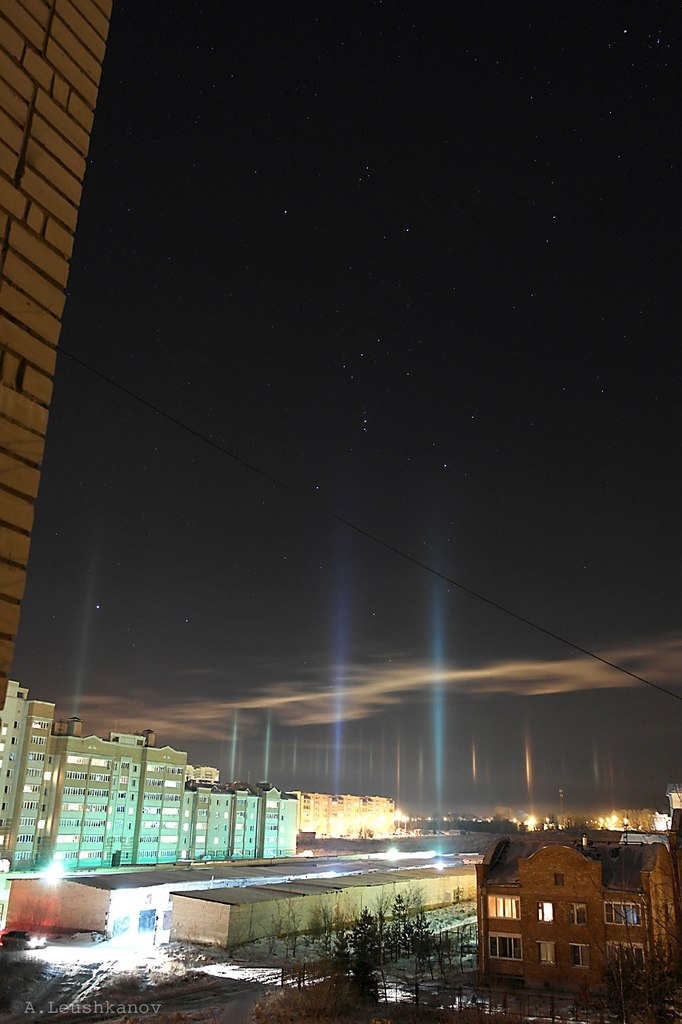
Light poles

Photo by Andrey Lozhkin Astroforum .
When the air temperature drops in winter, atmospheric moisture condenses into snow crystals even without cloud formation. If you watched the weather, you probably saw that light snow can come from clear skies. If the crystals are flat, or hexagonal, then atmospheric “light guides” can be formed, along which light from the earth rises up with a beautiful light column.
Halo

Source
Under the same conditions, when there are ice crystals in the atmosphere, a halo can form around the Sun or Moon.

A sign of increased likelihood of a halo or light poles is cooling. The probability is especially high if there is clear, cold, calm weather for several days. Be careful and do not miss the beauty.
Now smartphones are very powerful devices with a large amount of memory. Do not be lazy, put yourself a planetarium program, and a program showing the phases of the moon.
Additional Information
When writing a publication, the following resources were used:
Astronomical events by week, month, and year - astronet.ru ;
Maps of the starry sky, the solar system, comets, ISS, satellites and other things - heavens-above.com ;
And if you want to see more beautiful photos - the section "astrophotography" of the Astroforum ;
Source KDPV .