November 8, 2014 at 16:12
Fluid breathing

This is probably already a cliche in science fiction: a certain viscous substance enters a suit or capsule very quickly, and the main character suddenly discovers for himself how quickly he loses air residues from his own lungs, and his insides are filled with an unusual tint liquid from lymph to blood . In the end, he even panics, but takes a few instinctive sips or, rather, sighs and is surprised to find that he can breathe this exotic mixture as if he were breathing ordinary air.
Are we far from realizing the idea of liquid breathing? Is it possible to breathe a liquid mixture, and is there a real need for this?
There are three promising ways to use this technology: this is medicine, diving to great depths, and astronautics.
Pressure on the diver’s body increases with every ten meters per atmosphere. Due to a sharp decrease in pressure, a caisson disease can begin, with the manifestations of which the gases dissolved in the blood begin to boil with bubbles. Also, at high pressure, oxygen and narcotic nitrogen poisoning are possible. They are struggling with all this using special breathing mixtures, but they do not give any guarantees, but only reduce the likelihood of unpleasant consequences. Of course, you can use diving suits, which maintain pressure on the body of the diver and his breathing mixture exactly in one atmosphere, but they, in turn, are bulky, bulky, impede movement, and are also very expensive.
Liquid breathing could provide a third solution to this problem, while retaining the mobility of the elastic overalls and the low risks of tight spacesuits. Respiratory fluid, unlike expensive breathing mixtures, does not saturate the body with helium or nitrogen, so there is also no need for slow decompression to avoid decompression sickness.
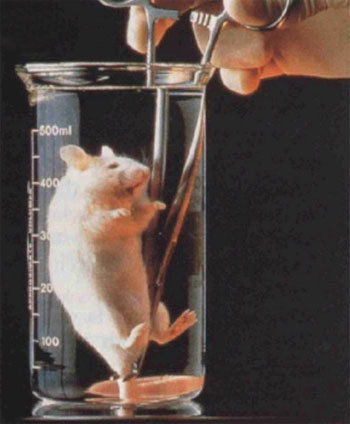 In medicine, liquid breathing can be used in the treatment of premature babies in order to avoid damage to the underdeveloped bronchi of the lungs by pressure, volume and concentration of air oxygen of mechanical ventilation apparatuses. To pick and try different mixtures to ensure the survival of the premature fetus began in the 90s. It is possible to use a liquid mixture with complete stops or partial respiratory failure.
Space flight is associated with large overloads, and liquids distribute pressure evenly. If a person is immersed in a liquid, then during overloads, pressure will go to his whole body, and not specific supports (seatbacks, seat belts). This principle was used to create a Libelle overload suit, which is a rigid spacesuit filled with water, which allows the pilot to maintain consciousness and performance even with overloads above 10 g.
This method is limited by the difference in the densities of the tissues of the human body and the liquid used for immersion, so the limit is 15-20 g. But you can go further and fill the lungs with a liquid close in density to water. A cosmonaut completely immersed in a liquid and breathing liquid will feel the effect of extremely high overloads relatively weakly, since the forces in the liquid are distributed evenly in all directions, but the effect will still be due to the different density of his body tissues. The limit will still remain, but it will be high.
The first experiments on liquid breathing were carried out in the 60s of the last century on laboratory mice and rats, which were forced to inhale a saline solution with a high content of dissolved oxygen. This primitive mixture gave animals the opportunity to survive a certain amount of time, but it could not remove carbon dioxide, so irreparable harm was done to the lungs of animals.
Later work began with perfluorocarbons, and their first results were much better than the results of experiments with brine. Perfluorocarbons are organic substances in which all hydrogen atoms are replaced by fluorine atoms. Perfluorocarbon compounds have the ability to dissolve both oxygen and carbon dioxide, they are very inert, colorless, transparent, can not cause damage to lung tissue and are not absorbed by the body.
Since then, breathing fluids have been improved, the most advanced solution at the moment is called Perflubron or “Liquid” (commercial name). This oil-like transparent liquid with a density two times higher than the density of water has many useful qualities: it can carry twice as much oxygen as ordinary air, has a low boiling point, so after use it is finally removed from the lungs by evaporation. Alveoli under the influence of this fluid open better, and the substance gains access to their contents, this improves the exchange of gases.
The lungs can be completely filled with fluid, this will require a membrane oxygenator, a heating element and forced ventilation. But in clinical practice, most often they don’t do this, but use liquid breathing in combination with conventional gas ventilation, filling the lungs with a perclubron only partially, about 40% of the total volume.

Frame from the film The Abyss, 1989
What prevents us from using liquid breathing? The breathing fluid is viscous and poorly removes carbon dioxide, so you will need forced ventilation. To remove carbon dioxide from an ordinary person weighing 70 kilograms, a flow of 5 liters per minute and higher is required, and this is very much taking into account the high viscosity of liquids. During physical exertion, the required flow will only grow, and it is unlikely that a person will be able to move 10 liters of fluid per minute. Our lungs are simply not designed for breathing in fluid and are not able to pump such volumes themselves.
The use of the positive features of breathing fluid in aviation and astronautics can also remain a dream forever - the fluid in the lungs of the overload protection suit should have a water density, and the perflubron is twice as heavy.
Yes, our lungs are technically able to “breathe” a certain oxygen-rich mixture, but, unfortunately, we can only do this for several minutes, since our lungs are not so strong as to allow the respiratory mixture to circulate for long periods of time. The situation may change in the future, it remains only to turn our hopes to researchers in this field.
Based on materials from zidbits.com and en.wikipedia.org .