May 15, 2018 at 16:23
Upgrading Fujitsu ETERNUS Storage Systems
Fujitsu has been operating on the disk storage market for over 50 years. Today in its product portfolio there are both hybrid and All-Flash arrays. The range of Fujitsu storage systems is regularly updated with interesting new products, in this article we will talk about some of them.
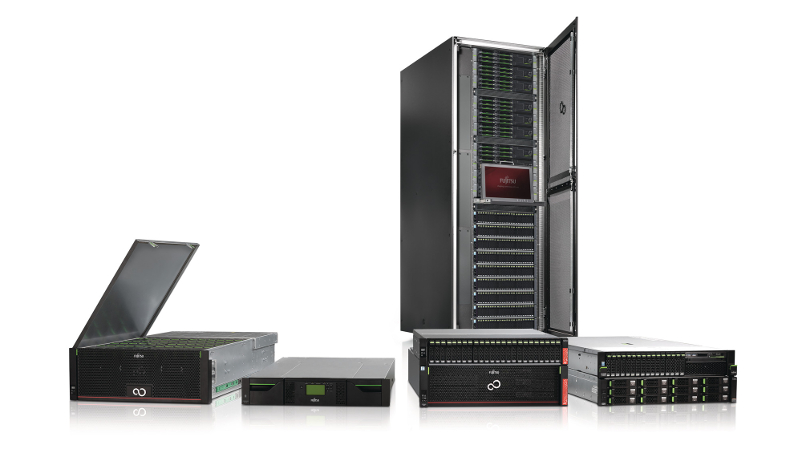
Last summer, entry-level hybrid storage systems were updated: ETERNUS DX60 S4, ETERNUS DX100 S4 and ETERNUS DX200 S4. This year, mid-level storage systems received an update: ETERNUS DX500 S4 and ETERNUS DX600 S4, as well as All-Flash arrays ETERNUS AF250 S2 and ETERNUS AF650 S2. First of all, the storage performance and hardware capabilities have improved. All Fujitsu storage systems are developed by a single development team, this is not an OEM development and it is not associated with the purchase of third-party manufacturers. As a result of this approach, all Fujitsu ETERNUS DX / AF storage systems of different models and generations are compatible with each other, and the transition to new models is easy to carry out gradually. You can create replicas and snapshots between different ETERNUS systems of the initial, middle and senior level, and directly transfer data between systems of different generations.
Almost all vendors claim high performance of their products, backing up these statements with numbers from internal tests. However, do not forget that the results of independent testing are most trusted. Portal Storageperformance.org tested ETERNUS DX200 S4 SSD with 20 on board. In a benchmark simulating the work of highly loaded OLTP databases, the response time of the DX200 was 0.59 milliseconds at 300,056 IOPS. Testing the All-Flash ETERNUS AF250 S2 model with 24 SSDs installed by the same portal showed a result of 0.67 milliseconds at 360 070 IOPS. This is an absolute record for the price / performance ratio of $ / IIOPS according to the results of the SPC-1 benchmark.

Such indicators guarantee that there are no problems when switching to a single-level storage model with the creation of high-speed fast storage.
The British IT portal The Register notes a tendency to reduce the cost of IOPS by 22 times over the past 6-7 years. At the same time , according to the portal, the record holder at the lowest cost for IOPS is Fujitsu ETERNUS AF250 S2.
ETERNUS Storage Foundation Express software is used to manage data storage in entry-level DX models, and the full version of ETERNUS SF is used for All-Flash models. In both cases, the management software is delivered directly “out of the box” with a convenient licensing mechanism. The licensing policy does not depend on the capacity of disk arrays. The amount of data storage can be increased without additional costs for software licenses. For hybrid solutions of the middle and senior level, the control system is provided separately.
What is the 99.9999% reliability level declared for ETERNUS systems in practice? The allowable downtime of IT infrastructures for modern enterprises is rapidly decreasing. Today, customers allow downtime for only a few minutes per year. To achieve this, Fujitsu engineers implemented the Storage Cluster mechanism.

This mechanism works "on top" of the synchronous replica. It can be configured both unidirectional and bidirectional. In the event of a disk group failure, complete array failure, or all access paths to one of the arrays disappearing, Storage Cluster switches to the second array in fully automatic mode. For this, all links on the primary array are previously forcibly disabled, and on the secondary, links with the same WWN are “raised”. From the point of view of the application, server, OS, or multi-pass driver, this switch looks like a momentary SFP failure on the switch.
This mechanism can work for individual volumes or storage pools. Switching between arrays takes 5 to 8 seconds when using Fiber Channel and a little more when using iSCSI. It can also be forced to execute at the command of the administrator. Reverse switching is possible both at the command of the administrator, and in fully automatic mode.
Starting with the entry-level storage system ETERNUS DX200, as well as in the entire All-Flash line, several data compression mechanisms are supported: compression, deduplication, and both mechanisms simultaneously. The effectiveness of various compression methods depends on the nature of the data. For example, encrypted data or information from CCTV cameras that have already been compressed, it is impractical to re-compress the means of storage. On the other hand, when creating a large number of identical virtual machines, the use of both deduplication and compression will be very effective.
Compared to the first generation, the performance of the ETERNUS AF250 S2 and ETERNUS AF650 S2 arrays increased by 30%. The average IOPS is 430,000 and 810,000, respectively. Higher performance - more features. New ETERNUS AFs now support 30% more virtual machines and database transactions, as well as 20% more virtual desktops (VDIs).
Business is not interested in abstract numbers, it is important for the performance of specific applications. Automation of the provision of guaranteed levels of service (QoS) allows you to efficiently allocate resources for various applications and services. For example, in online retail, the level of load on the front-end of an application changes depending on the calendar period and time of day. In big data analytics, work is distributed among various departments of a company. All this can be done using QoS mechanisms that allow you to prioritize each application, as well as target response times at the millisecond level for individual volumes or volume groups.
To increase the performance of ETERNUS AF, developers have improved the read / write process at the microcode level. So, with a long sequential reading process, performance increases markedly. During a long sequential recording process, the system interacts directly with the SSD, bypassing caching, which also increases its performance.
Significantly optimized performance when performing the Garbage Collection procedure, which is periodically exposed to each SSD. At the microcode level, the system recognizes which drive is currently performing this procedure and, if possible, does not use it. With a significant filling of SSD data (60-80% and above), the speed of storage is also not reduced.
In the new models, the mechanisms for transferring data to a new installed storage system have been improved. Some of the ports in the new storage system need to be transferred to initiator mode, in which case it will be perceived by other systems as the server initiating data transfer. This makes it possible to significantly simplify the migration process, since the server immediately “sees” all the data through the new storage system, although data copying has not yet been completed.

Rear View Expansion Shelf
Data migration with zero downtime is available in the latest firmware updates. In this case, switching is performed by sequentially reassigning the identifier of the new volume to a number identical to the old one for each access path. The server perceives the new volume as the old one, which became available after the disappearance of one of the paths.
Summarizing, the new Fujitsu ETERNUS storage systems not only retained all the advantages realized earlier in previous generation systems: universal management tools, the absence of volume-related licenses, but also significantly increased productivity. At the same time, the total cost of IOPS in new models can be called one of the most attractive on the market.
Last summer, entry-level hybrid storage systems were updated: ETERNUS DX60 S4, ETERNUS DX100 S4 and ETERNUS DX200 S4. This year, mid-level storage systems received an update: ETERNUS DX500 S4 and ETERNUS DX600 S4, as well as All-Flash arrays ETERNUS AF250 S2 and ETERNUS AF650 S2. First of all, the storage performance and hardware capabilities have improved. All Fujitsu storage systems are developed by a single development team, this is not an OEM development and it is not associated with the purchase of third-party manufacturers. As a result of this approach, all Fujitsu ETERNUS DX / AF storage systems of different models and generations are compatible with each other, and the transition to new models is easy to carry out gradually. You can create replicas and snapshots between different ETERNUS systems of the initial, middle and senior level, and directly transfer data between systems of different generations.
Independent Performance Testing Results
Almost all vendors claim high performance of their products, backing up these statements with numbers from internal tests. However, do not forget that the results of independent testing are most trusted. Portal Storageperformance.org tested ETERNUS DX200 S4 SSD with 20 on board. In a benchmark simulating the work of highly loaded OLTP databases, the response time of the DX200 was 0.59 milliseconds at 300,056 IOPS. Testing the All-Flash ETERNUS AF250 S2 model with 24 SSDs installed by the same portal showed a result of 0.67 milliseconds at 360 070 IOPS. This is an absolute record for the price / performance ratio of $ / IIOPS according to the results of the SPC-1 benchmark.
Such indicators guarantee that there are no problems when switching to a single-level storage model with the creation of high-speed fast storage.
The British IT portal The Register notes a tendency to reduce the cost of IOPS by 22 times over the past 6-7 years. At the same time , according to the portal, the record holder at the lowest cost for IOPS is Fujitsu ETERNUS AF250 S2.
Unified Management Software
ETERNUS Storage Foundation Express software is used to manage data storage in entry-level DX models, and the full version of ETERNUS SF is used for All-Flash models. In both cases, the management software is delivered directly “out of the box” with a convenient licensing mechanism. The licensing policy does not depend on the capacity of disk arrays. The amount of data storage can be increased without additional costs for software licenses. For hybrid solutions of the middle and senior level, the control system is provided separately.
Clustering and disaster recovery
What is the 99.9999% reliability level declared for ETERNUS systems in practice? The allowable downtime of IT infrastructures for modern enterprises is rapidly decreasing. Today, customers allow downtime for only a few minutes per year. To achieve this, Fujitsu engineers implemented the Storage Cluster mechanism.
This mechanism works "on top" of the synchronous replica. It can be configured both unidirectional and bidirectional. In the event of a disk group failure, complete array failure, or all access paths to one of the arrays disappearing, Storage Cluster switches to the second array in fully automatic mode. For this, all links on the primary array are previously forcibly disabled, and on the secondary, links with the same WWN are “raised”. From the point of view of the application, server, OS, or multi-pass driver, this switch looks like a momentary SFP failure on the switch.
This mechanism can work for individual volumes or storage pools. Switching between arrays takes 5 to 8 seconds when using Fiber Channel and a little more when using iSCSI. It can also be forced to execute at the command of the administrator. Reverse switching is possible both at the command of the administrator, and in fully automatic mode.
Saving without damage
Starting with the entry-level storage system ETERNUS DX200, as well as in the entire All-Flash line, several data compression mechanisms are supported: compression, deduplication, and both mechanisms simultaneously. The effectiveness of various compression methods depends on the nature of the data. For example, encrypted data or information from CCTV cameras that have already been compressed, it is impractical to re-compress the means of storage. On the other hand, when creating a large number of identical virtual machines, the use of both deduplication and compression will be very effective.
All-Flash Array Performance
Compared to the first generation, the performance of the ETERNUS AF250 S2 and ETERNUS AF650 S2 arrays increased by 30%. The average IOPS is 430,000 and 810,000, respectively. Higher performance - more features. New ETERNUS AFs now support 30% more virtual machines and database transactions, as well as 20% more virtual desktops (VDIs).
Additional features
Business is not interested in abstract numbers, it is important for the performance of specific applications. Automation of the provision of guaranteed levels of service (QoS) allows you to efficiently allocate resources for various applications and services. For example, in online retail, the level of load on the front-end of an application changes depending on the calendar period and time of day. In big data analytics, work is distributed among various departments of a company. All this can be done using QoS mechanisms that allow you to prioritize each application, as well as target response times at the millisecond level for individual volumes or volume groups.
To increase the performance of ETERNUS AF, developers have improved the read / write process at the microcode level. So, with a long sequential reading process, performance increases markedly. During a long sequential recording process, the system interacts directly with the SSD, bypassing caching, which also increases its performance.
Significantly optimized performance when performing the Garbage Collection procedure, which is periodically exposed to each SSD. At the microcode level, the system recognizes which drive is currently performing this procedure and, if possible, does not use it. With a significant filling of SSD data (60-80% and above), the speed of storage is also not reduced.
In the new models, the mechanisms for transferring data to a new installed storage system have been improved. Some of the ports in the new storage system need to be transferred to initiator mode, in which case it will be perceived by other systems as the server initiating data transfer. This makes it possible to significantly simplify the migration process, since the server immediately “sees” all the data through the new storage system, although data copying has not yet been completed.
Rear View Expansion Shelf
Data migration with zero downtime is available in the latest firmware updates. In this case, switching is performed by sequentially reassigning the identifier of the new volume to a number identical to the old one for each access path. The server perceives the new volume as the old one, which became available after the disappearance of one of the paths.
Summarizing, the new Fujitsu ETERNUS storage systems not only retained all the advantages realized earlier in previous generation systems: universal management tools, the absence of volume-related licenses, but also significantly increased productivity. At the same time, the total cost of IOPS in new models can be called one of the most attractive on the market.