May 7, 2018 at 11:30
RIPE allocated the last block / 22 from the last block / 8. What's next?

IP allocation in 185/8, the last free RIPE block, in 2012 (left) and 2018 (right), source
April 17, 2018 The RIPE Network Focal Point - one of the five Regional Registries - allocated the last 1024 IPv4 addresses from the last Block / 8 received from IANA in 2011. Although the last block 185/8 is completely distributed among European companies, there are 9 million “restored” addresses (that is, addresses seized from former owners) in the RIPE NCC pool . According to the calculations of the Coordination Center, this will be enough for about another two years, if issued at the request of local registrars for / 22 each.
Currently, each IPv4 address is an extremely scarce product, and the last allocated IP addresses are used very intensively. Therefore, situations like the current mass blocking of IP addresses in Russia are especially unpleasant . At the peak of blocking, 18 million IP addresses blocked by Roskomnadzor corresponded to 5.5 million blocked domains - this is about 2.45% of the 223 million known domains on the Internet.
Fortunately, now the Russian regulator is gradually lifting the blockade . Now only 14.6 million addresses remain in the block according to the statistics of the RKNSHOWTIME bot or 14.7 million according to the statistics of another RKN block digest service. The difference is due to the fact that in the first case only explicitly specified IP addresses are considered, and in the second - both IP addresses and domains (some entries in the Roskomnadzor upload contain only the domain name).
How was the last block / 8 distributed
When the RIPE NCC received the last / 8 (block 185/8, 16,777,216 addresses), about 75 million addresses remained in the RIPE pool, so that they continued to be freely distributed at the request of local registrars (LIRs). But in September 2012, 185/8 remained the only free block - and then Section 5.6 of the IPv4 Address Allocation Policy in the European Region came into effect . These rules were specifically adopted when it became clear that address shortages could not be avoided.
The rules distribute scarce resources in limited quantities (one block for each local registrar). As a result, we can say that the rules helped a lot. The last block / 8 was stretched for 5.5 years, while the previous block / 8 was distributed according to the old rules in five months .
Below is section 5.6 of the new rules in some abbreviation. In particular, we reduced the part on allocation of addresses to traffic exchange points, for which we reserved one range / 16 (65 536 addresses). It is distributed in blocks from / 24 to / 22, that is, from 256 to 1024 addresses.
5.6 Using the last / 8 block (Use of last / 8 for PA Allocations)
When the RIPE NCC starts to allocate IPv4 address blocks from the last / 8 block received from IANA, the policy described below will be applied.
- Block allocation for LIR from the last / 8.
The procedure for satisfying LIR applications for IPv4 addresses is as follows:
- LIR can only get one block from the last block / 8. The block size is / 22.
- The LIR will receive only one block / 22, even if the need for addresses is much higher.
- The LIR can request this block and receive it in accordance with the address space allocation policy that was in effect at the time of the request.
- IPv4 blocks will be issued only to those LIRs that received IPv6 addresses from their upstream local registrar (upstream LIR) or from RIPE NCC.
- Allocation to points of a traffic exchange (Internet Exchange Point).
- Unforeseen circumstances.
- Block / 16 will be reserved for future unforeseen purposes. If there are none, then by the time the last / 8 is used up, this block will be distributed in accordance with clause 1.
- Post-depletion Address Recycling
These provisions only apply to address space returned to the RIPE NCC and not to be returned to IANA.
- Any address space returned to the RIPE NCC will be allocated according to the rules described in Part 1.
- The minimum block size allocated from the last / 8 can be changed if necessary.
- If the addresses for allocating the / 22 block are not enough, the addresses will be allocated in multiple blocks, but in an amount equivalent to / 22.
So, for five and a half years, the RIPE NCC allocated blocks / 22 from the last / 8 according to these rules, with the exception of two blocks / 16, reserved for unforeseen circumstances and for traffic exchange points.
The essence of the new rules is that, regardless of the needs of local registrars, they were given only 1024 addresses, that is, only one / 22 block, and only when they already received an IPv6 block. However, according to statistics for 2012–2018, the allocation rate of IPv4 addresses in Europe grew in accordance with the quadratic function. RIPE NCC attributes this to the fact that more and more local registrars have been registered .

RIPE NCC uses this growth of registrations to forecast the distribution of IPv4 address balances
The network focal point noted an increase in the number of registrations as members of RIPE NCC organizations that themselves do not allocate addresses, but serve end users. According to experts, for organizations, membership in the RIPE NCC was the cheapest way to get additional IPv4 addresses for their own infrastructure.
It also turned out that the incentive to switch to IPv6 does not work either. Most organizations that registered IPv6 address ranges before receiving the IPv4 block did not use them . Moreover, in order to avoid wasting IPv6 address space, in March 2015, RIPE completely removed the requirement to register an IPv6 block.
In November 2015, RIPEbanned the registration of additional local registrars by members of the RIPE NCC, but this also did not help, so in May 2016 the restriction was removed. At this point, organizations began to register new legal entities in order to receive scarce blocks / 22. Reportedly, a certain member of the RIPE NCC managed to get 66 blocks / 22, although they issued only one for each local registrar. The restriction was lifted because they decided that it would be better if the organizations took advantage of a legal loophole in the current procedure, rather than looking for workarounds.
This is how scarce resources were distributed among countries ( statistics file ). To simplify, the numbers on the map are rounded to / 22, although many blocks were divided into / 23 and / 24.
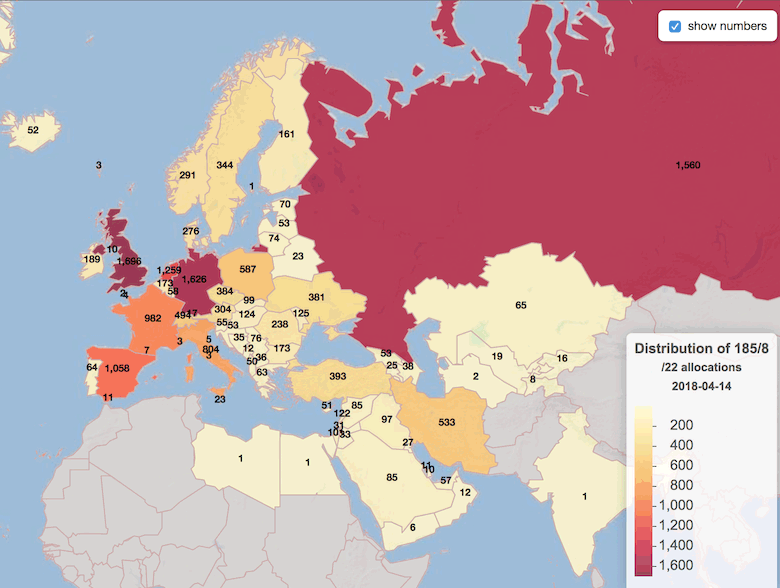
You can see some anomalies on the map: for example, unusually few blocks are allocated to organizations from Belgium, Portugal and Belarus, compared to their more “enterprising” neighbors.
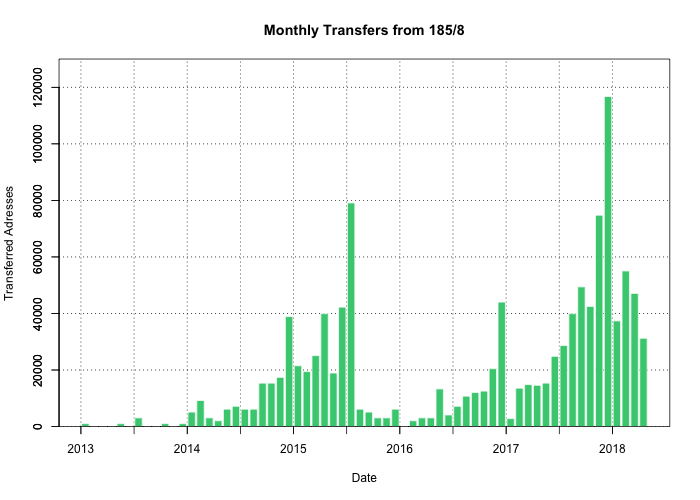
Only by 2015, RIPE NCC specialists realized that a large number of blocks / 22 immediately after allocation change their owner and within a few days or weeks transfer to another registrar (transfer). Then the regulator prohibited transfers for IPv4 addresses until 24 months after the allocation . But judging by the schedule of monthly transfers , this also did not help, it just froze the transfers of fresh ranges for two years.
When will the last IPv4 addresses end?
As already mentioned, about 9.03 million IPv4 addresses remain in the RIPE NCC pool , which will be enough for about two more years. Of these, four million are 1/5 of the 20 million addresses that IANA (Internet Address Space Administration) restored and distributed to five regional registries over the past four years. RIPE took another 5 million addresses on its own, after conducting a “roll call” of organizations. Under the terms of the procedure , if no response was received from the owner, then the IP addresses were withdrawn from him.
At the same time, providers learned to cope with the shortage of address space. Many have learned Address Translation Technology (NAT) when users are allocated private IPv4 or IPv6 addresses, while using fewer global IPv4 addresses.
If you extrapolate the schedule, then the current pool will be enough until about May 2020.
Proposals for the sale or rental of IPv4 are discussed on the forums of providers and on Habré . Apparently, leasing IPv4 addresses has become a good business.
Disposal of IPv4 and IPv6
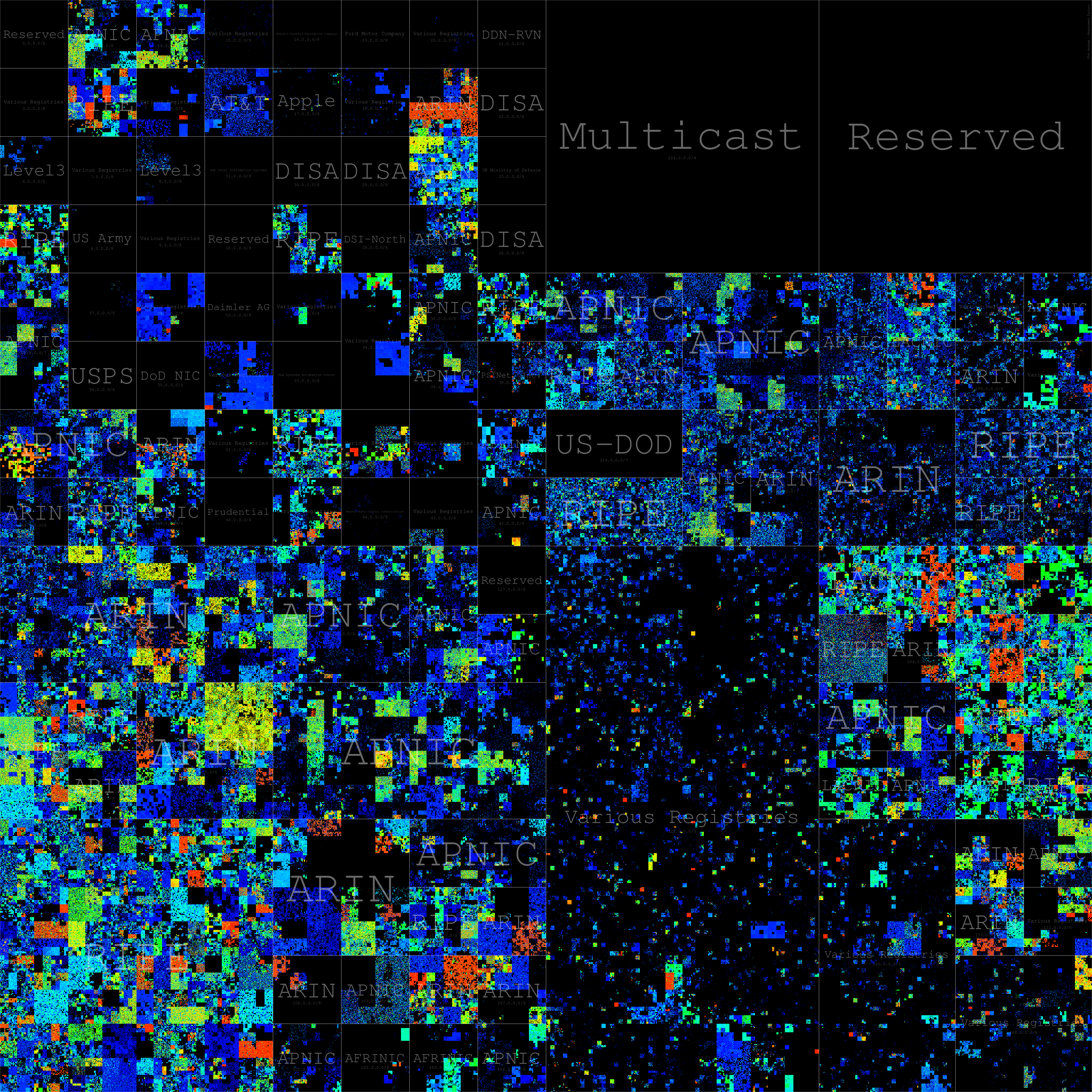
A lot of organizations have registered huge IPv4 ranges for today, which they practically do not use and are not going to give away (for example, 16.8 million addresses in block 44.0.0.0/8, allegedly registered for amateur radio , or 218 million IP addresses from US Department of Defense: 11.0.0.0/8, 22.0.0.0/8, 26.0.0.0/8, 28.0.0.0/8, 29.0.0.0/8, 30.0.0.0/8 and 33.0.0.0/8).
Other blocks are used very intensively. For example, visualization with Hilbert curves shows well how the address space is distributed from about 4.2 billion (2³²) addresses. IPv4 Address Space Allocation, April 2018 ( clickable )
For comparison, here's what IPv6 address space allocation looks like today.

IPv6 Address Space Allocation, April 2018
We announce the action “More cyber defense for sports”!

GlobalSign joins the celebration of the most ambitious event of all athletes and football fans - WORLD FOOTBALL CHAMPIONSHIP 2018 and GIVES 1 YEAR OF SSL PROTECTION! *
Promotion conditions:
* When you purchase any one - year SSL certificate of DV, OV or EV level, you receive a second year as a gift .
• The promotion applies to all sports-related websites.
• The promotion is valid only for new orders and does not apply to partners.
• To take advantage of the offer, send a request on the website with the promotional code: SL003HBFR .
The promotion will last until July 15, 2018.
You can get additional information on the campaign from GlobalSign Russia managers by phone: +7 (499) 678 2210.
MORE PROTECTION with GlobalSign!