Rolling Scopes Conference 2018: woodstock for front-end developer
As it turned out, the components of success at the legendary rock festival and conference of developers are approximately the same - a cool idea, cool content and a special atmosphere of unity. In mid-February, the 4th conference of the JavaScript community and Frontend developers was held in Minsk. They didn’t beat guitars about the stage, but “lit” them to the fullest. Let's roll!
This year, the Rolling Scopes community is preparing to celebrate its first anniversary: 5 years ago, our colleague Dmitry Vorobei got the idea to gather a company of like-minded people, so that in his spare time from work tasks, he would share his experience, implement original ideas and ... rolled. During this time, a small community managed to grow into a whole movement and become a brand. More than 40 meetings were held, Gomel, Grodno and Brest, as well as Polish Krakow and Gdansk joined the Minsk meetings. The “branch” of rolling will soon appear in Mogilev, there is an RS school , in which about 500 people were trained in 2017 alone.
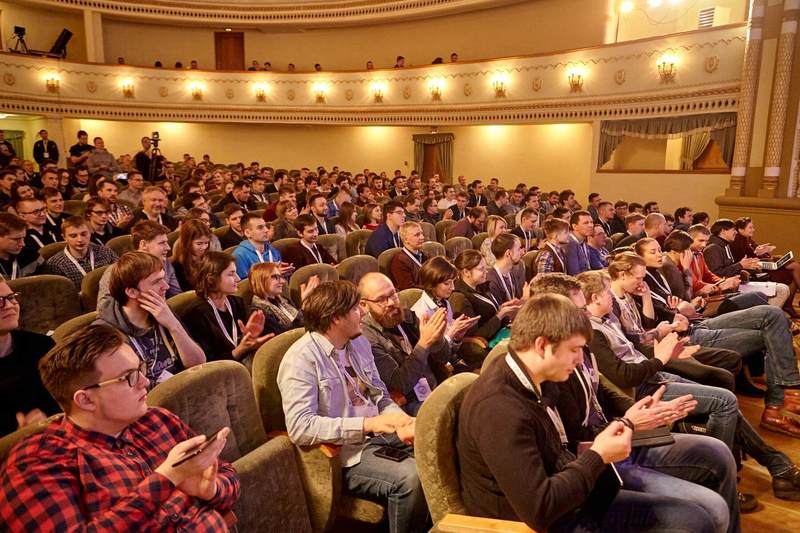
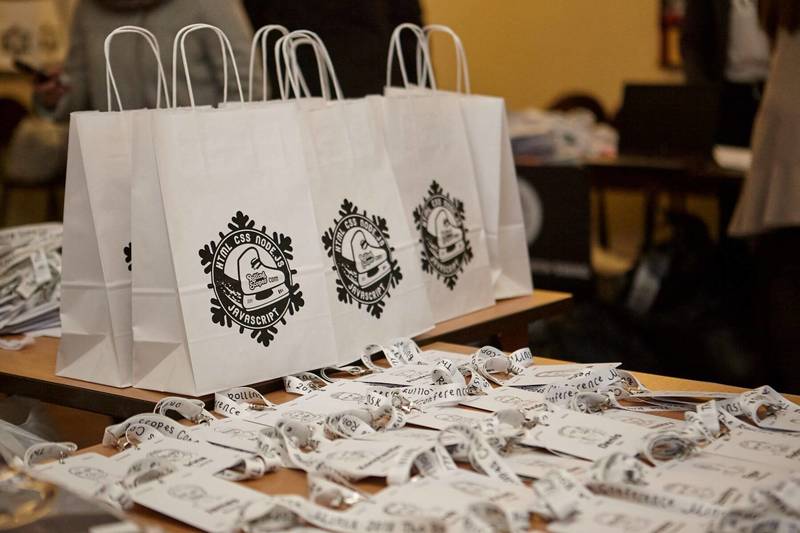
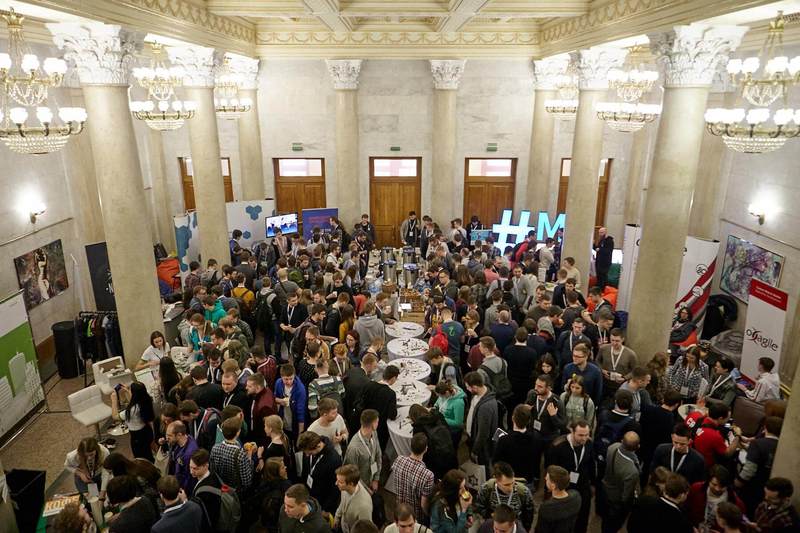
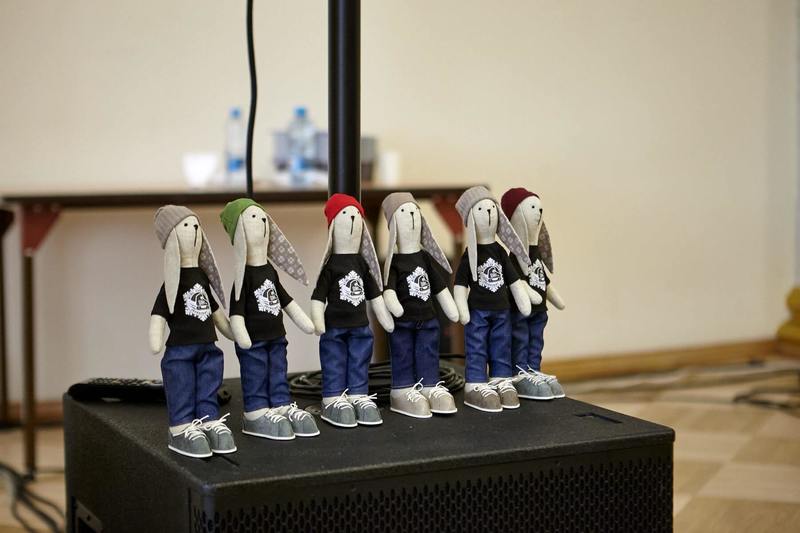
Registration for the conference was closed in 4 hours. Almost 1000 people spent the weekend under the sign of the Rolling Scopes: they pumped, talked and drew custom badges. Those who were unable to attend the conference joined the live broadcast from the Palace of Trade Unions.
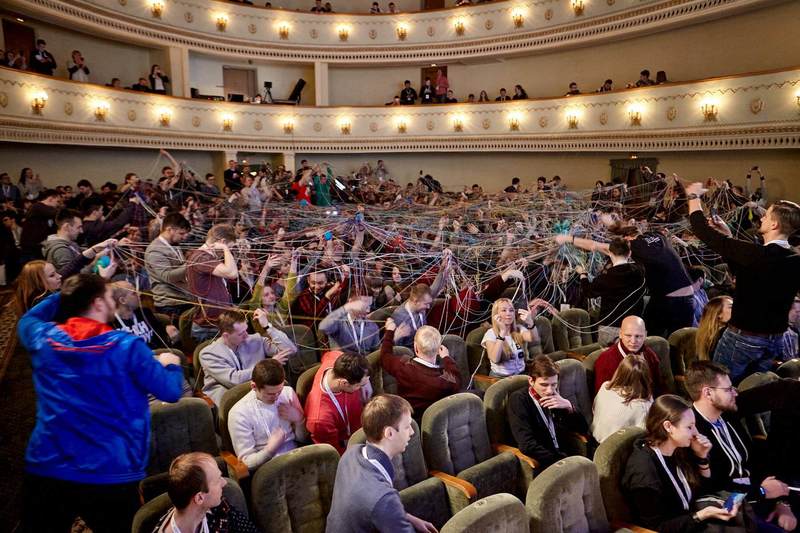

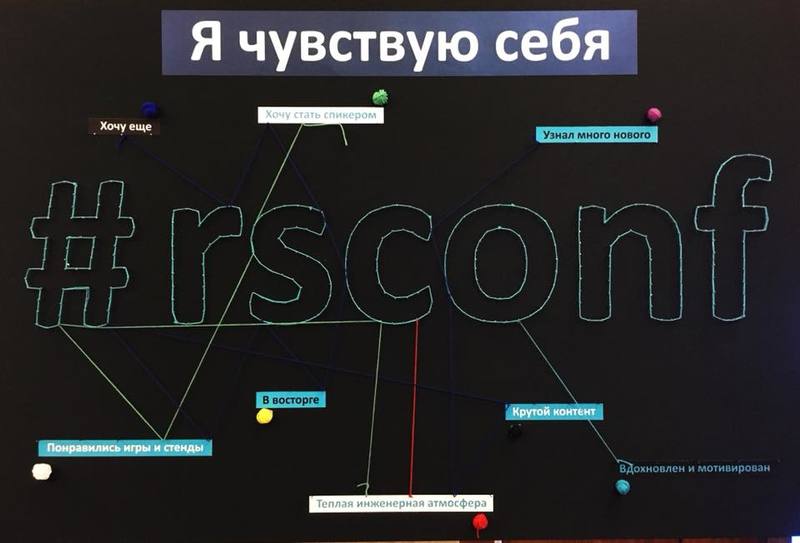
2 days, 2 streams, 33 reports and speakers from Belarus, Russia, Albania, India, Serbia, Great Britain, Poland, Ukraine, Holland and Germany.
Immediately after the opening speeches of the organizers, the large hall of the Palace of Trade Unions was encouraged by our colleague Andrei Volchenko with his report. His story about non-trivial solutions in the field of mobile development using js and webgl caused a lot of questions from the audience.
Christy Progri, the leader of the community from Albania, spoke about her experience in building a Mozilla community in small towns , shared her organizational “rake” and secrets to maintain the fighting spirit of the engineering community.

The report of our colleague Ales Zwil "Stream API, through Redux-Observable in Electron-based app" was devoted to the development of desktop applications.

The tale of microservices was started by Konstantin Krivlenya, and Ivan Yovanovitch continued his acquaintance with them, telling about what Micro Frontend is and what problem it solves, as well as how to build applications using React, Angular, and Vue along with detailed implementation examples and many more macro details of microservices.
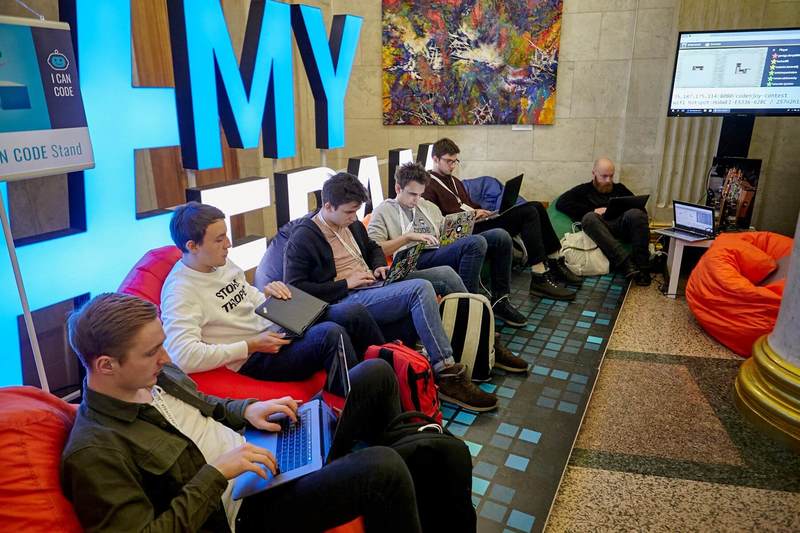
The experience of using Flow on a large project was touched upon by Alexander Shushunov, telling about the tools and problems that you may encounter during testing.
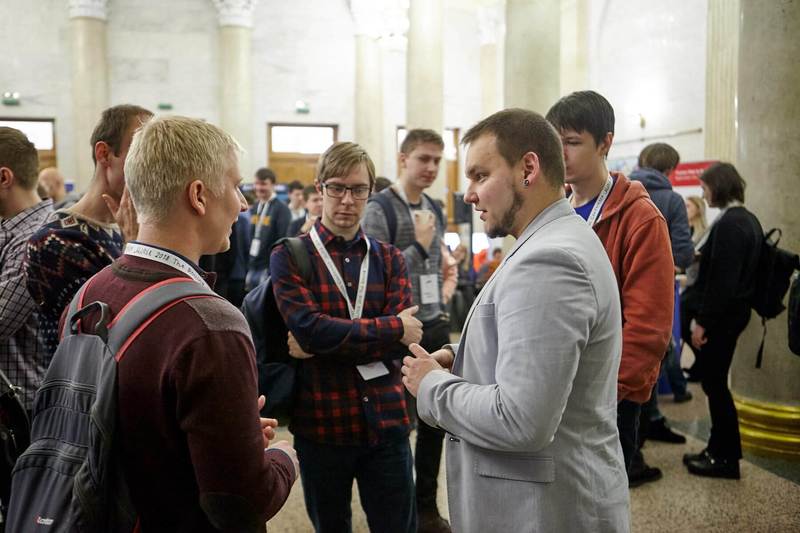
According to another colleague, Mikhail Gatilov, his Codemods report and the transformation of JavaScript code on the principles of AST work and analysis are worth a look to understand the basic principles of working with syntax trees.
Examples of real hacks in his report “How to hack a node app?” Were cited by Assim Hussain.
(More video presentations are available here , speaker presentations here ).
If you were not at the RS meetings and did not hear anything about the community, then you definitely should have seen the logo - a video on the four support wheels - JavaScript, HTML, CSS and Node. Js. The fifth wheel was added at the conference - UX design. The second day of Rolling Scopes was almost entirely devoted to this area. Almost half of the UX stream was taken over by EPAMers.
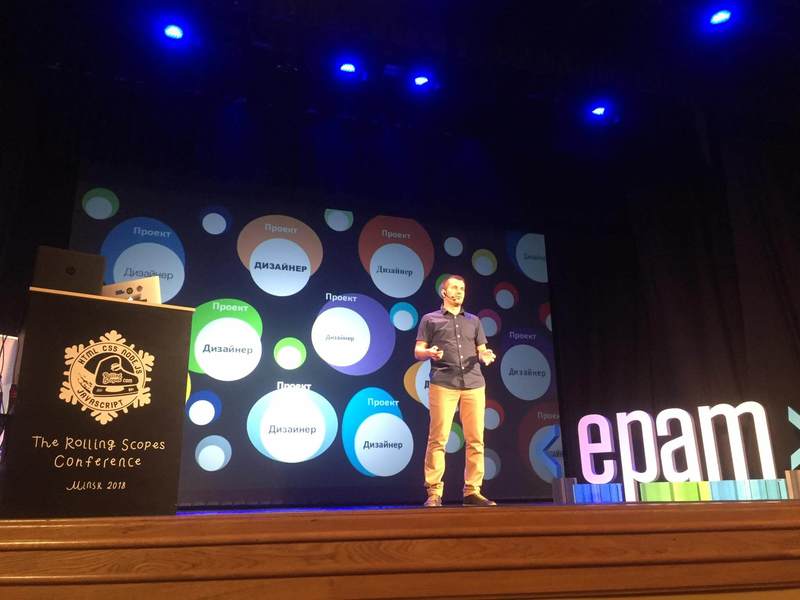
Vitaly Novikov set the way for the design thinking of the participants and guests of the conference. In his report “When there are a lot of products, and a little designers” He personally described in detail the management of design teams in a large company, gave advice on optimization and proper communication with managers, developers, customers and users.

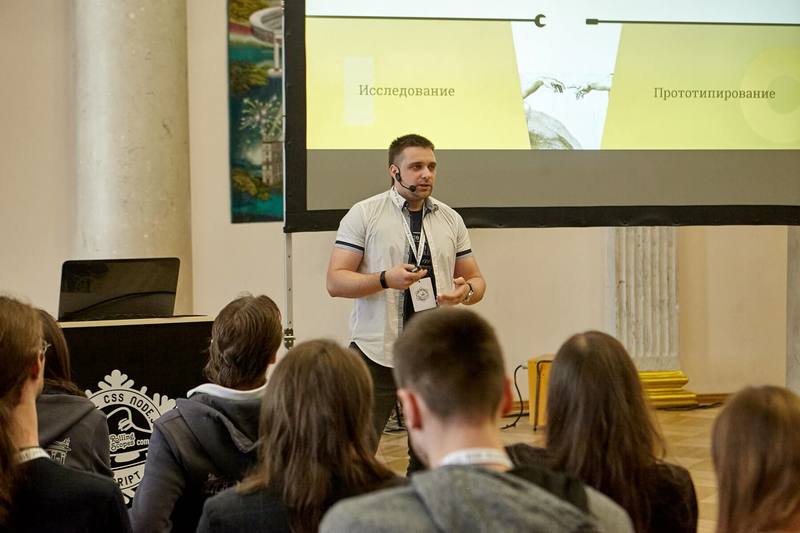
The problem of interconnection and prototyping in his report Reserch-reserch, but not outlifted was raised by Dmitry Vanitsky. Many believe that these two steps go one by one, but Dima will try to convince you of this.

Well, how to prevent this, you will learn from the speech itself. By the way, Dima has his own young blog , where you can read the article on the same topic.
Fedor Shepelenko spoke about trends in building system design:

Examples of designer surprise brought Eugene Jour. Her report was one of the most discussed speeches of the second day.

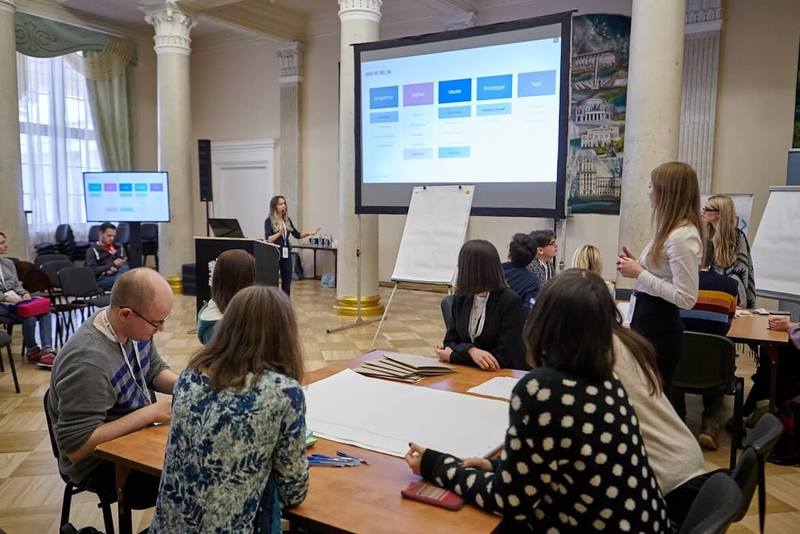
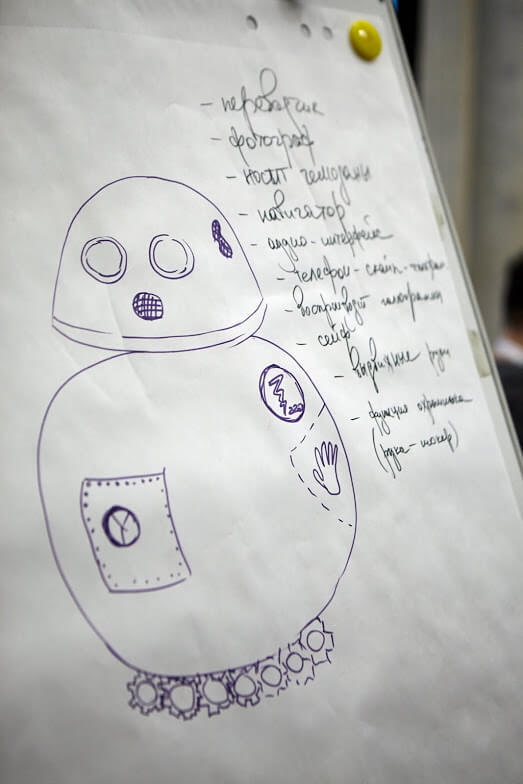
The highlight of the second day of the conference was the workshop “Think Like a Designer” . Everyone could try themselves in a new role and, together with the mentors, got acquainted with the methodology of design thinking. The participants were given a specific task - to draw robots that would help people travel. The guys conducted interviews with potential users, created on brainstorms, confirmed or refuted their hypotheses, and by the end of the workshop presented prototypes of products to the public. Morality: a real solution that will find a response from the user is always the result of complex work and an organized process.
Several weeks passed, and the talk of the conference did not cease. And, if the artist is inspired by a music festival, a new hit is born, then after the conference of developers, ours is definitely waiting for something very interesting.
News about upcoming mitaps and the work of the Rolling Scopes school is here .
Join a community in FB or VK .
Intro
This year, the Rolling Scopes community is preparing to celebrate its first anniversary: 5 years ago, our colleague Dmitry Vorobei got the idea to gather a company of like-minded people, so that in his spare time from work tasks, he would share his experience, implement original ideas and ... rolled. During this time, a small community managed to grow into a whole movement and become a brand. More than 40 meetings were held, Gomel, Grodno and Brest, as well as Polish Krakow and Gdansk joined the Minsk meetings. The “branch” of rolling will soon appear in Mogilev, there is an RS school , in which about 500 people were trained in 2017 alone.
Dmitry Vorobei:
“I know that many meetings and conferences are held on a point-to-point basis, not many people from the community are involved in the organization and the rest do not feel involved in the event. We strive to create a special atmosphere. There is a school where almost everyone can be a mentor or a coach and on an ongoing basis interact with participants, tell something, share news. Now the school employs 70 mentors and more than 20 teachers. I constantly get feedback from people who are studying. For example, they do not have specialized education; they are changing their profession. “The guys like it, they are happy that after such free training they get into EPAM or other companies and this is a very inspiring feedback.”
Registration for the conference was closed in 4 hours. Almost 1000 people spent the weekend under the sign of the Rolling Scopes: they pumped, talked and drew custom badges. Those who were unable to attend the conference joined the live broadcast from the Palace of Trade Unions.
Julia Rumyantseva:
“In general, the Rolling Scopes are changing lives. Yesterday, the guys were members of the community, today they became active contributors, and tomorrow they will become speakers, leaders and will develop the movement in their cities. Community is a large family that has united around the idea of making the world a better place, making the web a better place. You can look for a solution to your problem for a long time alone, or you can come to the guys, ask a question and this will be the topic of the next mitap. You can come to the community and say, "I have a cool idea, let's do it." We launched drones through code, played guitar through code - there are a lot of such examples of interesting tasks. ”
2 days, 2 streams, 33 reports and speakers from Belarus, Russia, Albania, India, Serbia, Great Britain, Poland, Ukraine, Holland and Germany.
Immediately after the opening speeches of the organizers, the large hall of the Palace of Trade Unions was encouraged by our colleague Andrei Volchenko with his report. His story about non-trivial solutions in the field of mobile development using js and webgl caused a lot of questions from the audience.
Andrey Volchenko:
“I talked about the fact that you don’t always rely on frameworks and their performance, you should not be afraid to look under the hood and get rid of several abstractions for the sake of performance, which is so much talked about now.”
Christy Progri, the leader of the community from Albania, spoke about her experience in building a Mozilla community in small towns , shared her organizational “rake” and secrets to maintain the fighting spirit of the engineering community.
The report of our colleague Ales Zwil "Stream API, through Redux-Observable in Electron-based app" was devoted to the development of desktop applications.
Ales Zwil:
“I took part in two RS meetings in our city of Gomel, and now I had the opportunity to speak at a full-fledged conference - it was super cool! In the report, he talked about his personal experience using an not quite familiar set of technologies and showed that you can combine pretty funny things and create some unusual combinations to solve non-trivial tasks. To diversify the daily lives of developers due to this. There were several reports that I would especially like to note - a report from Marek Piasecki - Beyond React , I also liked the report from Alexei Migutsky on how to make more money in Frontend. ”
The tale of microservices was started by Konstantin Krivlenya, and Ivan Yovanovitch continued his acquaintance with them, telling about what Micro Frontend is and what problem it solves, as well as how to build applications using React, Angular, and Vue along with detailed implementation examples and many more macro details of microservices.
The experience of using Flow on a large project was touched upon by Alexander Shushunov, telling about the tools and problems that you may encounter during testing.
According to another colleague, Mikhail Gatilov, his Codemods report and the transformation of JavaScript code on the principles of AST work and analysis are worth a look to understand the basic principles of working with syntax trees.
Mikhail Gatilov:
“Many front-end developers use such tools as Babel, eslint. I covered the topic a bit, showed how you can write plugins for these tools yourself and do it easily. In addition, I shared my experience with such a great tool like jscodeshift. We use it on the project to update our javascript code. For example, when we want to use some new features of the language, or we switch to new versions of lib. With this tool, we can write our own scripts through which our entire code base is run, and we get the desired result: old constructions are deleted and replaced with new ones.
I liked 2 reports most of all: “The elegance of decorated Redux” by Ilya Sachka and “Journey through VR and AR with React” Tomasha Lakoma. "
Examples of real hacks in his report “How to hack a node app?” Were cited by Assim Hussain.
(More video presentations are available here , speaker presentations here ).
If you were not at the RS meetings and did not hear anything about the community, then you definitely should have seen the logo - a video on the four support wheels - JavaScript, HTML, CSS and Node. Js. The fifth wheel was added at the conference - UX design. The second day of Rolling Scopes was almost entirely devoted to this area. Almost half of the UX stream was taken over by EPAMers.
Vitaly Novikov set the way for the design thinking of the participants and guests of the conference. In his report “When there are a lot of products, and a little designers” He personally described in detail the management of design teams in a large company, gave advice on optimization and proper communication with managers, developers, customers and users.
Vitaliy Novikov:
“The modern design approach allows us to identify not only the needs of the business, but also to study the requirements and expectations of users. We analyze the problems of those who will later use the product. But to accomplish this is extremely difficult. Time and resources are never enough. But, by properly building processes and creating a cohesive team, you can make sure that what 60 designers did before will do 10 today, improving the quality of ready-made solutions at times. ”
The problem of interconnection and prototyping in his report Reserch-reserch, but not outlifted was raised by Dmitry Vanitsky. Many believe that these two steps go one by one, but Dima will try to convince you of this.
Dmitry Vanitsky:
“I think my report will appeal to everyone who is a fan of the result and does not want to conduct a study, for the sake of a useless set of artifacts that no one needs.
Well, how to prevent this, you will learn from the speech itself. By the way, Dima has his own young blog , where you can read the article on the same topic.
Fedor Shepelenko spoke about trends in building system design:
Fedor Shepelenko:
“My report was called“ Lego for designers. ” It is dedicated to creating a unified system design for a large number of products. I talked about how to create it correctly, what mistakes we and our team encountered along the way and what could have been avoided. The conference itself is very cool and lamp-like. The first time I participated as a speaker, and in fact, everything went well.
Examples of designer surprise brought Eugene Jour. Her report was one of the most discussed speeches of the second day.
Evgenia Zhur:
“The report was aimed mainly at developers. I showed that it was not enough for a designer to simply draw and demonstrated cases where visual solutions did not solve real problems and vice versa: interfaces without a strong visual component that are quite viable and popular. The first time was a speaker (not only in RS, but in general). And because of this, she was so nervous that instead of going to the reports, she sat and prepared for a speech. The guys in RS are very cool and feel like one of them is an indescribable feeling!
Instead of a bonus track
The highlight of the second day of the conference was the workshop “Think Like a Designer” . Everyone could try themselves in a new role and, together with the mentors, got acquainted with the methodology of design thinking. The participants were given a specific task - to draw robots that would help people travel. The guys conducted interviews with potential users, created on brainstorms, confirmed or refuted their hypotheses, and by the end of the workshop presented prototypes of products to the public. Morality: a real solution that will find a response from the user is always the result of complex work and an organized process.
Outro
Several weeks passed, and the talk of the conference did not cease. And, if the artist is inspired by a music festival, a new hit is born, then after the conference of developers, ours is definitely waiting for something very interesting.
News about upcoming mitaps and the work of the Rolling Scopes school is here .
Join a community in FB or VK .