January 29, 2018 at 11:46
Leave all doubts: how to avoid impostor syndrome
- Transfer
I recently participated in the Feral Vector , an independent gaming festival held in Hebden Bridge, UK. This is an amazing event, and if you have never been there, I recommend visiting it. This year I wanted to take part, so I gave a short speech about impostor syndrome, in which I talked about psychological problems and creativity. It was an honor for me to go up to this stage and deliver this speech in front of an entire audience.
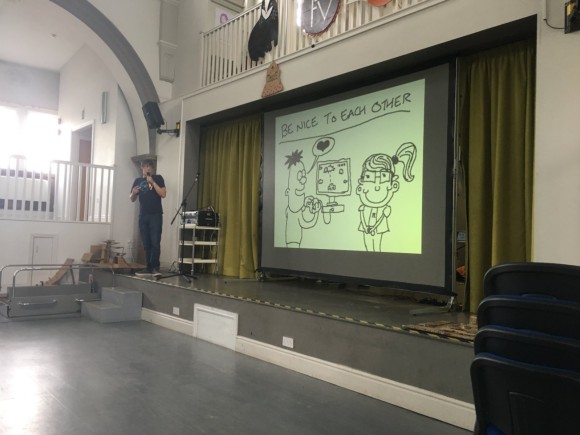
After the speech, I received many good comments from wonderful people. It seems that they mostly liked the slides I created, but the very content of the speech resonated with very few. I thought it would be nice to record my speech and write a quality article. I did not use notes or a script, so I tried to roughly correspond to what I was saying, and added some additional information.
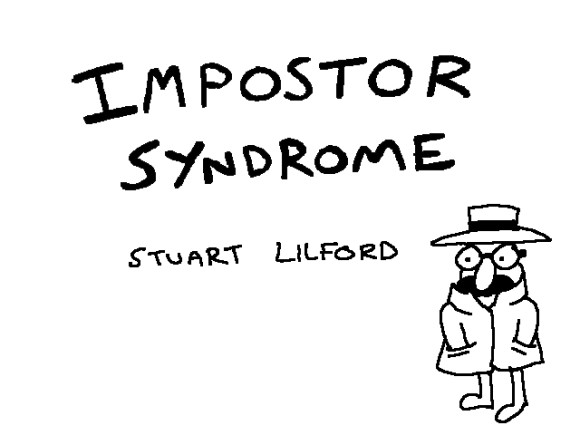
My name is Stuart Lilford. I think I can call myself a game designer. For three years I worked in studios in the QA / design department, and then I started to create games on my own and give lectures at a college in Yorkshire. My last game was The Temple of ADVENTURE , created for Adventure Jam, and now I'm working on Splodey Vaders for Android and iOS.
But enough about me. Let's find out a little about you. I want to start this article by asking you the question: “Did you have an imaginary friend in your childhood?” Think and raise your hand, if you were. I asked the Feral Vector audience about it and a lot of hands went up into the air, that is, many people had imaginary friends in childhood.
I also * had * an imaginary friend, but he appeared in my life when I became a little older (around the age of 14), and he is still with me. However, he was less an imaginary friend, and more an imaginary asshole. His name is Jason.

Jason is an asshole because he is one of those people who constantly humiliate you. When I decide to try to create something creative, Jason appears only to ask me: why bother at all? When I post something online, whether it's a game or some kind of graphics, Jason is right there to say that I should not have done this and I look like an idiot. When they praise me or recognize my merits for what I have created, he will definitely be there to say that all this is a hoax and I do not deserve recognition. I'm not as good as others doing the same job. Those who praise me make a mistake.
Jason appears constantly, but there were often cases when he really negatively affected my mental state. Here are some of the most important examples of how Jason appeared in my life:

This is me when I was just about to first work as a game designer. I had to work in an independent studio creating games published by Sony. I was incredibly delighted. Since childhood, when I first played Super Mario All Stars, I wanted to become a game designer. I was well aware of how difficult it is to become a designer without experience, because I read a lot of articles about it. I thought I was very lucky with the offer of this post. I studied this subject at the university and now I will get a real job! This was my dream and I was eager to start.
But then Jason appeared.
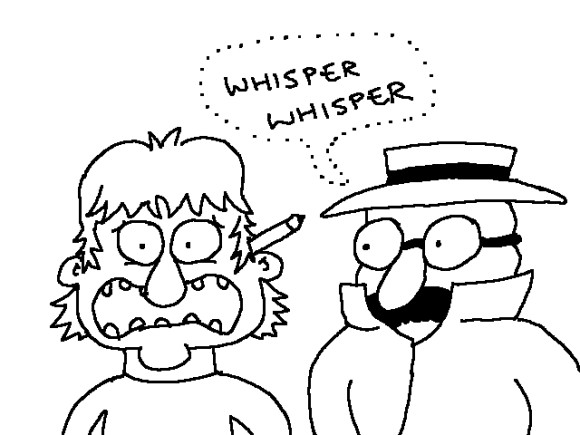
“What are you doing? You do not have experience in game design and now you want to earn this? You had a mediocre university. It was run by a graphic designer who did not even play games. You will fail. You will never get this job. ”
Despite Jason's whispering, I stayed at work for about a year, but the contract was temporary for three months, and the studio extended it every three months. One of the months I was told that the contract will not be renewed and I no longer worked in the gaming industry. I considered this a confirmation of Jason's words and told myself that he was right, although it was obvious that it was a business decision. I felt that this position is not for me, I am not good enough, I am not worthy of the game industry.
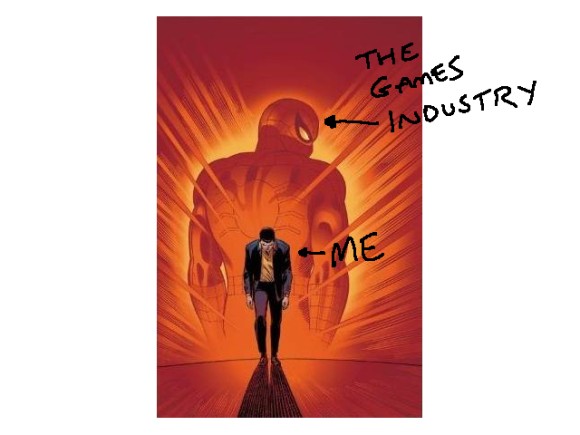
Me and the gaming industry
I decided not to look for work in the industry anymore and for some time I stopped making games. I turned my back on video games and got a job in the amazing world of B2B sales. I have sold non-ferrous metals to stainless steel and aluminum wholesalers to enterprises and companies. Sales were not my passion and I hated my job. Soon the desire to create returned to me and I began to make games again.
I created a short point-and-click Time Stone adventure in Adventure Game Studio . Desperate to get out of sales, I used this game as an example of my skills when I got a job as a game design teacher for 16-18 year old students at a local college. At first it was only an hourly employment contract, but six months later I was accepted to the position of lead teacher of game design.
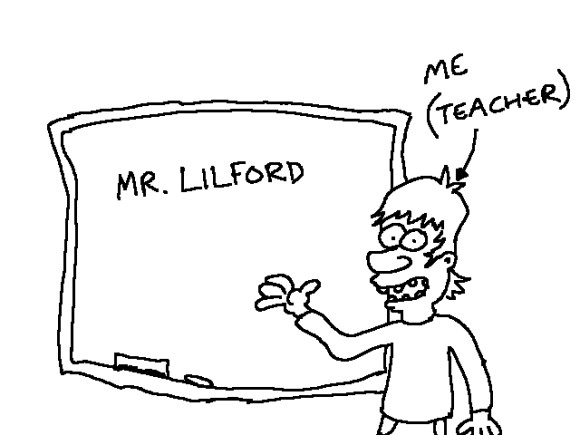
I really liked my position. It was a full-time job, and I enjoyed teaching game design to students. This position gave me stability, which was not enough when working in the gaming industry, in addition, I worked with my favorite topic (as opposed to sales, which I hated). But I had no experience in teaching, and Jason was not slow to appear again.
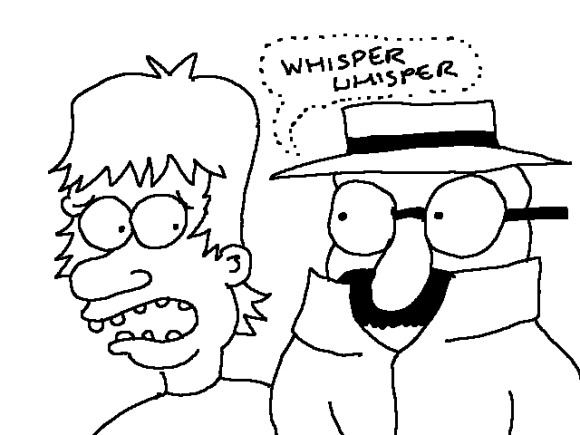
“Have you received the position of lead teacher who is responsible for the entire course? You taught less than six months, and now you will control people who have more experience than you! Your superiors were seriously mistaken. ”
When I got this job, I felt like a fraud, but I stayed on it and continue to work for three years. I love my work and I think that my contribution should be proud. I'm glad I got this job, but it took me a long time to feel that I was worthy of it.

Recently I was considering participating in Feral Vector. I have already been to this event and wanted to participate not only as a spectator. It was interesting for me to make a report or, for example, help in conducting a master class.
I sent a letter to the organizer of the event, suggesting several ideas for reports and simply tried to participate actively. But as soon as I sent the letter, Jason looked at me through the monitor and began to whisper through the speakers.

“I can’t believe you sent the letter. Why should they even want * you * to perform? No one even knows who you are. There will be much more experienced people performing, when you go up to the stage, everyone will think: “What kind of idiot is this?” And they will leave. You can’t stand the tension and they will soon realize that you have no idea what you’re talking about. ”
I panicked and could not fall asleep for a long time until I read Danny Moore's article, " Life with Impostor Syndrome ." He is a screenwriter of games; in the article, he describes his experiences of impostor syndrome. The article really touched me. I began to read more and more about this topic, constantly nodding, agreeing and thinking: “Yes, this is about me!”
So what is impostor syndrome? In essence, this feeling, you are a scammer and are not a successful, competent or intelligent person; you just pretend to be, despite all the evidence to the contrary. You are constantly worried that they will "bite you", everyone will understand that you are not smart, not talented and not stubborn. The game industry consists of many smart, talented, hardworking, creative people, so we can naturally assume that many in it experience such feelings. Despite a lack of comprehensive information about impostor syndrome, symptoms often recur. Here are some of the most common:
Avoiding creative work
If you feel like an imposter, then you think that you should not bother, and this leads to long periods of avoiding creative work. In Danny’s case, a colleague in a review of his script asked if he had dyslexia. This deprived him of confidence and for some time he could not engage in writing. As for me, when my contract was not renewed, I took it as a confirmation of my feeling of an impostor and did not create for several months.
The desire not to stand out
When the opportunity arises: getting a job, sending a game to an event or showing someone your creations, the impostor syndrome inspires a feeling that the result of labor is not worth sharing, the game is not good enough, and you are not good enough. These feelings naturally lead to the fact that you try not to stand out and not take risks.
Stress and anxiety
The syndrome can cause great anxiety, because you convince yourself that you will be “calculated” at any time, and in the long run it can lead to depression.
Underestimated experience
In the very first lines of this article, I said: “I think I can call myself a game designer.” I used the words and phrases “I think,” and “I can call,” which reveals an impostor in me, even if I am not one. Those with impostor syndrome have difficulty accepting that any praise they receive is sincere; they underestimate all their personal achievements.
Linking Your Success to Luck
Another symptom is that you connect most of your success with pure luck, not hard work. I hated most of the time spent in sales, but once the manager said a phrase that struck me. She is a successful woman, with status work and a good salary. Her brother often envied her, her beautiful house and expensive car, and said, “You are so lucky.” She replied: "It's funny, but it seems that the more I work, the more lucky I am." I always recalled this phrase when I tried to connect any success with luck.
A feeling of nervousness from meeting apparently successful people in your area of activity.
After the release of Thimbleweed Park, I saw how many people post a screenshot of it. It depicts a game character, a game designer, who is very afraid to speak at an exhibition with an apparently successful game designer.

People usually posted this picture with a comment about how similar it was to them. Many of them, it seems, were the creators themselves and compared their own success with the perceived success of others. At the same time, they felt they were deceivers in relation to their talents. I think this is enough for anyone to decide that it’s not worth talking with a “more successful” person, because he will waste his time.
What you can do about it
There are different ways you can deal with impostor syndrome. I reduced the list to the top five.
1. Be kind to each other
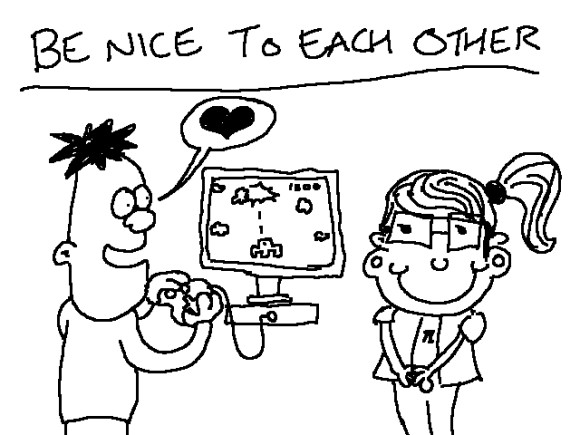
Impostor syndrome occurs when your invisible asshole tells you that your work is bad, so one way to deal with this is to have a lot of people tell you that your work is * good *. If we like someone’s work, then we should get in the habit of talking about it. I understand that sometimes in communication it’s inconvenient to tell someone that you like their work, but even something simple like likes, retweets or positive comments under the animated game play GIF allows you to hear less voices of different jason.
2. Recognize your accomplishments (maybe even keep a list)

Relate your success to your own hard work, and instead of the negative aspects of the project, look at the positive.
Take a recent example from my life - the game The Temple of Adventure, which I made for Adventure Jam 2017. This is a game that I made in two weeks with the help of my artist friends to learn how to work with Unreal Engine 4. The game is full of bugs, imperfect and not completed. She didn’t make it into the top 12 nominated games, and in some comments people claimed that she looked like another, existing game.
But if you look at the positive aspects and focus on the achievements of the game - PC Gamer declared it one of the best free games of the week, I got on the list of 25 best jam games (at number 24, but I'm still on the list!), It was watched by several lettered players, and two of them had more than ten thousand views, in the final voting of the jam she took 19th place (out of 122 games), but became the seventh rated gamejolt among games with the AdvJam2017 tag and won third place in the "Dialogues" category. Considering that I worked on the game for only two weeks, in my spare time from work and other duties, plus used an engine with which I had almost no experience, then everything is not so bad. On the contrary, even pretty good.
You need to evaluate your achievements in this way, perhaps even keep a list. All that I mentioned could be written on my personal “list of achievements”, to which I could refer. Each time you feel like a cheater, you can refer to this list and it will help you to continue working on what you love and share it with others.
3. Take advantage of the opportunities
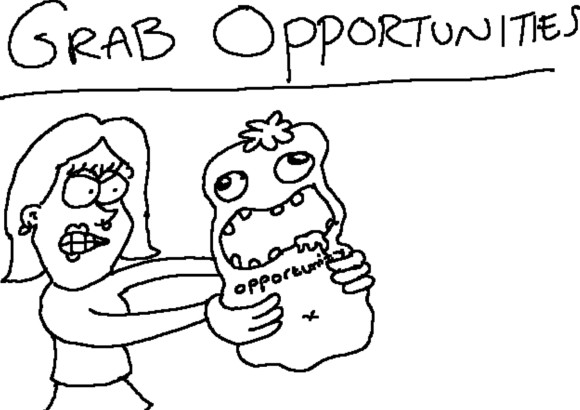
Imposter Syndrome may make you think that when you are given the opportunity, then you should not spend effort on it. I'm not so experienced as to try to get a job, my project is not good enough to participate in a competition / exhibition, etc. Everyone has uncertainty in their abilities, but if you allow this uncertainty to grow and take control over the choice of solutions, then everyone will lose from this. If you do not try to get a job, you will potentially lose an excellent job, and the employer will potentially lose a great hardworking and creative employee. The worst that can happen is that which will not happen. If you do not take advantage of the emerging opportunities, then you may steal an excellent game from the world or an excellent team member.
4. Stop comparing yourself to others
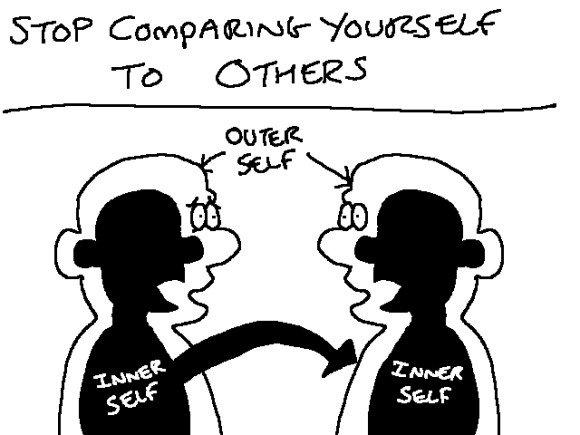
When you are in the same room with a 20-year-old industry veteran who is crowned with awards and is simply a wonderful person, you will most likely feel like a cheater against his background, but this does not mean that you are not capable of anything. This is where the above list comes in handy: if you have compiled it, then you already have real proof that you are something valuable.
If you compare yourself with leaders and veterans in your field of activity, you will feel that they are not good enough, but these are incomparable values. Most likely, you will compare your inner self with the outer self of others. You compare your insecurity, your doubts, your sense of impostor with the success, confidence and experience of another person. In the end, you don’t know how this person feels inside. Success can exacerbate impostor syndrome, and people around you may seem even bigger scammers than you. Compare only that which is comparable, and stop matching your inner feelings with the external manifestations of other people.
5. Talk about your problems.
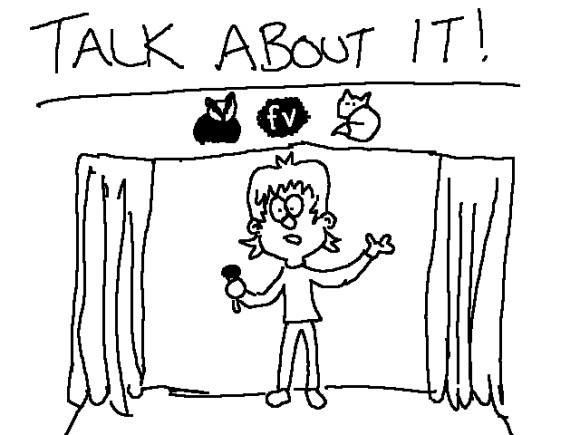
I am very grateful to Danny for writing an article about impostor syndrome. She helped me a lot when I was overwhelmed with self-doubt. At this point in my speech, I asked people in the hall which of them had feelings similar to the symptoms of impostor syndrome described by me, and most of the audience raised their hands. Some studies say that 70% of people have such feelings. That is why I wanted to talk about it, so I wanted to write this article. We need to share our feelings more, so that people with such thoughts can become aware of them and study them. Are you really a liar, or have you worked hard to achieve everything you have? Find people to whom you can say "I feel like a liar." Do they really agree with you?

Danny's article helped me with this, it made me think and question everything that Jason whispered to me. I looked at Jason and said, “Wait a minute.” I saw him in a different light and decided that I had enough. I took off Jason's hat and glasses, took off his coat, and underneath I found an abomination ...
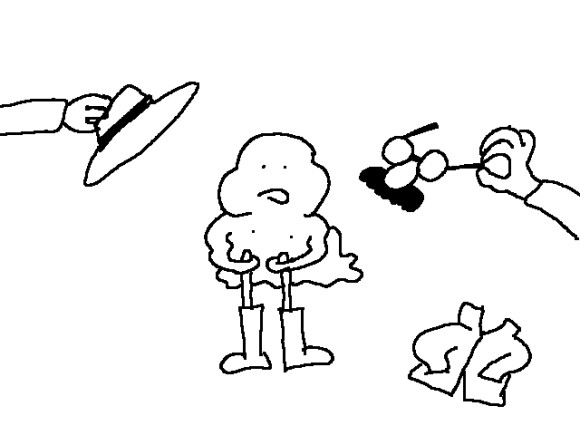
Jason was just a disgusting slug monster, posing as my own thoughts. All this time he disguised himself.
So, when you have thoughts that you are unworthy of something, or all your successes are just luck, ask yourself if this is true or if you are experiencing an impostor syndrome. Remember who the real imposters are - Jason and all the imaginary assholes looking like him.
Thank you for reading the article!
I apologize to everyone named Jason.
After the speech, I received many good comments from wonderful people. It seems that they mostly liked the slides I created, but the very content of the speech resonated with very few. I thought it would be nice to record my speech and write a quality article. I did not use notes or a script, so I tried to roughly correspond to what I was saying, and added some additional information.
My name is Stuart Lilford. I think I can call myself a game designer. For three years I worked in studios in the QA / design department, and then I started to create games on my own and give lectures at a college in Yorkshire. My last game was The Temple of ADVENTURE , created for Adventure Jam, and now I'm working on Splodey Vaders for Android and iOS.
But enough about me. Let's find out a little about you. I want to start this article by asking you the question: “Did you have an imaginary friend in your childhood?” Think and raise your hand, if you were. I asked the Feral Vector audience about it and a lot of hands went up into the air, that is, many people had imaginary friends in childhood.
I also * had * an imaginary friend, but he appeared in my life when I became a little older (around the age of 14), and he is still with me. However, he was less an imaginary friend, and more an imaginary asshole. His name is Jason.
Jason is an asshole because he is one of those people who constantly humiliate you. When I decide to try to create something creative, Jason appears only to ask me: why bother at all? When I post something online, whether it's a game or some kind of graphics, Jason is right there to say that I should not have done this and I look like an idiot. When they praise me or recognize my merits for what I have created, he will definitely be there to say that all this is a hoax and I do not deserve recognition. I'm not as good as others doing the same job. Those who praise me make a mistake.
Jason appears constantly, but there were often cases when he really negatively affected my mental state. Here are some of the most important examples of how Jason appeared in my life:
This is me when I was just about to first work as a game designer. I had to work in an independent studio creating games published by Sony. I was incredibly delighted. Since childhood, when I first played Super Mario All Stars, I wanted to become a game designer. I was well aware of how difficult it is to become a designer without experience, because I read a lot of articles about it. I thought I was very lucky with the offer of this post. I studied this subject at the university and now I will get a real job! This was my dream and I was eager to start.
But then Jason appeared.
“What are you doing? You do not have experience in game design and now you want to earn this? You had a mediocre university. It was run by a graphic designer who did not even play games. You will fail. You will never get this job. ”
Despite Jason's whispering, I stayed at work for about a year, but the contract was temporary for three months, and the studio extended it every three months. One of the months I was told that the contract will not be renewed and I no longer worked in the gaming industry. I considered this a confirmation of Jason's words and told myself that he was right, although it was obvious that it was a business decision. I felt that this position is not for me, I am not good enough, I am not worthy of the game industry.
Me and the gaming industry
I decided not to look for work in the industry anymore and for some time I stopped making games. I turned my back on video games and got a job in the amazing world of B2B sales. I have sold non-ferrous metals to stainless steel and aluminum wholesalers to enterprises and companies. Sales were not my passion and I hated my job. Soon the desire to create returned to me and I began to make games again.
I created a short point-and-click Time Stone adventure in Adventure Game Studio . Desperate to get out of sales, I used this game as an example of my skills when I got a job as a game design teacher for 16-18 year old students at a local college. At first it was only an hourly employment contract, but six months later I was accepted to the position of lead teacher of game design.
I really liked my position. It was a full-time job, and I enjoyed teaching game design to students. This position gave me stability, which was not enough when working in the gaming industry, in addition, I worked with my favorite topic (as opposed to sales, which I hated). But I had no experience in teaching, and Jason was not slow to appear again.
“Have you received the position of lead teacher who is responsible for the entire course? You taught less than six months, and now you will control people who have more experience than you! Your superiors were seriously mistaken. ”
When I got this job, I felt like a fraud, but I stayed on it and continue to work for three years. I love my work and I think that my contribution should be proud. I'm glad I got this job, but it took me a long time to feel that I was worthy of it.
Recently I was considering participating in Feral Vector. I have already been to this event and wanted to participate not only as a spectator. It was interesting for me to make a report or, for example, help in conducting a master class.
I sent a letter to the organizer of the event, suggesting several ideas for reports and simply tried to participate actively. But as soon as I sent the letter, Jason looked at me through the monitor and began to whisper through the speakers.
“I can’t believe you sent the letter. Why should they even want * you * to perform? No one even knows who you are. There will be much more experienced people performing, when you go up to the stage, everyone will think: “What kind of idiot is this?” And they will leave. You can’t stand the tension and they will soon realize that you have no idea what you’re talking about. ”
I panicked and could not fall asleep for a long time until I read Danny Moore's article, " Life with Impostor Syndrome ." He is a screenwriter of games; in the article, he describes his experiences of impostor syndrome. The article really touched me. I began to read more and more about this topic, constantly nodding, agreeing and thinking: “Yes, this is about me!”
So what is impostor syndrome? In essence, this feeling, you are a scammer and are not a successful, competent or intelligent person; you just pretend to be, despite all the evidence to the contrary. You are constantly worried that they will "bite you", everyone will understand that you are not smart, not talented and not stubborn. The game industry consists of many smart, talented, hardworking, creative people, so we can naturally assume that many in it experience such feelings. Despite a lack of comprehensive information about impostor syndrome, symptoms often recur. Here are some of the most common:
Avoiding creative work
If you feel like an imposter, then you think that you should not bother, and this leads to long periods of avoiding creative work. In Danny’s case, a colleague in a review of his script asked if he had dyslexia. This deprived him of confidence and for some time he could not engage in writing. As for me, when my contract was not renewed, I took it as a confirmation of my feeling of an impostor and did not create for several months.
The desire not to stand out
When the opportunity arises: getting a job, sending a game to an event or showing someone your creations, the impostor syndrome inspires a feeling that the result of labor is not worth sharing, the game is not good enough, and you are not good enough. These feelings naturally lead to the fact that you try not to stand out and not take risks.
Stress and anxiety
The syndrome can cause great anxiety, because you convince yourself that you will be “calculated” at any time, and in the long run it can lead to depression.
Underestimated experience
In the very first lines of this article, I said: “I think I can call myself a game designer.” I used the words and phrases “I think,” and “I can call,” which reveals an impostor in me, even if I am not one. Those with impostor syndrome have difficulty accepting that any praise they receive is sincere; they underestimate all their personal achievements.
Linking Your Success to Luck
Another symptom is that you connect most of your success with pure luck, not hard work. I hated most of the time spent in sales, but once the manager said a phrase that struck me. She is a successful woman, with status work and a good salary. Her brother often envied her, her beautiful house and expensive car, and said, “You are so lucky.” She replied: "It's funny, but it seems that the more I work, the more lucky I am." I always recalled this phrase when I tried to connect any success with luck.
A feeling of nervousness from meeting apparently successful people in your area of activity.
After the release of Thimbleweed Park, I saw how many people post a screenshot of it. It depicts a game character, a game designer, who is very afraid to speak at an exhibition with an apparently successful game designer.
People usually posted this picture with a comment about how similar it was to them. Many of them, it seems, were the creators themselves and compared their own success with the perceived success of others. At the same time, they felt they were deceivers in relation to their talents. I think this is enough for anyone to decide that it’s not worth talking with a “more successful” person, because he will waste his time.
5 tips for fighting impostor syndrome
What you can do about it
There are different ways you can deal with impostor syndrome. I reduced the list to the top five.
1. Be kind to each other
Impostor syndrome occurs when your invisible asshole tells you that your work is bad, so one way to deal with this is to have a lot of people tell you that your work is * good *. If we like someone’s work, then we should get in the habit of talking about it. I understand that sometimes in communication it’s inconvenient to tell someone that you like their work, but even something simple like likes, retweets or positive comments under the animated game play GIF allows you to hear less voices of different jason.
2. Recognize your accomplishments (maybe even keep a list)
Relate your success to your own hard work, and instead of the negative aspects of the project, look at the positive.
Take a recent example from my life - the game The Temple of Adventure, which I made for Adventure Jam 2017. This is a game that I made in two weeks with the help of my artist friends to learn how to work with Unreal Engine 4. The game is full of bugs, imperfect and not completed. She didn’t make it into the top 12 nominated games, and in some comments people claimed that she looked like another, existing game.
But if you look at the positive aspects and focus on the achievements of the game - PC Gamer declared it one of the best free games of the week, I got on the list of 25 best jam games (at number 24, but I'm still on the list!), It was watched by several lettered players, and two of them had more than ten thousand views, in the final voting of the jam she took 19th place (out of 122 games), but became the seventh rated gamejolt among games with the AdvJam2017 tag and won third place in the "Dialogues" category. Considering that I worked on the game for only two weeks, in my spare time from work and other duties, plus used an engine with which I had almost no experience, then everything is not so bad. On the contrary, even pretty good.
You need to evaluate your achievements in this way, perhaps even keep a list. All that I mentioned could be written on my personal “list of achievements”, to which I could refer. Each time you feel like a cheater, you can refer to this list and it will help you to continue working on what you love and share it with others.
3. Take advantage of the opportunities
Imposter Syndrome may make you think that when you are given the opportunity, then you should not spend effort on it. I'm not so experienced as to try to get a job, my project is not good enough to participate in a competition / exhibition, etc. Everyone has uncertainty in their abilities, but if you allow this uncertainty to grow and take control over the choice of solutions, then everyone will lose from this. If you do not try to get a job, you will potentially lose an excellent job, and the employer will potentially lose a great hardworking and creative employee. The worst that can happen is that which will not happen. If you do not take advantage of the emerging opportunities, then you may steal an excellent game from the world or an excellent team member.
4. Stop comparing yourself to others
When you are in the same room with a 20-year-old industry veteran who is crowned with awards and is simply a wonderful person, you will most likely feel like a cheater against his background, but this does not mean that you are not capable of anything. This is where the above list comes in handy: if you have compiled it, then you already have real proof that you are something valuable.
If you compare yourself with leaders and veterans in your field of activity, you will feel that they are not good enough, but these are incomparable values. Most likely, you will compare your inner self with the outer self of others. You compare your insecurity, your doubts, your sense of impostor with the success, confidence and experience of another person. In the end, you don’t know how this person feels inside. Success can exacerbate impostor syndrome, and people around you may seem even bigger scammers than you. Compare only that which is comparable, and stop matching your inner feelings with the external manifestations of other people.
5. Talk about your problems.
I am very grateful to Danny for writing an article about impostor syndrome. She helped me a lot when I was overwhelmed with self-doubt. At this point in my speech, I asked people in the hall which of them had feelings similar to the symptoms of impostor syndrome described by me, and most of the audience raised their hands. Some studies say that 70% of people have such feelings. That is why I wanted to talk about it, so I wanted to write this article. We need to share our feelings more, so that people with such thoughts can become aware of them and study them. Are you really a liar, or have you worked hard to achieve everything you have? Find people to whom you can say "I feel like a liar." Do they really agree with you?
Danny's article helped me with this, it made me think and question everything that Jason whispered to me. I looked at Jason and said, “Wait a minute.” I saw him in a different light and decided that I had enough. I took off Jason's hat and glasses, took off his coat, and underneath I found an abomination ...
Jason was just a disgusting slug monster, posing as my own thoughts. All this time he disguised himself.
So, when you have thoughts that you are unworthy of something, or all your successes are just luck, ask yourself if this is true or if you are experiencing an impostor syndrome. Remember who the real imposters are - Jason and all the imaginary assholes looking like him.
Thank you for reading the article!
I apologize to everyone named Jason.
Additional reading
http://www.wygamer.com/blog/living-with-imposter-syndrome
https://thehustle.co/why-70-percent-of-millennials-have-impostor-syndrome
http://impostersyndrome.com. au /
https://www.bustle.com/articles/119129-12-signs-you-might-be-suffering-from-imposter-syndrome-fellow-perfectionists-im-looking-at-you
https: // startupbros .com / 21-ways-overcome-impostor-syndrome /
https://thehustle.co/why-70-percent-of-millennials-have-impostor-syndrome
http://impostersyndrome.com. au /
https://www.bustle.com/articles/119129-12-signs-you-might-be-suffering-from-imposter-syndrome-fellow-perfectionists-im-looking-at-you
https: // startupbros .com / 21-ways-overcome-impostor-syndrome /