Third Martian Invasion

“There are no miracles in nature and in history, but every sharp turn of history, every revolution, among others, gives such a wealth of content, deploys such unexpectedly peculiar combinations of the forms of struggle and the balance of power of the struggling, that for the philistine mind, much should seem like a miracle.”
V.I. Lenin "Letters from afar"
I remember how at a telecommunication conference a representative of a specialized university asked the representative of a large foreign electronics supplier - is it possible to send any masters to your factory for an internship? The answer was this - you can send something, but this, unfortunately, will not help them in any way - all production is carried out in "clean rooms" by robots, where people are simply not allowed to enter.
Say what you like, but robotization is real, it is already happening, and this is a fact. But what are its consequences ... How has it affected our life right now, and what is it worth preparing for - we’ll talk about this.
Dumb common words
There are serious suspicions that the digital economy, which does not descend from the first pages of the media, is just a prologue to a robotic economy. Until recently, robots came to us from the pages of fantastic works. However, as the tale becomes a reality, robots began to visit us much more often, and already from workshops, offices and laboratories. From the history of economic evolution, we know that machines gradually and steadily replaced manual labor, so if robots replace a person in production, and then somewhere else, then all this will be within the framework of the general trends of the development of civilization. Actually, today we do not use coachmen, who were replaced by taxi drivers because cars appeared. Perhaps in the future the taxi driver will generally be replaced by a dispatcher who will remotely control some kind of flying transport. The advantage of robotic systems is that they do not get tired and can work in three shifts, and they do it more accurately than humans, while making much fewer mistakes (software failures of modern robots are quite rare). Robots are guided by the range of a given operation and within the framework of their workspace. In a specific operation, the robot is certainly more efficient than humans. Automata that simulate the mobility and versatility of human hands are faster and more agile. However, the imperfection of the current control systems does not allow the robot to respond to any force majeure circumstances. Robots are guided by the range of a given operation and within the framework of their workspace. In a specific operation, the robot is certainly more efficient than humans. Automata that simulate the mobility and versatility of human hands are faster and more agile. However, the imperfection of the current control systems does not allow the robot to respond to any force majeure circumstances. Robots are guided by the range of a given operation and within the framework of their workspace. In a specific operation, the robot is certainly more efficient than humans. Automata that simulate the mobility and versatility of human hands are faster and more agile. However, the imperfection of the current control systems does not allow the robot to respond to any force majeure circumstances.
In total, over 400 companies engaged in the production of robotics work in the world market. The list of existing and used robots in the world is already quite wide: industrial and transport, underwater and flying, domestic and military, medical and pharmacy, as well as zoobots, microrobots, nanorobots, personal robots, artist robots, trading trading robots, toy robots , waiters robots, surgeon robots, tour guides, social robots, program robots and, of course, a whole family of android robots for many of the above. All these robots are not only constantly improving, but also getting cheaper. According to various estimates, the volume of the robotics market ranges from 15 to 30 billion US dollars, and the difference in estimates arises from what exactly different experts consider robotics.
4 trends in robotics
This fall, one of the largest RoboBusiness automation conferences in North America was held in Santa Clara, California, where truly amazing devices like a pair of artificial legs that emulate a person’s gait or another rover with a robotic arm were presented. As experts who visited this event noted, four trends have appeared in today's robotics that reflect and explain what is happening quite well.
First of all, it's usability . Typically, robots require complex training, which is a huge obstacle for small entrepreneurs, such as family business owners. But a new generation of robots can be programmed on the fly, often simply by demonstrating actions or entering several commands through the iPad.
The next trend is accessibility . Serious industrial robots have serious prices of hundreds of thousands of dollars. Today, small and relatively inexpensive so-called collaborative robots for the price of about 20 thousand US dollars allow companies to get economic benefits after months, not decades.
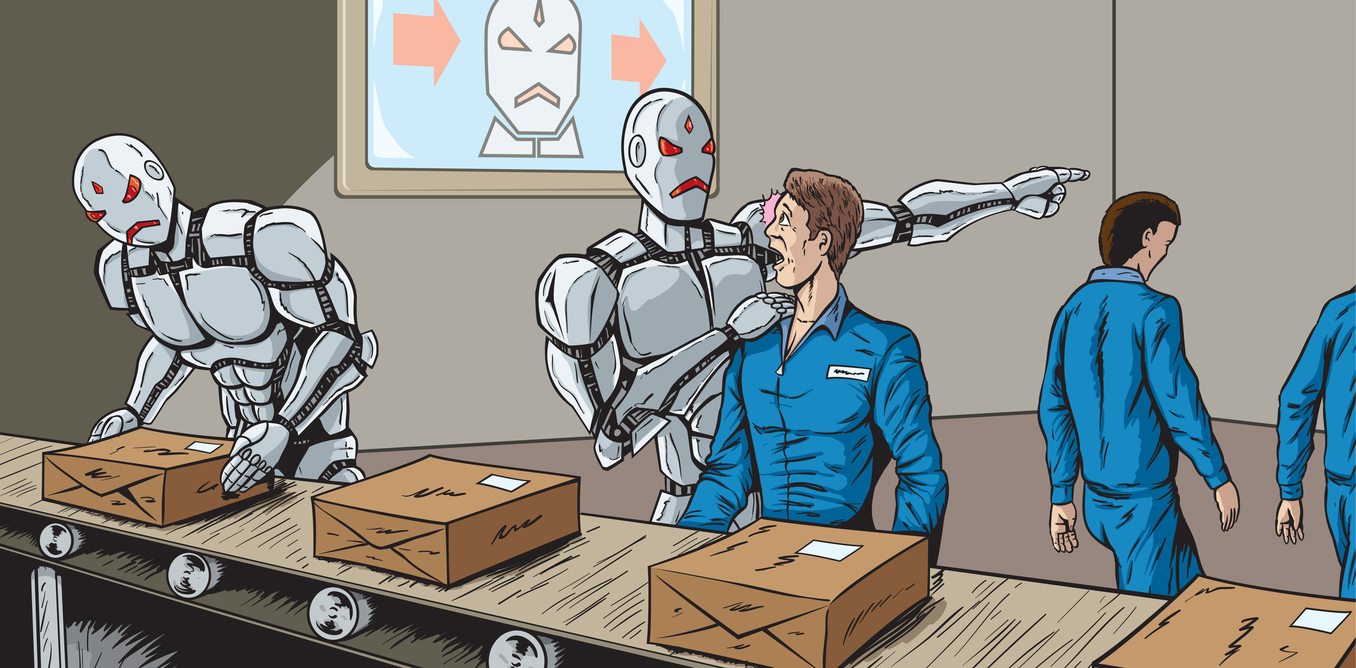
Today, many representatives of collaborative robots already fit behind a workbench or desk, which corresponds to the next trend of dramatic downsizing . If you compare them with huge aliens from the past, it is easy to understand why robots are invading all new sectors of the economy.
The latest trend - developer friendliness - is far from the last in importance. The need for an appropriate development environment and related tools is a huge obstacle to the creation of new equipment. Robotics, however, was fortunate enough to embrace the spirit of open source development early on. In particular, the Robotic Operating System (ROS) dominates the industry and provides turnkey solutions for a wide range of robots, so it is hard to overestimate the importance of an open source development environment to drive growth across the industry.
“The future of employment”
They say that after 3-5 years we will get a situation where we cannot distinguish robots from humans by functions, and this makes us once again pay attention to this side of human development. Today, industrial production, finance, medicine, science and other industries that previously were exclusively “human” are rapidly automated. Just recently, Sberbank announced that it plans to cut three thousand jobs in 2017 due to the emergence and implementation of a lawyer robot in business processes. Earlier, the head of Sberbank German Gref said that "if you compare the bank today and Sberbank five years ago, then about 50% of the decisions that people made are made today by machines." And after five years, "we will be able to make about 80% of all decisions automatically using artificial intelligence," which will lead to the loss of tens of thousands of jobs. Nowadays, artificial intelligence occupies only the second line, negatively affecting the labor market, taking a little more than 1.5% of jobs, and takes away work not only from blue-collar workers, but also from intellectual workers.
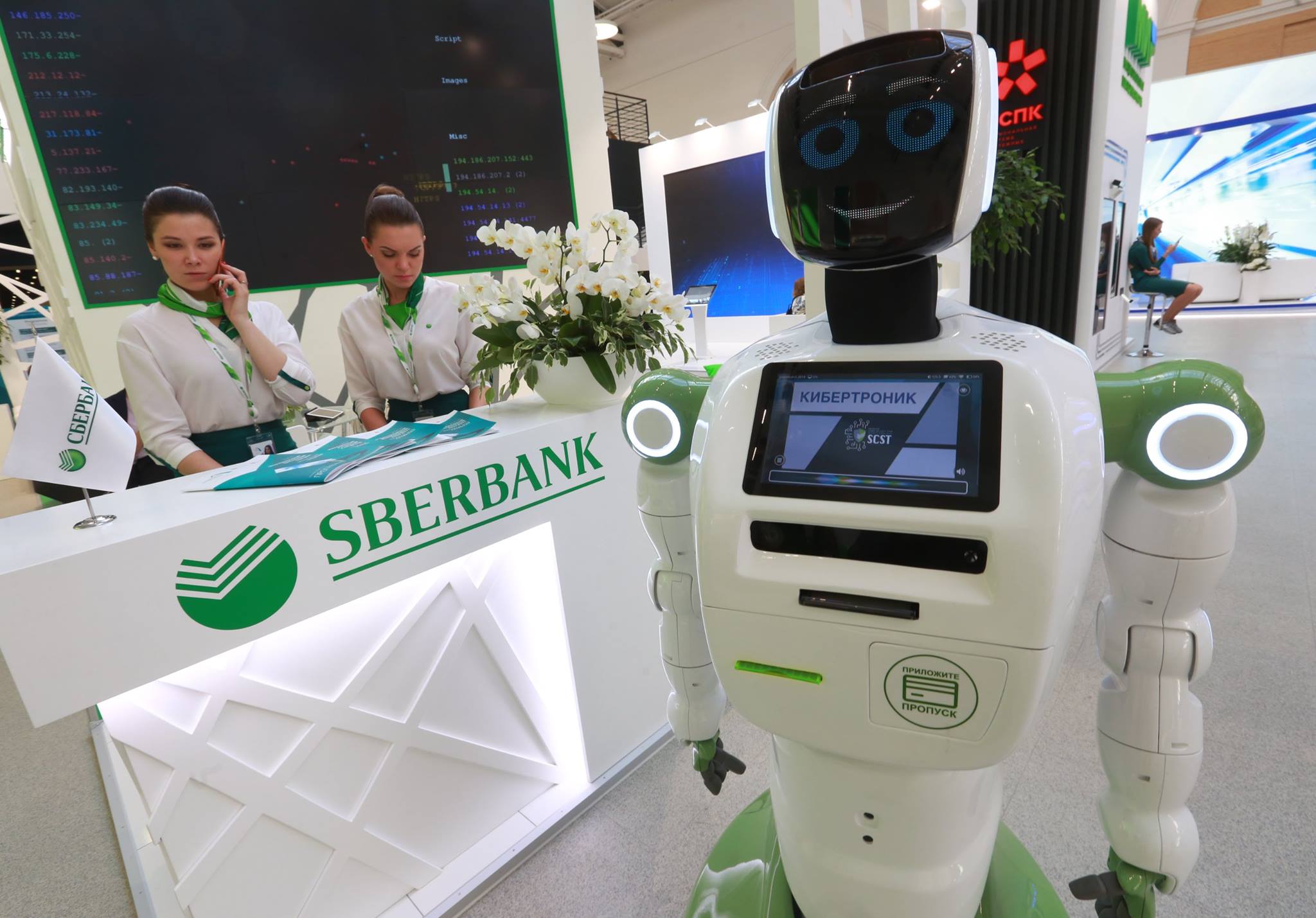
The use of robots will be steadily expanding, which, of course, creates a problem for human specialists, and the more actively the family of these robots develops, the more specialties begin to be exposed to this threat. However, large companies, no matter how advanced they are in terms of digital technologies, will always hire people for positions related to routine work that cannot be trusted or entrusted to robots. You can’t park a car to take you to a retail store and show you where to go - this should be done by a person. Therefore, in industries such as retail, entertainment, leisure, restaurants or hotels, people will always work. And, by the way, those who lost their jobs in production due to its automation will be arranged there. In 2013, two researchers from Oxford Karl Benedict Frey and Michael A. Osborne published a study, “The Future of Employment,” which identified which professions will automate over 20 years. According to their forecast, about 47% of specialties will be performed by machines. With a 98% probability in 2033 there will be no sports judges and referees, cashiers, packers, milling machines, examiners, investigators, accountants and auditors. There will also be no waiters, bus drivers and security guards.

Source . The first robot waiter started serving visitors in Bangalore (India)
A recent report by the Mitsubishi Research Institute noted that in Japan alone, by 2030, robots will push 2.4 million people out of the labor market, and jobs will be closed in industry, services and sales. Almost all traditional industries will undergo deep robotic modernization in the near future, and the government of every developed country should think about what to do not only with millions of people who will lose their jobs, but also with those who will never have one. In parallel, the old monetary system will be dismantled. Cash will soon cease to exist, like traditional banks, and citizens will be forever tied to their electronic account. By the way, developed countries are going to introduce the so-called guaranteed income for their citizens. So, In Finland, an experiment has already begun on the payment (albeit so far to a limited circle of citizens) of a guaranteed amount of 560 euros. True, Switzerland has so far refused such a benefit, but the idea has already matured and is waiting for appropriate marketing.
Robotic Digital Economy
Moreover, all that has been said is not writers' fantasies - robotics are so real that the European Parliament has begun discussing an initiative to give systems with artificial intelligence the legal status of “electronic persons” with the corresponding rights and responsibilities. True, a number of specialists are very skeptical of this initiative (at least for now), they say, whatever the parliamentarians would play ... However, in the new economy, robots will generate both the main income for corporations and the main stream of taxes. Robot owners must earn money and pay taxes and pensions, and this is nothing new. They also say that robots will also become consumers of the products they produce (remember, even the Lumberjack needed oil to lubricate the joints). Robot owners are an ever-growing stratum of capital owners, they always had a profit, and they paid taxes and pension contributions. There should not be any differences with the owners of other types of capital. Well, then it’s logical that other robots would become the owners of some robots. And here it is difficult to envy lawyers who have to introduce electronic and other new entities into the global legal field (until they are also replaced by robots). For example, if in an accident an unmanned vehicle and a car with a living driver meet, who will be to blame? who will have to introduce electronic and other new entities into the global legal field (until they are also replaced by robots). For example, if in an accident an unmanned vehicle and a car with a living driver meet, who will be to blame? who will have to introduce electronic and other new entities into the global legal field (until they are also replaced by robots). For example, if in an accident an unmanned vehicle and a car with a living driver meet, who will be to blame?
“One day, robots will produce what people are doing now,” so robot owners will have to pay taxes to finance the needs of members of society who will no longer be engaged in professional activities, as Professor Jürgen Schmidhuber, director of the Swiss Laboratory for Artificial Intelligence suggested in an interview with SonntagsBlick . And Ida Oken, a member of the Danish parliament, even described the world of prosperity expected by 2030, where robots do all the "dirty" work, and people "will have time to do other, more complex, more interesting things." In turn, the billionaire engineer-innovator and just the charismatic guy Elon Musk at the Code Conference 2016 said that “people are now partly cyborgs. And in the future, we must be prepared to become the pets of master robots. ” It turns out people need to create computers that interact with the cerebral cortex, and “such a connection with virtuality seems to me to be an injection through which electronics will connect to living neurons. Otherwise, we will be so intellectually lower than robots that we will become their pets. They will relate to us, as people now relate to a domestic cat. ” Of course, from all this perspective is breathtaking, but in this case it will be too twofold feeling. how people treat a domestic cat now. ” Of course, from all this perspective is breathtaking, but in this case it will be too twofold feeling. how people treat a domestic cat now. ” Of course, from all this perspective is breathtaking, but in this case it will be too twofold feeling.
The future robotic digital economy will give the poor and the unemployed the opportunity to survive. However, one can argue - after all, guaranteed income and the cheapest basic goods and services are just poverty benefits. Or maybe it will be a fee for non-interference in the affairs of robots? And only the real work (and it seems that it will be quite a bit) will become a pass to a more dignified life, where the products will remain natural, the benefits available will be really impressive, and the robots will be colleagues, and not the owners? In general, there is something to ponder and what to prepare for.
Letters from the future

In turn, we also thought a little and fantasized about what could be expected in the future. Mentally transported through a temporary television portal, and here is the result - a couple of letters (electronic, of course) from descendants addressed to their ancestors, with a description of the structure of a robotic human society of the future, if, of course, it can be called such. So…
First letter.“Welcome to 2047, the year of the triumph of the ideals of robotics and artificial intelligence. Welcome to my city - more precisely, it is “our intellectual city”. A city of dense greenery, dazzling purity of paving slabs, complete freedom and universal justice. I do not own anything. And not because I don’t need it - just nobody needs it at all. No documents of ownership are needed, no cadastral numbers and estimates are needed, no payment for water, heat, electricity and gas is needed, no taxes are needed. I don’t have my own house, because my house is more like a hotel, which has absolutely everything to meet old age. And if for some reason I don’t like my hotel, then I can move to any other if I want. However, this is unlikely to be what I want, because any desire of mine to change the environment, colors and lighting, clothing and domestic and entertainment services will be immediately performed by our beloved house intelligence manager or the cute minions he sent, the look of which we choose. In general, we live in very decent housing and at the same time are on full state support. Although, perhaps, not on the state, but it is absolutely unimportant for us. What, in fact, is the difference, why not pay?
Of course, I do not have my own car. And not because we still have not mastered teleportation, but I just do not need it. If I need to go somewhere, any vehicle I want will be served for me. It’s another matter that I don’t have to go anywhere, because directly from my place of residence I have access to absolutely all the benefits of civilization, including clean air and the most realistic pictures of nature. Everything else is done by robots in completely uninhabited automatic plants. I also do not have my own appliances and clothes. And in search of food I do not surf the supermarkets or the Internet. At my service are any clothes that I can only imagine in a 3D scanner and synthesize in a synthesis machine, and any food that our molecular cafe will prepare for me. Sometimes I don’t even have to open my mouth to eat - all the necessary nutrients are injected directly into my bloodstream, which is also cleansed, which, they say, can extend my life with my body for up to 300 years. And each of us has a “mask of reality” that can activate the necessary centers of the brain so that we can feel the amazing taste of the ordered dishes.
Yes, and almost fell out - I have remote access to my work. We rarely have anyone involved in work, because only certain types of art that not everyone has the ability to do are left out of work. But this work is so - for the pleasure and satisfaction of one's own ego, and not for the sake of money. The rest of the work is conceived, designed and performed by robots, which over the past 30 years have evolved from good helpers to our reliable partners.
True, sometimes I get annoyed that I don’t have any more personal life, but then the robots also took care of our reproduction. There are no places where I can go and not get registered. Therefore, I do not go anywhere. Moreover, I can get all the pleasures of the world right at home, you just have to put on a “mask of reality”. I know that absolutely everything that I do, think about and even dream about is recorded everywhere. However, there is confidence that no one will use it against me. - Why is it for robots?
I generally like our life. It is much better than the one we lived before, until it became clear that we can no longer exist with the previous growth model. Unlike our ancestors, we have confidence in the future, because after death all our memory will be copied by robots to special world repositories, and therefore there is no death in our new world. We just move to another place of residence. Of course, some people live outside cities, not wanting to become part of a new world in which machines and artificial intelligence have taken over all the work. But this is their personal choice.
Thank you, our dear robots, for our happy existence, for the fact that everything is so beautiful: it is a clean environment due to the use of clean energy and the complete processing of everything that is produced, and the lack of the need to work has given us unprecedented freedom. “Now we have time for reflection, time for creativity and time for putting ideas into practice, and goods, services, content and life itself are free.”
Second letter. “Welcome to our unforgettable 2047, the year of the triumph of the ideals of robotics and artificial intelligence. Welcome to my city - more precisely, to my former city, where I had a house, had a family, had friends, had work. This city of dense greenery and dazzling purity of paving slabs is now not for people like me who do not obey the most just intellect on Earth. The intelligence of a robot or robots - the devil himself will not understand where the mental boundaries between these bioelectronic creatures go. Sometimes it seems that they are all at the same time, as a whole, obeying a common program, unknown to anyone now developed.
In this realm of complete freedom, we are indeed completely free, because we do not own anything and cannot do anything. Once we ourselves put these robots on our necks, which performed more and more work for us, freeing us from monotonous mental and physical labor, without requiring either salaries or vacations from employers. Then they wised up so much that they were able to successfully replace all sorts of managers and many employers themselves. The latter were so impressed by what happened that they quickly surrendered to the robots our entire economy with virtually no resistance. Only a few business people managed to save themselves and their business, because they always did it personally. Today, having crowded out people, robots work at these enterprises, but do not have access to management. No one knows how long this will last. It’s nice to be longer because those those who did not accept the power of robots, including the remaining animal kingdom, are forced to seek shelter and food around these islands of still free business. There you can find real food and clothing, or at least their leftovers and hide pretty warm foam boxes from the cleaning robots in time.
Of course, we are few. Not everyone manages to survive, and keeping the mind even harder. You ask - where are the rest of the citizens, what are they doing? Imagine the invasion of the Martians, who "on the drum" all these earthly "cockroaches" swarming underfoot. You can just shove them on matchboxes. The housing of these citizens is similar to a honeycomb, where in each cell on a soft litter reclines a wire-wrapped carcass with a virtual reality mask on top, into which nutrients are pumped. But for me it’s not a honeycomb, but a real columbarium. I think they are still alive and happy only because they supply biomaterial to their owners, who were once mistaken for partners. Biorobots manage to receive energy not only due to the decomposition of protein and carbohydrates, but even due to photosynthesis,
The victim should not be aware that she is the victim. Ritual virtual dances and a sea of pleasures, including the opportunity to engage in art, are a relatively small fee for transferring control of the civilization of robots. Yes, it is civilization with its goals and objectives, achievements and entertainments, which, for example, have nothing to do with the goals of the remaining inhabitants of the columbarium. Robots have long flown into space and descended to the bottom of the ocean, they are going to live for thousands of years and began to engage in art. Perhaps they don’t understand the formula of our contemporary art: they collected a bunch of something and called everyone - this is an installation; and if they called everyone, then they made a bunch - is this a performance? Why should these robots draw a Mona Lisa? At least three Mona Lisa ...
However, it's time to end. Soon the remains of the meal will be taken out at one famous point, and it's time to run. Lord, help us find our Sarah Connor - mother and mentor of the future savior of mankind! How I now understand well my grandfather, who loved to joke that someday in the 21st century they would take a crust of bread beaten off a pig for a pork chop ... ”
Based on materials: servomh.ru, pcweek.ru, utmagazine.ru, news.eizvestia.com, radio.ru.
The author of the publication:
Alexander GOLYSHKO, Systems Analyst, GC "Technoserv"