January 16, 2018 at 03:54
PLF launch - how to launch a product so that someone knows about it
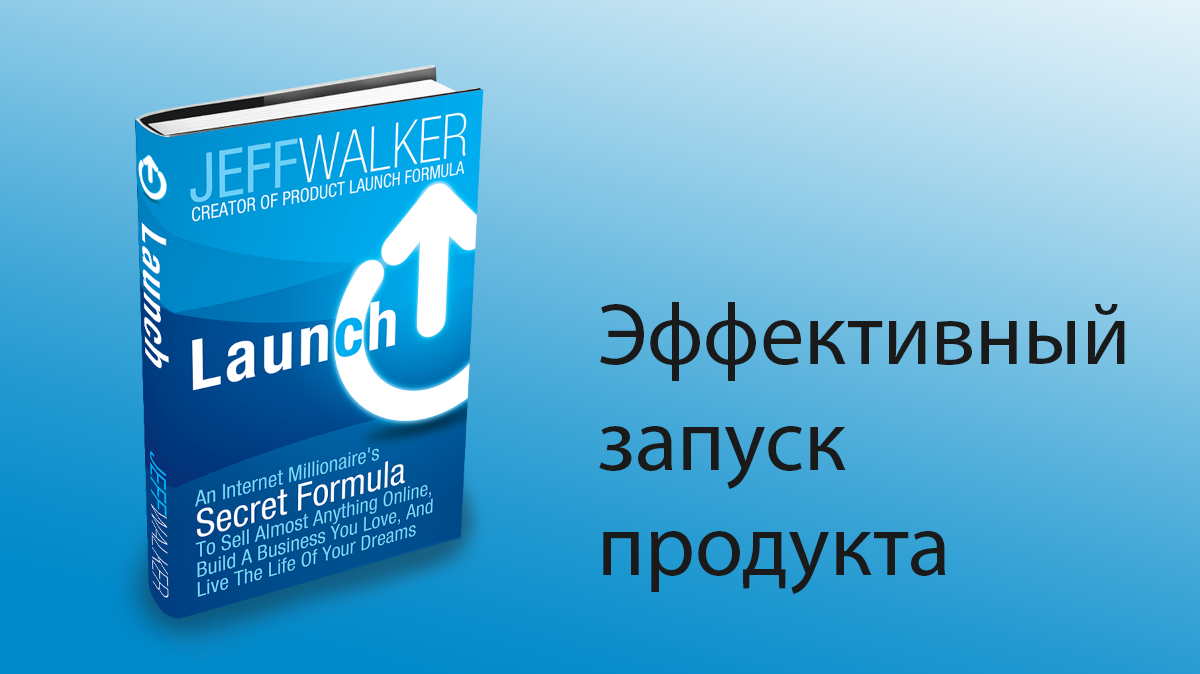
I'm going to launch several products and understand that I need to do the right launch. And this is not just advertising in Yandex.Direct and SEO-optimization, but also some kind of pre-launch actions. In one of the Like Center trainings, I stumbled upon the Launch book by Jeff Walker. It was announced as a unique tool for the successful launch of products, and I decided to try this tool on myself. In several articles I will tell you how it looks in practice. But in this article only theory, i.e. book abstract.
Jeff Walker has developed a unique launch technique. It consists in the fact that to launch you need to make some sequence of actions that will help sell the product and provide confidence. He called this PLF methodology: Product Launch Formula - the product launch formula. It consists of sequences, stories, and triggers.
If you want to feel the problem inside, listen to Uma2rmaH's song “Envy” .
Sequences in PLF
Every day a ton of information falls upon us and it will be very difficult for us to stand out against this background. My 2200 friends on Vkontakte generate such a dense news feed from seals, smart quotes and demotivators that it is almost impossible to see something useful. You can stand out against this background only by providing obvious benefits, and not through the news feed, but, for example, through personal messages or targeted repeated advertisements.
- Pre-start . This is where we start. At this stage, your fans begin to anticipate the appearance of a new product, and you can further clarify the needs of the market and adjust the final offer. Duration: 1 day.
- Pre-launch . You provide potential consumers with three high-quality pieces of pre-launch informational materials. This, for example, is a video that will benefit and make you wait for the release of the next material. Inside we use mental triggers such as authority, social significance, society, anticipation and mutual benefit. Duration: 5-12 days.
- Launch . This is the most important day when you open the sales window: a limited period of time in which you accept orders on certain conditions. Duration: 1-7 days.
- Post-launch . Prepares existing and potential customers for the next purchase. Gift, announcement, teaser, yummy. Duration: 1 day.
Stories
We like to listen and tell stories. I, as a notorious Vaishnava, often listen to lectures on philosophical topics and the lecture is always perceived much better if the lecturer tells some stories from life. Without them, the story becomes boring, and the audience falls asleep.
Knowing this, we need to prepare stories for pre-launch and pre-launch, which will tell more about your product than stupid advertising texts. The story can be divided into several parts as part of a pre-launch sequence. Or, each of the pre-launch informational materials will be a separate story, but within the framework of a common pre-launch line leading consumers to loyalty.
Mailing list - license to print money
All launches are done through the mailing list. This can be a mailing list or mailing via social networks, but this is definitely a list of target customers who have signed up to receive your messages. The reason for subscribing can be any: they know you personally and you are interesting, you give interesting information on the topic you need, you can get a discount on a product through you. Anything, if only people would follow you and want to read.
By creating your own mailing list, you will take a huge step towards your financial independence. 37signals also write about this in their book Getting Real.
Firstwhat you need to do to create a mailing list is to understand who your potential customers are. To do this, create a portrait of your client. Marketers call this portrait an "avatar." I like the term person more. For example, for our school for parents, this portrait looks like this: “a woman of 25-35 years old with one or two children of preschool age. There is no experience in education, but wants to do everything right the first time. "
The second step to form a mailing list is to find out where these targeted people live. Forums, groups in social networks, live clubs in your city, public organizations, state. institutions, business clubs, etc.
Third action- create a contact capture page. This page offers to subscribe to your newsletter and get a favor or leave the site. It sounds scary, but the experience of the author of the book shows that the number of subscribers grows precisely with this approach. It looks like a bribe: give us your mail and sign up, and we will give you tasty and useful items.
You need to understand that most users will prefer not to enter anything into the contact capture form, however, those who fill out the form are so valuable that there is no need to worry. You still do not need a person who will not leave his mail. So feel free to encourage potential buyers to action.
The bribe that you offer must be significant enough for people to leave you their contact. A video in which you tell a cool trick is quite suitable. For example, in a school for parents we shoot a video about 5 principles of responsible parenthood.
Mental triggers
Mental triggers are a weapon of mass influence. You can read about them in the book of Robert Cialdini or in my abstract article . As part of this article, I will list those used in PLF. But in your activity you can use any triggers that are suitable for your activity.
- Authority . PLF is a unique technique for creating and maintaining your credibility. Become an expert in your work and share your expertise with others. Photos with famous people, reviews, media publications, a white coat will help you.
- Reciprocity . When you give something to a person, you put a small weight on your bowl. A potential client will have a feeling that he owes you something a little. For example, if you were presented with a gift for the New Year, and you have nothing to give, it will cause you discomfort. Therefore, it is important to keep a stock of small gifts for such an occasion.
PLF assumes that during pre-launch and pre-launch you provide the customer with a sequence of pre-launch informational materials that are just such a gift for the customer. - Trust . When you have gained trust you are believed unconditionally. But in order to gain trust, we must build with friendships. Surely you have friends whose opinion you unconditionally accept. And it is precisely this kind of friend that you need to become, and this is done through pre-launch information materials.
- Anticipation . This is one of the very important triggers in PLF. It will allow you to break through the marketing fog and make customers wait for the release of your product. All of us, as children, can wait for some important events. It is important that anticipation is strongly associated with a rarity trigger, to which we will get a little lower.
- The ability to like . It is more pleasant to conduct business with people whom we like and whom we trust. How to increase your attractiveness? Do good to people, give gifts, bring benefits. People like to deal with good people, so even the largest companies are actively “humanizing” their brand, attracting famous personalities to advertising. The pre-launch sequence is how people like you, give benefits, conduct a webinar, answer questions, participate in the discussion in the comments.
- Events . People like time-bound events in which other people participate. The opportunity to feel part of "something more." They remember this event and wait for this event. This event will be your launch.
- Society . We are greatly influenced by social norms. If among my friends it is not customary to use any intoxication (even on holidays), then with a high degree of probability I will sooner or later accept these values.
Each of us belongs to a number of societies: tenants, volunteers, programmers, parents, owners of porshe. The coolest thing is that you can form a community among your subscribers. They will take part in discussions, pre-launches, leave critical comments on your products and, in the end, will become your most loyal customers. - Rarity . When your product is everywhere, you don’t want it. And vice versa: the less often a thing occurs, the more it is desired. Make a limited offer.
Limit your offer by time and price. For example, after the expiration of a stock, the price should increase or the sale should be temporarily temporarily suspended. Then people will not delay the purchase until the last. More precisely, they will postpone the purchase, but already until the last day of your special offer. Sales experience shows that a lot has been sold over the past 24 hours. Often even more than for the rest of the sales time. - Social proof . Go to google play or appstore. Type "alarm" in the search. You will find the results from a huge pile of results. Which application do you choose? One that has a million downloads or one that has only 100. When you see that the application has a million downloads, you think: apparently this million people knew what they were doing. I will join them.
Another example: two bistros opposite each other. There is a queue in one bistro and no queue in another. Where are you going? Here the answer is already not so obvious, but if you have time, you might be interested in what is it that they feed so deliciously that there is a line? And there is a high probability that you will stand at the end of this line and add +1 to the hype.
In PLF, social proof will be reviews, comments for videos, likes.
Speaking in combination with each other, mental triggers enhance their effect. Imagine that you have an interesting, rare, desired product that people like, comment on it, like it, and even create social networks about it yourself.
Pre-start. Warning shot
Here are ten questions you need to answer when you are preparing a pre-launch.
- How to present people with information about an upcoming event without causing them the feeling that they are selling something?
- How to arouse their curiosity?
- How to get people to help with the creation of my product? How to make them willing to cooperate?
- How to find out potential product comments?
- How to engage a potential customer in a product discussion? How to avoid the corporate-bureaucratic language that will kill the launch?
- How to make the launch fun, with a sense of humor and even exciting?
- How to stand out in a crowded market?
- How to understand what kind of advertising my market wants?
- How to clearly formulate a proposal?
- How does the pre-launch sequence follow from all this?
Based on the answers, you make materials for pre-launch and pre-launch. Record videos, prepare letters for distribution.
In the next article I will describe how I answer questions before launching one of the projects.
Pre-start sequence
A sequence generally consists of three components (product launch component)
PLC№1 - Opportunity (or travel)
Designed to attract and retain attention and should answer the question “Why?”. Why should this be of interest to a potential customer? Why should a client spend his time on this? Why should he listen to you? How can you be of help to him?
At the heart of every product, every service is the possibility of transformation and transformation. If you are creating a product that allows you to spend less time on routine work, you are proposing a transformation. If you offer to improve relations with children, you offer transformation. If you offer a methodology for attracting investments, this is also a transformation. Advertisers say that if you trade in drills, you are actually selling holes in wood.
Recipe:
- Demonstration of opportunity. Show customers how your product can change their lives.
- Positioning. Show / tell why they should listen to you
- Training. You should not only introduce opportunities, but also provide valuable information.
- Product notes and an answer to them, or a promise of an answer in the following videos. Whatever product you offer, you should be prepared for comments.
- Announcement of PLC№2. Hint that PLC # 2 is coming soon. Make it clear that another video is coming up soon and list what they can learn from PLC # 2.
- Call to action. Ask for a video on the launch blog or social media.
PLC№2 - Transformation
PLC # 1 answered the question “Why?”. PLC # 2 answers the question "What will they give me?" Answer your questions: what can you teach in 5 minutes, how we can change their life right now.
Recipe:
- Gratitude and repetition. Say thanks for watching the previous video, briefly recall its contents.
- A reminder of the opportunity mentioned in PLC # 1.
- Repeat positioning. Be sure to repeat who you are and why they should listen to you without going into details. Do it fast.
- Give something valuable. Teach them one thing that they can immediately put into practice.
- Responses to comments. Explain and answer the main objections to your proposed transformation.
- Announcement of PLC№3. Say that a new video is coming soon. Briefly describe what you will teach in the next video.
- Call to action. Ask for a video on the launch blog or social media.
PLC No. 3 Ownership Experience
Teach potential buyers that the solution to all problems is to buy your product.
Recipe:
- Expression of gratitude and joy. Thanks for the comments and questions about PLC # 2. Share your enthusiasm and share the enthusiasm and feedback from others.
- Quick reminder of opportunity and positioning. Repeat very briefly what you said in previous videos.
- Benefit. Benefit, talk about something useful.
- Answers to the main questions received. Even if you answered these questions in previous articles, answer them again. You can reformulate the questions.
- Explanation of the general principle and implementation details. Go back one step and consider the real possibilities: how buying your product will change the lives of your customers. Consider this issue from different perspectives and project it onto their future.
- Soft transition to the offer. Devote your offer to the last 25% of the material. At this point, potential customers already have warm feelings for you.
- The idea of supply shortages. The offer must have limitations. Hint that in the next article there will be an interesting but limited offer and that in no case should you skip the release of the next material.
- Call to action. Ask for a video on the launch blog or social media.
Sale of inexpensive goods can be shoved in 5-7 days. A typical seven-day sequence would look like this:

Selling a more expensive product A typical ten-day sequence would look like this:

Launch day
This is the most exciting day in your business. You prepared for it, spent money on creating a video, found subscribers, wrote texts. Now it's time to start.
1. Ready selling page
On launch day, you'll need a well-made selling page. It usually contains promotional video or text. On the same page should be able to pay. Test everything well so that at the time of launch the page works, copes with the load and accepts payments.
2. Sending a letter (message).
"Hi! I just started registering for a School course for Parents. Here is the address: link to your site.
The page is hosted on a good server, which, as they say, should cope with the load. If there are problems with access - write.
PS: There are no reasons to panic, we have as many as 30 seats on the course, however, they are usually pretty quickly dismantled and you should not postpone registration for the last day. ”
Sales process
The sales process should be limited in time. Even if you sell your products all the time, you are doing a promotion during which special conditions apply. Usually 4-7 days is enough. Sometimes there may be shorter launches: for one or two days.
There must be a clear end date for your launch. Failure to make a purchase should have negative consequences. There are three main ways to activate a rarity trigger:
- Rising price
- Disappearing bonuses (bonus lesson, book)
- The ending sentence
It is possible and necessary to combine these methods, superimposing them on top of one another.
Send letters during sales
- On the launch day we send two letters. The first is about opening the basket, the second is that everything works and we are ready to complete operations (after 4 hours). Tell us about your product warranty.
- The next day, a letter is sent with information about how sales are going well: social proof.
- On the third day, a letter is sent with answers to the main questions related to the product.
- On the fourth day, send a letter stating that sales will close in 24 hours. Activate the rarity trigger.
- On closing day, 2-3 letters. The first thing in the morning is that the shop will close soon. The second - 6-8 hours before closing. Do not think that too many letters have already been sent. Be sure to send 2-3 letters on the closing day.
After launch
Stock up on extra bonuses that you don’t talk about during the launch process.
Record a video lesson , conduct a webinar, send a book.
Provide support . Spend money providing written and verbal technical support.
Send something useful to everyone who hasn’t bought anything yet.
Sowing launch
What if there is no mailing list yet? Sowing will solve this problem. If you have any contacts in social networks and in the mail, you can do your first newsletter on a list of 200 of your friends. You’ll probably have 200 people. So the first step in building your mailing list is to create a microlist of 100-200 people.
Recruit customers to your launch through this mailing list. If not all places are sold, give away the rest for free among friends. It is important for you that the event take place.
It is a good idea to get as many opinions and feedback as you can during a seed run. If you are just starting the product for the first time, do a few surveys and webinars to understand what basic questions customers want to ask you. So you can create a product on the go, without actually having a product.
Write a book
As a result of your first or second launches, record your seminars in audio and video. Transcribe, hire an editor and turn the material into a book. Now you have not only a good workshop, but also a book that you will distribute as a bonus or will be sold separately.
Joint launch
After the first (seed) launch, on which you have already tested all your materials, find partners who already have large mailing lists. They will work with you on some interesting financial conditions, up to 50% of revenue. But their participation will more than pay off due to the fact that people will join your mailing list and make the first purchase. And further - your work already.
Not all partners are equally helpful. Only 1% of 100 will bring you almost all the profit. Take your partner seriously. It should be your target audience and they should be interested in what you are doing. For example, you should not send letters that you open a vegetarian kebab house to all contacts from Habr. You need to find partners who are already working in your market in your area. To do this, you can subscribe to all possible newsletters in your field, having allocated a separate mailbox for this.
Business Launch Formula
The author identifies six key points for starting a business.
- Always offer valuable pre-launch material. Benefit.
- Build a list and relationships with members of this list
- Make more than one sentence. It is normal to do two to four starts a year.
- Use a launch cycle: sowing → stand-alone → joint
- Forever popular launches. Run a good product again and again. But pre-launch materials will have to do different.
- Repeated sales. It is much easier to sell something to those who have already bought. Make a series of products for your customers.
A couple of add-ons
Do not write “we” in letters. People much more like personal appeals and personal relationships than interacting with a company. Write me.
Think about opportunity costs. This is a lost profit from choosing one of the alternative resource use options. Those. if you have chosen some path, it means that you have not chosen any other paths. So you should be very careful about where you spend your time. Warren Buffett said that "the difference between successful and very successful people is that the latter refuse almost everything." This is the magic of the word “no” which will save you from unnecessary adventures and useless projects.
References
1. The book can be found in Yandex , but there is only a PDF.
2. Ahead of me is the launch of several products. If you wonder how to be the trigger, join the Public VKontakte .
3. If anyone needs a book in epub format, write to the PM , I will send it.
4. A good webinar on the book.
I wish all readers successful launches!