December 12, 2017 at 16:17
How MEGA Belaya Dacha works: we open a shopping center on the other side
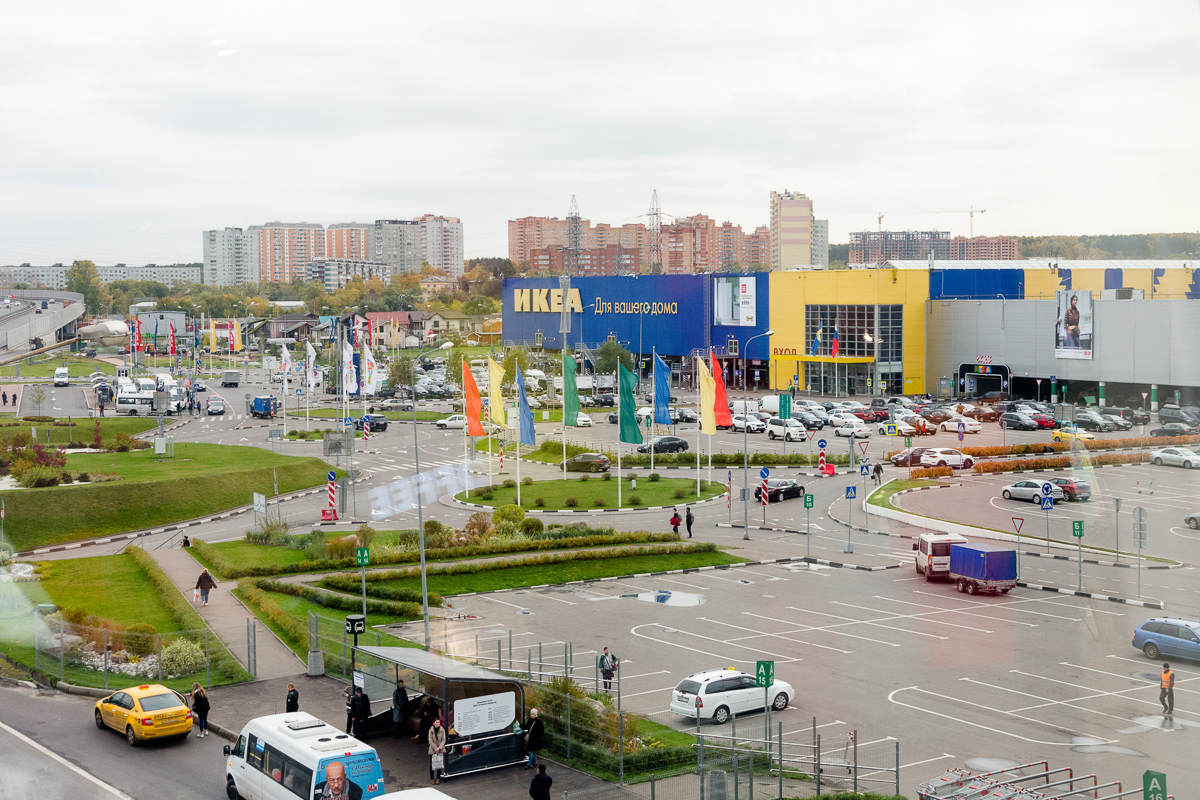
MEGA Belaya Dacha is the largest shopping center of the MEGA network, one of the ten largest shopping centers in Europe. The total turnover of all its stores consists of purchases of 40 million visitors annually. This imposes a great responsibility on all systems: even a minimal downtime can seriously affect the results of work. Today, for the first time, we decided to open the curtain and in this post we will talk about the infrastructure of Belaya Dacha.
The “reverse side” of MEGA begins with the office of its manager, Konstantinos Tsakalis.
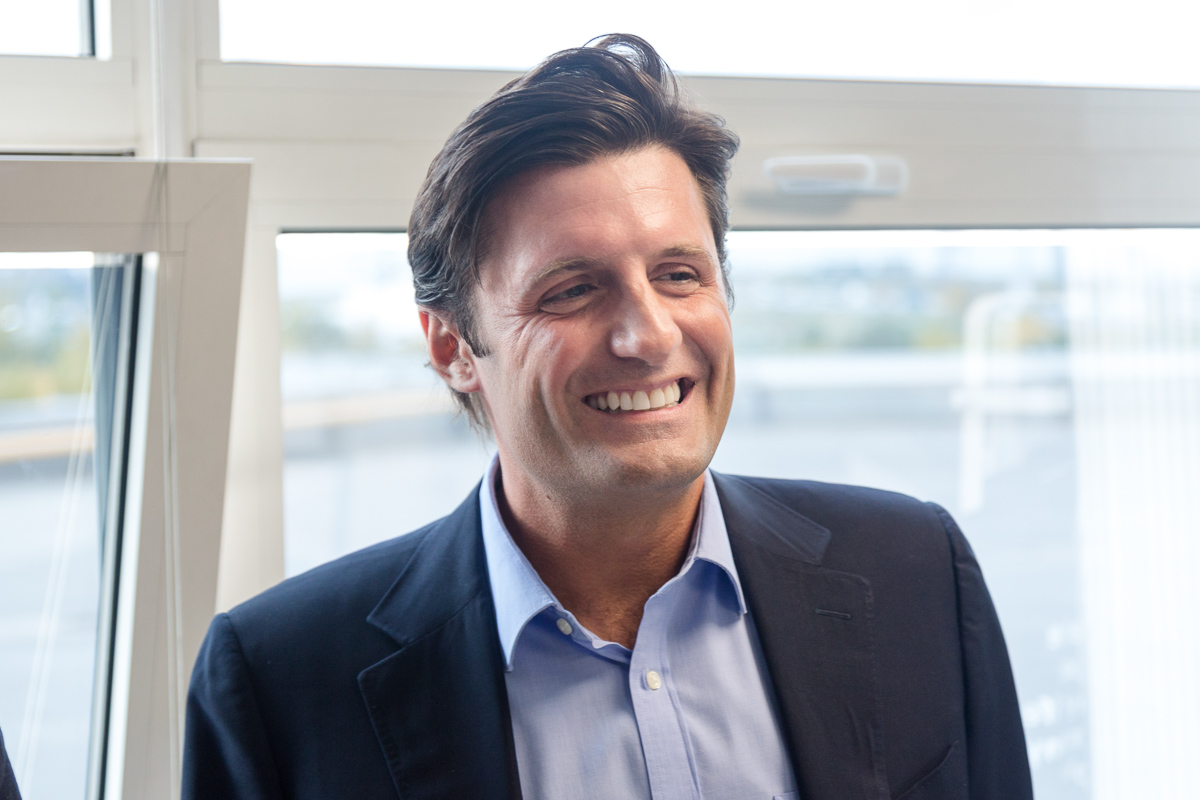
Looking around, you notice that there is very little furniture around - a table and several bar stools. Konstantinos (for his Costa) spends almost the whole day "at the facility" and only in the evening takes up papers - so the office is not suitable for classic meetings. We pass to more interesting locations.
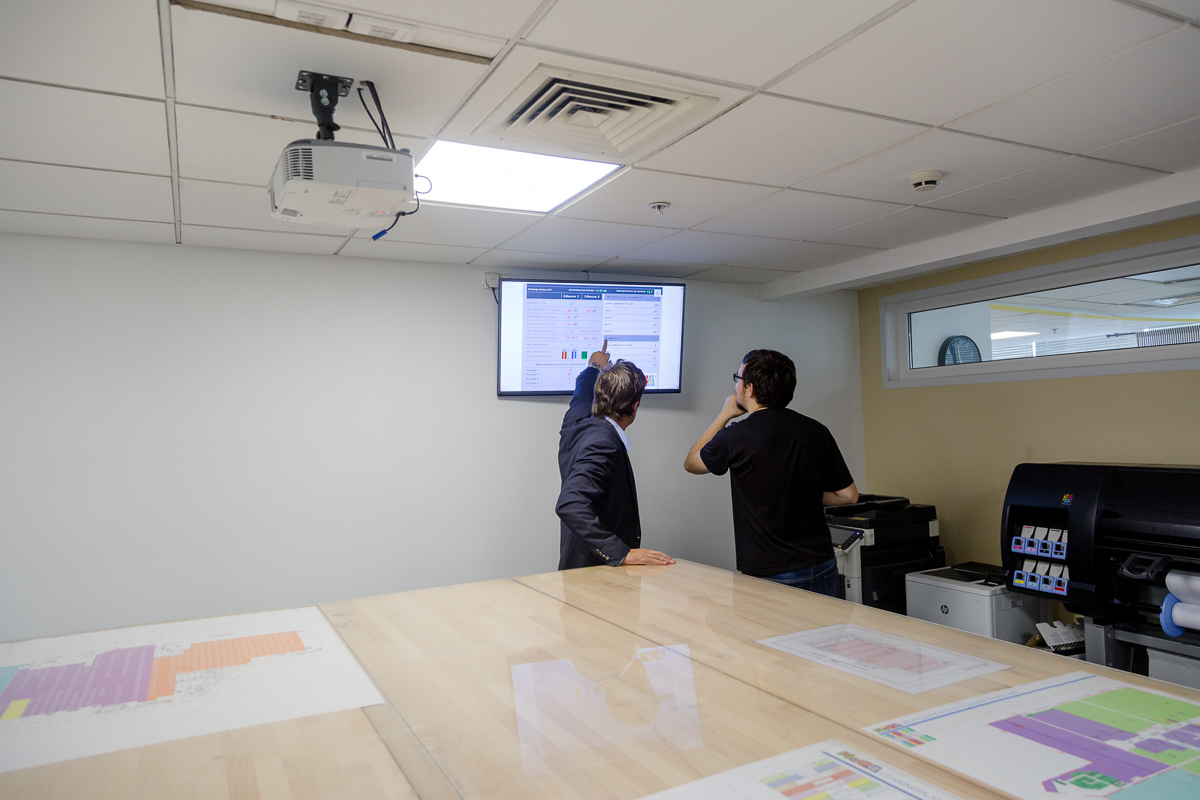
Morning meetings are held in the nearby hall. Also from here, using BMS, building management system (ACMS, automatic building management system), you can quickly monitor engineering systems and manage them. In the middle of the room is a large table with diagrams under glass, and a large-format plotter next to it for printing these diagrams.
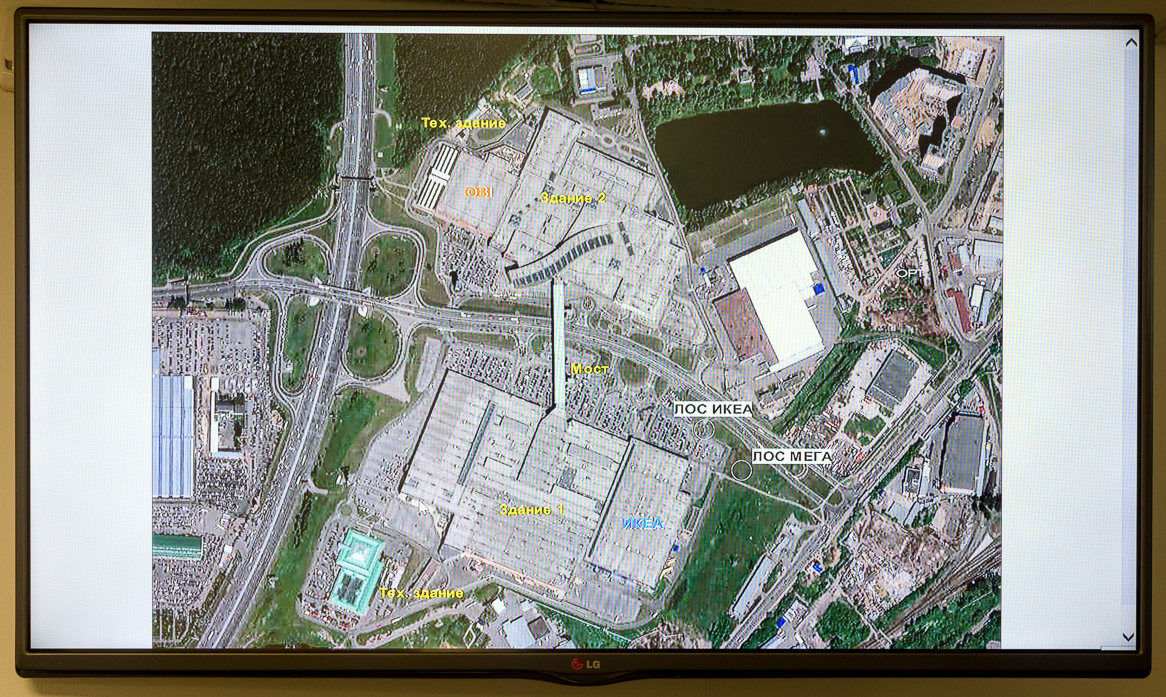
For visitors, MEGA consists of two buildings, but in fact there are more buildings. On the BMS card, its separation.
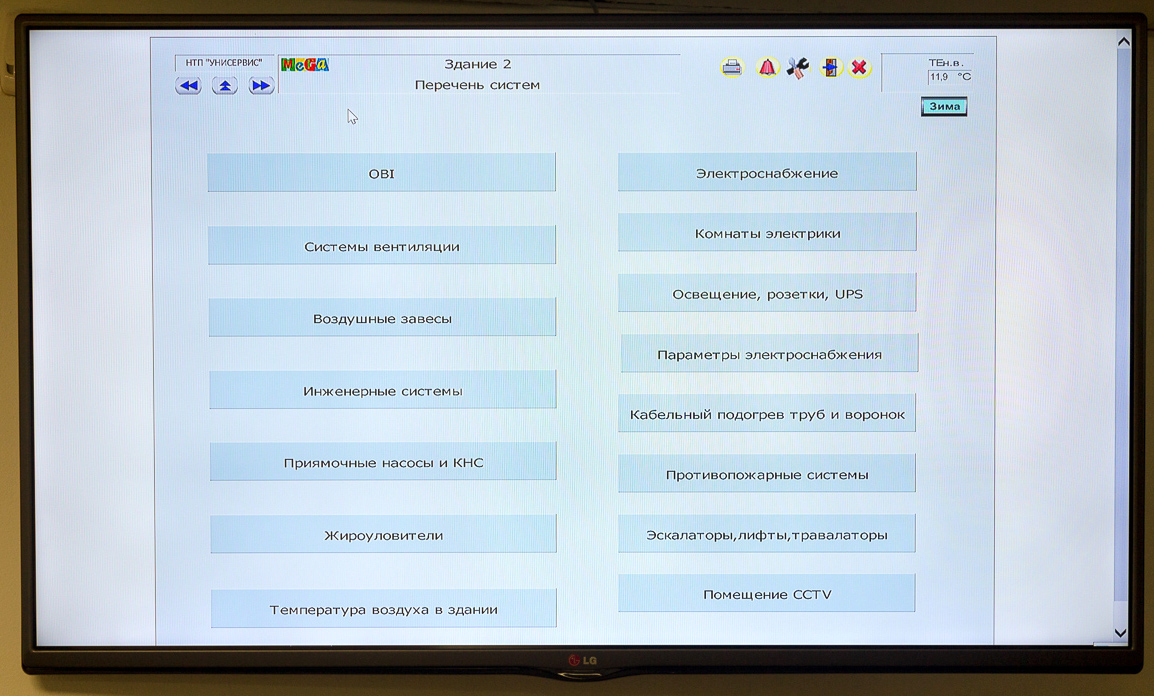
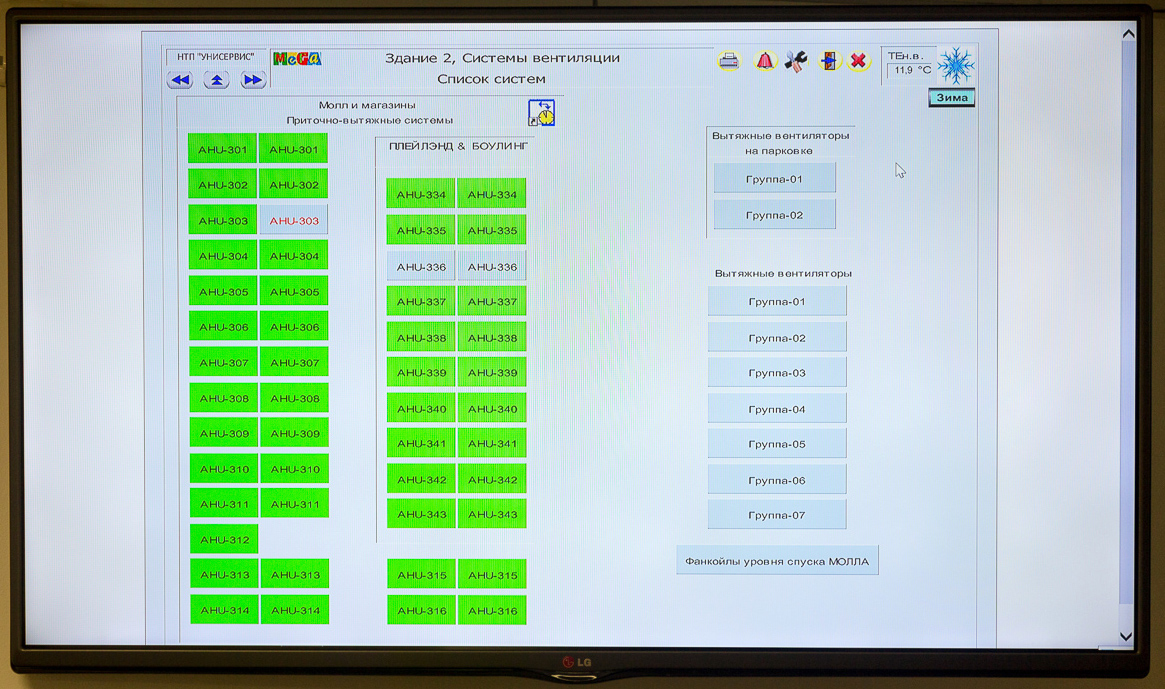
From the list of systems in buildings, you can quickly go down to the summary screen for a specific system, for example, a ventilation system.
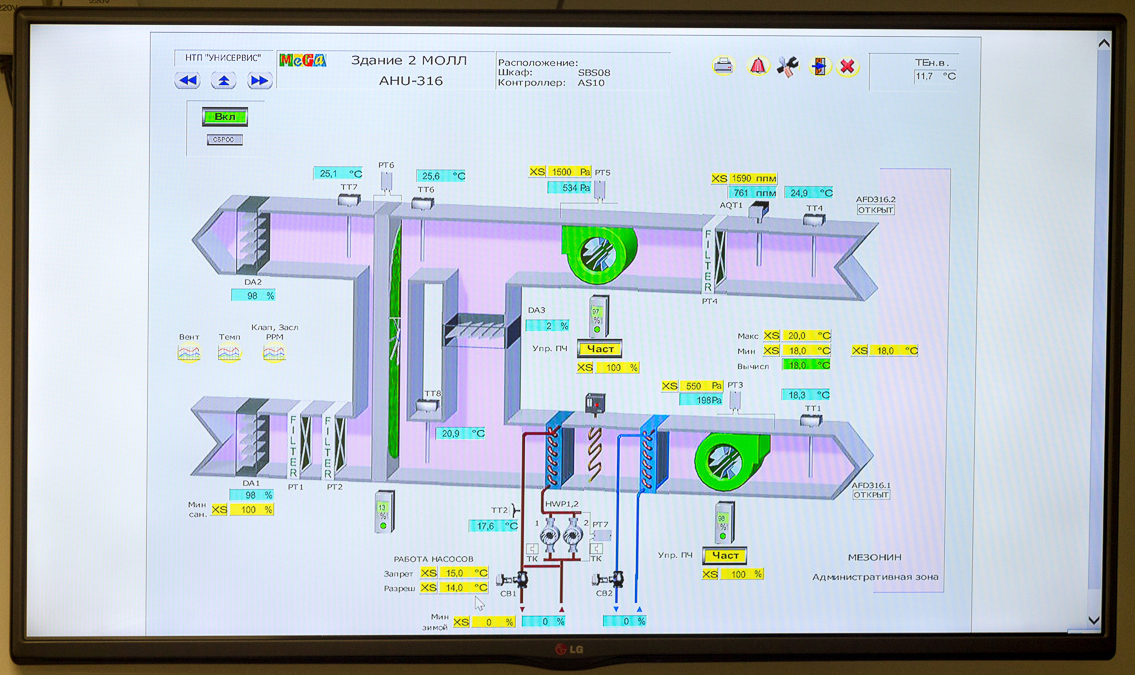
All important technical parameters of the system are marked here, as well as the direction of air flow.
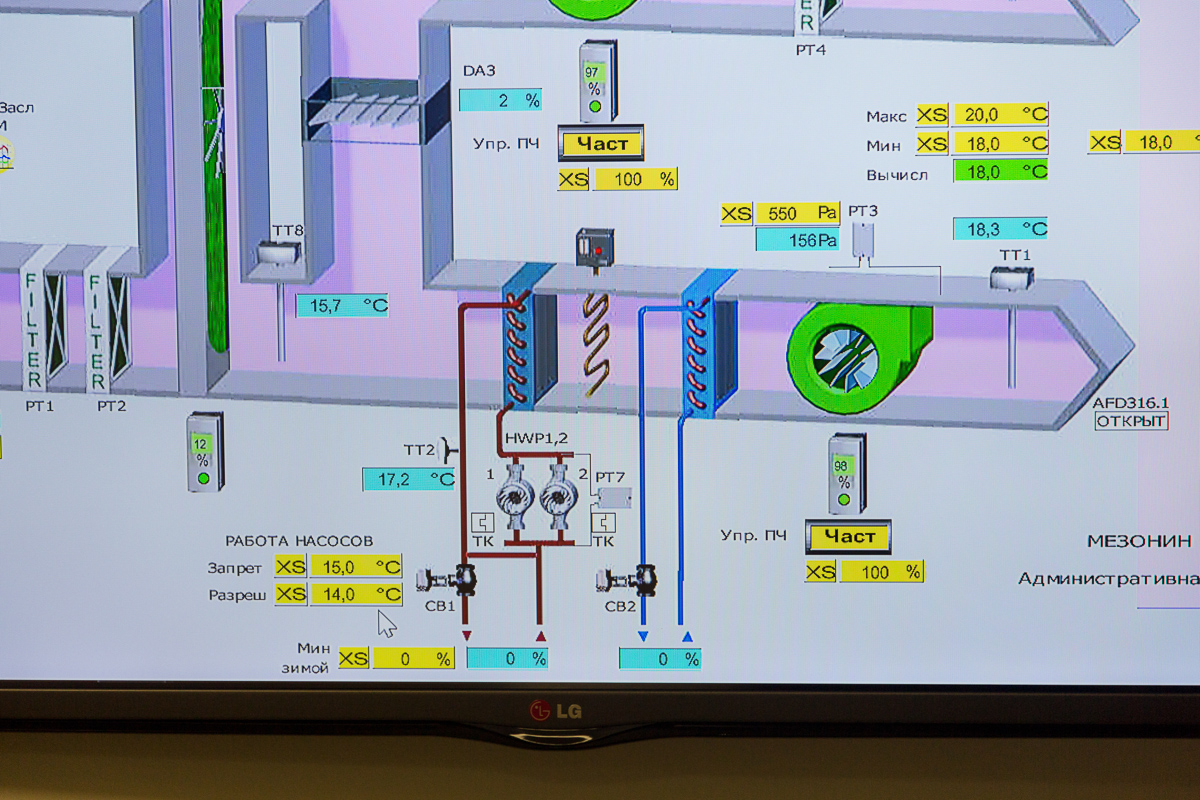
Frequency converters set the speed of rotation of the fans and recuperator wheels. Heat transfer radiators that heat the air flow in winter and cool in the summer. Left filters for cleaning the air flow taken from the atmosphere.
Using a frequency converter, the speed of rotation of the fan motors is formed, which is necessary for the inflow and exhaust of air. With an increased content of carbon dioxide in the air, part of the air flow is emitted into the atmosphere, which is compensated by the intake of fresh air from the atmosphere. If the real air temperature differs from the set temperature, the flow passing through the system is sent for recovery through heat transfer radiators. Depending on the season for ventilation and other systems, one of two modes is switched on - summer or winter.
In the upper corner is a street temperature sensor. We
switch to the boiler room of the technical building 1. There are three boilers in it that operate in cascade. At the time of shooting, one of them is active.
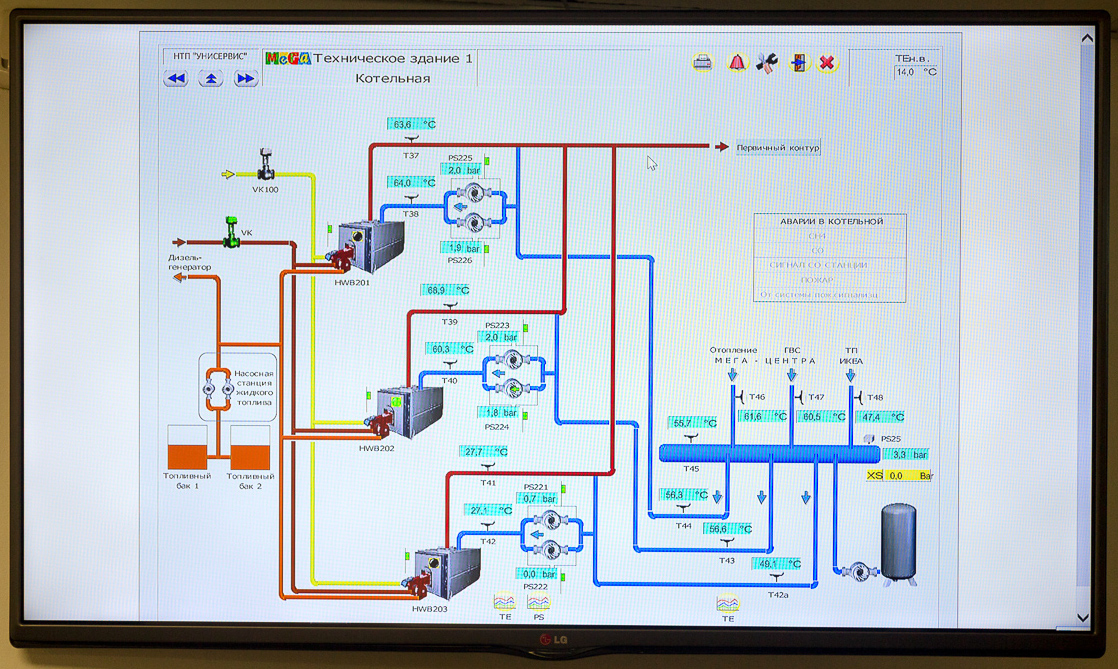
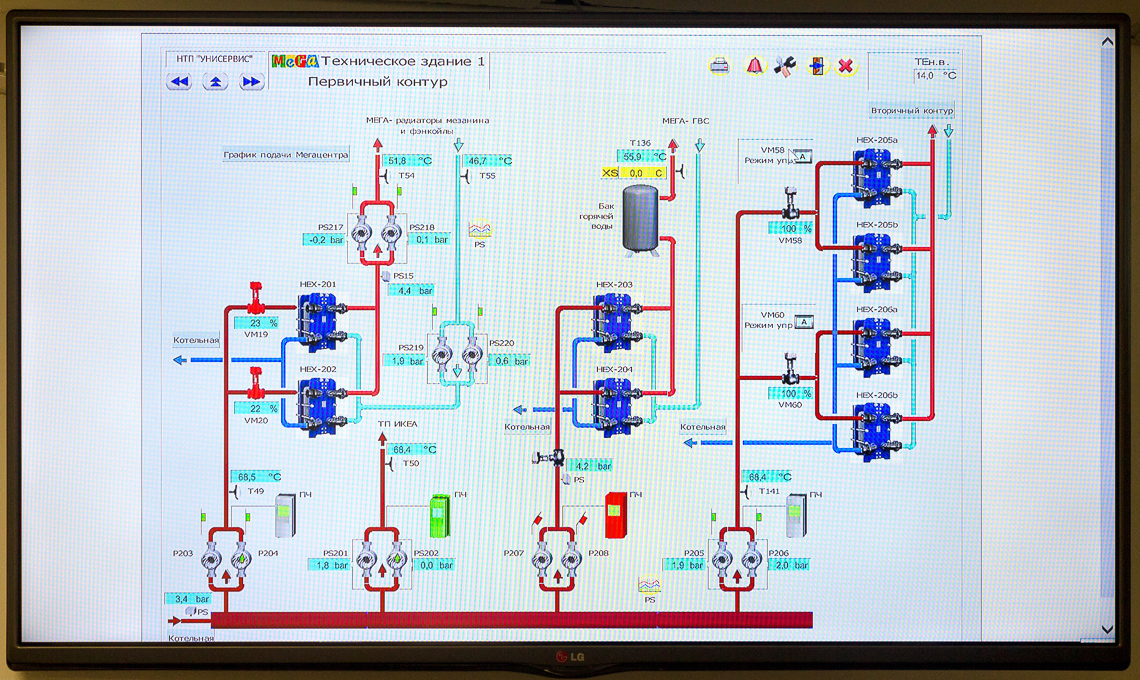
On separate screens, the primary and secondary heating circuits for the same building are shown:

Lighting usually works on a schedule, but it is possible to adjust its operation in accordance with real light (for example, on a cloudy day). For this, light sensors are installed in various parts of the building. The active palm icon means that this lighting group is switched to manual mode - this is usually done as necessary when some work is carried out in the desired area.

The mall has a storm-water treatment system, from which water is drained into the river or into the sewer.

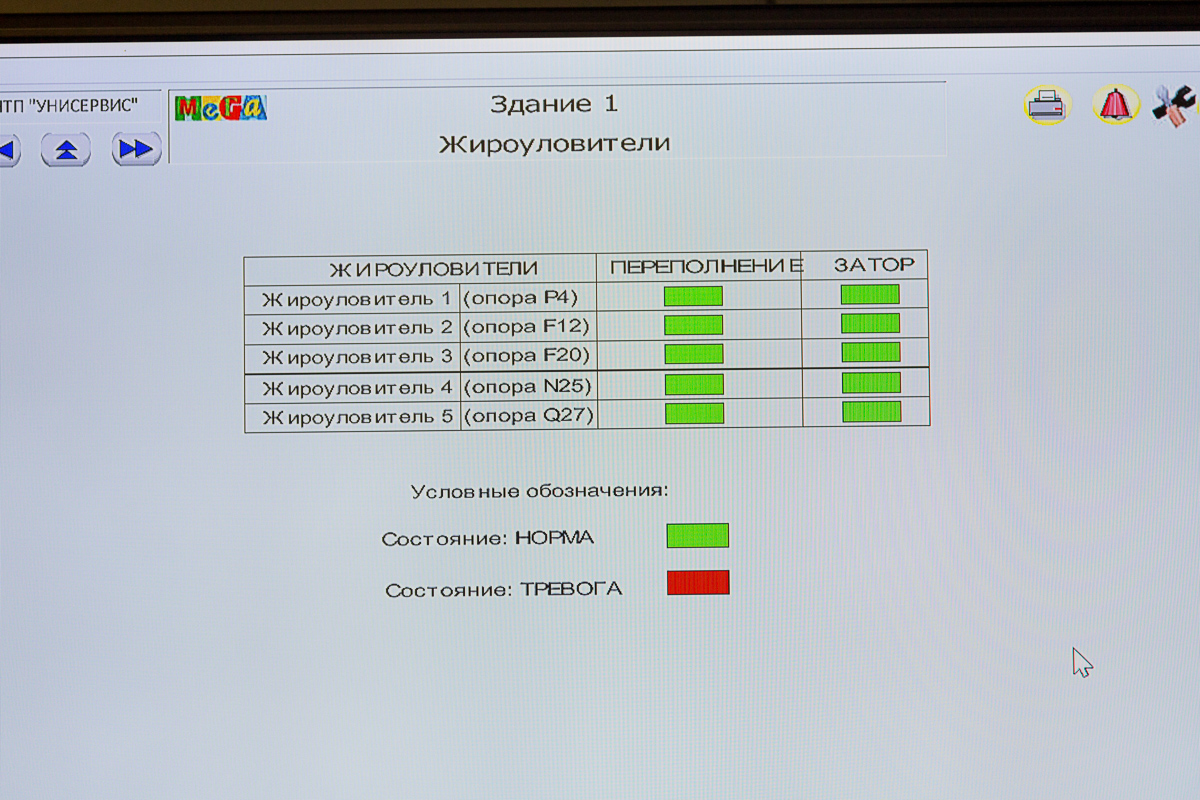
In BMS, the status of other auxiliary systems is also monitored: escalators, travelators, grease traps.
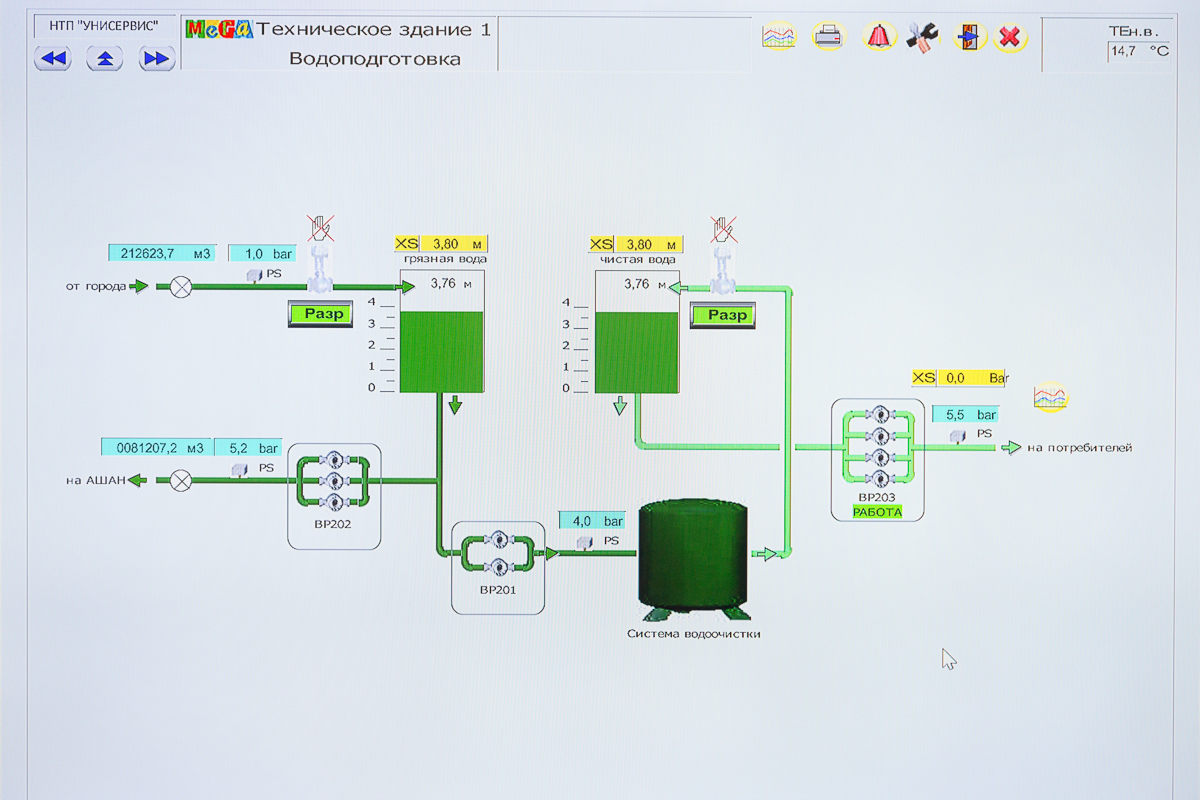
MEGA provides a preparation system for water coming from the city. It is fed into tanks with ultrasonic water level sensors. From one tank, water enters a multi-stage purification system, after which it is collected in another tank, clean and ready for use. As a result, visitors to the shopping center use cleaner water than in the city, and even if the center is temporarily disconnected from the central water supply for technical reasons, this water will last until the end of the day.
At the heart of the MEGA security system is a deep hierarchy of access levels and a “captain’s bridge” for monitoring all rooms. With their help, in case of emergency, you can make sure that everyone in the shopping center was evacuated.
The status of CCTV cameras is automatically monitored, and any breakdowns are quickly eliminated. All recordings from cameras are stored from one and a half weeks to a year and can be provided upon request of law enforcement agencies. The numbers of cars entering and leaving are automatically determined. If the car number matches the one indicated in the search base, a signal is sent to the guard and the information is urgently transmitted to law enforcement agencies.
The most interesting thing in the MEGA security system is the interactive course that everyone who is going to work in the shopping center should take. Following the results of the course, it is necessary to pass a test, without which it is impossible to get the necessary S3 sticker on the badge.
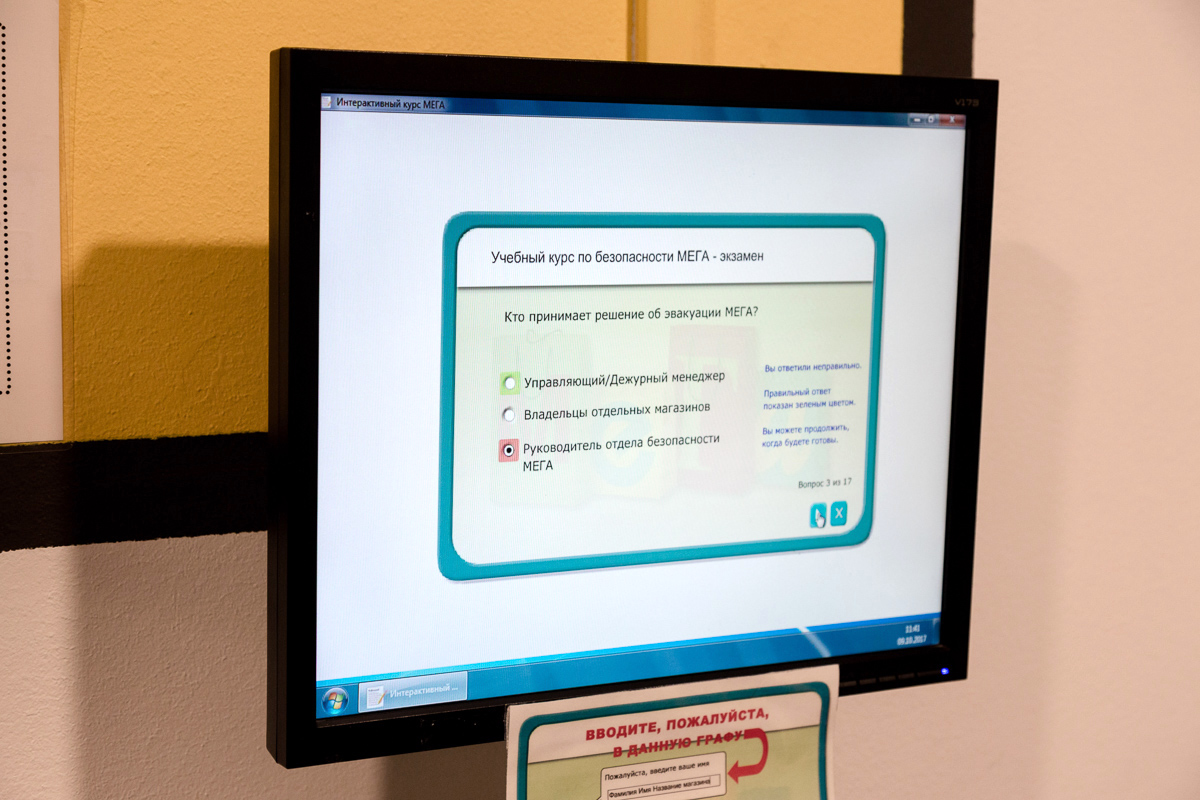
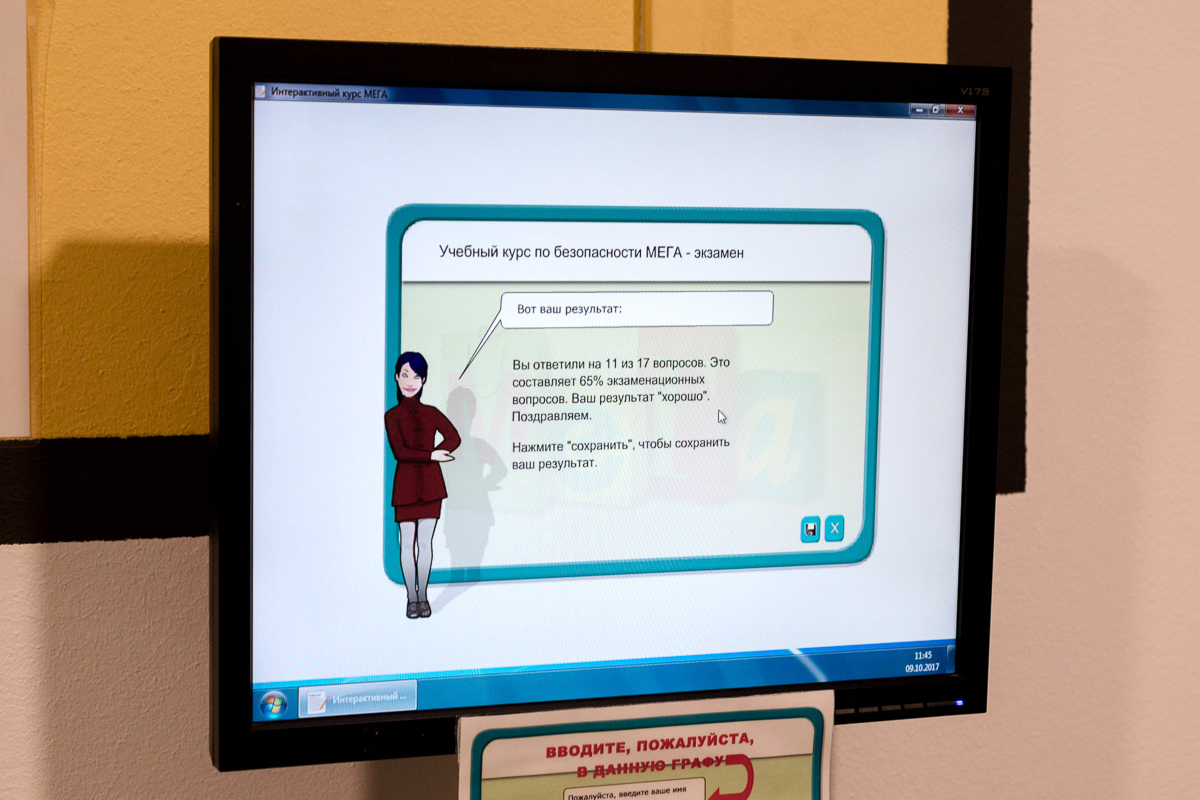
Our guests, for whom a MEGA tour was conducted, were handed over without preparation. Most of the questions seemed to them not too complicated, but in the end they could not cope with the exam. With 65%, no sticker shines - we do not give out the capital letters "U".
When bypassing the shopping center, day and night shifts fill out checklists for reporting. Any problem can be solved within a maximum of two weeks, and more or less minor breakdowns are fixed in the next night shift.

For each malfunction, such stickers are glued here. With their help, wizards can quickly find the problem spot. And if they do not have time to fix it before the new business day, buyers will know that the repair is underway.
Through the parking lot, we exit to the service complex of the first MEGA building. We start with an electrical substation.

Behind the largest door is the diesel generator of the first building. It comes into play only when the central power supply is turned off, providing the necessary minimum energy for critical systems. Within five seconds, while the generator starts, the UPS takes over the load. To check the generator run every week.
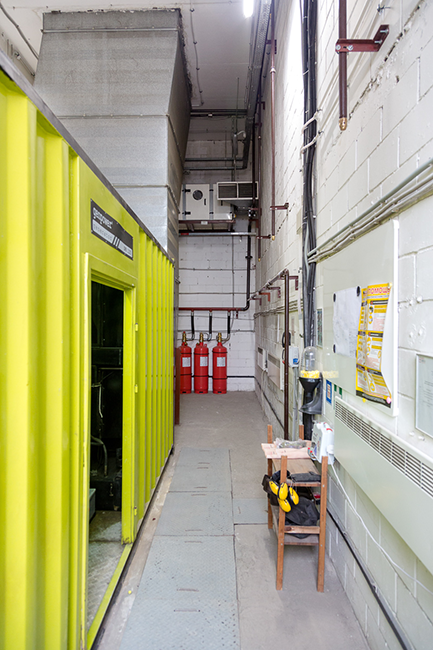
In adjacent rooms on rails transformers with a capacity of 2000 kVA are installed. For each of the two buildings there are ten transformers that operate simultaneously with a uniform load distribution.
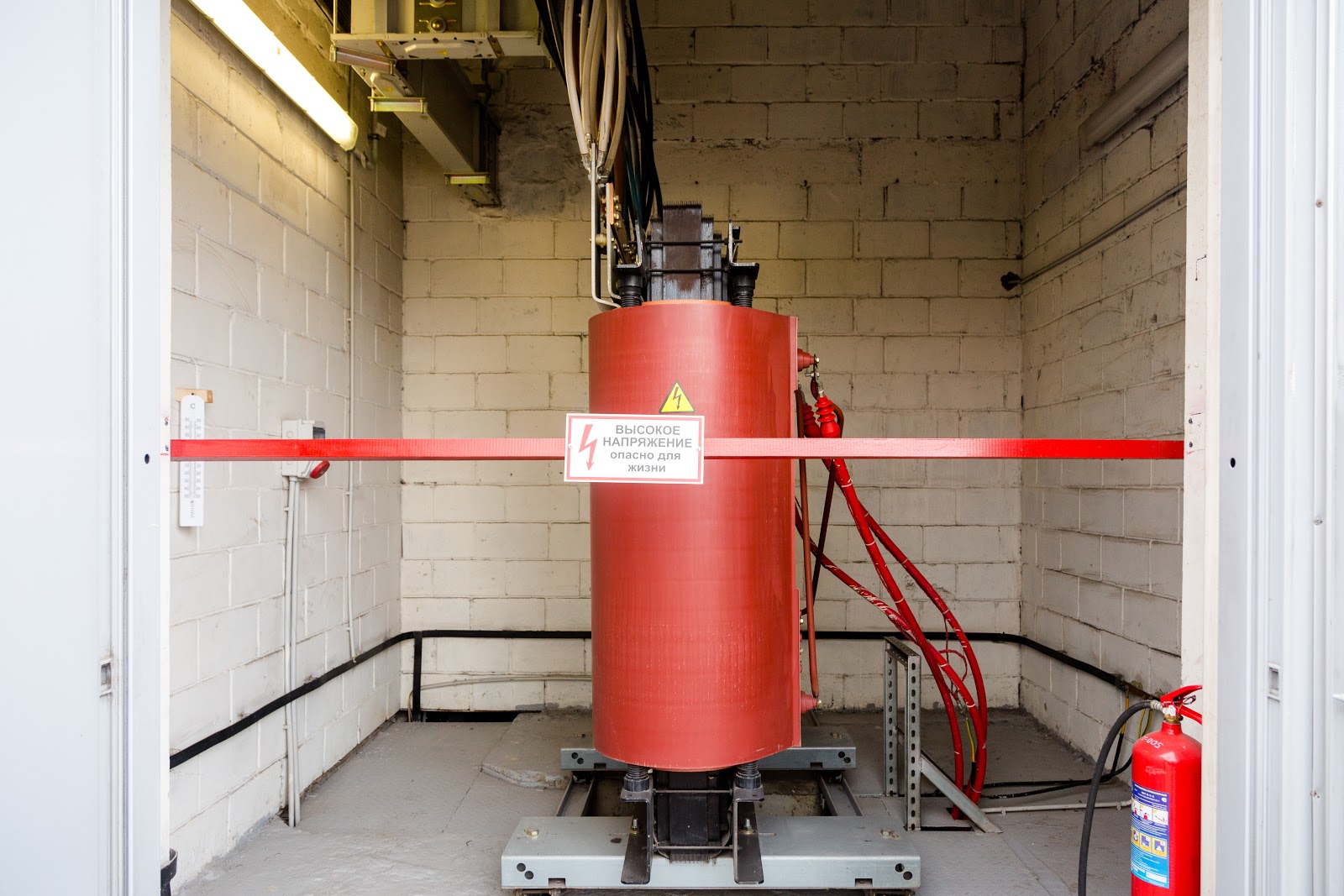
Transformers are isolated from switchgears, control elements and other related equipment, which is located in a separate room. The switchgear occupies a separate room. The connection diagram allows one of the transformers to be taken out for repair for maintenance and to redistribute the load on the transformer remaining in operation.
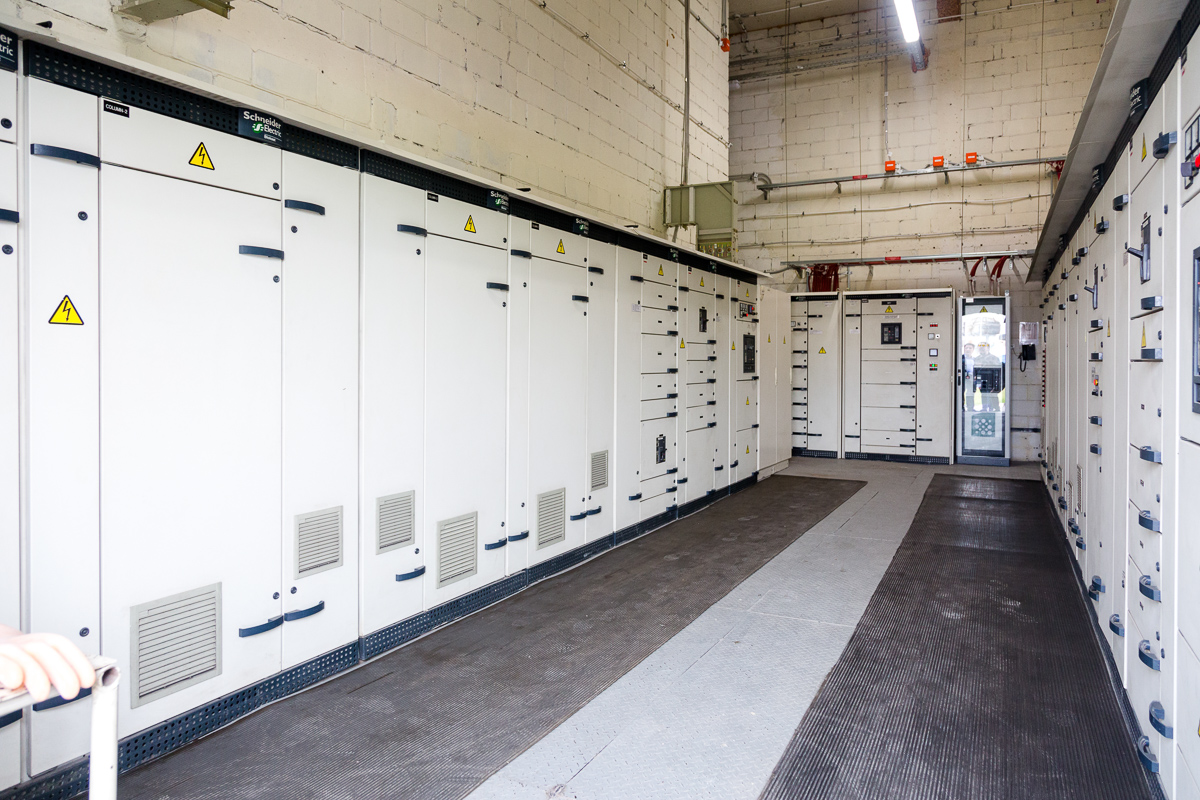
We move to another building, on the minus the first floor.
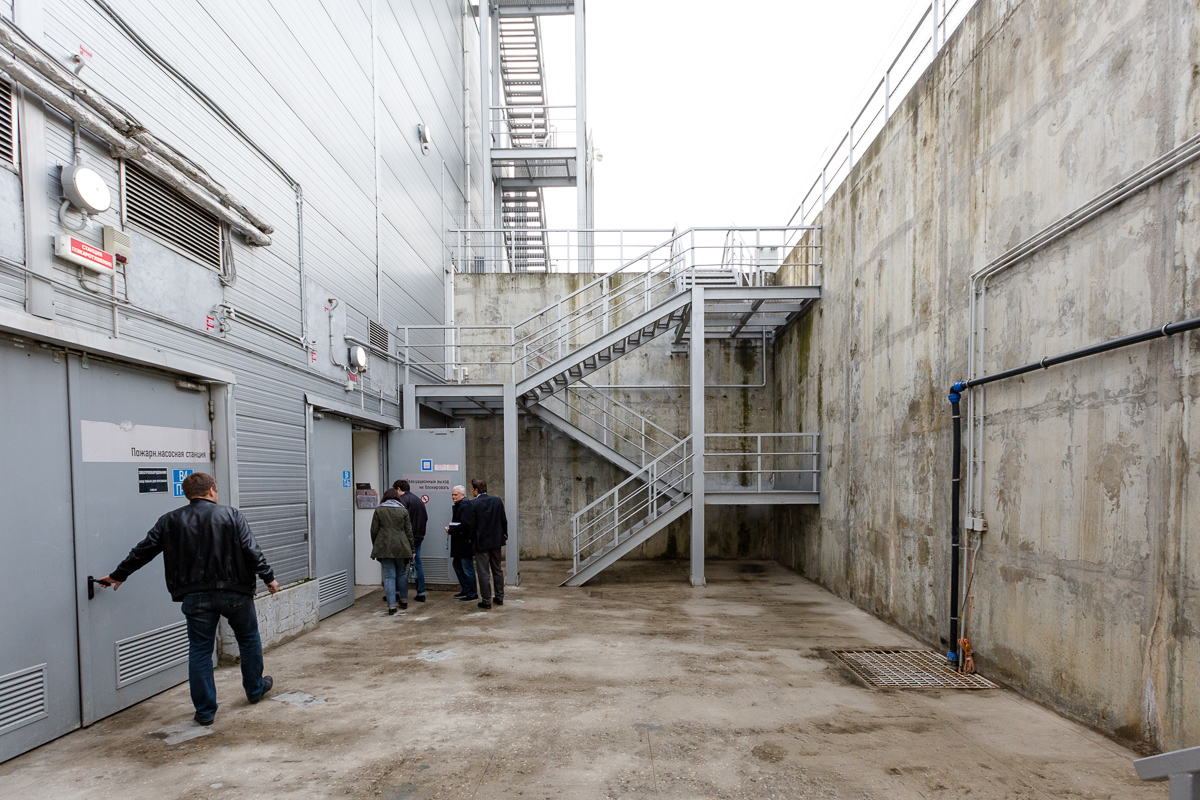
Here is the fire pump station of the first building.

On the back wall there are marks for monitoring the water level in fire tanks.
Water tanks are placed behind the wall. Their visual control is carried out using marks on the wall. When the pressure in the system decreases - for example, when the sprinklers are triggered - the pumps restore it. They are always in standby mode, connecting in cascade to work. There are three pumping stations in the mall - one for each building and one for the IKEA store.

Behind the next door is a purification system for water coming from the city. Here, in addition to cleaning, it undergoes softening and disinfection. There are two such stations - one for each building of the shopping center.

On the way to the next building there is a fuel storage for the boiler room of the first building - two tanks of 75 cubic meters each. In the cold season, it takes 6-8 cubic meters per building per day, so if necessary there will be enough fuel for almost three weeks.
We enter the boiler room of the first building. Now out of three boilers, one is active. Each boiler has a sand tray where, in the event of a leak, fuel will merge safely.
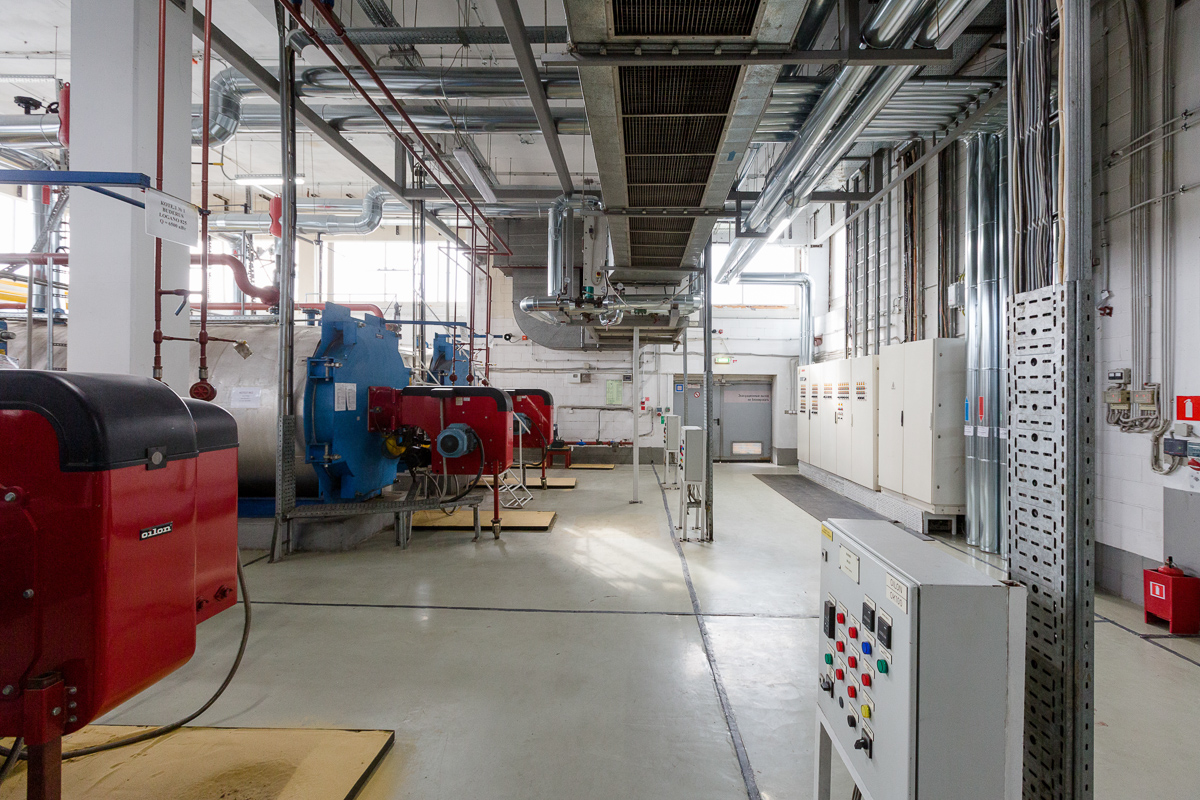
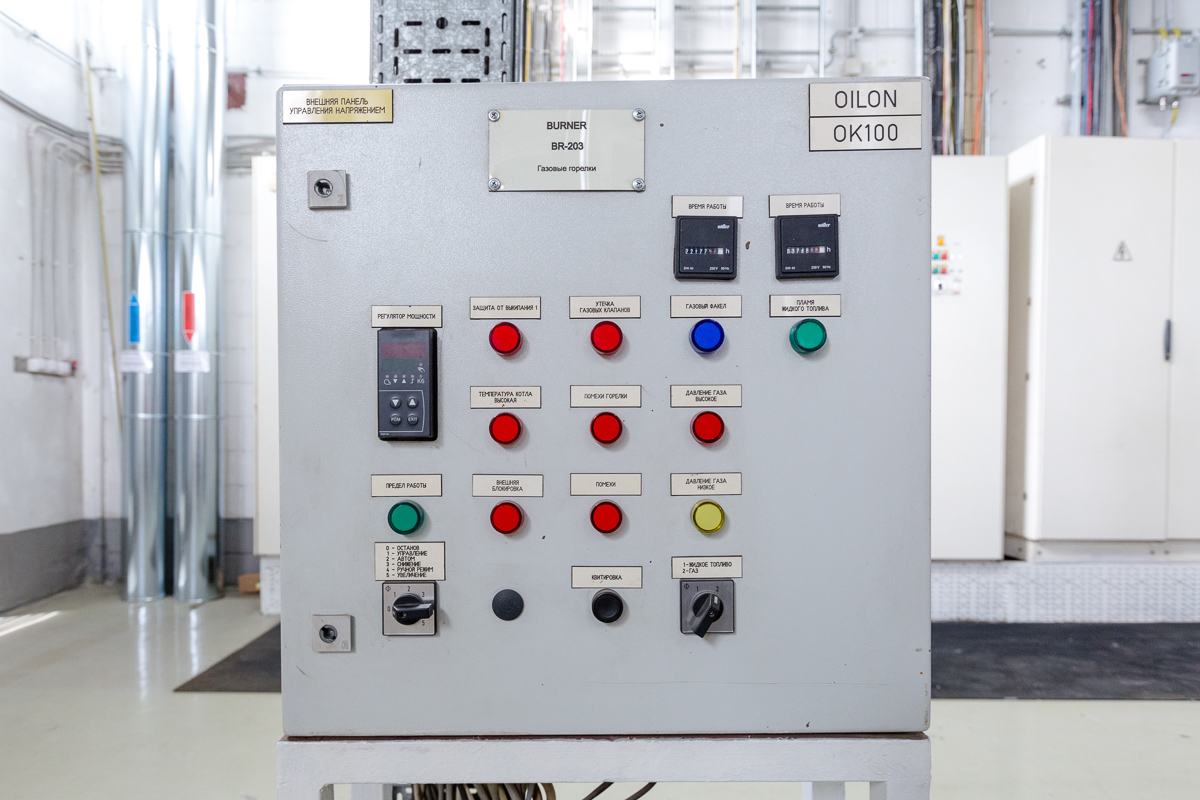
But by default, no fuel can flow out, because the boiler houses are fed with gas. Diesel is used as an alternative. Water for a closed boiler circuit comes from a purification system.
From the boiler room we go directly to the central heat point of the first building.
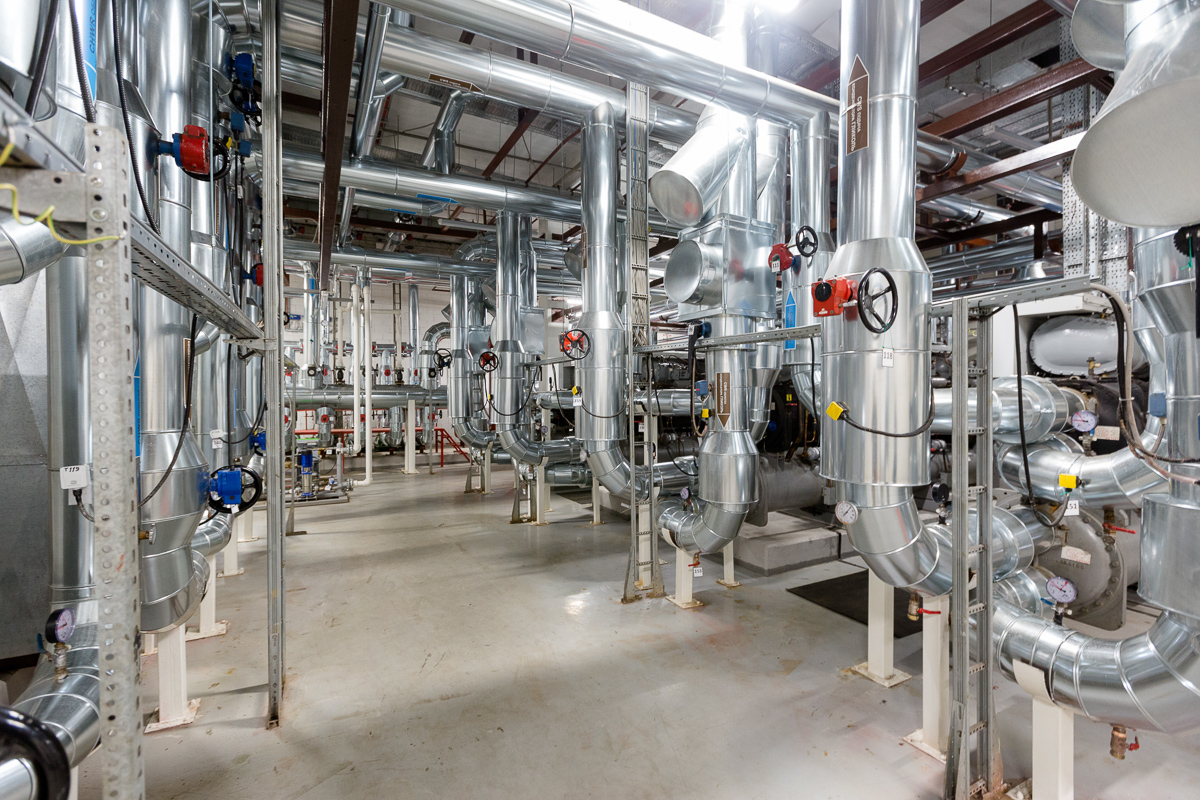
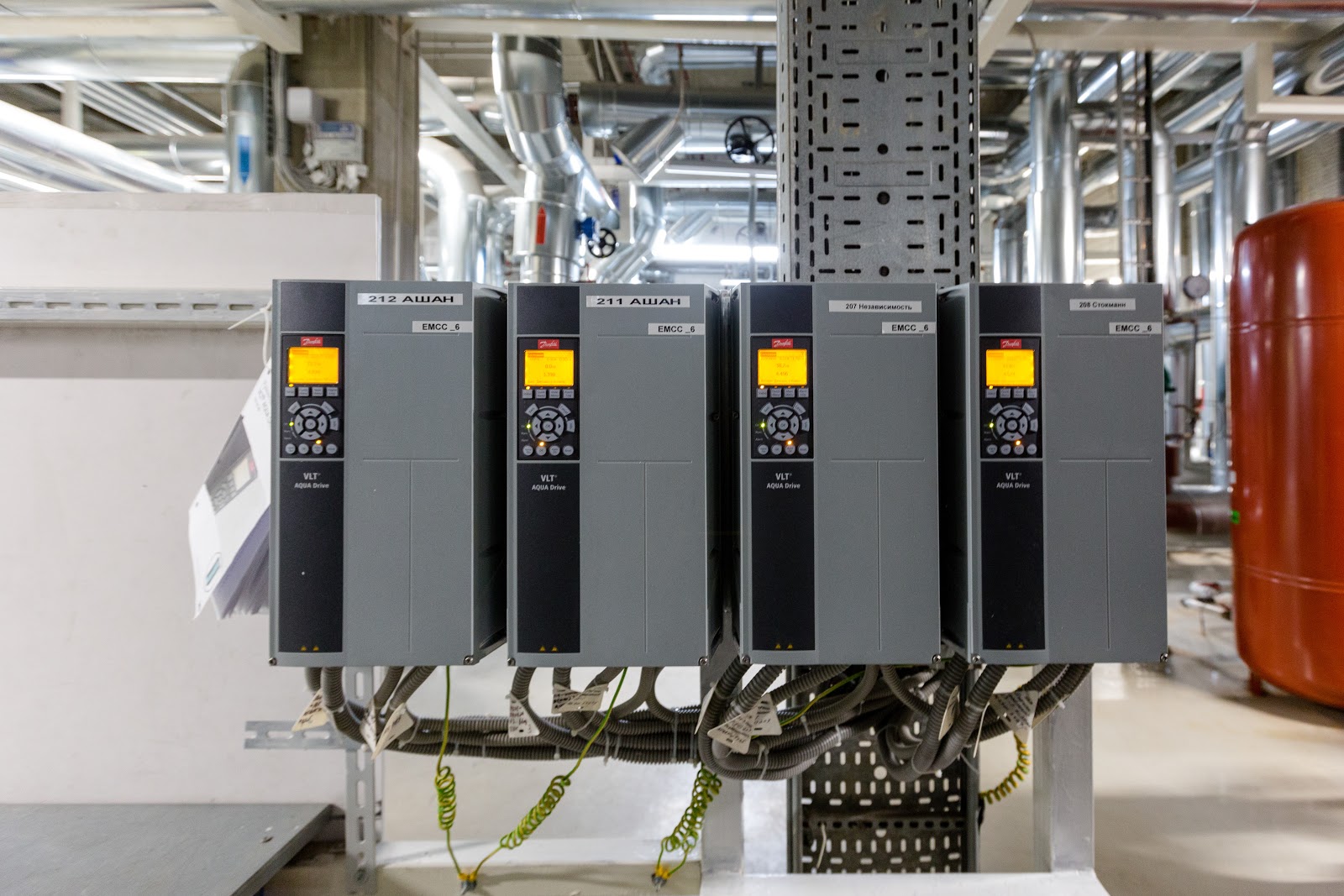
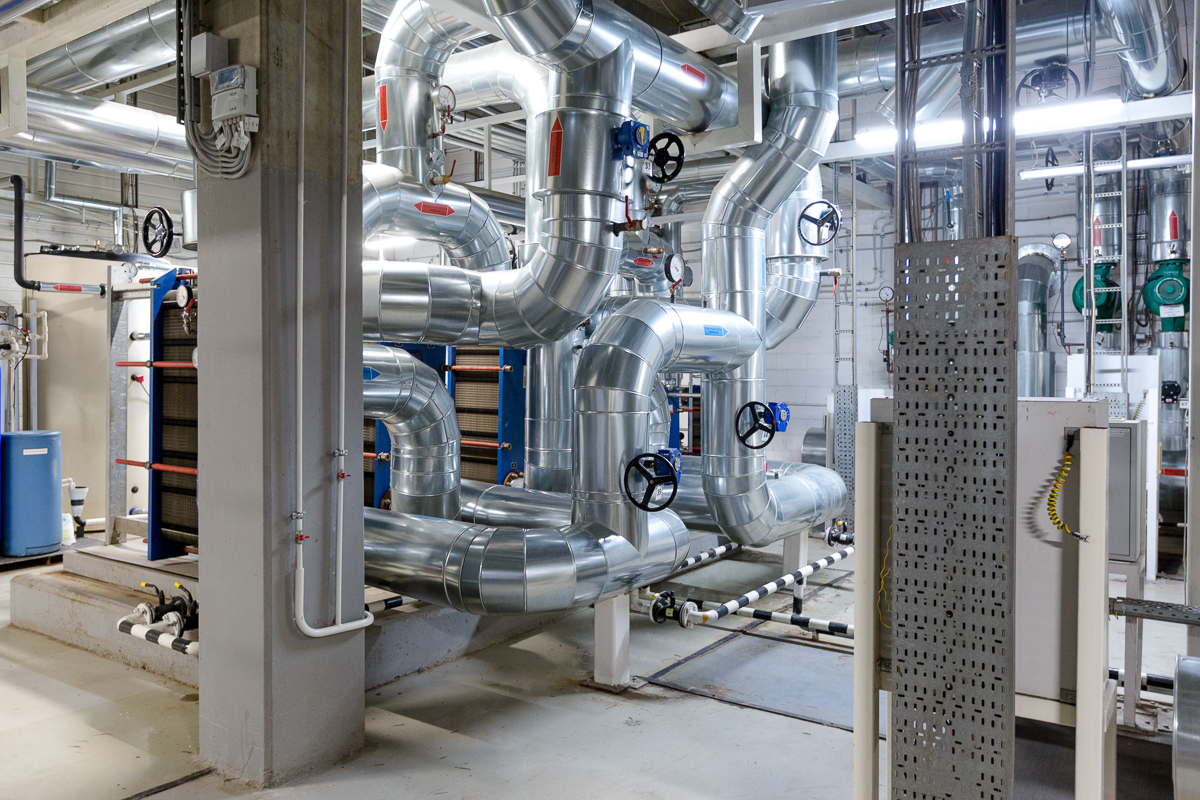
Frequency converters of pumps
Something like Winamp player built before us.
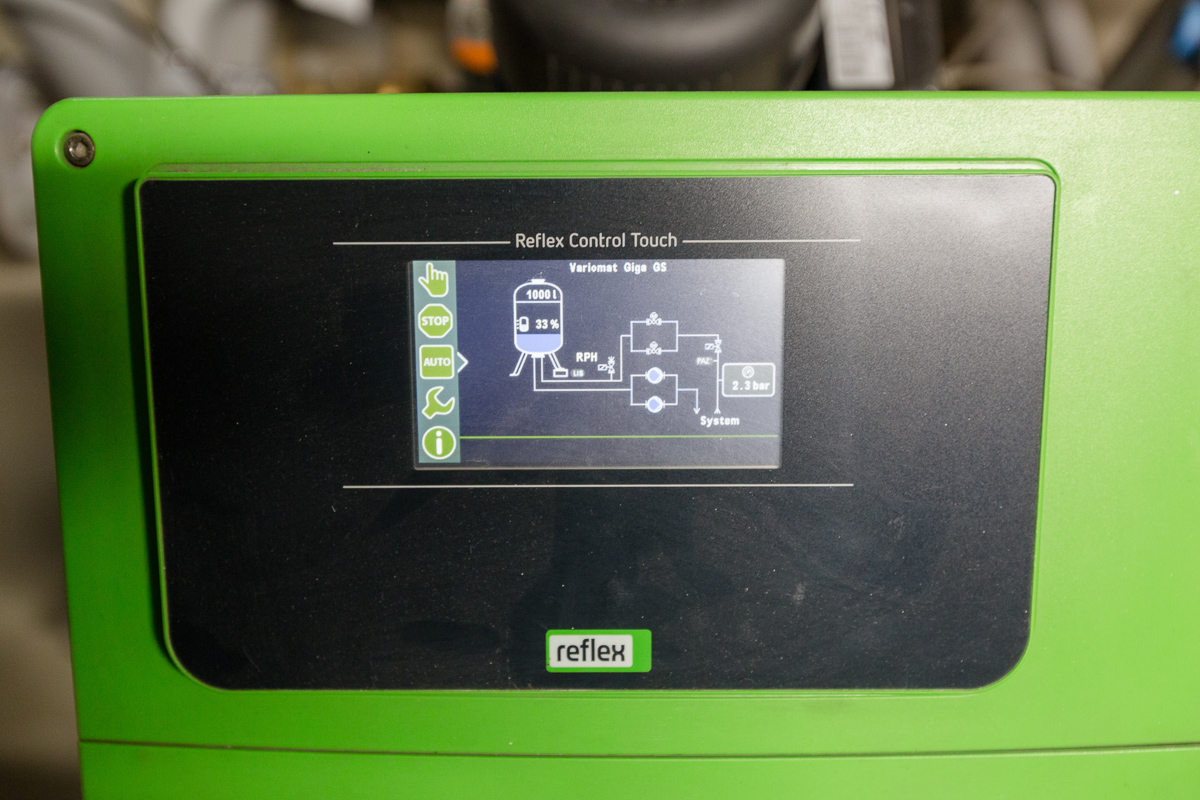
Not all user interfaces are brutal. In the heat point there is a very ordinary touchscreen
Through the wide service corridors we exit directly to the trading floor. Although this part is open to all comers, it also has its own “kitchen”, its own infrastructure features.
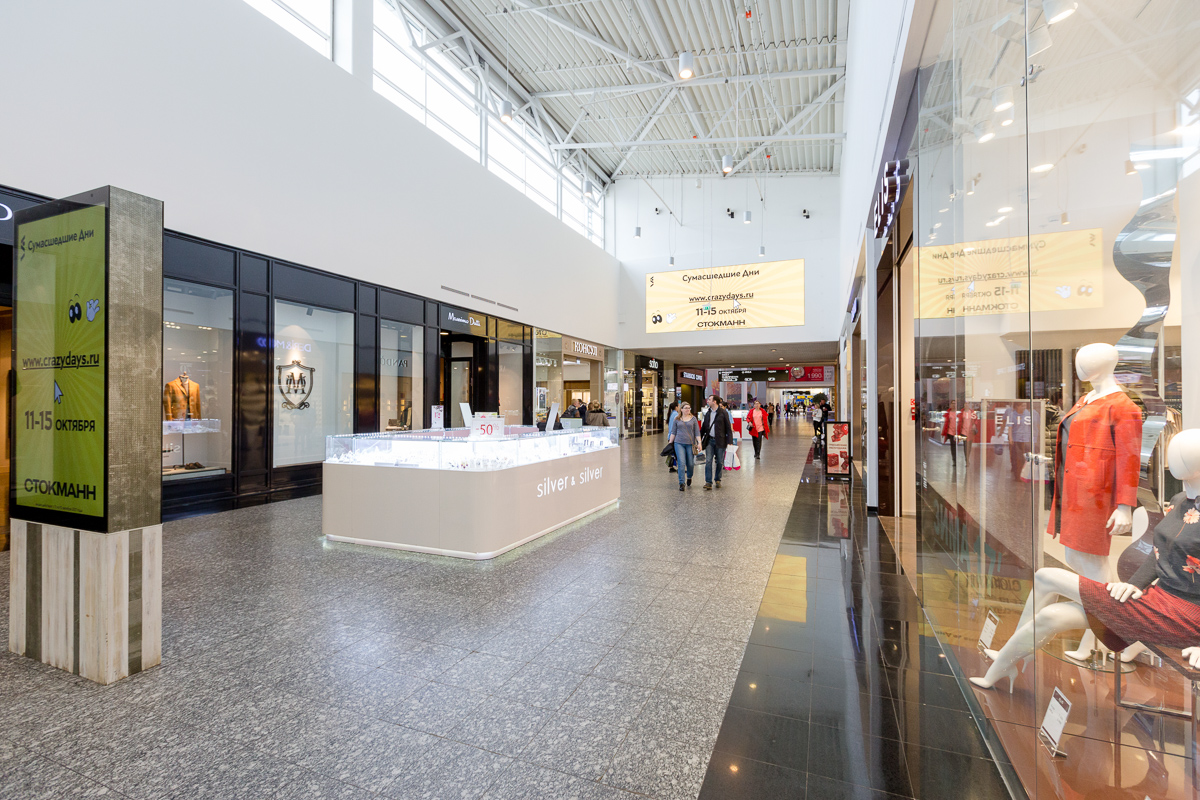
One of the most noticeable upgrades of recent times has been the installation of synchronized screens over the corridors. It is entered very accurately. In the photo with the help of screens, “crazy days” are moving forward - stock sales in Stockmann. Stockmann is one of the main, MEGA anchor tenants, such as OBI, Decathlon, Sportmaster, M. Video, MediaMarkt and others.
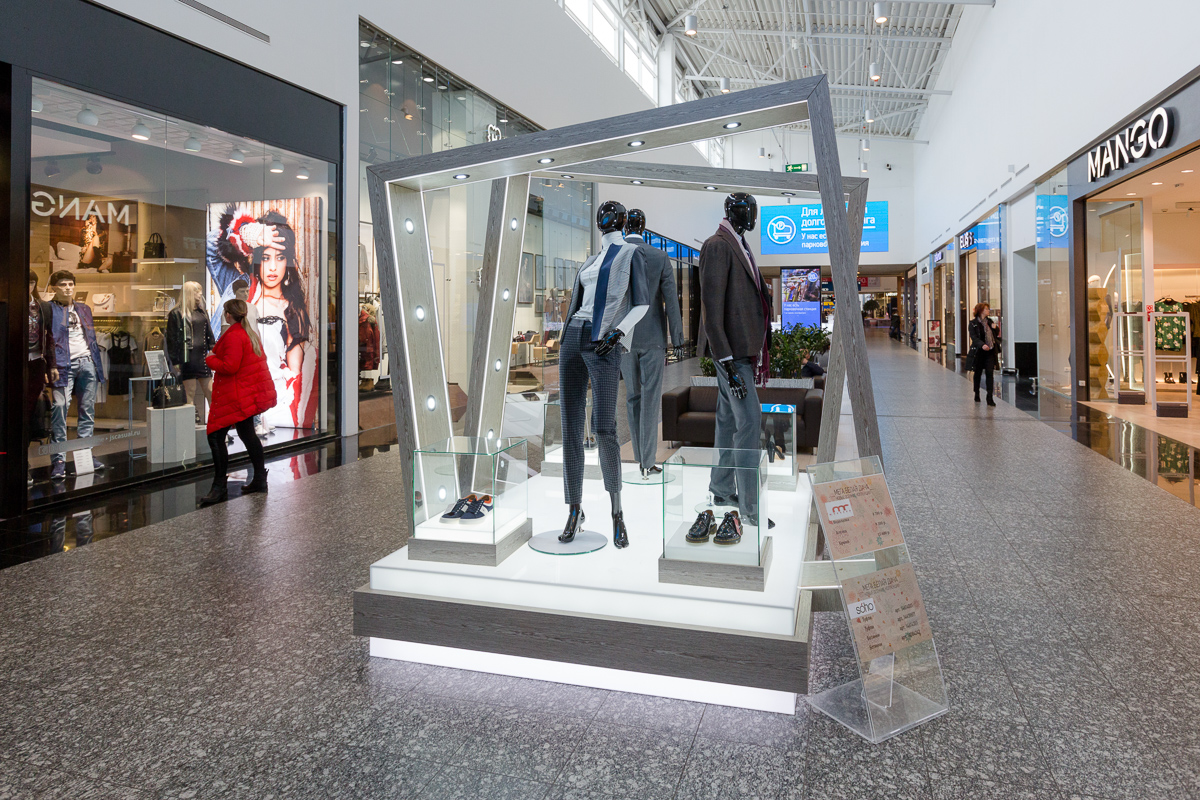
For the promotion of new stores such podiums in the middle of the galleries are provided free of charge. It takes into account topics that are priority for MEGA in a particular month. For example, in October this is a fashion - everyone is preparing for the new winter season.
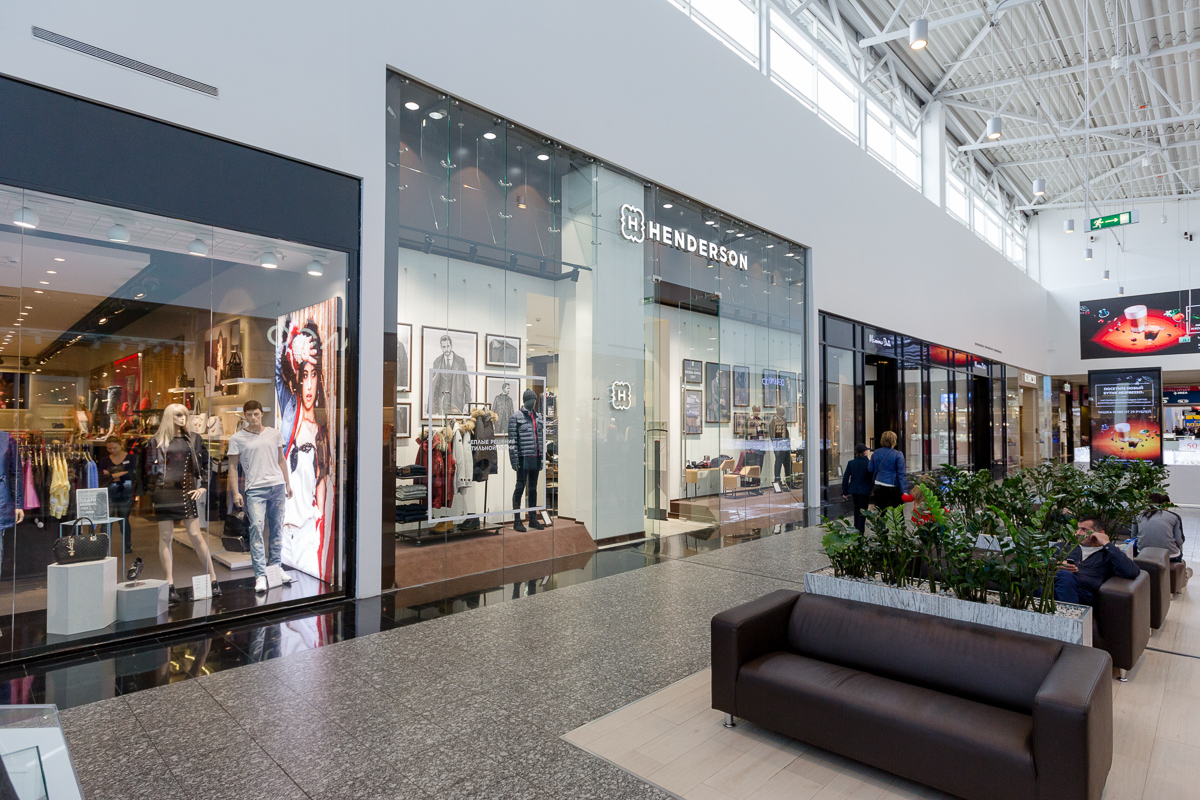
MEGA also encourages stores to create taller, double facades, like Henderson's. For an outsider, the difference with the neighbors is not critical, but in general it looks more interesting.
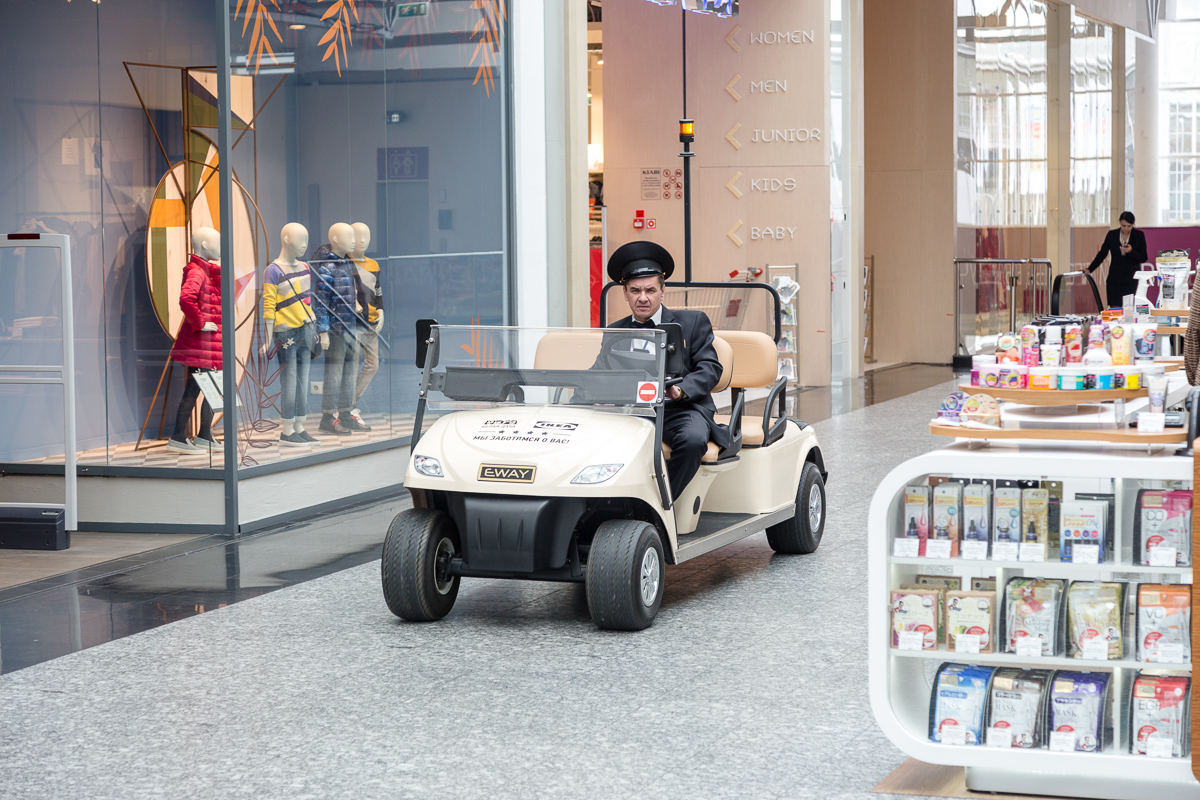
To move to other stores, compact electric cars are provided that meet handicapped and elderly visitors, and then take them to the desired point in the shopping center. They can be called remotely through the driver.
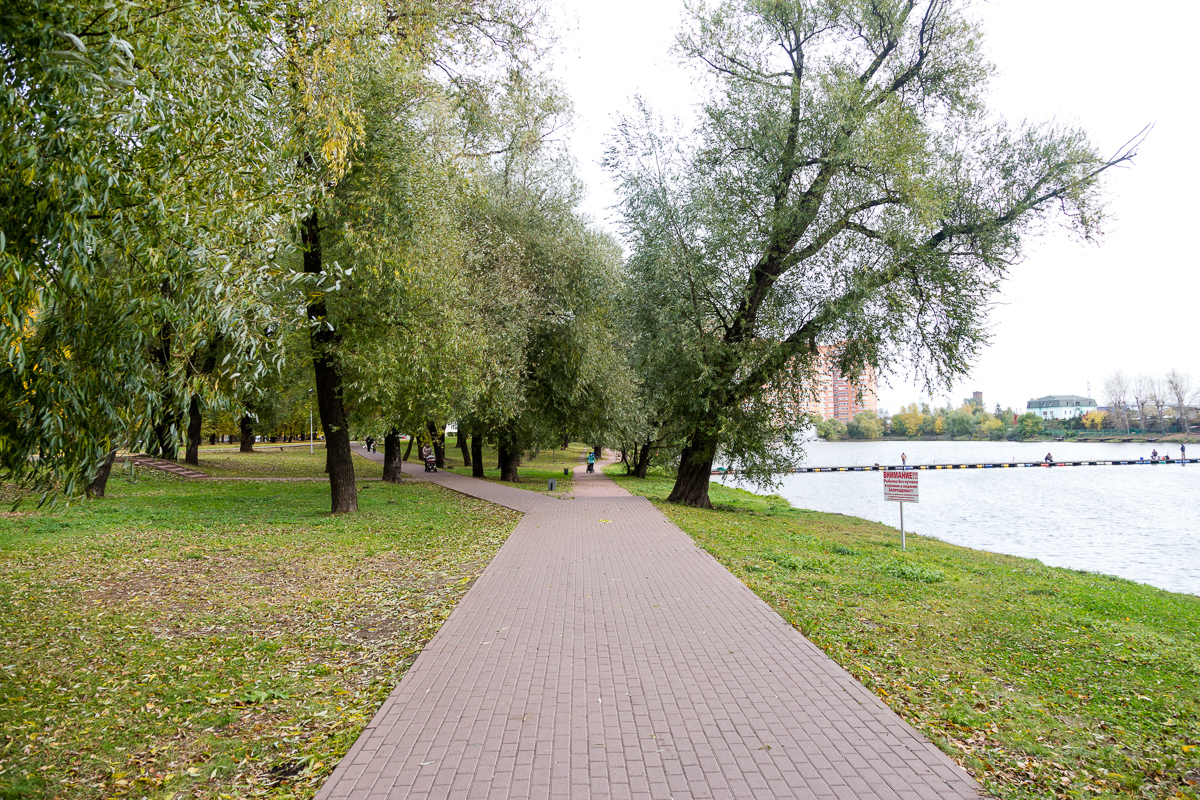
A stone's throw from MEGA is a park created with funds from a shopping center, local administration and one agricultural company. A great place to catch your breath after shopping. In September, by the way, Kotelniki city day was celebrated here.
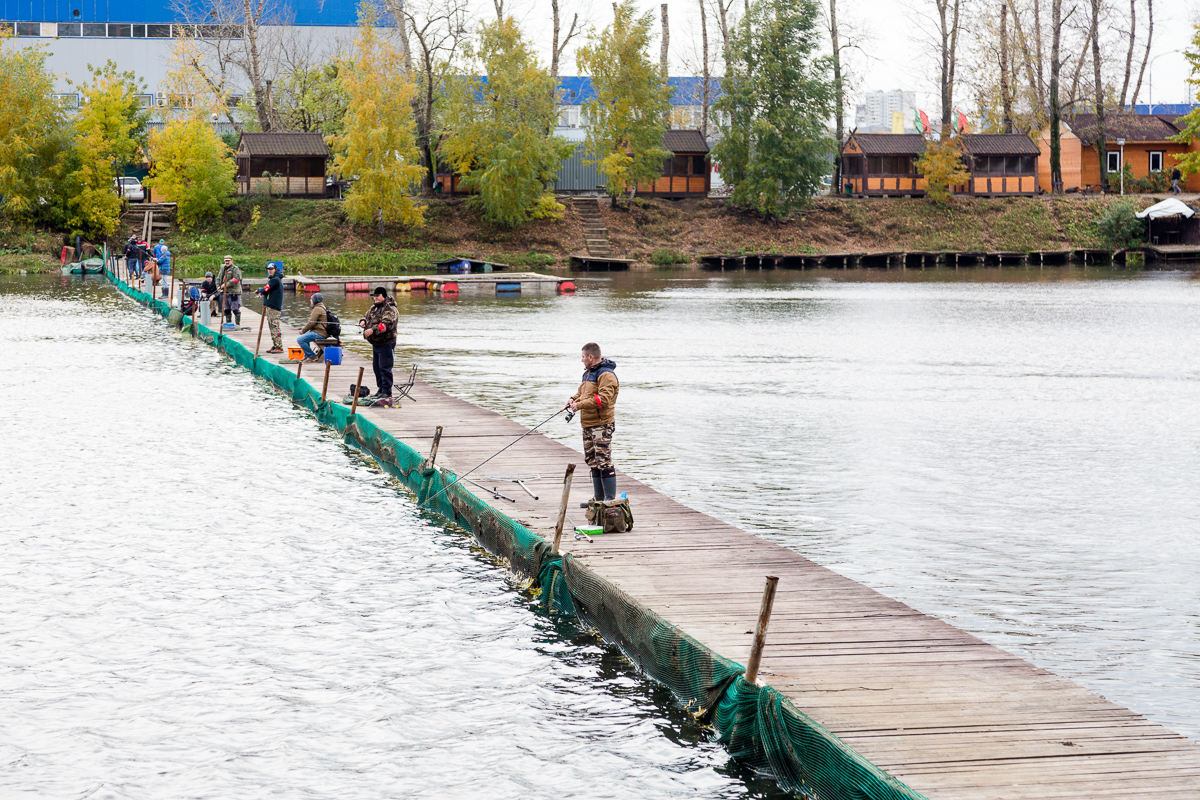
Konstantinos is surprised: “I saw people carrying 5 kg of freshly caught fish from here! I don’t know how much they catch in such a pond. ”
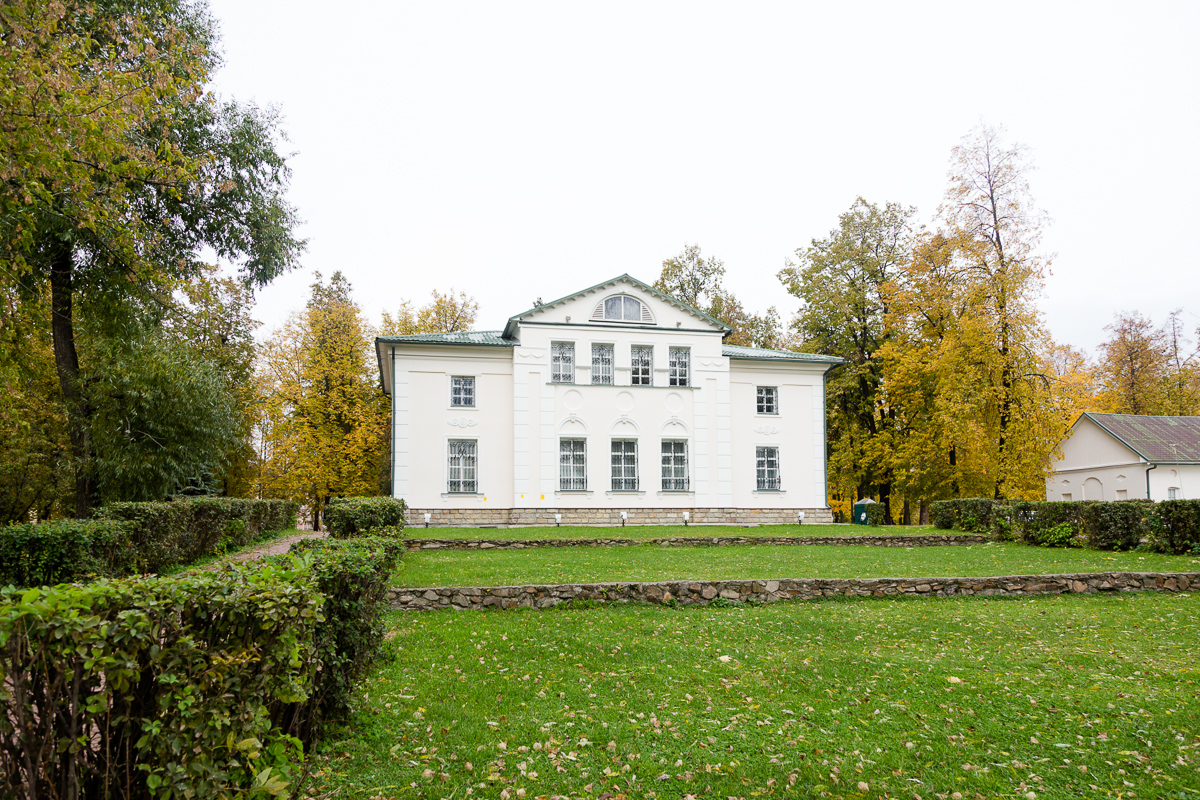
This building gave a name to the whole microdistrict. The main house of the country estate of N. Ya. Arshenevsky was built in 1788. Then the word "dacha" gradually came into use, and the locals called this house "white dacha" for the color of the walls.
On this our tour comes to an end. We invite you to MEGA!
The “reverse side” of MEGA begins with the office of its manager, Konstantinos Tsakalis.
Looking around, you notice that there is very little furniture around - a table and several bar stools. Konstantinos (for his Costa) spends almost the whole day "at the facility" and only in the evening takes up papers - so the office is not suitable for classic meetings. We pass to more interesting locations.
Control room
Morning meetings are held in the nearby hall. Also from here, using BMS, building management system (ACMS, automatic building management system), you can quickly monitor engineering systems and manage them. In the middle of the room is a large table with diagrams under glass, and a large-format plotter next to it for printing these diagrams.
For visitors, MEGA consists of two buildings, but in fact there are more buildings. On the BMS card, its separation.
From the list of systems in buildings, you can quickly go down to the summary screen for a specific system, for example, a ventilation system.
All important technical parameters of the system are marked here, as well as the direction of air flow.
Frequency converters set the speed of rotation of the fans and recuperator wheels. Heat transfer radiators that heat the air flow in winter and cool in the summer. Left filters for cleaning the air flow taken from the atmosphere.
Using a frequency converter, the speed of rotation of the fan motors is formed, which is necessary for the inflow and exhaust of air. With an increased content of carbon dioxide in the air, part of the air flow is emitted into the atmosphere, which is compensated by the intake of fresh air from the atmosphere. If the real air temperature differs from the set temperature, the flow passing through the system is sent for recovery through heat transfer radiators. Depending on the season for ventilation and other systems, one of two modes is switched on - summer or winter.
In the upper corner is a street temperature sensor. We
switch to the boiler room of the technical building 1. There are three boilers in it that operate in cascade. At the time of shooting, one of them is active.
On separate screens, the primary and secondary heating circuits for the same building are shown:
Lighting usually works on a schedule, but it is possible to adjust its operation in accordance with real light (for example, on a cloudy day). For this, light sensors are installed in various parts of the building. The active palm icon means that this lighting group is switched to manual mode - this is usually done as necessary when some work is carried out in the desired area.
The mall has a storm-water treatment system, from which water is drained into the river or into the sewer.
In BMS, the status of other auxiliary systems is also monitored: escalators, travelators, grease traps.
MEGA provides a preparation system for water coming from the city. It is fed into tanks with ultrasonic water level sensors. From one tank, water enters a multi-stage purification system, after which it is collected in another tank, clean and ready for use. As a result, visitors to the shopping center use cleaner water than in the city, and even if the center is temporarily disconnected from the central water supply for technical reasons, this water will last until the end of the day.
Safety system
At the heart of the MEGA security system is a deep hierarchy of access levels and a “captain’s bridge” for monitoring all rooms. With their help, in case of emergency, you can make sure that everyone in the shopping center was evacuated.
The status of CCTV cameras is automatically monitored, and any breakdowns are quickly eliminated. All recordings from cameras are stored from one and a half weeks to a year and can be provided upon request of law enforcement agencies. The numbers of cars entering and leaving are automatically determined. If the car number matches the one indicated in the search base, a signal is sent to the guard and the information is urgently transmitted to law enforcement agencies.
The most interesting thing in the MEGA security system is the interactive course that everyone who is going to work in the shopping center should take. Following the results of the course, it is necessary to pass a test, without which it is impossible to get the necessary S3 sticker on the badge.
Our guests, for whom a MEGA tour was conducted, were handed over without preparation. Most of the questions seemed to them not too complicated, but in the end they could not cope with the exam. With 65%, no sticker shines - we do not give out the capital letters "U".
When bypassing the shopping center, day and night shifts fill out checklists for reporting. Any problem can be solved within a maximum of two weeks, and more or less minor breakdowns are fixed in the next night shift.
For each malfunction, such stickers are glued here. With their help, wizards can quickly find the problem spot. And if they do not have time to fix it before the new business day, buyers will know that the repair is underway.
Power supply
Through the parking lot, we exit to the service complex of the first MEGA building. We start with an electrical substation.
Behind the largest door is the diesel generator of the first building. It comes into play only when the central power supply is turned off, providing the necessary minimum energy for critical systems. Within five seconds, while the generator starts, the UPS takes over the load. To check the generator run every week.
In adjacent rooms on rails transformers with a capacity of 2000 kVA are installed. For each of the two buildings there are ten transformers that operate simultaneously with a uniform load distribution.
Transformers are isolated from switchgears, control elements and other related equipment, which is located in a separate room. The switchgear occupies a separate room. The connection diagram allows one of the transformers to be taken out for repair for maintenance and to redistribute the load on the transformer remaining in operation.
Fire fighting and water purification
We move to another building, on the minus the first floor.
Here is the fire pump station of the first building.
On the back wall there are marks for monitoring the water level in fire tanks.
Water tanks are placed behind the wall. Their visual control is carried out using marks on the wall. When the pressure in the system decreases - for example, when the sprinklers are triggered - the pumps restore it. They are always in standby mode, connecting in cascade to work. There are three pumping stations in the mall - one for each building and one for the IKEA store.
Behind the next door is a purification system for water coming from the city. Here, in addition to cleaning, it undergoes softening and disinfection. There are two such stations - one for each building of the shopping center.
On the way to the next building there is a fuel storage for the boiler room of the first building - two tanks of 75 cubic meters each. In the cold season, it takes 6-8 cubic meters per building per day, so if necessary there will be enough fuel for almost three weeks.
Boiler room
We enter the boiler room of the first building. Now out of three boilers, one is active. Each boiler has a sand tray where, in the event of a leak, fuel will merge safely.
But by default, no fuel can flow out, because the boiler houses are fed with gas. Diesel is used as an alternative. Water for a closed boiler circuit comes from a purification system.
From the boiler room we go directly to the central heat point of the first building.
Frequency converters of pumps
Something like Winamp player built before us.
Not all user interfaces are brutal. In the heat point there is a very ordinary touchscreen
Frontend
Through the wide service corridors we exit directly to the trading floor. Although this part is open to all comers, it also has its own “kitchen”, its own infrastructure features.
One of the most noticeable upgrades of recent times has been the installation of synchronized screens over the corridors. It is entered very accurately. In the photo with the help of screens, “crazy days” are moving forward - stock sales in Stockmann. Stockmann is one of the main, MEGA anchor tenants, such as OBI, Decathlon, Sportmaster, M. Video, MediaMarkt and others.
For the promotion of new stores such podiums in the middle of the galleries are provided free of charge. It takes into account topics that are priority for MEGA in a particular month. For example, in October this is a fashion - everyone is preparing for the new winter season.
MEGA also encourages stores to create taller, double facades, like Henderson's. For an outsider, the difference with the neighbors is not critical, but in general it looks more interesting.
To move to other stores, compact electric cars are provided that meet handicapped and elderly visitors, and then take them to the desired point in the shopping center. They can be called remotely through the driver.
Park "Belaya Dacha"
A stone's throw from MEGA is a park created with funds from a shopping center, local administration and one agricultural company. A great place to catch your breath after shopping. In September, by the way, Kotelniki city day was celebrated here.
Konstantinos is surprised: “I saw people carrying 5 kg of freshly caught fish from here! I don’t know how much they catch in such a pond. ”
This building gave a name to the whole microdistrict. The main house of the country estate of N. Ya. Arshenevsky was built in 1788. Then the word "dacha" gradually came into use, and the locals called this house "white dacha" for the color of the walls.
On this our tour comes to an end. We invite you to MEGA!