November 1, 2017 at 09:43
Blockchain Ecosystem
- Transfer
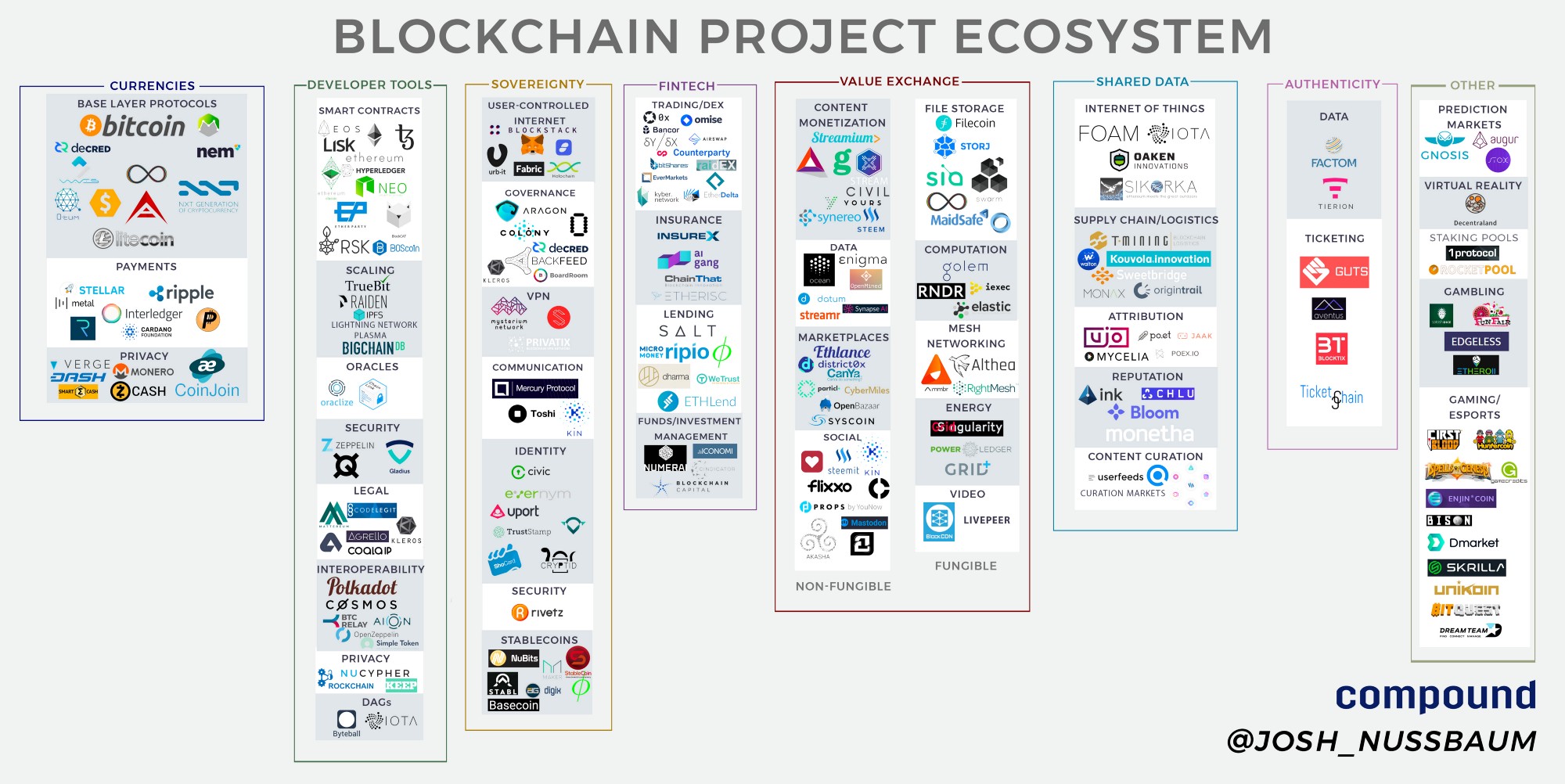
As I wrote in my article about ICOs, blockchain technology, cryptocurrencies and token sales are now at the peak of popularity. I have been working in the venture capital industry for more than five years and still have not come across technologies that would develop at such a dizzying speed, creating new companies and projects. Not so long ago, founders and venture investors dealt mainly with centralized exchanges, private blockchain solutions, wallets and some other startup ideas that dominated the market from 2012 to 2016.
However, as I said a few months ago, the growing popularity of Ethereum with its Turing-complete scripting language and the ability for developers to write the state in each block, created the conditions for the development of smart contracts. This has led to the fact that more and more teams are taking on decentralized projects in pursuit of the main advantage that the blockchain gives - the opportunity to develop a single truth with which everyone agrees, without the help of intermediaries or the central government.
Now on the market there are a lot of interesting developments that improve both the functionality of existing blockchain solutions and user experience. But given the frequency with which new new projects come out, it becomes increasingly difficult for me to track each of them and figure out what place it occupies in the ecosystem. In addition, the risk of not seeing the forest behind the trees increases if we do not have an exhaustive idea of what this forest looks like. Such considerations prompted me to compile a list of all decentralized blockchain projects that I track, including those that I was able to find information about myself or from tips from friends who are familiar with the ecosystem. This ecosystem map represents the outcome of this work.
A small caveat: many projects were difficult to relate to any one category, but I tried to identify the main purpose or unique value of each and distribute them accordingly. Of course, many projects fall into the “gray zone”: they can equally well be recorded in several different categories. The most difficult case is fat protocols, the functionality of which affects a number of areas.
Below I give an overview of all the selected large categories and briefly touch on those subcategories of which they consist.
Currencies

Base Layer Protocols - Payments - Privacy
For the most part, these projects were created as an improved type of currency for a particular use case; each of them represents a store of value, a medium of exchange, or a unit of accounting. Bitcoin has become the first and largest player in this category, however, many projects aim to finalize some aspects of its protocol or to adapt them to certain conditions. The Privacy subcategory could be merged with Payments or Base Layer Protocols, but I decided to write them separately, because anonymous, untraceable cryptocurrencies are very important for users who want to hide the transaction so as not to advertise some purchase for one reason or another, or for companies that do not want to divulge trade secrets.
Developer Tools
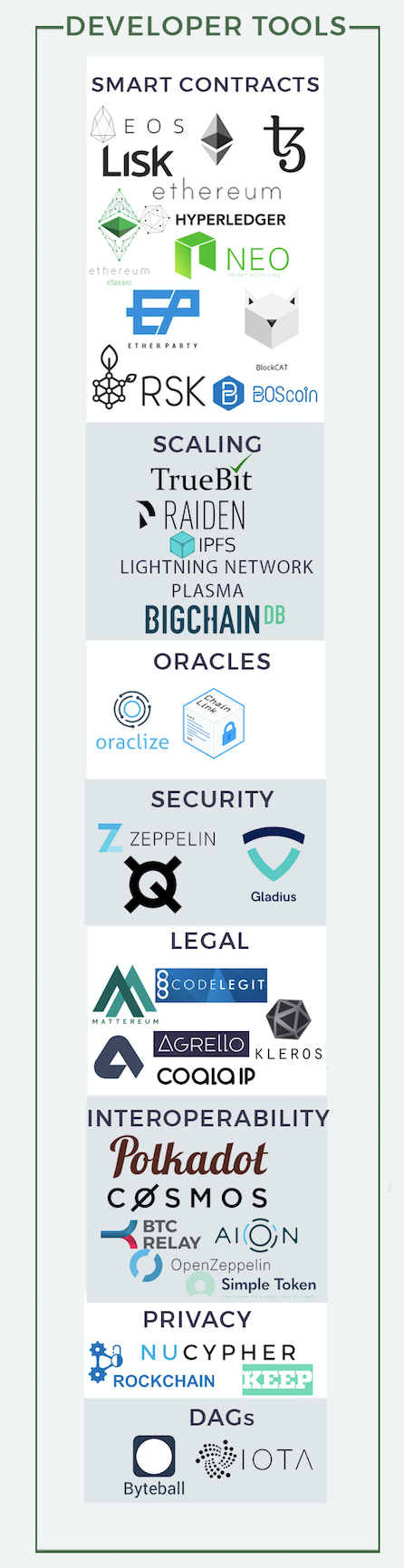
Smart Contracts - Scaling - Oracle - Security - Jurisprudence - Compatibility - Confidentiality - DAG Technology
Projects in this category are mostly used by developers as building blocks for decentralized applications. To enable users to directly interact with protocols through the application interface (to solve other tasks than financial), many of the modern products that are listed here need to be finalized for implementation on a wider scale. The scale and compatibility of protocols are areas of research that will play a major role in shaping the technology stack for Web3.
In my opinion, at the moment this is one of the most interesting categories, both from the point of view of theoretical interest and from the position of investor. In order for many of the blockchain applications that we predicted (for example, completely decentralized anonymous organizations or the Facebook alternative, which gives the user full control over personal data) to see the light, the basic scalable infrastructure must grow and develop. Many of these projects have set themselves such a goal.
Also, the principle “only one will win!” Does not work for this cut of products, unlike, say, cryptocurrencies, which serve as a means of accumulation. For example, to create a decentralized data marketplace, you may need tools from various subcategories: Ethereumfor smart contracts, Truebit for accelerated computing, NuCypher for re-encryption through proxies, ZeppelinOS for security and Mattereum for the execution of legal contracts to protect the interests of the client in case of disagreement. Since they are protocols and not isolated data warehouses, they are able to interact with each other. Such compatibility gives rise to new applications due to the exchange of data and functionality between several protocols in a single application. Preethi Kasireddy very clearly explains this process in his article .
Fintech
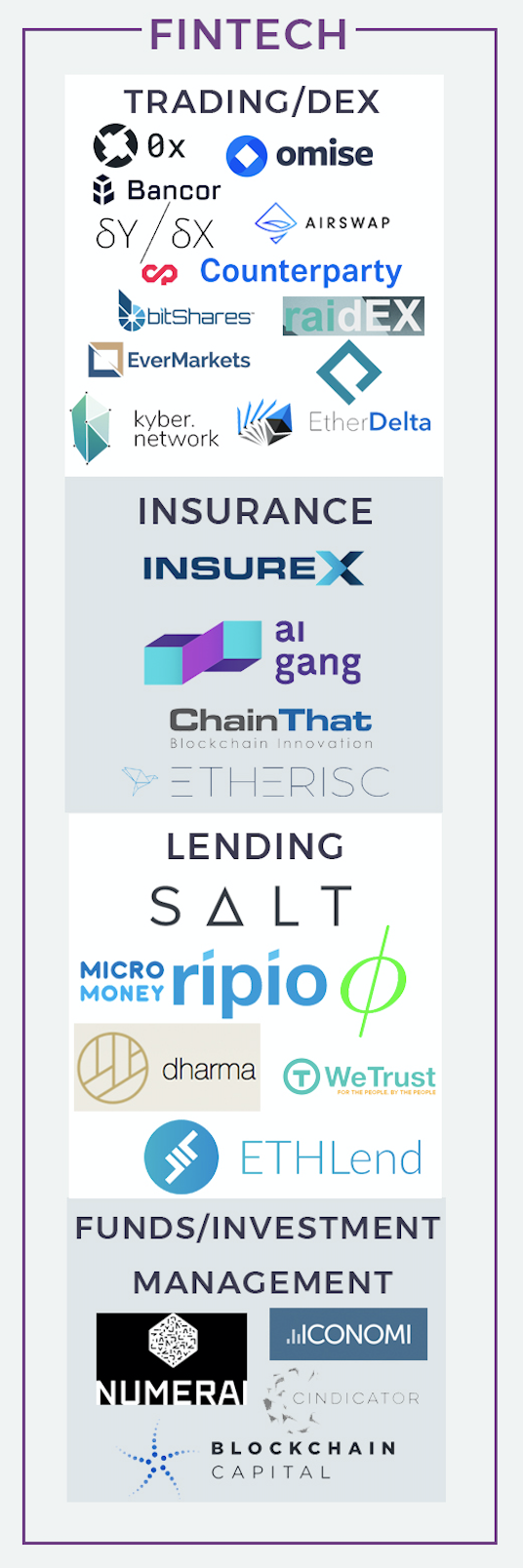
Commerce - Insurance - Loans - Investment Management
Everything is quite transparent here. When you use a large number of different protocols and applications (as in the example above), many of them may have their own cryptocurrency; as a result, a number of new economies are emerging. Any economy that operates with several currencies needs tools to convert one unit to another, so that it is easier to make loans, accept investments, and so on.
The DEX (Decentralized Exchange) subcategory could be categorized as Developer Tools. Many projects are already starting to implement the 0x protocol, and I suppose that in the near future this trend will only intensify. In a world where you can potentially make as many tokens as you like, a wide distribution of applications that use several tokens of different types will be possible only if all the difficulties associated with converting them are eliminated. It is this advantage that gives a decentralized exchange.
Products from the Loans and Insurance subcategories use the economies of scale by aggregating risks. By making the relevant markets open and allowing people to be evaluated in the context of a wider base or on an individual, differentiated basis (in accordance with their personal risk characteristics), it is possible to achieve lower prices for services - accordingly, theoretically, customers should benefit. The blockchain remembers and saves states unchanged; since records of all previous interactions are stored in a chain, users can be sure that no one will distort the data that make up their personal history.
Autonomy
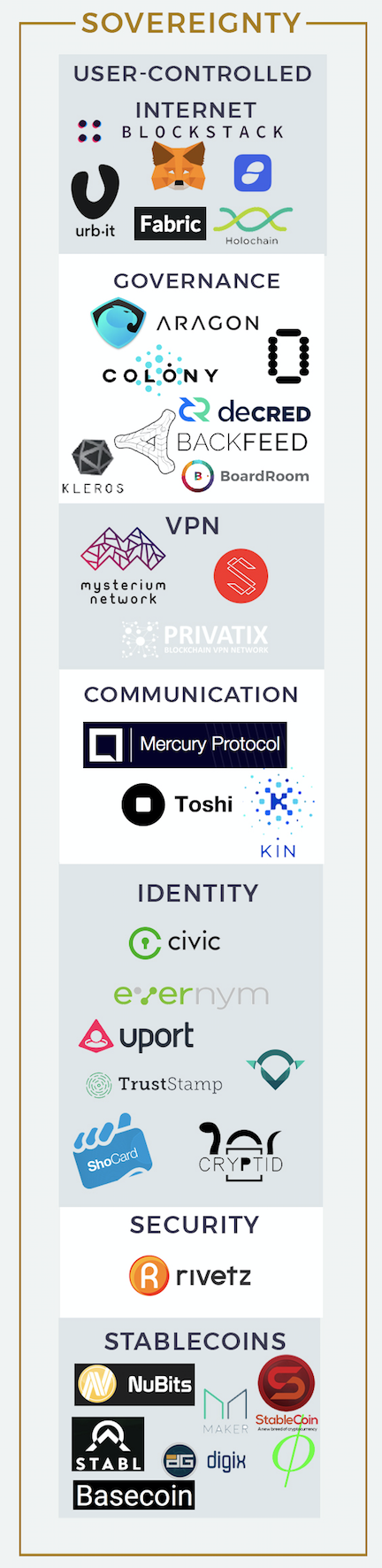
User Controlled Internet - Management - VPN - Communication - Identity - Security - Stablecoins
The Blockstack team writes about it this way:
“In the past ten years, we have seen a shift from desktop applications (which work locally) to cloud applications that store user data on remote servers. Such centralized services are a favorite target of hackers, they are often hacked. ”
Autonomy is another area that today causes me the most lively interest. The blockchain still suffers from problems with scalability and performance, but when it comes to confidential information that we are now forced to trust a third party, the value of its trustless architecture is more than worth it. Thanks to cryptoeconomics, users do not have to trust any person or organization - only theories that people will act rationally if given the right incentive.
Projects from this category provide the functionality needed in a world where the client must not believe in the honesty of people and organizations, but in incentives that are introduced through cryptography and economics.
Exchange of values
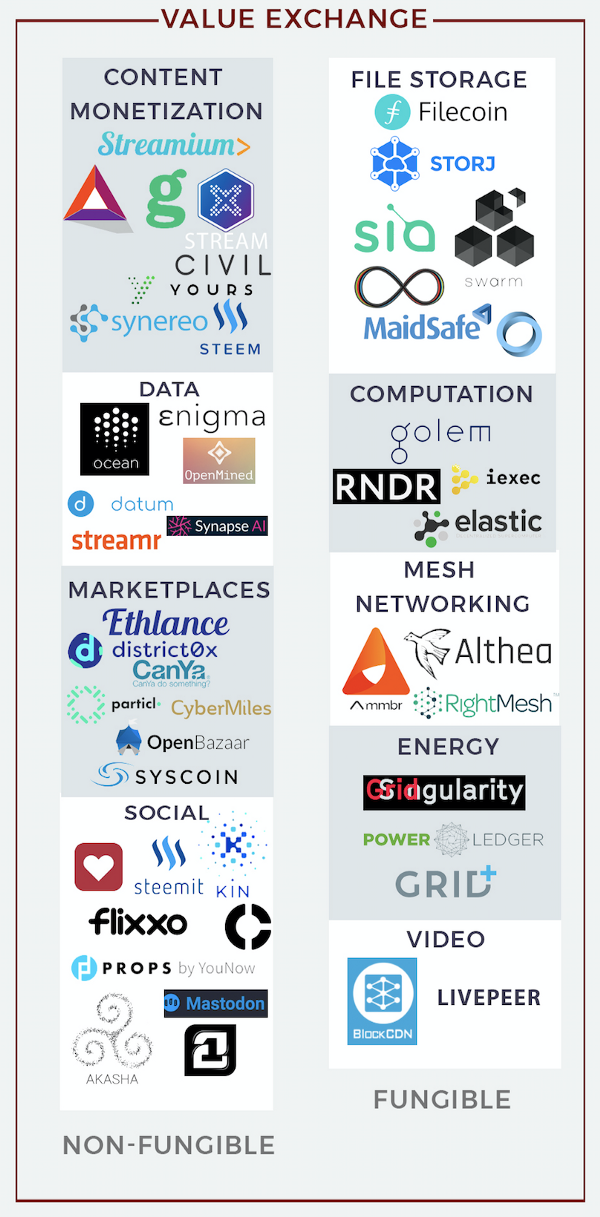
Non- Interchangeable: Content Monetization - Data - Marketplace - Social Services
Interchangeable: File Storage - Computing - Mesh Networks - Energy - Video
The main feature of the Bitcoin protocol is that several different participants can trust each other without the need to build trust relationships outside the blockchain. Participants can conduct transactions and exchange data in such a way that information about them will be stored unchanged. It is considered a generally accepted fact that people join companies when coordination of the production process on the market begins to cost more than within an individual organization. But what if even those who have no reason to trust each other could unite in such “firms”? Through blockchain and cryptoeconomics, the time and effort spent on building trust relationships is reduced to zero, which allows more people to take part in this kind of cooperation and receive part of the profit,
Now intermediaries and other rent-seeking individuals are an inevitable evil that allows you to maintain order, maintain security and enforce rules on the P2P market. But in many areas, cryptoeconomic systems can replace trusting relationships, as a result of which the need for intermediaries will disappear. Due to savings on the payment of their services, users will be able to provide each other with goods and services at much lower prices.
Projects in this category can be divided into two main groups according to one basic feature - whether the products with which they work are interchangeable. Markets that allow users to exchange interchangeable goods and services, modulate things like storage, computing, Internet connection, traffic, energy and so on. Now the competition among the companies that provide these goods and services is based on economies of scale - this paradigm can only be replaced by one where economies of scale become even more significant. This is not difficult to achieve if you turn to hidden resources and make the market open to all; marginal costs in this situation begin to tend to zero.
Marketplaces that work with non-interchangeable goods do not receive such benefits. However, they allow the supplier to collect the full value of their product or service, and not what the intermediary will leave them.
Data exchange
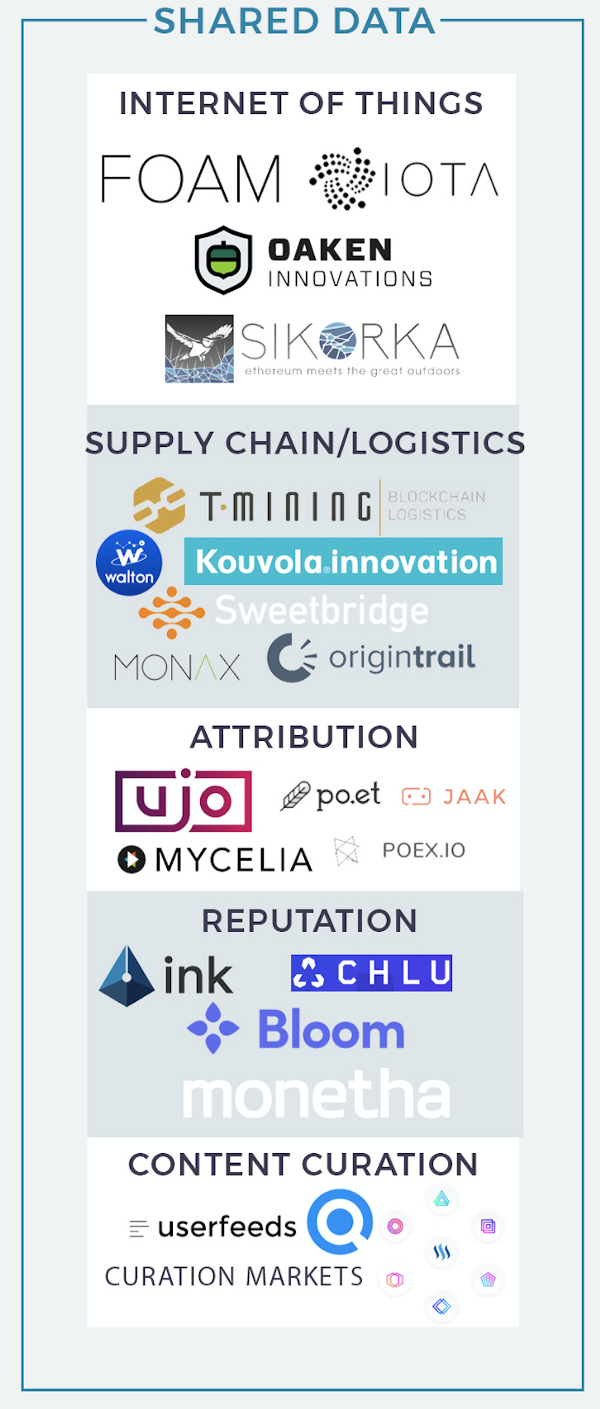
The Internet of Things - Supply Chain / Logistics - Attribution - Reputation - Content Management
The public data layer can be compared to the global distribution system used by airlines. This system provides a centralized data warehouse to which all airlines send their registries to make it easier to coordinate all information about available flights, including routes and prices. This allows companies such as Kayak and others to supplant classic travel agents - just add a front-end component to this system so that users can perform operations themselves. Typically, such intermediary aggregators attract those markets where there is a barrier to direct competition, but technological progress gives the intermediary the opportunity to combine the functions of employees, the necessary metadata and user preferences (as it happened with the GDS).
On the example of financial initiatives that carry out blockchain projects, we observe in action the most powerful technological catalyst that will push the boundaries of many markets - only the profit will now go not to the intermediary, but to those individuals and organizations that provide data.
In 2015, Hunter Walkwrote that one of the biggest missed opportunities of the last decade is the refusal of eBay to open its reputation system for third parties, which would make the company a P2P commerce center. I would put it even more categorically: the most valuable thing on eBay is reputation data, which has been collected for a long time. This is what makes users loyal and gives eBay the opportunity to charge them an impressive tax for the fact that they can make transactions with a calm mind, knowing that they are dealing with a trustworthy person. In blockchain protocols with open data, users can transfer such information from application to application as the latter connect to common protocols. As a result, increased competition leads to a more rapid pace of innovation.
Another example on which you can understand the principle of the public data layer is centralized companies, such as Premise Data. Premise Data staff contains a whole network of employees who collect all kinds of information about more than 30 countries - from the consumption of a particular product to the materials that are used in production in a particular location. The company processes this information through machine learning and sells the resulting databases to a wide range of customers. Instead of looking for and hiring people to collect materials, you can start a project in which anyone can search and add information, annotate the collected data and create various models to draw conclusions based on them. Participants will be able to earn tokens, which will gradually increase in price, as companies will pay them for the processed data and calculations based on them.
You can list many other similar features: the “open data platform” became a popular concept for startups several years ago, and several companies even managed to achieve great success with it. The problems, according to my forecasts, will arise mainly with sales and business development. Most companies sell databases to larger organizations; It will be interesting to see how decentralized projects manage their projects. Separate private enterprises also now have additional opportunities, which until now have been unprofitable or impossible for them to use.
Authentication
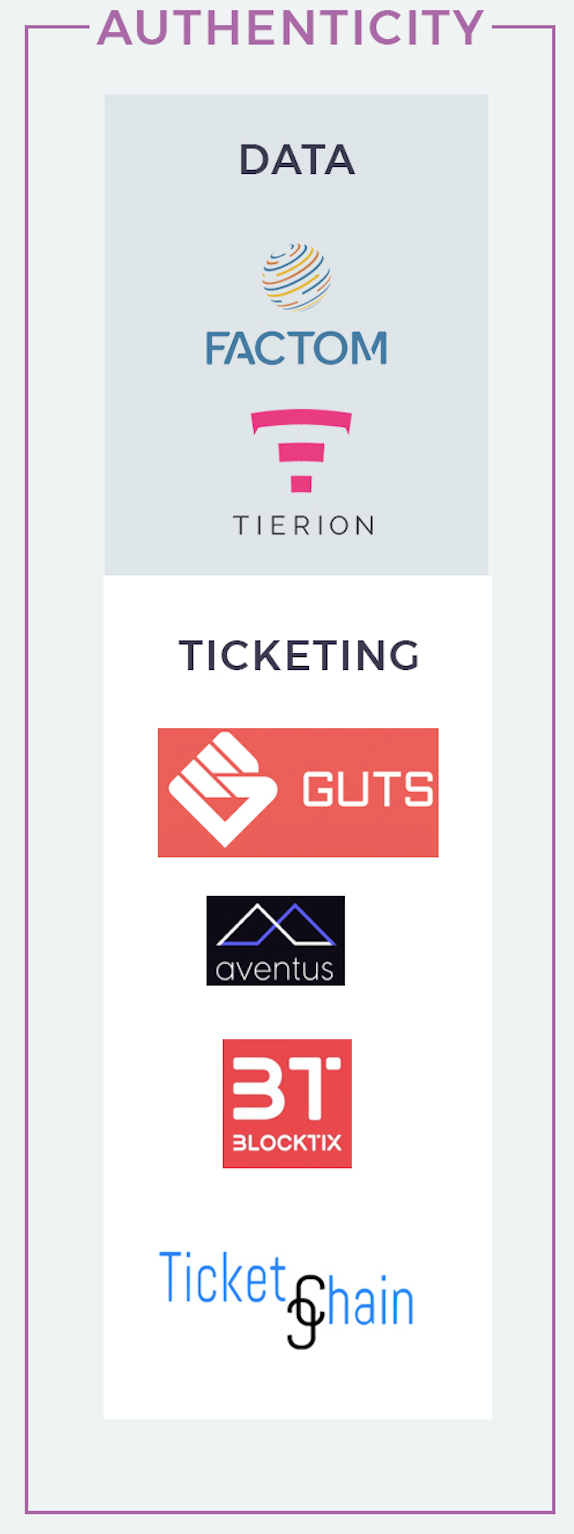
Data - Ticket Distribution
At its core, cryptocurrencies are simply digital assets that belong to a particular block chain. Products in this category use these digital assets to indicate goods in reality (for example, tickets for an event) or data. The invariability of the chain, even in the public domain, gives the participants confidence that no one has touched the data that they receive and that they will be accessible even after a long time. That is why for confidential information and those markets where fraud is a common thing, the introduction of a blockchain is a good way to convince the user that everything is done honestly.
Conclusion
Innovative solutions can be found in all these categories, but personally I am most interested in young projects that contribute to the development of the technology stack for web3: they provide functionality that will be useful in various usage scenarios, give the user independence in managing their own data and contribute the sale of interchangeable goods and services. So far, we can talk about cryptocurrency among the masses only in theory, but it is logical to assume that the infrastructure and applications that provide users with benefits, privacy or security in particularly sensitive matters (for example, identification, credit balance or VPN, among others), most can count on success.
If we talk about the more distant future, projects that strengthen the ecosystem as a whole through the exchange of data and bootstrapping of the system (that is, the exchange of non-interchangeable assets) are also of interest. I’m sure there are other areas that I’m looking at from the wrong perspective or can’t even imagine! If you are working on something that fits these descriptions, or want to clarify or object something, I will, as always, be happy to hear from you. Jesse Walden , Larry Sukernik , Brendan Bernstein , Kevin Kwok , Mike Dempsey , Julian Moncada , Jake Perlman-Garr ,
also participated in the compilation of the map and its explanations .Angela Tran Kingyens and Mike Karnjanaprakorn .