October 9, 2017 at 16:49
Startup of the day (August and September 2017)

Continuing the series of Startup of the Day digests, today I present the most interesting projects for August and September. If you want to get acquainted with the rest, then I ask in my blog. Entries are available on Facebook , ICQ and Telegram .
Curve
One of the Important Problems of a modern person is too many bank cards in the wallet: one debit, where the salary falls, one credit to live in the grace period, and also bonus cards that you need to pay in different cases for gifts from the bank. English Curve proposes to solve this trouble with another special card, “one ring to rule them all”.
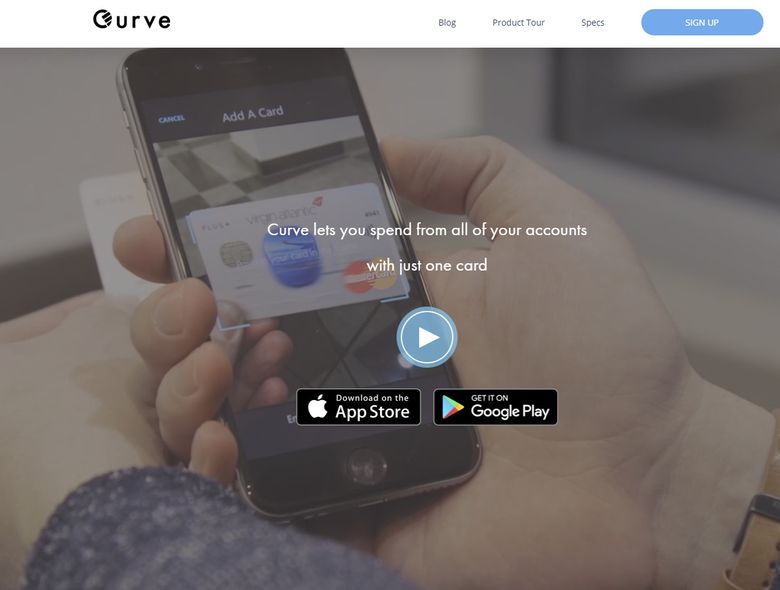
The card is completely ordinary, plastic, not virtual, and arrives by mail, and does not click on the site. But in the mobile application, you can connect all your old credit cards to it and indicate which one you need to pay with in the future. From now on, it is enough to carry only a new card with you, and payments from it will be transmitted to the one indicated in the application, Curve does not have his own account. Naturally, the choice of the active payment method can be changed through the application at any time.
Moreover, it is possible to change the card after the transaction, it takes two weeks. If the user suddenly noticed that the bonus miles have not arrived, he makes a few clicks on the statement, a refund occurs on the old card, a transaction is made on the new one.
Curve launched two years ago, then received $ 3 million in seed investment. In addition to product development, 50 thousand users were found with this money (very good, $ 60 per person, even if you do not take into account everything except marketing): now they are mostly small entrepreneurs, Curve helps them combine personal and corporate expenses. The other day, a startup received the first big round - $ 10 million, promises support for all European countries and currencies, active marketing and more attention for ordinary hipsters, not business users.
Brandless

Imagine a store in which there is no Tide, Ariel and dozens of other items, but there is only “washing powder”? And next to it - “dishwashing detergent”, “tea” and “golden rice”? If you make such a store on the Internet, you get Brandless.
The main advantage of nameless goods is that they are cheaper. Household chemicals are, of course, not designer clothes, and the mark-up for a brand in this segment does not amount to thousands of percent of the prime cost, but advertising is an expensive thing, and in the end the consumer pays for it anyway. As for quality, the startup believes that it can provide it itself, and the millennials are rational enough to believe in it. In fact, it turns out that Brandless acts as a low-cost brand and carries all the costs of developing its name, but they are harmoniously distributed among many products. The traditional brand doesn’t succeed; Coca-Cola washing powder will not enter the market.
The prices of unnamed goods are really low, when compared with Instacart counterparts - the difference is one and a half times. To emphasize cheapness, Brandless uses the FixPrice approach: everything costs $ 3, sometimes it’s a package, sometimes two, sometimes three, but psychologically 3 dollars anyway - it's cheap.
The company was founded a year and a half ago, this summer the first big investment came to it - $ 50 million. For this age - a lot, Facebook at the same "age" received 27.5.
Booster
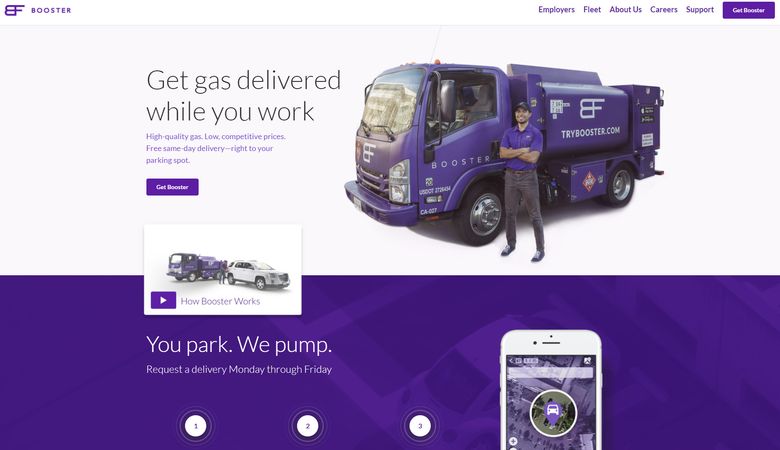
If a startup wants to change the traditional pre-Internet industry, here are two important success factors: the popularity of a niche and the standardization of services. From this point of view, refueling a car is one of the ideal candidates for transformation: it is both very popular and very simple.
Therefore, it is not surprising that many projects are trying to replace the traditional gas station. But the trouble is that the old solution is very effective and you can’t easily replay it. In a "normal startup", the user clicks in a mobile application, a fuel truck arrives to him and refuel a parked car, you only need to open the tank in advance.
The only problem is the price. A special truck with a driver spends a significant amount of time on each car, and as a result the client pays for it. It turns out more expensive than at a gas station near the road, well, and who needs it?
Booster does the same, but with one small caveat: it only leaves the parking lot of large employers from the list of those with which it has agreed. Of course, this dramatically reduces the cost of delivery: if ten employees ordered gas, then the fuel truck will serve them in one trip at a convenient time for themselves, anyway, no one will go anywhere on a working day. As a result, Booster prices are the same as at gas stations, with no extra charges. And this, of course, dramatically changes the user's perception, convenience and time saving become free. In addition, the HR department of the corporation is a free advertising channel, they need to show concern for employees, eychars will necessarily send a letter “we agreed with a cool service”.
The start-up will soon turn three years old, while it works only in the Valley and one area of Texas, it raised investments a little more than $ 30 million, of which two-thirds - in the last round this summer. Will expand to new territories.
Dataminr
If the First World War began now, its earliest sign would be a tweet like “Wow, some shots near the Latin bridge! It’s interesting, what’s happened with the Archduke? ”A report of the wound would have passed through the main news agencies in about fifteen, or even half an hour. This lag has almost no significance for most of humanity, but there is one important exception - the exchange. Immediately after the publication of such news, quotes will collapse, and anyone who reads and correctly understands the tweet will get time to sell their portfolio at old, pre-crisis prices or even short-circuit everything.
Dataminr sells access to early information. Deep integration with Twitter and (this time without jokes) smart algorithms help him find tweets of witnesses of something unusual, group them according to real world events and give them to subscribers in a relatively compact form. Well, users get an advantage in time and find out which stocks will fall or rise in half an hour. In promotional materials, Dataminr talks about his successes in the early detection of several known terrorist attacks - and, in principle, for a large fund, even one case is enough to pay back any subscription price. Alas, no one knows the number of false alarms - but they can be very expensive.
In addition to traders, Dataminr services are bought by the media and the state. Last year there was a big scandal with the special services, Twitter was outraged by the use of his data for resale in intelligence and blocked access. Then, apparently, without a hassle, we agreed on everything, now on the Dataminr website there is an offer for government agencies. The company has attracted $ 180 million of investments in its history, the last round was estimated at $ 700 million. Among the interesting shareholders of the project are Twitter itself and the CIA Venture Fund.
Duolingo
Not a startup anymore, reCAPTCHA was a double-bottom project. On the surface, webmasters protected sites with complex pictures, and users entered letters to prove that they were human beings, not robots. Under the hood - words recognized by people were used to refine the results of automatic scanning of old books in the library. After selling reCAPTCHA to Google, its founder, Luis Von Ahn, decided to repeat the same trick in a different area and created Duolingo.
For the user, Duolingo is a foreign language tutorial, something like our LinguaLeo. "The girl in English will be a girl; select the picture where a girl is drawn; translate the phrase "I am a girl" ... ", and so 10-15-20 minutes. In theory, after a year of daily exercise, the results will be noticeable. The second bottom was the use of translation results for commercial purposes. Everything is like with captcha and books: we take a large document, cut it into 200 sentences, include each sentence in an exercise for ten users, if at least seven results coincide, this is the correct translation.
The application - a free simulator quickly became popular: usually they take money for a foreign language, but here it’s free: how can one not take off. The last time Duolingo boasted 150 million users, it has more than 100 million downloads on Google Play - everything is really good. The trouble came from the commercial side: it was not possible to sell the results of user translations. It was easier with reCAPTCHA's books: the customer had the project from the beginning, his process was fine, he wasn’t looking for alternatives. And Duolingo came out with transfers to an open and super-competitive market with an infinite number of other suppliers for every taste and budget. In addition, reCAPTCHA's efficiency was almost 100%, the user always helped the startup scan the library, and with translations everything is different: a complex phrase can be offered only to the most advanced students,
As a result, one of the most popular or even the most popular foreign language learning application has been eating away investor money for six years now, somewhere around $ 15-20 million a year, and earning almost nothing. After failing ideas with translations, Duolingo turned on ads, then launched paid tests with certificates, now it implements in-game currency. And since the training product remains fundamentally free, only rather strange things are sold for diamonds: for example, for 60 rubles the application will “forget” to skip one lesson and continue to praise the user for days without a break. Buying this, of course, is negligible, the tests are not very popular: everyone needs TOEFL, not Duolingo. But, I repeat, new investors are still regularly located, the audience is huge. The next round was this summer,
Acorns
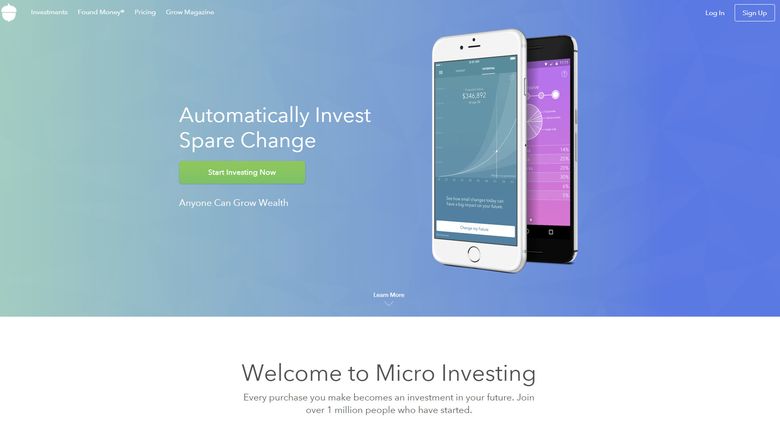
Every American knows that for a better old age you need to buy stocks from a young age. But when it comes to practice, willpower is often not enough, and instead of securities, money goes to entertainment. Acorns helps people outsmart their dark side and work on a decent retirement.
To start investing, just download the mobile application and authorize the main bank card in it. Acorns analyzes payments from it and automatically invests in the index funds the difference between the real price and round dollars. They bought something for $ 14 and 1 cent - they set aside 99 cents, and so every time, with any operation. Psychologically, this is not felt, the user does not infringe on himself, just think - a trifle. But with two non-cash payments per day per year, 350 bucks accumulate in the investment account - the amount is already tangible.
Of course, Acorns is ready to take ordinary transfers, you can just send him any amount or set up regular replenishment, but the basis of his positioning is investing change, everything else can be offered with fifty more services. Two million people entrusted their cards to the startup, in 2017, they have to make a billion payments, which means a billion micro-investments. Acorns charges $ 1 per month for services (surprisingly, not 1.01), or 0.25% of the bill per year if it has more than $ 5,000; annual revenue, respectively, is about 25 million dollars. The company has raised nearly 100 million investments in its history.
If we think about localization, then the Russians will not spend money on stocks, but the mechanics are interesting, and it will come with us for charity.