We create an “external circuit” of the ecosystem with independent developers: the results of the Skyeng API contest

The competition of projects using the open Skyeng API has come to an end; Today we represent winners and prize winners. This, however, is only a preparatory stage for the creation of an “external circuit” of our ecosystem. We plan to actively help our competitors bring their projects to the state of full-fledged products. Why do we need this, as well as whom and why we chose - in our article.
Participants and criteria
On our competition received 25 applications, of which 11 reached the final, ie were in a state of at least MVP (minimally viable version). Next, we put marks on four criteria :
1) Methodological utility for a Skyeng student (from 0 to 2 points). How competitive the project helps to improve the effectiveness of learning English.
2) Product utility for a Skyeng student (0 to 2 points). The further the competitive project from our existing products, the higher the score. The first two scores overlap somewhat, but they were put up by different members of the jury, so they were posted.
3) The number of API methods used (from 1 to 3 points). In total, we have 5 methods open (search for a word in the dictionary, obtaining all data on the meaning of a word, linking a Skyeng account, importing studied words from Skyeng, adding words for learning into Skyeng applications), all five were used in only one competitive project. We decided not to make estimates from 1 to 5 here, since some projects simply do not need all the API methods, it would not be very honest with them.
4) Product availability (1 or 2 points). Extra point for a fully functional version.
We decided that projects that received 0 in at least one of the first two ratings cannot be prize winners. The main goal of the competition is to expand our ecosystem with products useful for learning English by our students. Competitive projects with an assessment of product utility 0, in our opinion, do not expand it, but only duplicate the functionality of the existing Skyeng Words application. They may have some additional goodies, for example, training for speed or the presence of a huge number of languages, but the benefit from them is for our ecosystem is minimal. And projects, the methodological utility of which we rated at 0, simply do not fulfill the learning function. We are glad that the developers use our API, but this is not enough to win the competition.
Grades are gathered in such a plate .
Winners and Prizewinners
First Place: Nail Galiaskarov, Readore
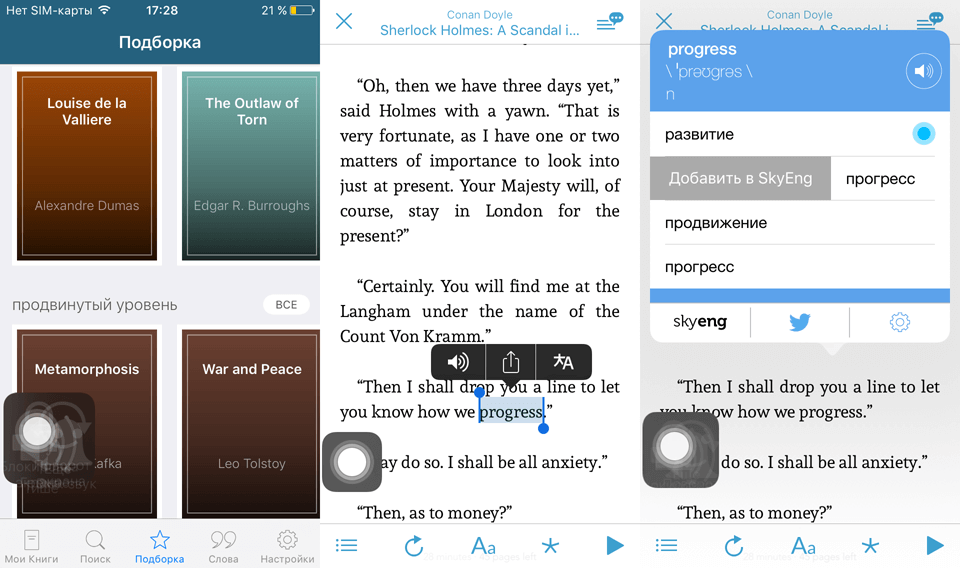
We already talked about this electronic reader for the iPhone with an educational bias and our own collection of books. In fact, we thought that there would be more such applications, since the idea lies on the surface: here there is obvious benefit both for a school student and for any person learning a language from books, and ready-made content in the form of these very books, including uploaded by the user. Nevertheless, only the Readore project took part in the competition - a high-quality, well-developed and fully ready reader using almost all the methods of our API. Obvious first place. It is a pity that there is no version for Android (hint!).
Second place: Kirill Lyakhov and Shakuro team, SkyLocker

The first thought when we saw the Skylocker was: “how could we not have thought of it ourselves ?!” This is a simple application that replaces the standard Androidphone lock screen with vocabulary training. So far, you only need to choose the correct version of the word in English, in the future it is planned to include other skills. In our experience, it is great as a reinforcement of already learned words. By the way, this is the only project in the competition created exclusively for school students.
Third place: Evgeni Kriulin and Mirbek Imarov, LennyBot
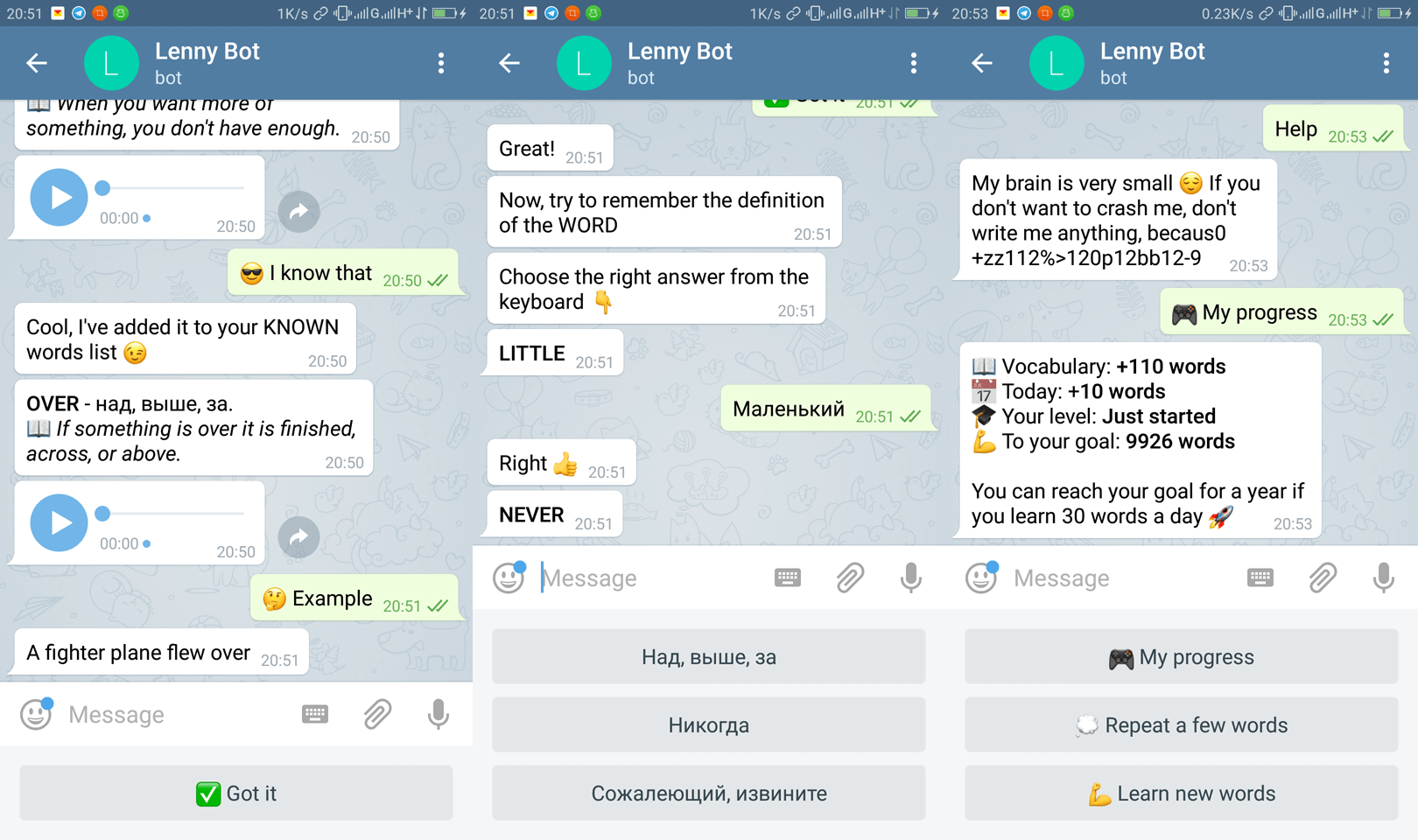
The reason why “Lenny”, unlike individual applications with the same functionality, turned out to be winners: this is a bot. Bots have a different audience - people who are psychologically more comfortable training without installing any third-party programs; as a result, there is an obvious benefit to some of our students. API functionality is still limited, the authors plan to make a separate bot for our API so as not to overload Lenny - in general, there is a prospect, and it pleases.
Third place: Sergey Novikov, ESLBot
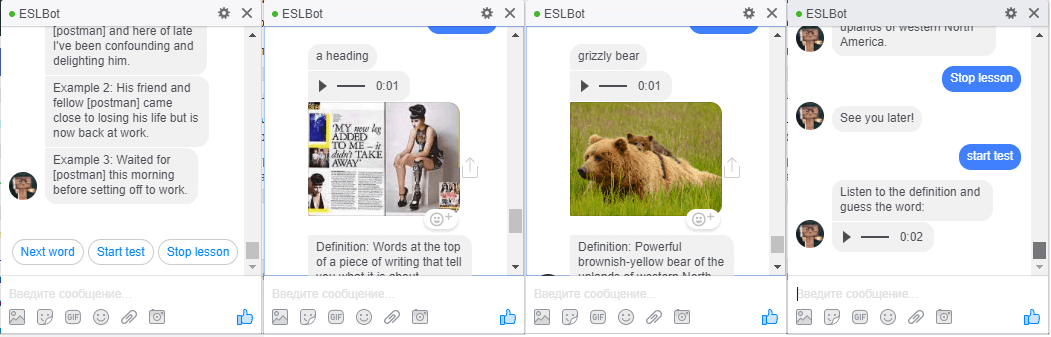
Another bot, this time for Facebook. The functionality is even more limited, but bots are useful for our ecosystem, therefore, a well-deserved prize.
Third Place: Dmitry Sadovnikov, Enwords
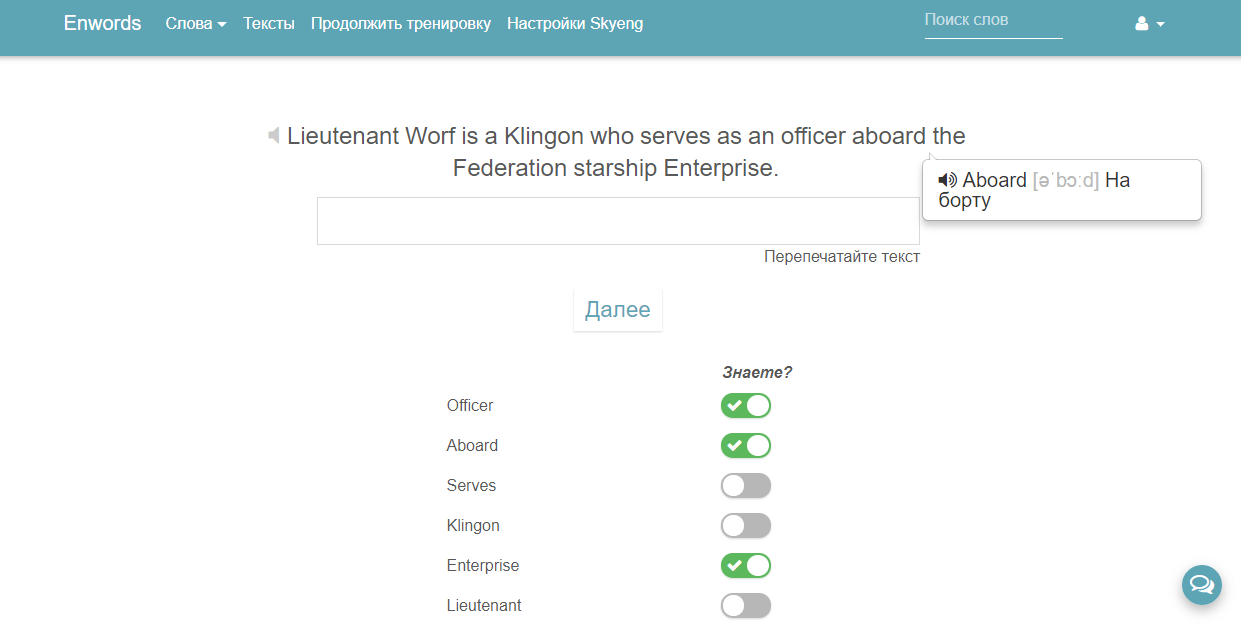
A site offering to train English words in context. So far it looks like this: the site selects sentences containing the desired word, the user reprints them. The value of this workout is not obvious, but we see potential in this product. For example, if you include new API methods, you can thematically tailor sentences to the lesson just passed by the student, or to the word lists taken by him for study, or simply to his interests. We believe that with the help of our methodologists, this site will become a valuable participant in the Skyeng ecosystem.
Third Place: Vadim Bondar, Lingvasto
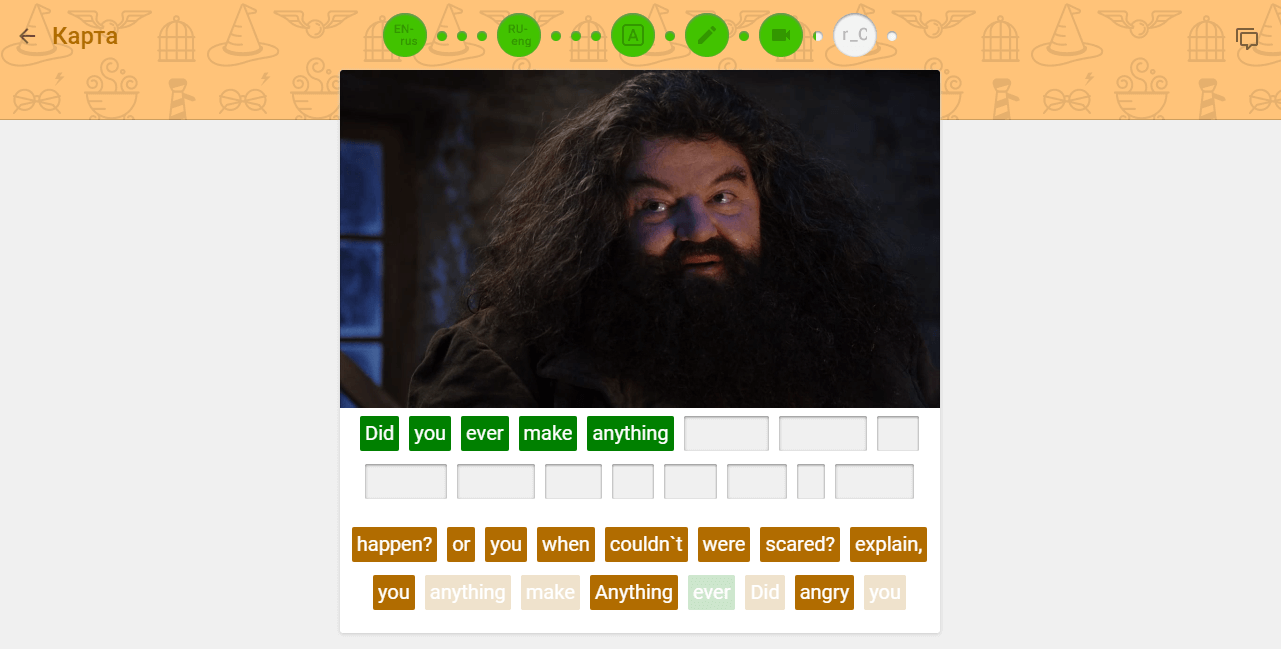
This game educational program fascinated our methodologists, therefore, to describe it, let us give them the floor (under the cut)
* Methodical comment *
1. Training at Lingvasto is gamified based on the Harry Potter storyline. Waypoints show the subject of the task, which prepares the user, and the entire route is chronologically laid out in the plot of the book, which may motivate the user to go see or read one piece in the original. Very pleased with the mechanics in the form of potions, magic items, grammar spells.
2. The basis is “edible pieces of material”, which prepares the user for perceiving a small excerpt of an unadapted video from Harry Potter, which at the end of the path creates a “success story” - “wow, I trained a bit and understand the phrases, let’s go I'll watch a movie in the original. "
3. The service resembles a simulator, ie mini-workouts working on different aspects of words: meaning, spelling, sounding of a word, recognizing it by ear and, as a result, recognizing this word in context. We go from simple to complex, which again prepares the student and gives him confidence, shows his progress when he repeated / learned the words, and then he understood a whole segment.
4. The service is focused on different types of users: audials (they hear), visuals (they see pictures) and kinesthetics (they do interesting tasks).
* User tips *
This service is for entry-level (elementary, inter-mid), which, based on your favorite movie, shows that even now you can watch something in the original. Tip - after going through the card, find this episode in a movie or book and look / read everything in small pieces. You can use the selection of words in the Words application by Harry Potter, and for reading our extension for the browser.
Train regularly. On a day, it’s better not all at once, but dosed. So that the words remain in memory and there is no overload, but interest remains.
2. The basis is “edible pieces of material”, which prepares the user for perceiving a small excerpt of an unadapted video from Harry Potter, which at the end of the path creates a “success story” - “wow, I trained a bit and understand the phrases, let’s go I'll watch a movie in the original. "
3. The service resembles a simulator, ie mini-workouts working on different aspects of words: meaning, spelling, sounding of a word, recognizing it by ear and, as a result, recognizing this word in context. We go from simple to complex, which again prepares the student and gives him confidence, shows his progress when he repeated / learned the words, and then he understood a whole segment.
4. The service is focused on different types of users: audials (they hear), visuals (they see pictures) and kinesthetics (they do interesting tasks).
* User tips *
This service is for entry-level (elementary, inter-mid), which, based on your favorite movie, shows that even now you can watch something in the original. Tip - after going through the card, find this episode in a movie or book and look / read everything in small pieces. You can use the selection of words in the Words application by Harry Potter, and for reading our extension for the browser.
Train regularly. On a day, it’s better not all at once, but dosed. So that the words remain in memory and there is no overload, but interest remains.
Despite the fact that the use of our API is minimal, we decided to include it among the winners: it is a truly unique product with great prospects, whose game and educational mechanics are brought to the level of a strong MVP, and tightening the API and filling the engine with content is a technical matter. We are going to actively help this project develop.
Other participants in the top 11
Dmitry Lapaev, “More Words” is a dictionary application on Android, in which it is possible to add words to the lists “for study” and “learned”, with a little test. Unfortunately, the final usefulness of this product for our students was lower than that of rivals.
Alexander Bilchuk and Mikhail Zhikharev, Daily 5 - a nice Android application for word training with simple mechanics “choose the correct translation”. An important plus is a huge number of languages. The authors did a good job and were able to connect all the methods of our API for English. Unfortunately, this was not enough to win the competition.
Oleg Tabot, http://easylang.ru/- A site where you can choose books and films for your level of English. However, you cannot read and see them there, the site provides only links to third-party resources. The author managed to connect the import of words from the Skyeng account, but all that allows you to do this is to see the number of unfamiliar words in the work, which in itself is uninformative. In general, a recommendation system of media content in English would be a useful product, but we did not see the methodological value in providing the site in its current form.
Sergey Ilyushin, enWords Trainings - iOS-application for training words, almost identical to our Words, except that it has a temporary training. For obvious reasons, we are not ready to give a prize to products similar to our own developments.
Timofei Zhiganov, Flash Town is a multifunctional entertainment bot for Telegram, in which the authors have integrated the word translation function using our API. We are not against such use of our API, however, the value of such a product for learning English from the point of view of our methodologists is minimal.
Plans and reality
A brief description of the goals of the competition at the beginning of summer looked like this:
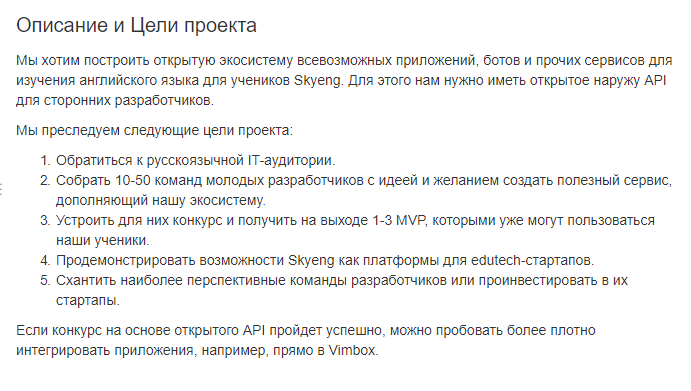
How do the results correspond to them?
1: We broadcast information about the competition in the IT community, including in our blog on Habré. Once again, we say that we are an IT company, and not just an English language school. This is a large and continuous campaign, the contest was a good information occasion, but it is impossible to single out its effect.
2: We received 25 applications that fit into the estimated framework; 11 of them reached the final part - well.
3: According to the results of the competition, we got 6 MVPs that are quite well-developed and useful for our students, which we are ready to put on the school window right now - this is much more than we expected.
4: This task relates to the next step in creating the “outer circuit” of the Skyeng ecosystem. Having posted the projects of the contest winners to the Vimbox storefront, we will direct them our traffic, a super-motivated target audience that already pays an average of several thousand rubles a month for learning English and which it will not be a pity to give a penny for a useful application or service. Thus, we did not just open our API, we give startups the opportunity to earn on our platform. And we ourselves also don’t remain unprofitable: we could write the same chat bots, but it’s more profitable for us to give someone else to make them (and make money for them), having received a new useful product in the ecosystem.
5: While at work. They didn’t scam anyone; the investment option is being discussed. Various other ways to help projects, such as resources, are also discussed.
Application integration: There will not be direct integration into Vimbox yet, but we have a “Downloads” section, where we will place links. Theoretically, the option of integrating Enwords is possible if it has something like its own API or widget, but for this, we and the author of Enwords will have to work hard; economic feasibility has not yet been evaluated. In general, this item did not have a number, since it assumed the appearance of a rather specific competitive project - a ready-made widget that can be easily embedded anywhere. As an example, we looked at crosswords (hint!).
Present and future
The competition is a preparatory stage on the way to creating an “external circuit” of the Skyeng ecosystem. He allowed us to choose six winners (and a couple of interesting projects) whose products are in varying degrees of readiness. At the next stage, we have to work with them, looking for solutions to their problems, opening them some new tools for working with our API, helping with advice and deed. This work will not only lead to the appearance of finished high-quality products in our ecosystem, but will also allow us to improve and expand its linking mechanisms, as well as possibly establish the interaction of independent teams among themselves.
In general, there are interesting days ahead that will throw up a lot of interesting cases that we will share with readers of Habra.
As for the contests themselves, they, of course, will still be in one format or another, although probably with different prizes (focused specifically on the needs of specific developers). But you should understand that this is a formality: the real competition continues non-stop, and if you have an interesting development that is useful for our ecosystem, you can always fill out an application and join our pool of independent projects.
Well, if you want to become part of the Skyeng team, then we are always in search of talented developers !