HPE ProLiant Gen8 and Gen9 vs. Servers Gen10
The HPE ProLiant server family today has dozens of multi-generation models. There are many detailed descriptions of individual models. However, it is often necessary to cover the whole picture with one glance and compare models. This article focuses on the comparative characteristics of some of the most common Gen8 and Gen9 servers with the appearance of Gen10 this year.
 .
.
Obviously, IT should work at the speeds that a modern business requires and be an accelerator of new ideas, products and services. To build fast-growing hybrid solutions, an appropriate IT infrastructure is needed that combines cloud-based economy and agility with the security of an on-premises data center.
HPE ProLiant servers are designed to simplify the building of enterprise hybrid information technology (Hybrid IT). According to an external independent testing conducted in May 2017, HPE ProLiant is recognized as the most secure industry standard server in the world.
More than 1 million customers worldwide have built their business on HPE ProLiant servers. The following server lines are currently available in the rack and tower versions.
- HPE ProLiant Easy Connect
- HPE ProLiant MicroServer
- HPE ProLiant DL
- HPE ProLiant ML
All four families are designed for many types of workloads, but each of them is optimized for specific applications.
HPE ProLiant Easy Connect
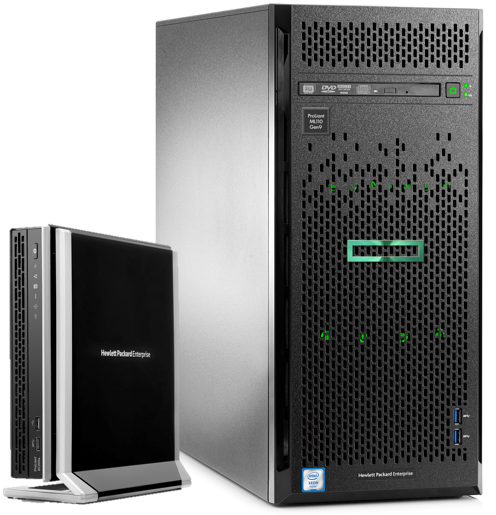
Appearance of EC200a (left) and ML110 servers in the entry illustration
=
HPE ProLiant Easy Connect Managed Hybrid Servers provide remotely managed services offered by HPE partners as a 1, 3, or 5 year subscription paid monthly or annually. They provide safe and reliable access to Windows, Linux, and SaaS applications. These managed solutions reduce the Total Cost of Ownership (TCO) for remote points of sale and offices
Note. Hereinafter, official photographs and tables from the site https://www.hpe.com /
HPE ProLiant MicroServer are used
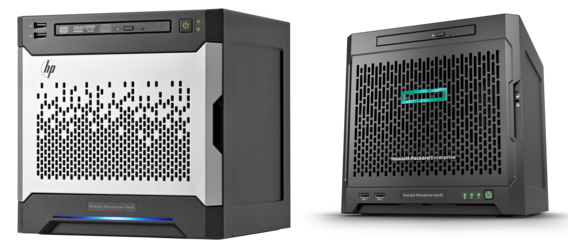
Appearance of MicroServer Gen8 (left) and Gen10
The compact, quiet and stylish HPE ProLiant MicroServer is positioned as “the perfect first solution for micro and small businesses.”
The HPE ProLiant MicroServer Gen10 supports dual-port 4K streaming media for displays. It comes with pre-installed, easy-to-use ClearOS and applications for small or home office (Small Office / Home Office, SOHO).
MicroServer helps reduce costs while increasing productivity and efficiency. Its form factor is convenient to maintain, and there is no need for a special server room.
HPE ProLiant DL

Appearance of DL380 Gen9 servers (left) and Gen10

Appearance of DL560 Gen9 servers (left) and Gen10
Secure and versatile, optimized rack-mounted servers for high performance, excellent manageability, and expandability.
HPE ProLiant ML

The appearance of ML350 Gen9 servers in a cabinet (left) and rack-mount version.
Ideal choice for a remote office or division, as well as for growing companies. While the DL server family includes the most flexible, reliable servers with optimized rack-mount performance, ML provides the greatest business value for solutions based on them.
Series Overview (1H 2017)
HPE ProLiant 10 series . Small Scale Servers They are inexpensive and easy to deploy.
HPE ProLiant 100 series. “These are the servers that are needed” (Right Sized Servers). Provide the best combination of performance, efficiency, capabilities and manageability.
HPE ProLiant 300 series . Versatile Performance Servers Industry-leading design with flexible choices for diverse computing and storage workloads.
HPE ProLiant 500 series . Extensible Servers (Scale-up Servers). Scalable for critical workloads in any business.
For a preliminary rough calculation of economic characteristics, the HPE server TCO calculator can be used .
Additional architecture information, including complete configurations, calibration, BOM, and deployment details, is provided here .
For many users, HPE MicroServer will be the best choice, at least in the beginning. In Gen10, its features are improved.
HPE ProLiant Solution Options
To build a modern and optimized IT environment, you can choose between various HPE Rack and Power Infrastructure options. It contains the following components.
- racks with many options for height, width and depth;
- Power Distribution Units (PDUs), from minimum to enterprise scale;
- Uninterruptable Power Supplies (UPS) of various power and size;
- solutions for virtual machines (Virtual Machine, VM);
- other elements of equipment rack solutions.
Rack-mount HPE ProLiant Gen10 delivers a 71% increase in performance with the new Intel Xeon Processor Scalable Family processors and a 66% increase in memory bandwidth for memory-intensive applications.
Comparison of the bandwidth of the Gen10 and Gen9 servers (July 2017).
Gen10 = 12 Channels x 2666 data rate x 8 bytes = 256 GB / sec.
Gen9 = 8 channels x 2400 x 8 bytes = 154 GB / Sec.
256/154 = 1.66 i.e., Gen10 bandwidth is 66% larger.
HPE ProLiant Gen10 Server Technologies
Agility. Intelligent System Tuning (IST) optimizes performance. Includes Jitter Smoothing, Core Boosting, and Workload Matching.
- Intel Xeon Processor Scalable Family provides more cores and higher bandwidth.
- Increased server performance is achieved through HPE SmartMemory with a performance of 2666 MT / s (megatransfers per second) and technology "fast fault tolerance" (Fast Fault Tolerance).
- Servers are equipped with the fastest permanent memory (Persistent Memory), the volume of which can reach a terabyte level.
- Provides easy selection, deployment, management and support for the HPE server infrastructure throughout the life cycle through the use of HPE OneView 3.1, HPE iLO 5 and iLO Amplifier Pack.
Security is provided by a number of technologies .
- Implemented protection against cyber attacks with Silicon Root of Trust.
- Detects malicious code and malware with Run-time Firmware Verification.
- Restores original or safe settings with Secure Recovery.
- Enhanced security is achieved with iLO 5 Advanced Premium Security Edition.
- Hardware security options include Trusted Platform Module (TPM), Chassis Intrusion Detection Kit, and Secure NICs.
Gen10 Upgrade Guide
The Gen10 family offers options that fit all your workload needs. For added flexibility, HPE FlexibleLOM, HPE Flexible Smart Array, HPE SmartMemory, NVMe, Persistent Memory and more are available. For a complete list of options and details, see QuickSpecs .
The Gen10 server line was built on the experience of previous generations of HPE ProLiant and customer feedback. The tables below provide official information on the evolution of HPE ProLiant servers from Gen8 to Gen10, as well as specifications for HPE MicroServer Gen8, HPE DL380 Gen9 and HPE DL560 Gen9 ─ for cases when they can be correctly compared with similar Gen10 models. For HPE ProLiant Easy Connect and HPE ProLiant ML, such a comparison has not yet been published by the developer.

Tab. 2. Comparison of HPE MicroServer Gen8 and Gen10
The most notable changes in the HPE MicroServer Gen10 were the replacement of the Intel Xeon processor with AMD Opteron. The characteristics of the subsystems of RAM and data storage have improved.


Tab. 3. Comparative characteristics of DL380 Gen9 and Gen10
The positioning of the HPE ProLiant 300 series universal servers has barely changed. The performance of the DL380 Gen10 is more optimized than significantly improved.


Tab. 4. Comparison of DL560 Gen9 and Gen10
Extensible HPE ProLiant 500 series servers have undergone the most significant changes in the data and power subsystems.


Note. In all tables, an asterisk beside a characteristic indicates its introduction in the second half of 2017.
Enhanced functionality and additional benefits with HPE Server Options
The building blocks of each HPE server are DDR memory, storage, and network adapters, collectively called HPE Server Options. They are designed to provide the highest productivity for any workload, work with high continuous reliability, and be attractive from an economic point of view.
Thus, the ProLiant Gen10 servers configured with HPE Server Options are the ideal solution for any application workload and any IT environment, ─ from SMB to a large corporate data center.
HPE Server Options integrates with many HPE system management tools for easy installation, configuration, and support, reducing operational costs compared to non-HPE components. HPE offers a wide range of storage, memory, network adapter, and processor options.
HPE memory . Choosing the right memory is the key to obtaining the highest consumer features, system reliability and a faster return on IT investment. The HPE portfolio includes HPE Standard Memory for typical workloads and HPE SmartMemory for memory intensive workloads. Customers can choose from various HPE memory types and DIMM sizes to optimize server performance and efficiency.
HPE Server Storage. HPE Server Storage for ProLiant Gen10 Servers includes Hard Drives (HDDs), Solid State Drives (SSDs) and Smart Array Controllers. HPE's new line of enterprise RAID controllers for Gen10 servers helps maximize performance, data availability and storage capacity.
They provide up to 1.6 million I / O operations per second (IOPS) and 65% better performance, while consuming up to 45% less power than previous generation controllers.
The new mixed mode provides customers with high flexibility through the use of both HBA (Host Bus Adapter) and RAID at the same time on a single controller, which frees up the PCIe slot for other uses. The HPE product range includes Smart Array S-Class software RAID, Smart Array E-Class and P-Class controllers.
For entry-level solutions with SATA drives, HPE Smart Array Software RAID is most suitable. Its features include RAID levels 0/1/5/10, 6G SATA support, and access to the Unified Extensible Firmware Interface (UEFI) configuration tool.
Cost-effective HPE Smart Array E-Class Controllers implement simple RAID for Software Defined Storage (SDS) software with enterprise-class reliability and security. Its main features are RAID on Chip (ROC) and the implementation of RAID levels 0/1/5/10.
These controllers operate in mixed mode, encrypt any drive connected to them using HPE Smart Array SR Secure Encryption, and provide the administrator with a UEFI configuration tool.
Enterprise-class storage delivers maximum performance with HPE Smart Array P-Class Controllers.
These controllers are supported in HPE ProLiant Racks and Enclosures, BladeSystem, Apollo Servers, and Synergy Compute Modules. Their main features are Raid-on-Chip (ROC) technology, flash cache support (Flash-Backed Write Cache, FBWC) and advanced RAID levels 0/1/5/6/10/50/60/1 ADM / 10 ADM .
The controller operates in mixed mode, encrypts any attached drive with HPE Smart Array SR Secure Encryption, and provides UEFI. It is available for three types of workloads: enterprise (performance optimization), medium-sized business (capacity optimization), and small business. It has SAS (12G) and SATA (6G) interfaces and allows two disk form factors ─ SFF (2.5 inches) and LFF (3.5 inches).
Enterprise-level hard drives (SAS 15K and 10K) provide the highest levels of application performance and reliability for mission-critical tasks with an intensive I / O flow (Input / Output, I / O).
Mid-range hard drives (SAS / SATA 7.2K) provide high performance and reliability for most business applications.
Entry-level hard drives are designed for the non-critical needs of today's storage applications. These drives have sufficient performance and the lowest value ($ / GB).
Further accelerating the execution of applications with intensive data exchange in a corporate environment is achieved by using solid-state drives (Solid-State Drives, SSD) with high performance and low latency.
HPE SSDs can have six form factors ─ SFF (2.5 inches), LFF (3.5 inches), M.2, M.2 Enablement Kits, Mezzanine and Add-in Cards. They are available in three categories, divided by the level of target workloads ─ Read Intensive, Mixed Use, and Write Intensive.
The workload is defined as the number of records per disk per day (Drive Writes Per Day, DWPD) and is usually calculated using the formula
DWPD = (GB / Day) / Capacity
That is, how many disk volumes are recorded per day. HPE also defines DWPD as “the maximum number of 4K host entries per full SSD disk capacity per day over a five-year period.”
Read Intensive SSDs tend to have the lowest price and endurance <= 1 DWPD. They are ideal for downloading applications, web servers and reading the cache.
Write Intensive SSDtypically have the highest reading performance with a value of DWPD> = 10. Ideal for online transaction processing (On-Line Transaction Processing, OLTP), for use in business intelligence (Business Intelligence, and Big Data analytics.
Mixed Use SSDs are used for undefined workloads that need a balance between high write and read performance with a DWPD of 1-10, ideal for applications with large I / O streams,
all HPE server drives are supported by HPE Digitally Signed Firmware, which prevents unauthorized access to data. Ka zhdy drive tested at 3.35 million. hours of trouble. For more information, see here .
Robust memory (HPE Persistent Memory). HPE offers the broadest assortment of sustainable memory on the market, consisting of high-performance NVDIMM and HPE Scalable Persistent Memory ─ an integrated storage solution. The solution runs at DRAM speeds, combining memory performance with storage resiliency. Currently, HPE Scalable Persistent Memory is only supported on DL380 Gen10 servers.
HPE Scalable Persistent Memory contains three main components ─ DRAM to speed up applications, a dedicated flash memory for stability and a backup power supply for seamless data transfer from DRAM to Flash.
HPE Scalable Persistent Memory implements additional memory functions by checking that operations are performed up to x27 faster, and up to x20 reduces database restart time, ensuring maximum uptime.
HPE Scalable Persistent Memory can also be useful in HTAP (Hybrid Transactional / Analytical Processing), multi-line SDS caching, etc. 8 GB and 16 GB HPE NVDIMMs (the latter are available from the second half of 2017) are supported by DIMM flash. See here for more information .
HPE Server Network Adapters. HPE Server Networking Adapters help prevent, detect, and recover from cyber attacks by protecting applications, data, and server infrastructure with the ability to authenticate firmware through the Root of Trust architecture. In addition, they offer Secure Boot, Device-level Firewall and other advanced security mechanisms. See here for more information .
HPE Rack and Power Infrastructure. HPE Rack and Power Infrastructure provides configurable out-of-the-box infrastructure solutions to meet the needs of businesses of all sizes ─ today and in the future. HPE Rack and Power Infrastructure includes a server rack, as well as power and cooling systems.
HPE Power Supplies offers various options for specific server, storage, and IT environments. This flexibility helps minimize excess power and reduce overall energy costs. See here for more information .
This article did not include information about additional HPE services for HPE ProLiant Gen10 servers that require a separate description ─ OneView, ASHRAE, iLO5 and others.
. Obviously, IT should work at the speeds that a modern business requires and be an accelerator of new ideas, products and services. To build fast-growing hybrid solutions, an appropriate IT infrastructure is needed that combines cloud-based economy and agility with the security of an on-premises data center.
HPE ProLiant servers are designed to simplify the building of enterprise hybrid information technology (Hybrid IT). According to an external independent testing conducted in May 2017, HPE ProLiant is recognized as the most secure industry standard server in the world.
More than 1 million customers worldwide have built their business on HPE ProLiant servers. The following server lines are currently available in the rack and tower versions.
- HPE ProLiant Easy Connect
- HPE ProLiant MicroServer
- HPE ProLiant DL
- HPE ProLiant ML
All four families are designed for many types of workloads, but each of them is optimized for specific applications.
HPE ProLiant Easy Connect
Appearance of EC200a (left) and ML110 servers in the entry illustration
=
HPE ProLiant Easy Connect Managed Hybrid Servers provide remotely managed services offered by HPE partners as a 1, 3, or 5 year subscription paid monthly or annually. They provide safe and reliable access to Windows, Linux, and SaaS applications. These managed solutions reduce the Total Cost of Ownership (TCO) for remote points of sale and offices
Note. Hereinafter, official photographs and tables from the site https://www.hpe.com /
HPE ProLiant MicroServer are used
Appearance of MicroServer Gen8 (left) and Gen10
The compact, quiet and stylish HPE ProLiant MicroServer is positioned as “the perfect first solution for micro and small businesses.”
The HPE ProLiant MicroServer Gen10 supports dual-port 4K streaming media for displays. It comes with pre-installed, easy-to-use ClearOS and applications for small or home office (Small Office / Home Office, SOHO).
MicroServer helps reduce costs while increasing productivity and efficiency. Its form factor is convenient to maintain, and there is no need for a special server room.
HPE ProLiant DL
Appearance of DL380 Gen9 servers (left) and Gen10
Appearance of DL560 Gen9 servers (left) and Gen10
Secure and versatile, optimized rack-mounted servers for high performance, excellent manageability, and expandability.
HPE ProLiant ML
The appearance of ML350 Gen9 servers in a cabinet (left) and rack-mount version.
Ideal choice for a remote office or division, as well as for growing companies. While the DL server family includes the most flexible, reliable servers with optimized rack-mount performance, ML provides the greatest business value for solutions based on them.
Series Overview (1H 2017)
HPE ProLiant 10 series . Small Scale Servers They are inexpensive and easy to deploy.
HPE ProLiant 100 series. “These are the servers that are needed” (Right Sized Servers). Provide the best combination of performance, efficiency, capabilities and manageability.
HPE ProLiant 300 series . Versatile Performance Servers Industry-leading design with flexible choices for diverse computing and storage workloads.
HPE ProLiant 500 series . Extensible Servers (Scale-up Servers). Scalable for critical workloads in any business.
For a preliminary rough calculation of economic characteristics, the HPE server TCO calculator can be used .
Additional architecture information, including complete configurations, calibration, BOM, and deployment details, is provided here .
For many users, HPE MicroServer will be the best choice, at least in the beginning. In Gen10, its features are improved.
HPE ProLiant Solution Options
To build a modern and optimized IT environment, you can choose between various HPE Rack and Power Infrastructure options. It contains the following components.
- racks with many options for height, width and depth;
- Power Distribution Units (PDUs), from minimum to enterprise scale;
- Uninterruptable Power Supplies (UPS) of various power and size;
- solutions for virtual machines (Virtual Machine, VM);
- other elements of equipment rack solutions.
Rack-mount HPE ProLiant Gen10 delivers a 71% increase in performance with the new Intel Xeon Processor Scalable Family processors and a 66% increase in memory bandwidth for memory-intensive applications.
Comparison of the bandwidth of the Gen10 and Gen9 servers (July 2017).
Gen10 = 12 Channels x 2666 data rate x 8 bytes = 256 GB / sec.
Gen9 = 8 channels x 2400 x 8 bytes = 154 GB / Sec.
256/154 = 1.66 i.e., Gen10 bandwidth is 66% larger.
HPE ProLiant Gen10 Server Technologies
Agility. Intelligent System Tuning (IST) optimizes performance. Includes Jitter Smoothing, Core Boosting, and Workload Matching.
- Intel Xeon Processor Scalable Family provides more cores and higher bandwidth.
- Increased server performance is achieved through HPE SmartMemory with a performance of 2666 MT / s (megatransfers per second) and technology "fast fault tolerance" (Fast Fault Tolerance).
- Servers are equipped with the fastest permanent memory (Persistent Memory), the volume of which can reach a terabyte level.
- Provides easy selection, deployment, management and support for the HPE server infrastructure throughout the life cycle through the use of HPE OneView 3.1, HPE iLO 5 and iLO Amplifier Pack.
Security is provided by a number of technologies .
- Implemented protection against cyber attacks with Silicon Root of Trust.
- Detects malicious code and malware with Run-time Firmware Verification.
- Restores original or safe settings with Secure Recovery.
- Enhanced security is achieved with iLO 5 Advanced Premium Security Edition.
- Hardware security options include Trusted Platform Module (TPM), Chassis Intrusion Detection Kit, and Secure NICs.
Gen10 Upgrade Guide
The Gen10 family offers options that fit all your workload needs. For added flexibility, HPE FlexibleLOM, HPE Flexible Smart Array, HPE SmartMemory, NVMe, Persistent Memory and more are available. For a complete list of options and details, see QuickSpecs .
The Gen10 server line was built on the experience of previous generations of HPE ProLiant and customer feedback. The tables below provide official information on the evolution of HPE ProLiant servers from Gen8 to Gen10, as well as specifications for HPE MicroServer Gen8, HPE DL380 Gen9 and HPE DL560 Gen9 ─ for cases when they can be correctly compared with similar Gen10 models. For HPE ProLiant Easy Connect and HPE ProLiant ML, such a comparison has not yet been published by the developer.
Tab. 2. Comparison of HPE MicroServer Gen8 and Gen10
The most notable changes in the HPE MicroServer Gen10 were the replacement of the Intel Xeon processor with AMD Opteron. The characteristics of the subsystems of RAM and data storage have improved.
Tab. 3. Comparative characteristics of DL380 Gen9 and Gen10
The positioning of the HPE ProLiant 300 series universal servers has barely changed. The performance of the DL380 Gen10 is more optimized than significantly improved.
Tab. 4. Comparison of DL560 Gen9 and Gen10
Extensible HPE ProLiant 500 series servers have undergone the most significant changes in the data and power subsystems.
Note. In all tables, an asterisk beside a characteristic indicates its introduction in the second half of 2017.
Enhanced functionality and additional benefits with HPE Server Options
The building blocks of each HPE server are DDR memory, storage, and network adapters, collectively called HPE Server Options. They are designed to provide the highest productivity for any workload, work with high continuous reliability, and be attractive from an economic point of view.
Thus, the ProLiant Gen10 servers configured with HPE Server Options are the ideal solution for any application workload and any IT environment, ─ from SMB to a large corporate data center.
HPE Server Options integrates with many HPE system management tools for easy installation, configuration, and support, reducing operational costs compared to non-HPE components. HPE offers a wide range of storage, memory, network adapter, and processor options.
HPE memory . Choosing the right memory is the key to obtaining the highest consumer features, system reliability and a faster return on IT investment. The HPE portfolio includes HPE Standard Memory for typical workloads and HPE SmartMemory for memory intensive workloads. Customers can choose from various HPE memory types and DIMM sizes to optimize server performance and efficiency.
HPE Server Storage. HPE Server Storage for ProLiant Gen10 Servers includes Hard Drives (HDDs), Solid State Drives (SSDs) and Smart Array Controllers. HPE's new line of enterprise RAID controllers for Gen10 servers helps maximize performance, data availability and storage capacity.
They provide up to 1.6 million I / O operations per second (IOPS) and 65% better performance, while consuming up to 45% less power than previous generation controllers.
The new mixed mode provides customers with high flexibility through the use of both HBA (Host Bus Adapter) and RAID at the same time on a single controller, which frees up the PCIe slot for other uses. The HPE product range includes Smart Array S-Class software RAID, Smart Array E-Class and P-Class controllers.
For entry-level solutions with SATA drives, HPE Smart Array Software RAID is most suitable. Its features include RAID levels 0/1/5/10, 6G SATA support, and access to the Unified Extensible Firmware Interface (UEFI) configuration tool.
Cost-effective HPE Smart Array E-Class Controllers implement simple RAID for Software Defined Storage (SDS) software with enterprise-class reliability and security. Its main features are RAID on Chip (ROC) and the implementation of RAID levels 0/1/5/10.
These controllers operate in mixed mode, encrypt any drive connected to them using HPE Smart Array SR Secure Encryption, and provide the administrator with a UEFI configuration tool.
Enterprise-class storage delivers maximum performance with HPE Smart Array P-Class Controllers.
These controllers are supported in HPE ProLiant Racks and Enclosures, BladeSystem, Apollo Servers, and Synergy Compute Modules. Their main features are Raid-on-Chip (ROC) technology, flash cache support (Flash-Backed Write Cache, FBWC) and advanced RAID levels 0/1/5/6/10/50/60/1 ADM / 10 ADM .
The controller operates in mixed mode, encrypts any attached drive with HPE Smart Array SR Secure Encryption, and provides UEFI. It is available for three types of workloads: enterprise (performance optimization), medium-sized business (capacity optimization), and small business. It has SAS (12G) and SATA (6G) interfaces and allows two disk form factors ─ SFF (2.5 inches) and LFF (3.5 inches).
Enterprise-level hard drives (SAS 15K and 10K) provide the highest levels of application performance and reliability for mission-critical tasks with an intensive I / O flow (Input / Output, I / O).
Mid-range hard drives (SAS / SATA 7.2K) provide high performance and reliability for most business applications.
Entry-level hard drives are designed for the non-critical needs of today's storage applications. These drives have sufficient performance and the lowest value ($ / GB).
Further accelerating the execution of applications with intensive data exchange in a corporate environment is achieved by using solid-state drives (Solid-State Drives, SSD) with high performance and low latency.
HPE SSDs can have six form factors ─ SFF (2.5 inches), LFF (3.5 inches), M.2, M.2 Enablement Kits, Mezzanine and Add-in Cards. They are available in three categories, divided by the level of target workloads ─ Read Intensive, Mixed Use, and Write Intensive.
The workload is defined as the number of records per disk per day (Drive Writes Per Day, DWPD) and is usually calculated using the formula
DWPD = (GB / Day) / Capacity
That is, how many disk volumes are recorded per day. HPE also defines DWPD as “the maximum number of 4K host entries per full SSD disk capacity per day over a five-year period.”
Read Intensive SSDs tend to have the lowest price and endurance <= 1 DWPD. They are ideal for downloading applications, web servers and reading the cache.
Write Intensive SSDtypically have the highest reading performance with a value of DWPD> = 10. Ideal for online transaction processing (On-Line Transaction Processing, OLTP), for use in business intelligence (Business Intelligence, and Big Data analytics.
Mixed Use SSDs are used for undefined workloads that need a balance between high write and read performance with a DWPD of 1-10, ideal for applications with large I / O streams,
all HPE server drives are supported by HPE Digitally Signed Firmware, which prevents unauthorized access to data. Ka zhdy drive tested at 3.35 million. hours of trouble. For more information, see here .
Robust memory (HPE Persistent Memory). HPE offers the broadest assortment of sustainable memory on the market, consisting of high-performance NVDIMM and HPE Scalable Persistent Memory ─ an integrated storage solution. The solution runs at DRAM speeds, combining memory performance with storage resiliency. Currently, HPE Scalable Persistent Memory is only supported on DL380 Gen10 servers.
HPE Scalable Persistent Memory contains three main components ─ DRAM to speed up applications, a dedicated flash memory for stability and a backup power supply for seamless data transfer from DRAM to Flash.
HPE Scalable Persistent Memory implements additional memory functions by checking that operations are performed up to x27 faster, and up to x20 reduces database restart time, ensuring maximum uptime.
HPE Scalable Persistent Memory can also be useful in HTAP (Hybrid Transactional / Analytical Processing), multi-line SDS caching, etc. 8 GB and 16 GB HPE NVDIMMs (the latter are available from the second half of 2017) are supported by DIMM flash. See here for more information .
HPE Server Network Adapters. HPE Server Networking Adapters help prevent, detect, and recover from cyber attacks by protecting applications, data, and server infrastructure with the ability to authenticate firmware through the Root of Trust architecture. In addition, they offer Secure Boot, Device-level Firewall and other advanced security mechanisms. See here for more information .
HPE Rack and Power Infrastructure. HPE Rack and Power Infrastructure provides configurable out-of-the-box infrastructure solutions to meet the needs of businesses of all sizes ─ today and in the future. HPE Rack and Power Infrastructure includes a server rack, as well as power and cooling systems.
HPE Power Supplies offers various options for specific server, storage, and IT environments. This flexibility helps minimize excess power and reduce overall energy costs. See here for more information .
This article did not include information about additional HPE services for HPE ProLiant Gen10 servers that require a separate description ─ OneView, ASHRAE, iLO5 and others.