September 13, 2017 at 16:48
Neural networks: how artificial intelligence helps in business and life
Read the original DTI Blog article .
A 2013 study at Oxford Martin School stated that 47% of all jobs could be automated over the next 20 years. The main driver of this process is the use of artificial intelligence working with big data as a more effective replacement for humans.

Machines are now able to solve more and more processes for which people were previously responsible. In addition, they make it better and in many cases cheaper. German Gref spoke about what this means for the labor market in July this year, speaking to students of the Baltic Federal University named after Kant:
Continuing to cover the #technological future, the DTI team prepared everything you need to know for the first immersion in neural networks : how they work, why more and more companies prefer neural networks to live employees, and what potential this technology has to optimize various processes.
A neural network is one of the ways to implement artificial intelligence (AI) .
In the development of AI, there is a vast area - machine learning . She is studying methods for constructing algorithms that can learn on her own. This is necessary if there is no clear solution to any problem. In this case, it’s easier not to look for the right solution, but to create a mechanism that will come up with a method for finding it.
# help In many articles you can find the term “deep” - or “deep” - training. It is understood as machine learning algorithms that use a lot of computing resources. In most cases, it can be understood simply as “neural networks”.
In order not to get confused in the concepts of “artificial intelligence”, “machine learning” and “deep learning”, we suggest looking at the visualization of their development:
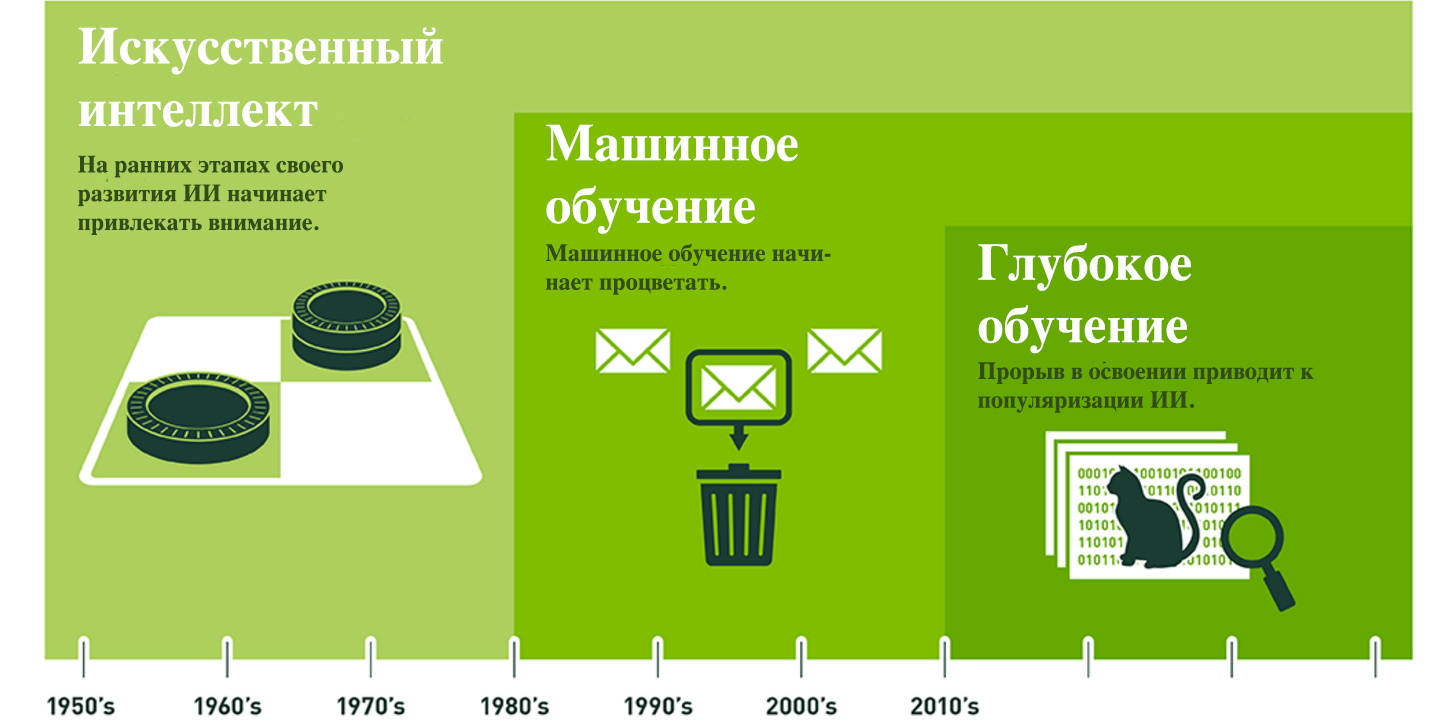
# interesting There are two types of artificial intelligence (AI): weak (narrowly focused) and strong (general). Weak AI is designed to perform a narrow list of tasks. These are the Siri and Google Assistant voice assistants and all the other examples that we provide in this article. Strong AI, in turn, is capable of completing any human task. At the moment, the realization of a strong AI is impossible; it is a utopian idea.
A neural network simulates the work of the human nervous system, a feature of which is the ability to self-study, taking into account previous experience. Thus, each time the system makes fewer errors.
Like our nervous system, a neural network consists of separate computing elements - neurons located on several layers. The data received at the input of the neural network are sequentially processed on each layer of the network. Moreover, each neuron has certain parameters that can vary depending on the results obtained - this is the network training.
Suppose the task of a neural network is to distinguish cats from dogs. To configure the neural network, a large array of signed images of cats and dogs is fed. The neural network analyzes the signs (including lines, shapes, their size and color) in these pictures and builds such a recognition model that minimizes the percentage of errors relative to the reference results.
The figure below shows the operation of a neural network, the task of which is to recognize a handwritten postal code digit.

Despite the fact that neural networks have come into the limelight recently, this is one of the oldest machine learning algorithms. The first version of a formal neuron, a neural network cell, was proposed by Warren McCulloch and Walter Pitts in 1943.
And already in 1958, Frank Rosenblatt developed the first neural network. Despite its simplicity, it could already distinguish, for example, objects in two-dimensional space.

Mark I Perceptron - Rosenblatt machine
The first successes attracted increased attention to technology, but then other machine learning algorithms began to show better results, and neural networks faded into the background. The next wave of interest came in the 1990s, after which almost no one heard about neural networks until 2010.
Until 2010, there simply was no database large enough to properly train the neural networks to solve certain problems, mainly related to the recognition and classification of images. Therefore, neural networks were often mistaken: they confused a cat with a dog, or, even worse, a picture of a healthy organ with a picture of an organ affected by a tumor.
But in 2010, ImageNet appeared, containing 15 million images in 22 thousand categories. ImageNet was many times the size of existing image databases and was available to any researcher. With such volumes of neural network data, one could learn to make practically error-free decisions.
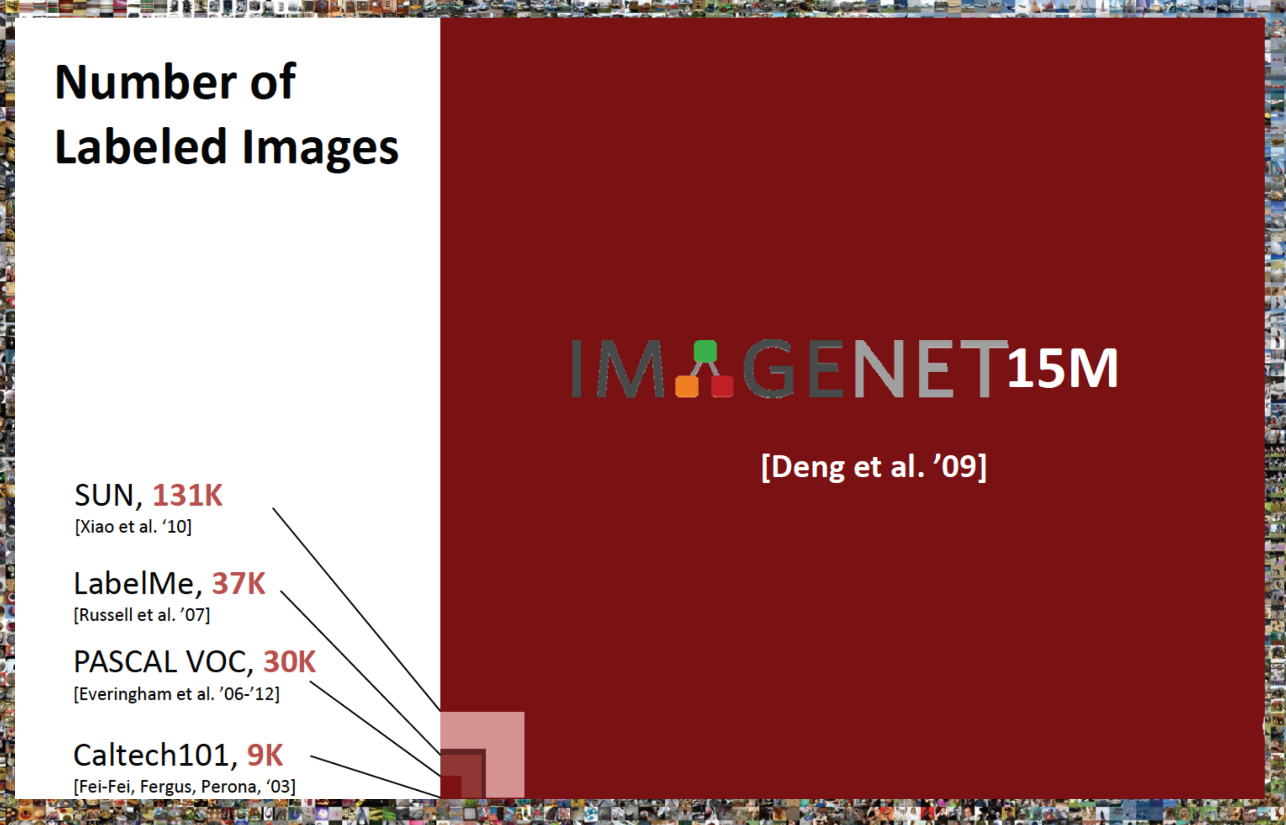
ImageNet size compared to other 2010 image databases
Prior to this, another, no less significant, problem was facing the development of neural networks: the traditional teaching method was ineffective. Despite the fact that the number of layers in a neural network plays an important role, the method of training the network is also important. The reverse encryption method used earlier could effectively train only the last layers of the network. The learning process was too long for practical use, and the hidden layers of deep neural networks did not function properly.
The results in solving this problem in 2006 were achieved by three independent groups of scientists. Firstly, Jeffrey Hinton implemented the pre- training of the network using the Boltzmann machine , training each layer separately. Secondly, Jan LeCan proposed the use of a convolutional neural networkto solve image recognition problems. Finally, Joshua Benggio developed a cascading auto-encoder that enabled all layers in a deep neural network.
A team of researchers from the University of Nottingham has developed four machine learning algorithms to assess the risk of patients with cardiovascular disease. For training, data from 378 thousand British patients were used. Trained artificial intelligence determined the risk of cardiac diseases more effectively than real doctors. The accuracy of the algorithm is between 74 and 76.4 percent (the standard system of eight factors, developed by the American College of Cardiology, provides accuracy of only 72.8%).
Japanese insurance company Fukoku Mutual Life Insurance signed a contract with IBM. According to him, 34 employees of the Japanese company will be replaced by the IBM Watson Explorer AI system. The neural network will look at tens of thousands of medical certificates and take into account the number of hospital visits, operations carried out and other factors to determine the conditions of customer insurance. Fukoku Mutual Life Insurance is confident that using IBM Watson will increase productivity by 30% and pay off in two years.
Machine learning helps you identify potential cases of fraud in various areas of life.For example, PayPal uses a similar tool - as part of the fight against money laundering, the company compares millions of transactions and detects suspicious ones among them. As a result, PayPal fraudulent transactions account for a record low 0.32%, while the standard in the financial sector is 1.32%.
Artificial intelligence has significantly improved the recommendation mechanisms in online stores and services. Machine learning-based algorithms analyze your site behavior and compare it to millions of other users. All in order to determine which product you are most likely to buy.
The referral mechanism provides Amazon with 35% of sales. The Brain algorithm used by YouTube to recommend content made it possible for people to find almost 70% of the videos viewed on the site through recommendations (rather than links or subscriptions). WSJ reported that the use of artificial intelligence for recommendations is one of the factors that influenced 10-fold audience growth over the past five years.
Yandex Data Factory Algorithmable to predict the effect of promotions on sales of goods. Analyzing the history of sales, as well as the type and assortment of the store, the algorithm gave 87% accurate (accurate to the box) and 61% ultra-precise (accurate to the packaging) forecasts.
Natural language analyzing neural networks can be used to create chat bots that allow customers to obtain the necessary information about the company's products. This will reduce the cost of call center teams. A similar robot is already working in the reception room of the Moscow Government and processes about 5% of requests. The bot is able to tell, including the location of the nearest MFC and the schedule for switching off hot water.
Albert is also based on neural network technology -A full-cycle marketing platform that independently carries out almost all operations. Cosabella, the underwear manufacturer that uses it, eventually disbanded its own marketing department and completely trusted the platform.
Unmanned vehicles - a concept that most large concerns are working on, as well as technology companies (Google, Uber, Yandex and others) and startups, rely on neural networks in their work. Artificial intelligence is responsible for the recognition of surrounding objects - whether it be another car, a pedestrian or another obstacle.

This is how our world sees a neural network.
The potential of artificial intelligence in this area is not limited to autopilot. A recent IBM poll showed that 74% of automotive executives expect smart cars to hit the road by 2025. Such cars are integrated into the Internet of things (see our previous longrid) will collect information about the preferences of passengers and automatically adjust the temperature in the cabin, the volume of the radio, the position of the seats and other parameters. In addition to piloting, the system will also inform about emerging problems (and even try to solve them yourself) and the situation on the road.
A neural network developed by Mark Waller of Shanghai University specializes in the development of synthetic molecules . The algorithm was a six-step synthesis of the benzopyran sulfonamide derivative (necessary in the treatment of Alzheimer's) in just 5.4 seconds.
Yandex Data Factory tools help steelmaking: metal scrap used for steel production is often heterogeneous in composition. In order for steel to meet the standards, it is always necessary to take into account the specifics of scrap during its smelting and introduce special additives. This is usually done by specially trained technologists. But, since such industries gather a lot of information about incoming raw materials, additives used and the result, the neural network is able to process this information with greater efficiency. According to Yandex, the introduction of neural networks can reduce the cost of expensive ferroalloys by 5%.
Similarly, a neural network can help in the processing of glass. Now it is unprofitable, albeit useful, business that needs government subsidies. Using machine learning technologies will significantly reduce costs.
Microsoft engineers and scientists from ICRISAT use artificial intelligence to determine the optimal sowing time in India . An application using the Microsoft Cortana Intelligence Suite also monitors soil conditions and selects the necessary fertilizers. Initially, only 175 farmers from 7 villages participated in the program. They started sowing only after the corresponding SMS notification. As a result, they harvested 30–40% more than usual.
Last year, applications using neural networks for processing photos and videos came out and instantly became popular : MSQRD from Belarusian developers (later the service was bought by Facebook), and Russian Prisma and Mlvch. Another service, Algorithmia, colors black and white photographs.
Yandex has successfully experimented with music: the neural networks of the company have already recorded two albums: in the style of Nirvana and Civil Defense . And the music, written by a neural network under the classical composer Alexander Scriabin, was performed by a chamber orchestra, which makes us think again about whether the robot can compose a symphony. A neural network created by Sony employeesinspired by bach.
The Japanese algorithm wrote the book, “The Day the Computer Wrote a Novel.” Despite the fact that people helped the inexperienced writer with the characters of the characters and storylines, the computer did a great job - as a result, one of his works passed the qualifying stage of the prestigious literary award. Neural networks also wrote sequels to Harry Potter and Game of Thrones .
In 2015, the AlphaGo neural network, developed by the Google DeepMind team, was the first program to defeat a professional go player . And in May this year, the program beat the strongest go player in the world.Ke Ke. This was a breakthrough, since for a long time it was believed that computers did not have the intuition necessary to play go.
A development team from the University of Technology, Sydney introduced drones to patrol the beaches. The main task of drones will be to search for sharks in coastal waters and warn people on the beaches . The analysis of video data is performed by neural networks, which significantly affected the results: the developers claim the probability of detecting and identifying sharks is up to 90%, while the operator viewing video from drones can successfully recognize sharks only in 20-30% of cases.
Australia ranks second in the world after the United States in the number of cases of shark attacks on humans. In 2016, 26 cases of shark attacks were recorded in this country, two of which ended in the death of people.
In 2014, Kaspersky Lab reported that their antivirus logs 325 thousand new infected files daily. At the same time, a study by Deep Instinct showed that new versions of viruses are practically no different from previous ones - the change is from 2% to 10%. The self-learning model developed by Deep Instinct, based on this information, is able to identify infected files with high accuracy .
Neural networks are also able to look for certain patterns in how information is stored in cloud services, and report detected anomalies that can lead to security holes.
In 2016, the 65-year-old NVIDIA engineer Robert Bond faced a problem: neighbor cats regularly visited his site and left traces of his presence, which annoyed his gardening wife. Bond immediately cut off the too unfriendly idea of setting up traps for uninvited guests. Instead, he decided to write an algorithm that would automatically turn on garden water sprinklers as cats approached.
Robert was faced with the task of identifying cats in a video stream coming from an external camera. To do this, he used a system based on the popular Caffe neural network. Each time the camera observed a change in the situation on the site, she took seven pictures and transmitted them to the neural networks. After this, the neural network had to determine whether a cat is present in the frame, and, in the case of an affirmative answer, turn on the sprinklers.
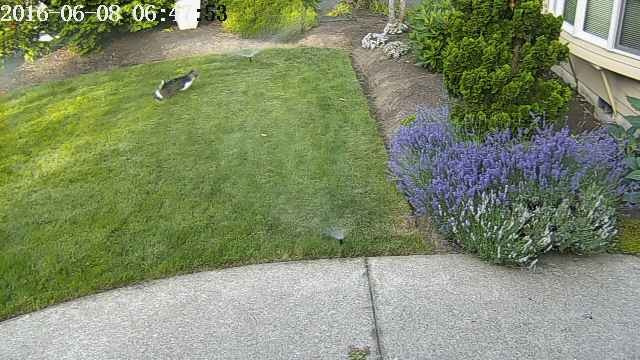
The camera image in Bond’s courtyard
Before the work began, the neural network was trained: Bond “fed” 300 different photos of cats to her. By analyzing these photos, the neural network learned to recognize animals. But this was not enough: she correctly identified cats in only 30% of cases and mistook Bond for a cat, as a result of which he himself turned out to be wet.
The neural network worked better after additional training on more photos. However, Bond warns that the neural network can be trained too much, in which case it develops an unrealistic stereotype - for example, if all the images used for training are taken from one angle, then artificial intelligence may not recognize the same cat from a different angle. Therefore, it is extremely important to correctly select the training data series.
After some time, cats who studied not in photographs, but in their own skin, stopped visiting the Bond site.
Neural networks, the technology of the middle of the last century, are now changing the work of entire industries. The reaction of society is ambiguous: some of the capabilities of neural networks are delighted, while others are made to doubt their use as specialists.
However, not everywhere where machine learning comes, it crowds out people. If a neural network diagnoses better than a living doctor, this does not mean that in the future we will be treated exclusively by robots. Most likely, the doctor will work with the neural network. Similarly, the IBM Deep Blue supercomputer won chess against Garry Kasparov back in 1997, but people from chess haven’t gone anywhere, and eminent grandmasters still fall on the covers of glossy magazines.
Cooperation with machines will bring much more benefits than confrontation. Therefore, we have compiled a list of materials in the public domain that will help you continue to familiarize yourself with neural networks:
A 2013 study at Oxford Martin School stated that 47% of all jobs could be automated over the next 20 years. The main driver of this process is the use of artificial intelligence working with big data as a more effective replacement for humans.
Machines are now able to solve more and more processes for which people were previously responsible. In addition, they make it better and in many cases cheaper. German Gref spoke about what this means for the labor market in July this year, speaking to students of the Baltic Federal University named after Kant:
“ We stop hiring lawyers who don’t know what to do with the neural network. <...> You are students of yesterday. Comrade lawyers, forget your profession. Last year, the 450 lawyers who are preparing lawsuits in our country have been cut back. Our neural network prepares statements of claim better than lawyers prepared by the Baltic Federal University. We definitely won’t hire them. ”
Continuing to cover the #technological future, the DTI team prepared everything you need to know for the first immersion in neural networks : how they work, why more and more companies prefer neural networks to live employees, and what potential this technology has to optimize various processes.
Artificial Intelligence, Machine Learning and Neural Networks: What is the Difference
A neural network is one of the ways to implement artificial intelligence (AI) .
In the development of AI, there is a vast area - machine learning . She is studying methods for constructing algorithms that can learn on her own. This is necessary if there is no clear solution to any problem. In this case, it’s easier not to look for the right solution, but to create a mechanism that will come up with a method for finding it.
# help In many articles you can find the term “deep” - or “deep” - training. It is understood as machine learning algorithms that use a lot of computing resources. In most cases, it can be understood simply as “neural networks”.
In order not to get confused in the concepts of “artificial intelligence”, “machine learning” and “deep learning”, we suggest looking at the visualization of their development:
# interesting There are two types of artificial intelligence (AI): weak (narrowly focused) and strong (general). Weak AI is designed to perform a narrow list of tasks. These are the Siri and Google Assistant voice assistants and all the other examples that we provide in this article. Strong AI, in turn, is capable of completing any human task. At the moment, the realization of a strong AI is impossible; it is a utopian idea.
How is the neural network
A neural network simulates the work of the human nervous system, a feature of which is the ability to self-study, taking into account previous experience. Thus, each time the system makes fewer errors.
Like our nervous system, a neural network consists of separate computing elements - neurons located on several layers. The data received at the input of the neural network are sequentially processed on each layer of the network. Moreover, each neuron has certain parameters that can vary depending on the results obtained - this is the network training.
Suppose the task of a neural network is to distinguish cats from dogs. To configure the neural network, a large array of signed images of cats and dogs is fed. The neural network analyzes the signs (including lines, shapes, their size and color) in these pictures and builds such a recognition model that minimizes the percentage of errors relative to the reference results.
The figure below shows the operation of a neural network, the task of which is to recognize a handwritten postal code digit.
History of Neural Networks
Despite the fact that neural networks have come into the limelight recently, this is one of the oldest machine learning algorithms. The first version of a formal neuron, a neural network cell, was proposed by Warren McCulloch and Walter Pitts in 1943.
And already in 1958, Frank Rosenblatt developed the first neural network. Despite its simplicity, it could already distinguish, for example, objects in two-dimensional space.
Mark I Perceptron - Rosenblatt machine
The first successes attracted increased attention to technology, but then other machine learning algorithms began to show better results, and neural networks faded into the background. The next wave of interest came in the 1990s, after which almost no one heard about neural networks until 2010.
Why neural networks are popular again
Until 2010, there simply was no database large enough to properly train the neural networks to solve certain problems, mainly related to the recognition and classification of images. Therefore, neural networks were often mistaken: they confused a cat with a dog, or, even worse, a picture of a healthy organ with a picture of an organ affected by a tumor.
But in 2010, ImageNet appeared, containing 15 million images in 22 thousand categories. ImageNet was many times the size of existing image databases and was available to any researcher. With such volumes of neural network data, one could learn to make practically error-free decisions.
ImageNet size compared to other 2010 image databases
Prior to this, another, no less significant, problem was facing the development of neural networks: the traditional teaching method was ineffective. Despite the fact that the number of layers in a neural network plays an important role, the method of training the network is also important. The reverse encryption method used earlier could effectively train only the last layers of the network. The learning process was too long for practical use, and the hidden layers of deep neural networks did not function properly.
The results in solving this problem in 2006 were achieved by three independent groups of scientists. Firstly, Jeffrey Hinton implemented the pre- training of the network using the Boltzmann machine , training each layer separately. Secondly, Jan LeCan proposed the use of a convolutional neural networkto solve image recognition problems. Finally, Joshua Benggio developed a cascading auto-encoder that enabled all layers in a deep neural network.
Examples of successful application of neural networks in business
The medicine
A team of researchers from the University of Nottingham has developed four machine learning algorithms to assess the risk of patients with cardiovascular disease. For training, data from 378 thousand British patients were used. Trained artificial intelligence determined the risk of cardiac diseases more effectively than real doctors. The accuracy of the algorithm is between 74 and 76.4 percent (the standard system of eight factors, developed by the American College of Cardiology, provides accuracy of only 72.8%).
Finance
Japanese insurance company Fukoku Mutual Life Insurance signed a contract with IBM. According to him, 34 employees of the Japanese company will be replaced by the IBM Watson Explorer AI system. The neural network will look at tens of thousands of medical certificates and take into account the number of hospital visits, operations carried out and other factors to determine the conditions of customer insurance. Fukoku Mutual Life Insurance is confident that using IBM Watson will increase productivity by 30% and pay off in two years.
Machine learning helps you identify potential cases of fraud in various areas of life.For example, PayPal uses a similar tool - as part of the fight against money laundering, the company compares millions of transactions and detects suspicious ones among them. As a result, PayPal fraudulent transactions account for a record low 0.32%, while the standard in the financial sector is 1.32%.
Commerce
Artificial intelligence has significantly improved the recommendation mechanisms in online stores and services. Machine learning-based algorithms analyze your site behavior and compare it to millions of other users. All in order to determine which product you are most likely to buy.
The referral mechanism provides Amazon with 35% of sales. The Brain algorithm used by YouTube to recommend content made it possible for people to find almost 70% of the videos viewed on the site through recommendations (rather than links or subscriptions). WSJ reported that the use of artificial intelligence for recommendations is one of the factors that influenced 10-fold audience growth over the past five years.
Yandex Data Factory Algorithmable to predict the effect of promotions on sales of goods. Analyzing the history of sales, as well as the type and assortment of the store, the algorithm gave 87% accurate (accurate to the box) and 61% ultra-precise (accurate to the packaging) forecasts.
Natural language analyzing neural networks can be used to create chat bots that allow customers to obtain the necessary information about the company's products. This will reduce the cost of call center teams. A similar robot is already working in the reception room of the Moscow Government and processes about 5% of requests. The bot is able to tell, including the location of the nearest MFC and the schedule for switching off hot water.
Albert is also based on neural network technology -A full-cycle marketing platform that independently carries out almost all operations. Cosabella, the underwear manufacturer that uses it, eventually disbanded its own marketing department and completely trusted the platform.
Transport
Unmanned vehicles - a concept that most large concerns are working on, as well as technology companies (Google, Uber, Yandex and others) and startups, rely on neural networks in their work. Artificial intelligence is responsible for the recognition of surrounding objects - whether it be another car, a pedestrian or another obstacle.
This is how our world sees a neural network.
The potential of artificial intelligence in this area is not limited to autopilot. A recent IBM poll showed that 74% of automotive executives expect smart cars to hit the road by 2025. Such cars are integrated into the Internet of things (see our previous longrid) will collect information about the preferences of passengers and automatically adjust the temperature in the cabin, the volume of the radio, the position of the seats and other parameters. In addition to piloting, the system will also inform about emerging problems (and even try to solve them yourself) and the situation on the road.
Industry
A neural network developed by Mark Waller of Shanghai University specializes in the development of synthetic molecules . The algorithm was a six-step synthesis of the benzopyran sulfonamide derivative (necessary in the treatment of Alzheimer's) in just 5.4 seconds.
Yandex Data Factory tools help steelmaking: metal scrap used for steel production is often heterogeneous in composition. In order for steel to meet the standards, it is always necessary to take into account the specifics of scrap during its smelting and introduce special additives. This is usually done by specially trained technologists. But, since such industries gather a lot of information about incoming raw materials, additives used and the result, the neural network is able to process this information with greater efficiency. According to Yandex, the introduction of neural networks can reduce the cost of expensive ferroalloys by 5%.
Similarly, a neural network can help in the processing of glass. Now it is unprofitable, albeit useful, business that needs government subsidies. Using machine learning technologies will significantly reduce costs.
Agriculture
Microsoft engineers and scientists from ICRISAT use artificial intelligence to determine the optimal sowing time in India . An application using the Microsoft Cortana Intelligence Suite also monitors soil conditions and selects the necessary fertilizers. Initially, only 175 farmers from 7 villages participated in the program. They started sowing only after the corresponding SMS notification. As a result, they harvested 30–40% more than usual.
Entertainment and art
Last year, applications using neural networks for processing photos and videos came out and instantly became popular : MSQRD from Belarusian developers (later the service was bought by Facebook), and Russian Prisma and Mlvch. Another service, Algorithmia, colors black and white photographs.
Yandex has successfully experimented with music: the neural networks of the company have already recorded two albums: in the style of Nirvana and Civil Defense . And the music, written by a neural network under the classical composer Alexander Scriabin, was performed by a chamber orchestra, which makes us think again about whether the robot can compose a symphony. A neural network created by Sony employeesinspired by bach.
The Japanese algorithm wrote the book, “The Day the Computer Wrote a Novel.” Despite the fact that people helped the inexperienced writer with the characters of the characters and storylines, the computer did a great job - as a result, one of his works passed the qualifying stage of the prestigious literary award. Neural networks also wrote sequels to Harry Potter and Game of Thrones .
In 2015, the AlphaGo neural network, developed by the Google DeepMind team, was the first program to defeat a professional go player . And in May this year, the program beat the strongest go player in the world.Ke Ke. This was a breakthrough, since for a long time it was believed that computers did not have the intuition necessary to play go.
Security
A development team from the University of Technology, Sydney introduced drones to patrol the beaches. The main task of drones will be to search for sharks in coastal waters and warn people on the beaches . The analysis of video data is performed by neural networks, which significantly affected the results: the developers claim the probability of detecting and identifying sharks is up to 90%, while the operator viewing video from drones can successfully recognize sharks only in 20-30% of cases.
Australia ranks second in the world after the United States in the number of cases of shark attacks on humans. In 2016, 26 cases of shark attacks were recorded in this country, two of which ended in the death of people.
In 2014, Kaspersky Lab reported that their antivirus logs 325 thousand new infected files daily. At the same time, a study by Deep Instinct showed that new versions of viruses are practically no different from previous ones - the change is from 2% to 10%. The self-learning model developed by Deep Instinct, based on this information, is able to identify infected files with high accuracy .
Neural networks are also able to look for certain patterns in how information is stored in cloud services, and report detected anomalies that can lead to security holes.
Bonus: neural networks guard our lawn
In 2016, the 65-year-old NVIDIA engineer Robert Bond faced a problem: neighbor cats regularly visited his site and left traces of his presence, which annoyed his gardening wife. Bond immediately cut off the too unfriendly idea of setting up traps for uninvited guests. Instead, he decided to write an algorithm that would automatically turn on garden water sprinklers as cats approached.
Robert was faced with the task of identifying cats in a video stream coming from an external camera. To do this, he used a system based on the popular Caffe neural network. Each time the camera observed a change in the situation on the site, she took seven pictures and transmitted them to the neural networks. After this, the neural network had to determine whether a cat is present in the frame, and, in the case of an affirmative answer, turn on the sprinklers.
The camera image in Bond’s courtyard
Before the work began, the neural network was trained: Bond “fed” 300 different photos of cats to her. By analyzing these photos, the neural network learned to recognize animals. But this was not enough: she correctly identified cats in only 30% of cases and mistook Bond for a cat, as a result of which he himself turned out to be wet.
The neural network worked better after additional training on more photos. However, Bond warns that the neural network can be trained too much, in which case it develops an unrealistic stereotype - for example, if all the images used for training are taken from one angle, then artificial intelligence may not recognize the same cat from a different angle. Therefore, it is extremely important to correctly select the training data series.
After some time, cats who studied not in photographs, but in their own skin, stopped visiting the Bond site.
Conclusion
Neural networks, the technology of the middle of the last century, are now changing the work of entire industries. The reaction of society is ambiguous: some of the capabilities of neural networks are delighted, while others are made to doubt their use as specialists.
However, not everywhere where machine learning comes, it crowds out people. If a neural network diagnoses better than a living doctor, this does not mean that in the future we will be treated exclusively by robots. Most likely, the doctor will work with the neural network. Similarly, the IBM Deep Blue supercomputer won chess against Garry Kasparov back in 1997, but people from chess haven’t gone anywhere, and eminent grandmasters still fall on the covers of glossy magazines.
Cooperation with machines will bring much more benefits than confrontation. Therefore, we have compiled a list of materials in the public domain that will help you continue to familiarize yourself with neural networks:
- The course "Machine Learning" from the School of Data Analysis (SHAD) Yandex
- Google Deep Learning Course
- The book "Mathematical teaching methods on precedents (theory of machine learning)" K. V. Vorontsova
- The book "Neuro-computer technology: Theory and practice" F. Wasserman
- Movidius Neural Compute Stick - a flash-sized neural network
- A selection of machine learning frameworks