June 5, 2017 at 10:23
NeoQUEST-2017: what awaits guests at the anniversary confrontation?
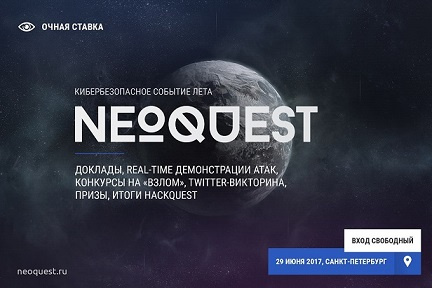 On June 29, 2017, St. Petersburg will host the anniversary, fifth NeoQUEST Full-time! And we are happy to invite everyone who is interested in information security: students and applicants of IT specialties, developers, testers, admins, seasoned specialists and newcomers to information security, hackers and geeks!
 Entrance to NeoQUEST-2017 is traditionally free , but requires registration on the event website !
The anniversary “Face-to-face” prepares surprises, and a rich, varied program awaits the guests, in which there will be a lot of new and interesting! So, at NeoQUEST-2017 will be:
- Fascinating practical reports on the most relevant in the world of cybersecurity. Even in the traditional one, there were some surprises: for the first time in the history of the Confrontation, guests will find an interesting report from the depths of cryptography: about elliptic curves and cryptosystems on isogeny. In addition, we’ll talk about security both at the hardware level (SMM, motherboards, Embedded devices) and at the high level (WSN networks, pentests, and much more)!
- FIRST TIME: Workshops section! We boldly declare: it is impossible to become a really cool information security specialist without practice. That is why, in parallel with the presentations, workshops will be held where active guests can learn something new.
- FIRST: FastTrack-reports: fast, clear, with a twinkle - we will tell you about the latest news in the field of information security!
- Contests for "hacking" and not only, the quiz "Unified State Examination on Information Security" and space cool prizes. We remind you that this year NeoQUEST has a space theme, and this will undoubtedly be reflected in contests and prizes!
In addition, a report contest will continue for a whole week : do you want to tell your hacker community in St. Petersburg about your cyber-safe drawings? Leave a request on the site , and our team will certainly contact you!
Intrigued? Welcome to kat: we will tell you in detail about reports and workshops!
For those who first hear about NeoQUEST
NeoQUEST is a cybersecurity event that has been held by NeoBIT in conjunction with the Department of Computer Systems Information Security at St. Petersburg Polytechnic University since 2012. NeoQUEST includes 2 stages:
1) Hackquest - online qualifying stage of the competition, which is an individual CTF;
2) “Face to face” - a one-day event for everyone, in the framework of which, among other things, the hackquest final stage is also held.
Online hackquest stage
As part of the online hackquest phase, we are developing many tasks from different areas of information security and come up with a fascinating legend. Within 10-11 days, registered participants go through these tasks, receiving points for them in accordance with the dynamic rating scale: points are awarded taking into account who completed the task before everyone else.
Tasks have different complexity and cover many areas of information security: cryptography, network security, security of the Web and mobile operating systems iOS and Android, virtualization, vulnerability search and exploitation, steganography and much more. After the end of the online phase, we summarize, give valuable prizes to the first three, and send pleasant souvenirs to some of the best. Then we send a certain number of participants an invitation to St. Petersburg for the hackquest final as part of the “confrontation”.
"Confrontation"
“Face to face” - a one-day event taking place in St. Petersburg, which includes:
- reports on the most relevant issues of cybersecurity;
- real-time attack demonstrations;
- contests for "hacking";
- Twitter quiz “Unified State Examination on Information Security” - quick wit and basic knowledge in the field of information security;
- The final hackquest stage for the best participants in the online stage.
Anyone can visit the “confrontation” - admission is free! This year, “Confrontation” will be held at the PetroCongress Congress Center (by the way, only 5 minutes from the metro!), The reports will begin at 11:00 in the morning.
And now about the reports!
The list is still being specified; at the moment, the following reports are waiting for guests:
- Vadim Shmatov: “Blockchain on copyright protection”.Everyone loves torrents: they are fast, easily accessible, and completely free. Unfortunately, torrents create a ton of information security problems: copyright infringement, malware distribution, and so on. The report will examine how blockchain technology can be used to create an alternative network to torrents. On such a network, files are downloaded quickly and easily, authors receive royalties, and active users are rewarded. Such a network would allow both large companies and individual authors to organize the distribution of their works without intermediaries, and for ordinary users to get quick and inexpensive access to author's music, films, games. This could reduce piracy and reduce the damage from it to both copyright holders and ordinary users.
- Anastasia Yarmak, Anna Shtyrkina: “Winter is coming: post-quantum cryptography and sunset RSA - a real threat or an imaginary future?”. In 2015, NIST and NSA announced the need to move to new quantum computer-resistant cryptographic algorithms. Is the world ready for a cryptographic apocalypse, and does this mean that the sunset is approaching the classic asymmetric cryptosystems? The report will examine the role of elliptic curves in modern cryptography, the problem of computing the isogeny of elliptic curves as a candidate for constructing post-quantum cryptosystems, as well as real-life examples of using the Microsoft SIDH library to create custom applications.
- Alexei Nikolsky: "I am for you SMMotryu." Modern x86-computers are oversaturated with features and functions, which explains their popularity, including among hackers, who are happy to use all existing capabilities to attack users' computers and benefit from it. At previous NeoQUESTs we already talked about Intel VTx, TXT, TPM , and ME (AMT) technologies . This year, it is time to talk about System Management Mode - a special processor mode that has been used for a long time by both computer developers and hackers. In the report, we will figure out how the most privileged mode on the processor is protected (steeper than even the hypervisor). In practice, we will see how violators can use it.
- Andrei Dakhnovich: “What bad can happen when you type google.com in the address bar of your browser and press Enter?”. 2 years ago, an article was published on github.com titled “What happens when you type google.com into your browser's address box and press enter”. During the first two months, as many as 2 translations of this article into Russian were posted on Habrahabr ( here and here ). It describes in detail everything that happens to your computer during such a request, starting by pressing the "g" key and ending with the rendering of the page in the browser. In the report, we will try to summarize, but what can happen from the point of view of information security with your computer when sending a request?
- Tigran Hovasapyan: “Can networks feel danger?” To date, the scope of technology of wireless self-organizing sensor networks is quite wide. Inexpensive wireless sensors can be used both for military and civilian purposes (healthcare, environmental monitoring, climate control systems, etc.). However, the features of these networks provide attackers with a wide range of opportunities for attacking them. Let's talk about the principles of operation, features and the most promising areas of application of this technology. Actual threats, methods for their implementation and existing methods of protection against them will be considered.
- Roman Shcherbakov: “HARD HACK. How AliExpress helps with hardware research. ” One of the important aspects of research in the field of information security is the study of the hardware of the devices and work with it. The report will consider some types of similar tasks with specific examples, consider the types of equipment that can solve these problems, and make a comparative analysis. Let's talk about the existing models of logic analyzers and their main advantages. We will analyze in detail the above examples and the possibilities of logic analyzers for their solution.
- Sergey Sychev: “We disassemble the firmware of Embedded devices into bolts and cogs.” Recently, embedded devices have become widespread and, as a result, are of real interest for analysis. In the report, we will consider general approaches to the analysis of embedded software, existing integrity control mechanisms, and also recall the real cases of embedding additional functionality in equipment. As an example, the popular IP camera from Hikvision will be considered.
- Alexey Myasnikov: “We RasPilivaet computer security.” Modern computers are becoming smaller, but at the same time they are confidently catching up on desktop solutions in power. Nowadays, a full-fledged computer can fit on one board a little larger than a credit card. Someone uses these computers to create smart homes, someone - for work, but in this report we will consider possible ways to use the “raspberry” to automate attacks on the older brothers of our non-payers (PCs, laptops, etc.).
- Victor Vagisarov: “Link the invisible: assistant to the pentester.” A competent pentester is fluent in dozens of utilities that help him in security analysis: nmap, burp suite, sqlmap, etc. But their huge number and tons of mottled output often do not allow you to add up the big picture of a large test object. And it would be nice if there was a system that, on one command, automatically launches scanners, analyzes and normalizes their findings, intelligently builds dictionaries for password brutes, establishes and visualizes (!) The connections between the detected components, offers attack vectors for them, looks for exploits for detected vulnerabilities, and also advises (!)Pentester, what steps to take next to get maximum profit. And we made such a system! About her will be our report.
- Alexey Finagin: “HDMagIc - we turn HDMI into an information security tool.” Transferring any file to a neighboring computer with ultra-high speed through ... HDMI interface? Why not? The report will present a non-standard approach to the application of multimedia technology. We will talk about how to create a prototype of a hardware-software complex for one-way data transfer via HDMI. We will analyze the main difficulties and limitations encountered during the implementation of the prototype. In conclusion, we show the possibilities of using such solutions in information security systems.
Workshops section: prepare crazy hands!
1. Bad USB: making USB devices.
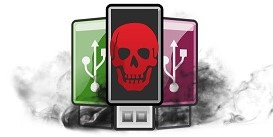 The term " mimicry ", familiar to us from the biology lessons at school, applies to computer devices. USB has become the most popular computer port to which we connect completely different devices, from a mouse and flash drive to a phone and a camera. But can you be sure that the device is exactly what it seems?
 Is it possible to determine the functionality of a device by its appearance? It turns out that not at all: a keyboard with built-in data storage devices, a WiFi adapter that looks like a USB flash drive - all this is already a little strange, but still quite harmless ... But when hackers get down to business, you can already expect anything!
At our workshop, 10 lucky ones will be able to learn how to make USB devices with “non-standard” functionality with their own hands and in practice make sure that things like bad USB are found not only on magazine pages and articles on the Internet.
2. We decrypt traffic.
 Everyone knows about the ability to decrypt SSL / TLS traffic using a private key in Wireshark. But not everyone knows that this is not the only way to decrypt: Wireshark also supports decryption using session secrets. And this means that any encrypted SSL / TLS traffic can be decrypted, being on the client side!
 In the workshop, we will demonstrate in which cases this can be applicable, and we will decrypt the traffic of even complex obfuscated applications, if they are running on the local machine.
The list of workshops, as well as the list of reports, is still being specified!
… And many many others!
In addition to presentations and workshops, we will delight guests with the FastTrack reports section, attack demos, great hacking contests and more, cool prizes and a wonderful atmosphere! We will not forget the already held traditional contest “Unified State Examination on Information Security” held on Twitter .
While guests will learn new things in a relaxed atmosphere, the best participants of hackquest will face difficult tasks in their sweat. 8 hours of continuous work will reveal the winner who will receive the main prize - a trip to one of the international conferences, as well as silver and bronze winners who will receive cool gifts.
Anniversary “Face-to-face bid” will be just space, so sign upon the NeoQUEST website, take friends and colleagues (do not forget about laptops or devices that replace them!) and come (come, fly and sail if you are not from St. Petersburg) on June 29 at NeoQUEST-2017!