May 27, 2017 at 00:01
Three cycles in the Lorenz attractor
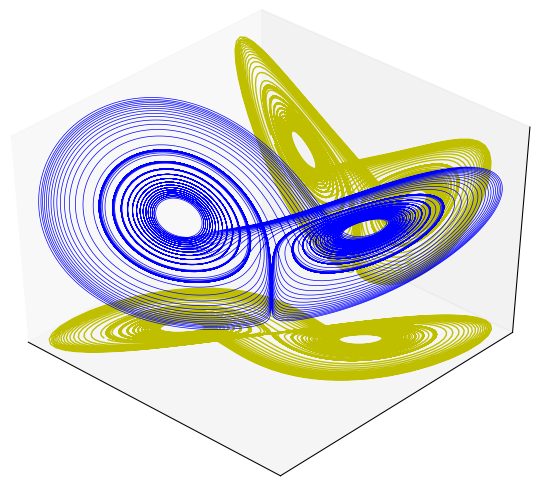
Studying foreign literature, I recently stumbled upon the work [1, 2] of the University of Michigan professor Divakar Viswanath on an iterative algorithm for calculating the periodic orbits of dynamical systems based on the Lindstedt-Poincaré method (LP) (I recommend the book [3 , p. 408-411] ). The advantage of this method is that it does not require the numerical integration of the differential equation, and therefore can be applied to the construction of unstable cycles.
One of the most popular areas of research in mathematics today is the theory of dynamic chaos. The most famous object here is the Lorenz system, introduced in the 60s of the 20th century. I note that since that time many non-linear mathematical models have appeared, where chaotic behavior of solutions takes place in various fields of science . A few years ago, chaotic systems without equilibrium positions used to encrypt signals gained popularity (see, for example, [4]). For those who are just starting to study the theory of chaos, I advise you to watch the mathematical film CHAOS , consisting of nine chapters.
It is believed that Warwick Tucker in [5] solved the 14th Smale problem using interval arithmetic, but I could not find convincing evidence for the cycles found in the numerical experiments of the authors of various articles.
Let x (t), y (t) and z (t) be the phase coordinates of the Lorentz system. In 2004, Viswanath in [2] found three cycles by the LP method. He gave the values of the initial conditions and the period:
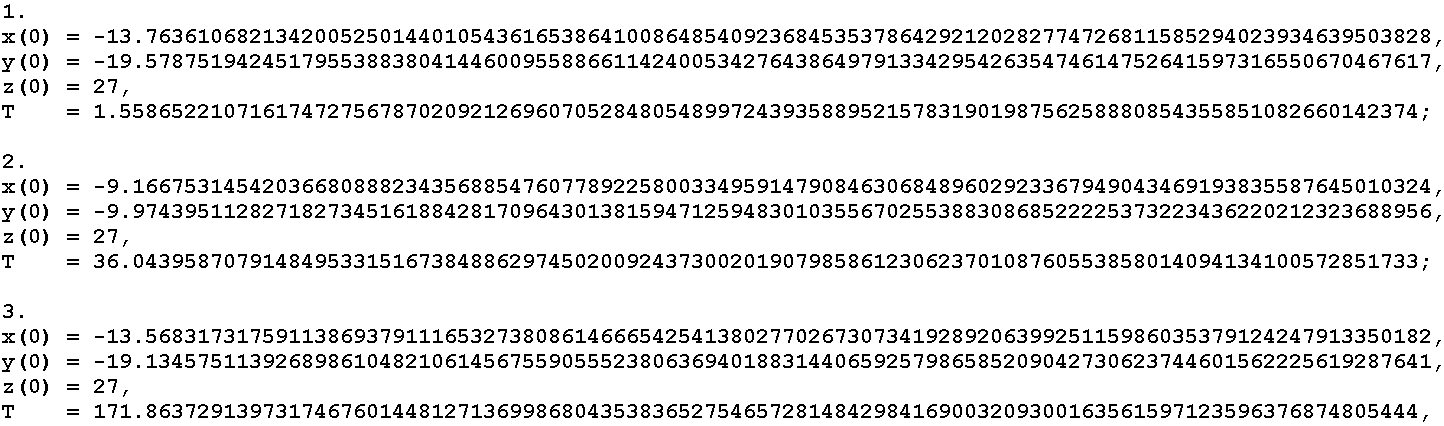
where T is the period.
In my opinion, this is a significant breakthrough in the study of the Lorentz attractor.
The question may arise - why 99 characters in the fractional part of numbers? The fact is that periodic orbits are unstable (and these numbers are most likely irrational), and to construct them numerically on a period with acceptable accuracy, you need to have a large number of decimal places.
I decided to check and build Viswanath cycles in the program given in the topic [6] (a numerical scheme is also described in [7]). For this, we took accuracy 1e-110 in a power series, the number of bits for the mantissa of a real number was 390 (machine epsilon is equal to 7.93107e-118), the passage in time is only forward. The following equalities were verified:
x (0) = x (T),
y (0) = y (T),
z (0) = z (T).
For the first cycle, all the signs in the fractional part of all coordinates coincided, except for the last character for y (T) (I got the number 6 there), for the second - 80 characters, for the third - 38 characters.
The following are drawings of Viswanatha cycles.
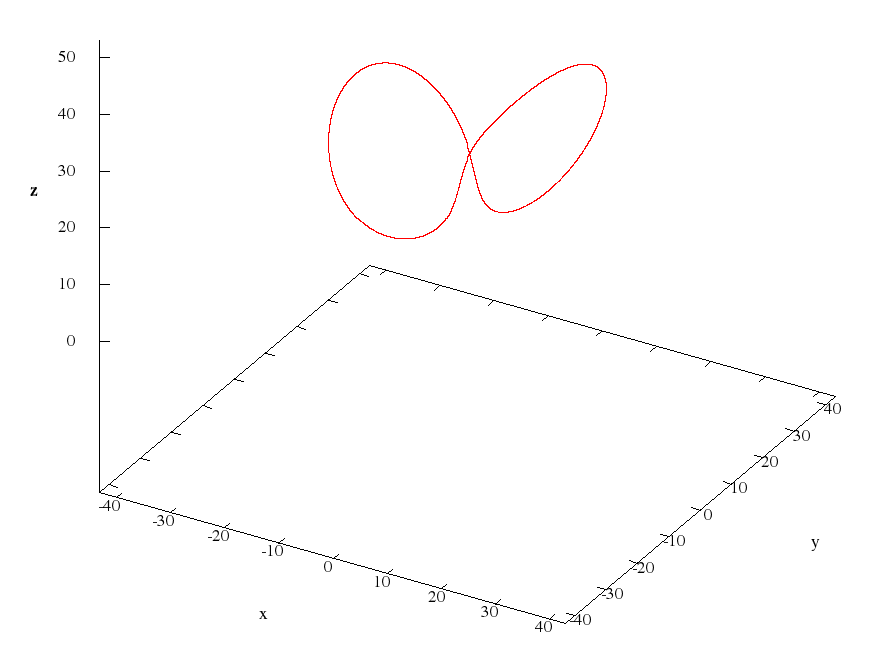
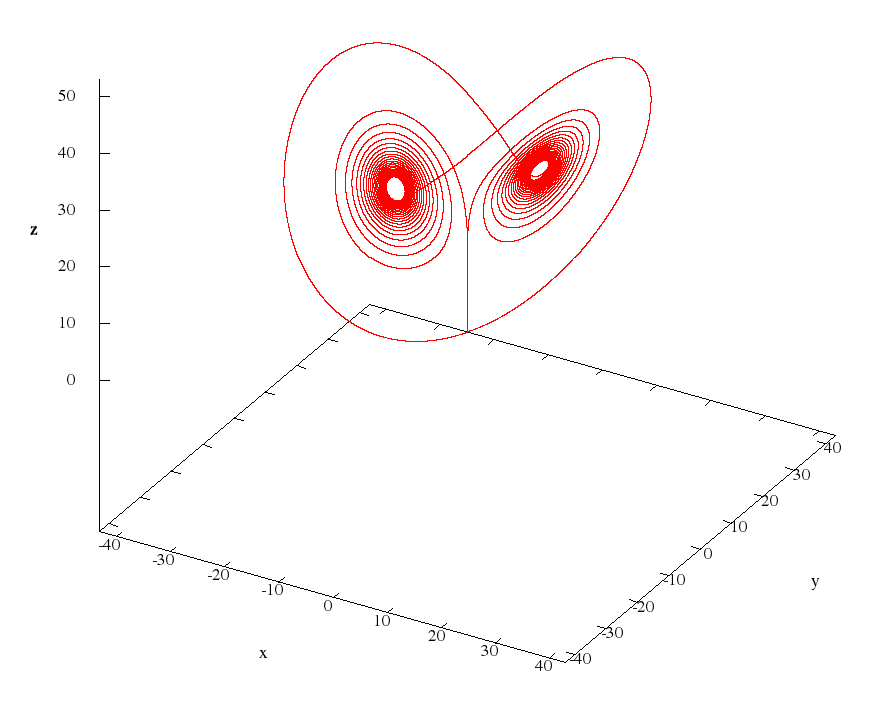
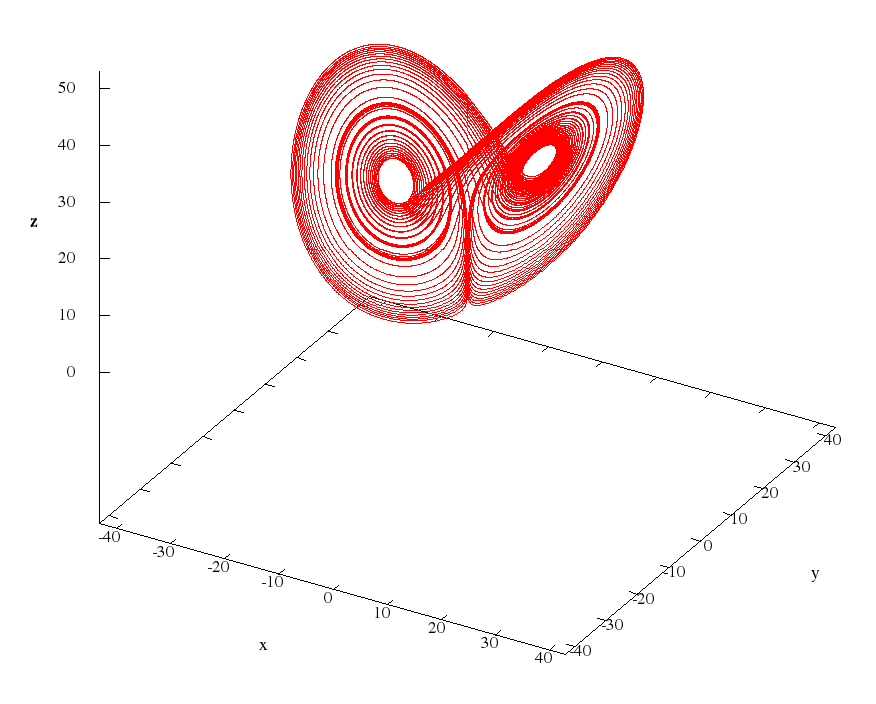
And the animation uploaded to YouTube.
For the second figure, I was interested in how close the trajectory of the system goes to the origin O (0; 0; 0). A point with coordinates was found in a numerical experiment.

Since the power-series method is the basic method for the numerical scheme, the maximum degree of the approximating polynomial in the variable integration steps, where the solution is arranged in rows, is 78, the approximate maximum value of the integration step is = 0.0120621 for the third cycle. Since the T value here is quite large, the calculation time on my computer was approximately 6.2 minutes.
Literature
1. Viswanath D. The Lindstedt-Poincare Technique as an Algorithm for Computing Periodic Orbits // SIAM Review. - 2001. - Vol. 43, Iss. 3, pp. 478-495.
2. Viswanath D. The Fractal Property of the Lorenz Attractor // Physica D: Nonlinear Phenomena. - 2004. - Vol. 190, Iss. 1-2, pp. 115-128.
3. Fedoryuk M.V. Ordinary differential equations. - M .: Nauka, 1985 .-- 448 p.
4. Wang Z., Akgul A., Pham V.-T., Jafari S. Chaos-Based Application of a Novel No-Equilibrium Chaotic System with Coexisting Attractors // Nonlinear Dynamics. - 2017, pp. 1-11.
5. Tucker W. A Rigorous ODE Solver and Smale's 14th Problem// Foundations of Computational Mathematics. - 2002. - Vol. 2, Iss. 1, pp. 53-117.
6. Pchelintsev A. Dynamic Lorentz system and computational experiment, 2014. Habrahabr. https://habrahabr.ru/post/229959/
7. Pchelintsev A.N. Numerical and physical modeling of the dynamics of the Lorentz system // Siberian Journal of Computational Mathematics. - 2014. - T. 17, No. 2. - S. 191-201.
2. Viswanath D. The Fractal Property of the Lorenz Attractor // Physica D: Nonlinear Phenomena. - 2004. - Vol. 190, Iss. 1-2, pp. 115-128.
3. Fedoryuk M.V. Ordinary differential equations. - M .: Nauka, 1985 .-- 448 p.
4. Wang Z., Akgul A., Pham V.-T., Jafari S. Chaos-Based Application of a Novel No-Equilibrium Chaotic System with Coexisting Attractors // Nonlinear Dynamics. - 2017, pp. 1-11.
5. Tucker W. A Rigorous ODE Solver and Smale's 14th Problem// Foundations of Computational Mathematics. - 2002. - Vol. 2, Iss. 1, pp. 53-117.
6. Pchelintsev A. Dynamic Lorentz system and computational experiment, 2014. Habrahabr. https://habrahabr.ru/post/229959/
7. Pchelintsev A.N. Numerical and physical modeling of the dynamics of the Lorentz system // Siberian Journal of Computational Mathematics. - 2014. - T. 17, No. 2. - S. 191-201.