How we save half a million rubles a month with Slack

Skyeng School is actively growing, many people work for us. There are already more than 70 developers alone, with only a few of them sitting in the office - most are scattered across the country and the world. In such conditions, properly built communications play a huge role, and today we will talk about the main tool that allows us to maintain the workflow in good shape.

Why did you decide to write another article about Slack?
Khariton Matveyev, co-founder of Skyeng School, explains: “ I saw a bunch of working Slacks, and they are all dead, incomprehensible. You can not do it this way. If your Slack is not interesting to read, if there is no personalization in it, it does not work at full strength . " Khariton can happily talk for hours about all kinds of Slack tools that he actively uses in his work. But in this article there will be no such details - if only because all of them have already been described many times, for example, here .
In general, Slack is one of our main working tools. A significant part of the team is working remotely, so Slaka's channels replace many of us with an office, a smoking room, and a rest room. However, even employees sitting at adjacent tables prefer to communicate in Slaka - simply because it is more effective from the point of view of corporate communications.

Corporate communications?
In our work, communications occupy a very important place and take a lot of time. In fact, in a fairly large team, communication is more than half the workflow. We distinguish three types of communications: long, medium and urgent. Long - this is an e-mail to which employees must respond within 24 hours. Medium is just Slack with a three-hour response time. An urgent one is Skype (an hour) and a telephone, but this is already if something exploded. The urgency of communication also affects its price - the longest is the cheapest, and personal and telephone communication flies us a pretty penny, because it distracts people and disrupts the work process.
It is also important that communications take place at the right time. If the message arrives ahead of time, it distracts from work. If later - then there is a jamb.

That is, Slack is your messenger for medium-term communication.
Not only. Slack's strength is that it allows you to flexibly "play with time." It is possible to solve urgent issues and read some not so important things every three days. It has integration with third-party applications that need to work - Jira, Google Docs, Hangouts and more, and more. And he knows how to not only mark messages as “unread”, but attach reminders to them that will ring when he needs to - this helps a lot to avoid the distraction from work mentioned above. Quickly put a reminder - and returned to the question when the opportunity arose. In general, in Slaka, as in communications in general, there are also three levels of urgency that help control your time.


What are the three levels of urgency in Slaka?
The most urgent messages are if someone opens a private chat or mentions a person in a channel. Slack reports this with a sound, icon, push in the phone. As a rule, this should be read quickly. The second level is communication within the channels. They can be read when a free minute appears - because if it is I who is urgently needed, I will be “pinged” by mentioning in this channel, and I will find out about it. Well, and the third - information channels that help to keep abreast of what is happening, but not directly related to current work responsibilities. Executives, for example, take time about three times a day to read Aword’s user reviews on the App Store and Google Play. It is clear that special people monitor these reviews in real time, but there is no need for management to do this.

At the beginning of the article, personalization was mentioned - but what about it?
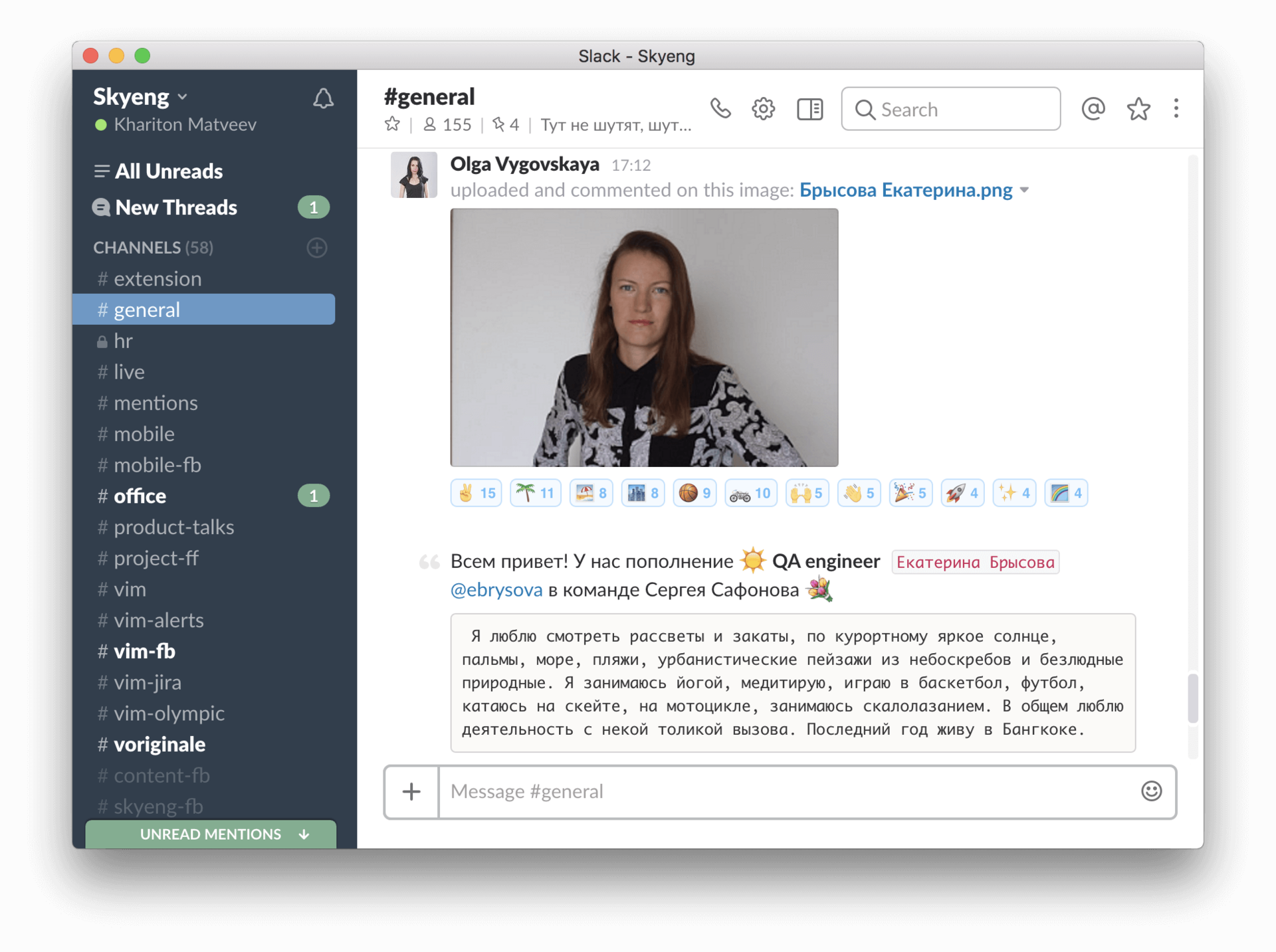
It is clear that our remote developers are deprived of the joy of personal communication with the team. We are trying to recover this loss in Slaka. This is done using conditional entertainment channels such as #live, using avatars, imoji and maximally lively communication. So, all employees must have a completed profile with a photo. Our HRs report about each new employee in the #general channel, attaching a photo and a short essay about who they are, what they will do, what they are fond of, etc. This has a very positive effect on the cohesion of the team - before, many employees were not aware of the remote colleagues, they might not know who was sitting in the next room and what he was doing.
We used to have automatic release alerts coming from Jira. It was awkward, because few people understood what it was about. Now, each developer, closing a task, writes a couple of sentences in his own words - and everyone who subscribes to the channel has the opportunity to be happy for him, and most importantly, he is understood not only by his teammates, but also, for example, guys from the business. If something fell somewhere and “Jenkins came”, then QA will tell you what happened.

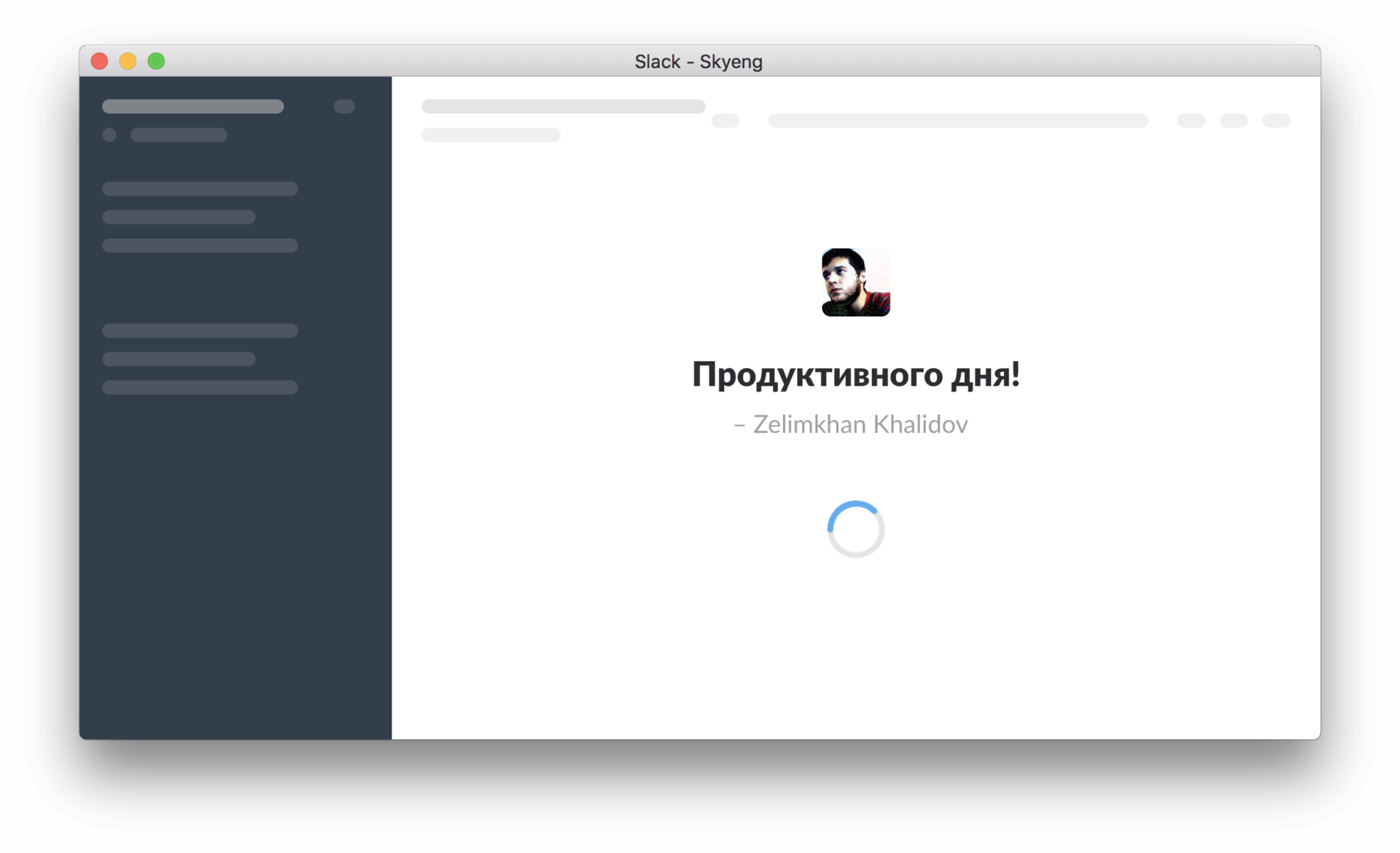
When downloading, a message written by one of our colleagues pops up. We have collected quotes and put them. This is much more fun than reading the default quote.
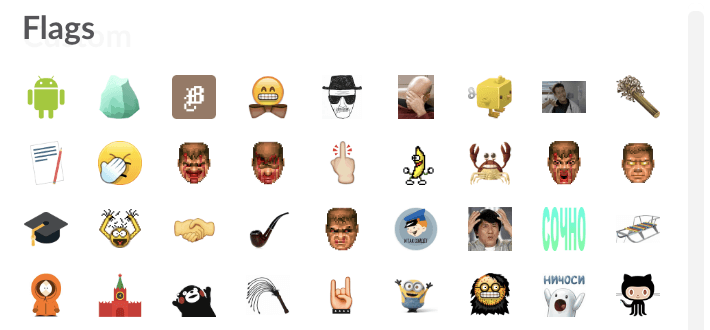
Well, we also encourage the use of imoji, we have our own replenished custom sets, which people are actively using.
All this increases the involvement of employees in the team, wherever they are.

You do not get confused in your channels with this approach?
In order not to get confused in the channels, it is necessary, firstly, to limit their number, and secondly, to use some understandable conventions when naming them. We must clean the stalled channels once every three months, fork the crowded ones and merge the same ones. The channels we have have clear names - for example, everything related to the Vimbox platform starts with # vim-, and all topics of the mobile application team start with # mobile-. The names and surnames of all employees are strictly Latin letters. All channels are signed with a summary. And there are channel packages for departments that new employees automatically subscribe to.


This Slack is probably paid! How much does it cost you?
We have 350 employees talking in Slaka. Eight dollars for each - it turns out about 168 thousand rubles a month.

168 thousand per messenger ?! Yes, with this money you can ... (substitute at will)
350 employees at Slack - this is approximately 32 million rubles of payroll per month. 168 thousand - half a percent of this payroll. In our work, communications play a very large role and are very expensive, therefore, if the messenger increases the efficiency of these communications by more than half a percent, it is beneficial for us. Does Slack do the job? We are sure that yes, and we are talking about more than a three percent increase in labor productivity. That is, with Slack we save at least half a million rubles a month.