April 18, 2017 at 13:04
Mission critical communication and what does NFV have to do with it?
Firefighters are looking,
Police are looking ...
What is Mission critical communication? This is a connection on whose reliability people's lives depend. Examples of services for which such communication is needed are system-112, the Ministry of Emergencies, and law enforcement agencies (the Ministry of Internal Affairs, the FSB, the Ministry of Defense). Also mission critical communication is necessary in the emergency zone and at facilities where accidents can bring devastating consequences: energy, chemical industry, public transport, etc.
Mission critical communications networks are built on the basis of professional mobile radio (PMR) standards. There are currently two main standards: TETRA (Terrestrial Trunked Radio) ETSI EN 300 392 and DMR(Digital Mobile Radio) ETSI 102 361. I will not go into details (information on these standards is available on the network), but they, in addition to their advantages, have a significant drawback: they are sharpened by voice, and the data and video transmission speed is significantly limited. Although it is clear that the ability to transmit video from the scene can be critical. What to do?
When it comes to high-speed mobile Internet, we immediately recall LTE networks, which are already widespread both abroad and in Russia. The solution seems simple and logical: to build a professional communication network LTE. In addition to speeds, we immediately get the coverage that mobile operators provide. No sooner said than done, and in 2014 the 3GPP TS 22.179 “Mission Critical Push to Talk (MCPTT) over LTE” standard appeared. That's all, 3GPP has done its job, now it remains for equipment manufacturers to implement MCPTT support, and telecom operators to implement this equipment and PMR throughout the country! :) Well, to agree more on RAN Sharing between operators, but these are organizational trifles.
Despite the availability of examples, there is a significant limitation for PMR projects. In Russia, as you know, a course has been taken on the import substitution of equipment, and in such an important area for the state as the PMR, the requirements for components are only being tightened. But it is often impossible to find a replacement even for equipment manufacturers for conventional mobile communication networks (such as Huawei, Ericsson, Nokia), and for PMR the problem is even more acute. Not to mention specialized terminals, the choice of which is extremely limited.
The smiley in the introduction was not without reason - everything, of course, is not so easy. We are starting to dive into the standards ... The main functionality of the PMR is reliable voice communications, so first of all we look at what LTE offers. We are surprised to find that voice was not initially provided for in LTE, and the technologies used for VoLTE have gone a long way from Circuit-Switched Fallback (CSFB) to using IMS (IP Multimedia Subsystem). Currently, the use of IMS or SIP core in LTE is recognized as the target architecture for mobile networks. What is an IMS? IMS standards appeared long before LTE and are used to organize voice and video transmission in packet data networks. A very simplified diagram looks like this:

I will not even try to draw a complex diagram, because IMS is a separate world with hundreds of standards, if you're interested, a little more detailed here: “Providing voice services in the next generation communication networks”. Briefly according to the scheme. The main idea of IMS is to divide the architecture into layers: transport, management and application layer. At the transport level is MRF (Media Resource Function), it provides the implementation of such services as: conference calling, notification, transcoding of the transmitted signal and MGW (Media Gateway) - media gateways. To simplify the scheme, he immediately drew MGCF (Media Gateway Control Function) - a function of managing transport gateways, although in fact it is at the control level. Switching and call control is carried out by CSCF (Call Session Control Function), which interacts with application servers and media gateways via SIP protocol. Subscriber profiles are stored in HSS; HSS interacts with the world using the Diameter protocol.
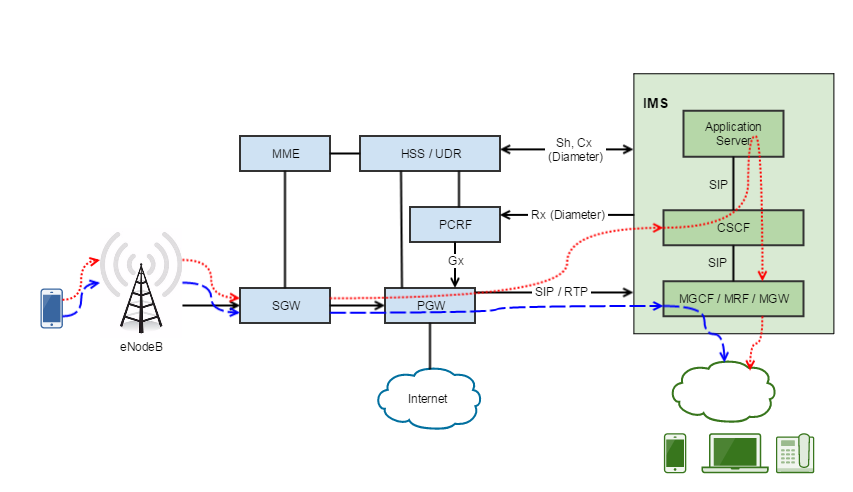
How does IMS c interface with LTE? There is a special standard for this with the requirements: GSMA PRD IR.92 v9.0: “IMS Profile for Voice and SMS”. Those. if the operator already has an IMS system, then he integrates it in accordance with the standard. If not, then for VoLTE you can restrict yourself to functional elements that implement only the necessary interfaces, then it will be called SIP core. Add the network to the LTE circuit:

The actual architecture will depend on which systems already exist with the carrier. For clarity, I did not share PGW (Packet Data Network Gateway) for IMS and the Internet. Again, for clarity, I painted HSS common for LTE, IMS and PCRF, although HSS for LTE and IMS are generally different, but for PCRF you need to draw a separate UDR or SPR. PCRF (Policy and Charging Rules Function) in LTE controls the rate of traffic that passes through the PGW. Accordingly, when the CSCF understands that a voice call is beginning, it instructs the PCRF to set a certain QCI priority (QoS Class Identifier) for traffic, more about PCRF can be found here: “Charging of modern data services in mobile communication networks and managing subscriber service policies” .
To install and control a voice call in VoLTE, it is necessary for SIP to go from a subscriber device, i.e. the device must support SIP natively or through the application. The diagram shows the flows of SIP signaling (red arrows with a small dashed line) and data (blue arrows with a large dashed line). Application servers are used to implement services on top of pure VoLTE, for example, to organize call forwarding, to implement black / white lists, etc.
So, with VoLTE a little figured out, for MCPTT, the network requirements are tightened:
A new functionality is added - broadcast communication: one to many, many to many.
Prioritization of calls and traffic is required; for this, special QCI 65.66 are introduced, which should provide a voice delay of not more than 75 ms and 100 ms, respectively.
The devices themselves must also support MCPTT natively and be able to interact with each other directly, without a communication network.
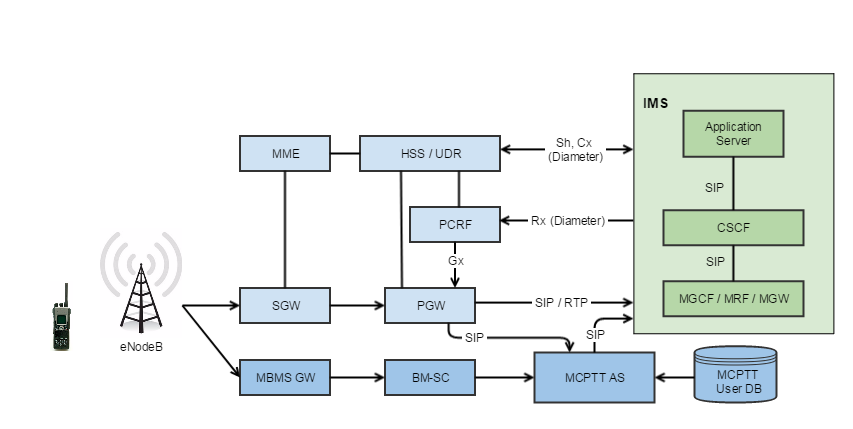
Let's look at the standards and see what the carrier needs to do to run MCPTT on top of LTE. In accordance with the standard, MCPTT introduces elements for supporting broadcast messages MBMS GW (Multimedia Broadcast Multicast Services) and BM-SC (Broadcast Multicast Services Center), as well as MCPTT Application Service and for implementing service logic and MCPTT User DB for setting up and storing groups subscribers:
A little more detail. MCPTT Application Service consists of MCPTT server, “Common service core”, MCPTT User Database and MCPTT client running on the user terminal. From the scheme from the standard it becomes sad:
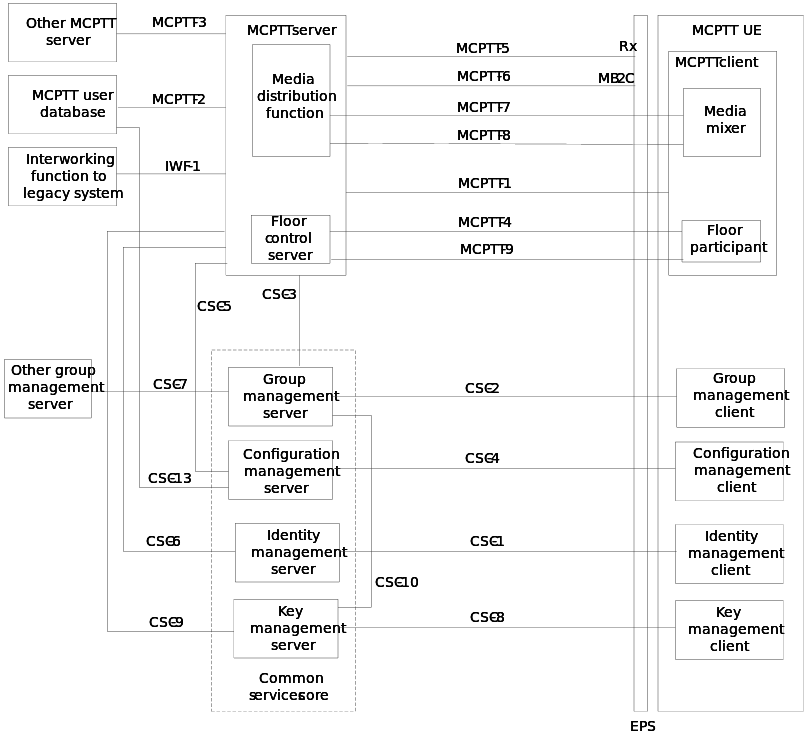
Therefore, I drew more clearly:
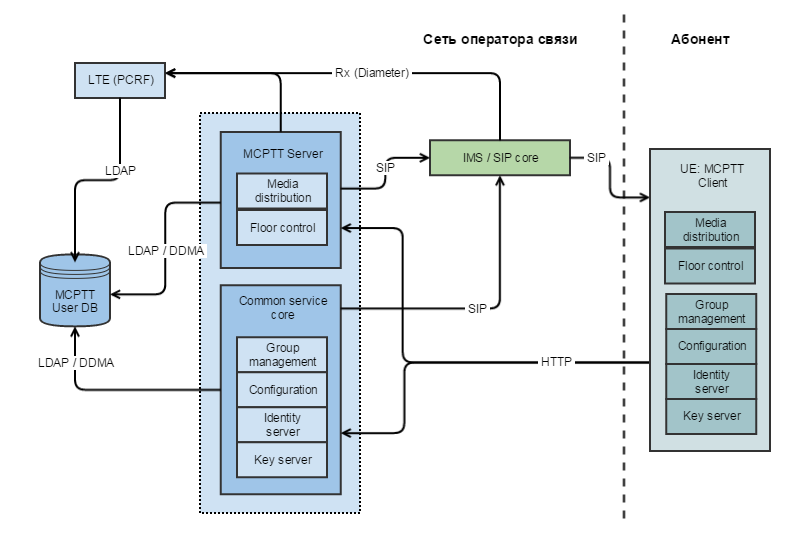
MCPTT server
MCPTT server is a functional element (implements GCS AS (Group Communication Service Application Server), as described in 3GPP TS 23.468) for monitoring multicast and single calls. MCPTT server includes SIP AS (Application Server), HTTP client and server. It interacts with IMS and MTTP client via SIP protocol for:
MCPTT DB
The DDMA protocol (Diameter Data Management Applications) is used to interact with MCPTT DB. As transport, SCTP is recommended. Provides data receipt, subscription / unsubscription for notification of changes, receipt of changes, data modification. When receiving data, MCPTT Users are identified by their MCPTT ID. For MCPTT IDs, the URI format is recommended.
Common service core
Interacts with the “Common service core” functional element via HTTP and SIP protocols. Common service core provides:
To activate the MCPTT service, the following interaction sequence occurs.
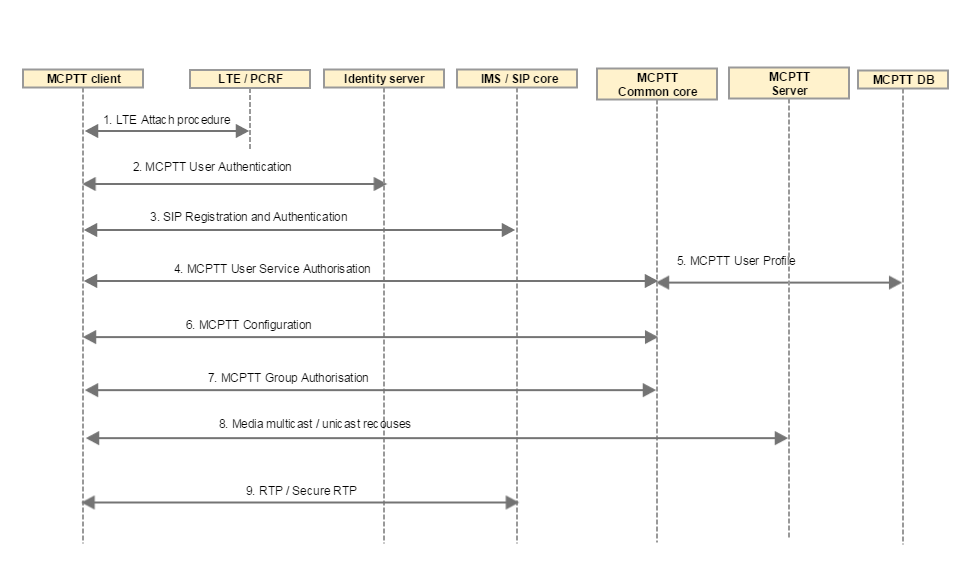
What a full CallFlow looks like for an end-to-end connection can be seen, for example, here .
About what NFV is, I already wrote . How are Network Functions Virtualization and MCPTT related? For telecom operators, launching VoLTE is the second step after building the LTE network itself. But most operators lack IMS. There is a natural desire to minimize cash and labor costs. The deployment of a virtual environment and the launch of the necessary IMS elements in it in the form of virtual network functions (VNF) allows you to quickly achieve what you want. Other network functions, such as HSS or PCRF, are also well virtualized. And if the operator does not have them, their virtualization is quite logical. In addition, the elements of the MCPTT system itself are required to work in virtual environments. What should probably be done with iron is the “Media distribution” function, which encodes data streams.
So for NFV there was one more worthy application - MCPTT service!
SDN & NFV and what does it have Clouds
Clouds like love
Mission critical communication and what does NFV have to do with it?
Interfaces and function blocks NFV (at work)
Manufacturers and cases of using SDN and NFV (planned)
Preparing NFV at home (planned)
BigData and NFV - is there a connection? (planned)
Police are looking ...
What is Mission critical communication? This is a connection on whose reliability people's lives depend. Examples of services for which such communication is needed are system-112, the Ministry of Emergencies, and law enforcement agencies (the Ministry of Internal Affairs, the FSB, the Ministry of Defense). Also mission critical communication is necessary in the emergency zone and at facilities where accidents can bring devastating consequences: energy, chemical industry, public transport, etc.
Mission critical communications networks are built on the basis of professional mobile radio (PMR) standards. There are currently two main standards: TETRA (Terrestrial Trunked Radio) ETSI EN 300 392 and DMR(Digital Mobile Radio) ETSI 102 361. I will not go into details (information on these standards is available on the network), but they, in addition to their advantages, have a significant drawback: they are sharpened by voice, and the data and video transmission speed is significantly limited. Although it is clear that the ability to transmit video from the scene can be critical. What to do?
When it comes to high-speed mobile Internet, we immediately recall LTE networks, which are already widespread both abroad and in Russia. The solution seems simple and logical: to build a professional communication network LTE. In addition to speeds, we immediately get the coverage that mobile operators provide. No sooner said than done, and in 2014 the 3GPP TS 22.179 “Mission Critical Push to Talk (MCPTT) over LTE” standard appeared. That's all, 3GPP has done its job, now it remains for equipment manufacturers to implement MCPTT support, and telecom operators to implement this equipment and PMR throughout the country! :) Well, to agree more on RAN Sharing between operators, but these are organizational trifles.
Examples of projects where PMR is used
- Service-112 is being built in Russia, while the sources of information for it are not only voice calls from people, but also GLONASS, video from surveillance cameras and even video cameras of intercoms.
- The possibility of controlling traffic lights to provide a "green line" to fire engines is being explored. Security Information Systems
- Transdniestria on transport and energy: MS-Spattelecom is ready to launch MVNO
- MegaFon and the project for the Ministry of Internal Affairs
Despite the availability of examples, there is a significant limitation for PMR projects. In Russia, as you know, a course has been taken on the import substitution of equipment, and in such an important area for the state as the PMR, the requirements for components are only being tightened. But it is often impossible to find a replacement even for equipment manufacturers for conventional mobile communication networks (such as Huawei, Ericsson, Nokia), and for PMR the problem is even more acute. Not to mention specialized terminals, the choice of which is extremely limited.
Ims
The smiley in the introduction was not without reason - everything, of course, is not so easy. We are starting to dive into the standards ... The main functionality of the PMR is reliable voice communications, so first of all we look at what LTE offers. We are surprised to find that voice was not initially provided for in LTE, and the technologies used for VoLTE have gone a long way from Circuit-Switched Fallback (CSFB) to using IMS (IP Multimedia Subsystem). Currently, the use of IMS or SIP core in LTE is recognized as the target architecture for mobile networks. What is an IMS? IMS standards appeared long before LTE and are used to organize voice and video transmission in packet data networks. A very simplified diagram looks like this:
I will not even try to draw a complex diagram, because IMS is a separate world with hundreds of standards, if you're interested, a little more detailed here: “Providing voice services in the next generation communication networks”. Briefly according to the scheme. The main idea of IMS is to divide the architecture into layers: transport, management and application layer. At the transport level is MRF (Media Resource Function), it provides the implementation of such services as: conference calling, notification, transcoding of the transmitted signal and MGW (Media Gateway) - media gateways. To simplify the scheme, he immediately drew MGCF (Media Gateway Control Function) - a function of managing transport gateways, although in fact it is at the control level. Switching and call control is carried out by CSCF (Call Session Control Function), which interacts with application servers and media gateways via SIP protocol. Subscriber profiles are stored in HSS; HSS interacts with the world using the Diameter protocol.
VoLTE
How does IMS c interface with LTE? There is a special standard for this with the requirements: GSMA PRD IR.92 v9.0: “IMS Profile for Voice and SMS”. Those. if the operator already has an IMS system, then he integrates it in accordance with the standard. If not, then for VoLTE you can restrict yourself to functional elements that implement only the necessary interfaces, then it will be called SIP core. Add the network to the LTE circuit:
The actual architecture will depend on which systems already exist with the carrier. For clarity, I did not share PGW (Packet Data Network Gateway) for IMS and the Internet. Again, for clarity, I painted HSS common for LTE, IMS and PCRF, although HSS for LTE and IMS are generally different, but for PCRF you need to draw a separate UDR or SPR. PCRF (Policy and Charging Rules Function) in LTE controls the rate of traffic that passes through the PGW. Accordingly, when the CSCF understands that a voice call is beginning, it instructs the PCRF to set a certain QCI priority (QoS Class Identifier) for traffic, more about PCRF can be found here: “Charging of modern data services in mobile communication networks and managing subscriber service policies” .
To install and control a voice call in VoLTE, it is necessary for SIP to go from a subscriber device, i.e. the device must support SIP natively or through the application. The diagram shows the flows of SIP signaling (red arrows with a small dashed line) and data (blue arrows with a large dashed line). Application servers are used to implement services on top of pure VoLTE, for example, to organize call forwarding, to implement black / white lists, etc.
Mcptt
So, with VoLTE a little figured out, for MCPTT, the network requirements are tightened:
A new functionality is added - broadcast communication: one to many, many to many.
Prioritization of calls and traffic is required; for this, special QCI 65.66 are introduced, which should provide a voice delay of not more than 75 ms and 100 ms, respectively.
The devices themselves must also support MCPTT natively and be able to interact with each other directly, without a communication network.
Let's look at the standards and see what the carrier needs to do to run MCPTT on top of LTE. In accordance with the standard, MCPTT introduces elements for supporting broadcast messages MBMS GW (Multimedia Broadcast Multicast Services) and BM-SC (Broadcast Multicast Services Center), as well as MCPTT Application Service and for implementing service logic and MCPTT User DB for setting up and storing groups subscribers:
A little more detail. MCPTT Application Service consists of MCPTT server, “Common service core”, MCPTT User Database and MCPTT client running on the user terminal. From the scheme from the standard it becomes sad:
Therefore, I drew more clearly:
MCPTT server
MCPTT server is a functional element (implements GCS AS (Group Communication Service Application Server), as described in 3GPP TS 23.468) for monitoring multicast and single calls. MCPTT server includes SIP AS (Application Server), HTTP client and server. It interacts with IMS and MTTP client via SIP protocol for:
- obtaining information about the location of the UE to determine the use of multicast broadcasting;
- coordination and management of media streams (floor control). Secure RTCP protocol (SRTCP) is used;
- transmission of the media streams themselves (media distribution). Secure RTP (SRTP) protocol is used;
- can directly control PCRF over the Rx interface or interact with it through the IMS system;
- If there is a Multimedia Broadcast network, Multicast Services requests multicast resources for broadcasting.
MCPTT DB
The DDMA protocol (Diameter Data Management Applications) is used to interact with MCPTT DB. As transport, SCTP is recommended. Provides data receipt, subscription / unsubscription for notification of changes, receipt of changes, data modification. When receiving data, MCPTT Users are identified by their MCPTT ID. For MCPTT IDs, the URI format is recommended.
Common service core
Interacts with the “Common service core” functional element via HTTP and SIP protocols. Common service core provides:
- authentication and authorization of subscribers (Identity);
- connecting subscribers to group calls, group management (Group management);
- configuration management, such as service policies (Configuration);
- stores and transmits encryption keys (Key server);
- receives notification of the MCPTT UE connection, informing the UE of calls;
- organizes queues and prioritization of calls.
To activate the MCPTT service, the following interaction sequence occurs.
- At the beginning of a call, the mobile terminal performs the usual setup of an Internet connection.
- And then the MCPTT client starts working, which authenticates the subscriber.
- Next, the SIP client is registered in IMS / SIP core.
- After successful SIP registration, service authorization occurs.
- To do this, a subscriber profile is requested from MCPTT DB.
- The required configuration from the profile is sent to the client MCPTT.
- And information about the groups in which the subscriber participates.
- A request is made for the necessary media resources.
- And voice or video streams are installed.
What a full CallFlow looks like for an end-to-end connection can be seen, for example, here .
What does the NFV have to do with it?
About what NFV is, I already wrote . How are Network Functions Virtualization and MCPTT related? For telecom operators, launching VoLTE is the second step after building the LTE network itself. But most operators lack IMS. There is a natural desire to minimize cash and labor costs. The deployment of a virtual environment and the launch of the necessary IMS elements in it in the form of virtual network functions (VNF) allows you to quickly achieve what you want. Other network functions, such as HSS or PCRF, are also well virtualized. And if the operator does not have them, their virtualization is quite logical. In addition, the elements of the MCPTT system itself are required to work in virtual environments. What should probably be done with iron is the “Media distribution” function, which encodes data streams.
So for NFV there was one more worthy application - MCPTT service!
A series of articles about NFV
SDN & NFV and what does it have Clouds
Clouds like love
Mission critical communication and what does NFV have to do with it?
Interfaces and function blocks NFV (at work)
Manufacturers and cases of using SDN and NFV (planned)
Preparing NFV at home (planned)
BigData and NFV - is there a connection? (planned)