April 4, 2017 at 10:33
Run the fluid flow rate sensor
The post is dedicated to the Out Of Liquid flow rate sensor, a hot-wire anemometer for measuring fluid flow. Under the cutter, the reader will find a description of the principle of operation of the sensor, as well as a video in which this principle is clearly demonstrated.
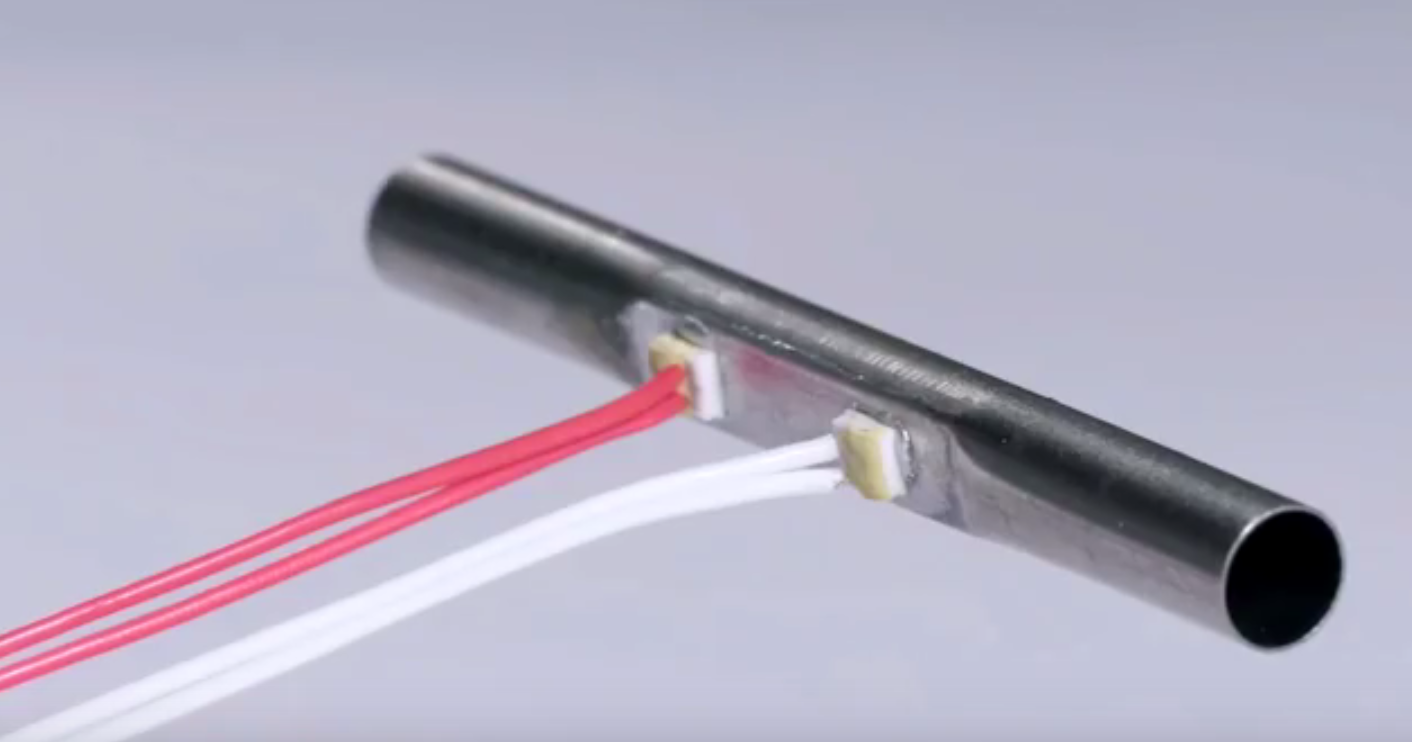
The element is a small stainless steel tube and is suitable for both water and aggressive liquids and gases.
Recently, an article was published about the FS7 hot-wire anemometric sensor ; today's text can be called its continuation.
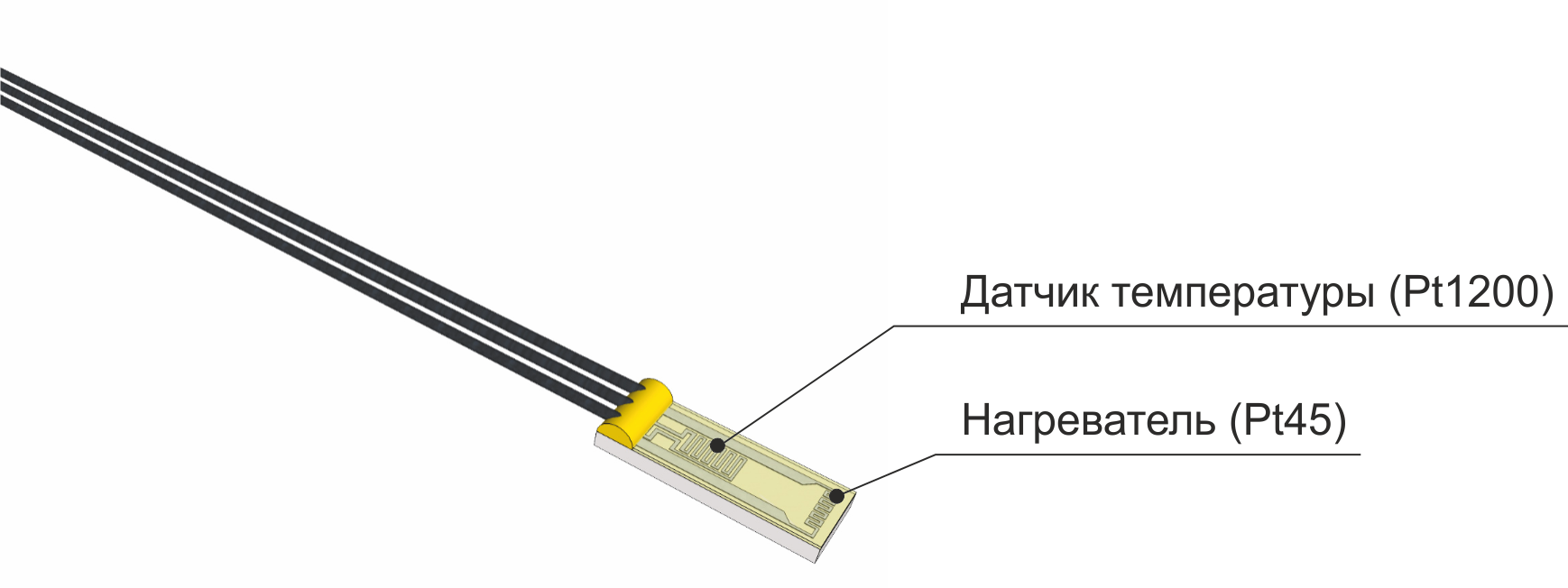
Let me remind you that FS7 is a miniature ceramic plate measuring 6.9 by 2.4 mm, on which two platinum thermal resistors (RTD) are applied. One of them has a nominal resistance of 45 Ohms and is used as a heater, the other has a nominal resistance of 1200 Ohms and serves as a temperature sensor. The first element, respectively, is denoted by Pt45, the second by Pt1200.
The sensor is placed in the pipe through which the flow passes, and the Pt45 and Pt1200 elements are included in the bridge circuit. In the absence of a flow of resistance, the heater and the temperature sensor do not change, the bridge is balanced. However, when the medium begins to move “past” the sensor, part of the heater’s heat is transferred to the flow, i.e. the resistance of the heater (Pt45 element) is reduced. At the same time, the resistance of the Pt1200 element remains the same, which means the bridge will be unbalanced. The imbalance signal depends on the amount of heat given to the flow, which in turn depends on the flow rate.

However, all this is described in much more detail in the previous article , today we will consider the sensor for conditions in which the use of FS7 is not recommended.
The FS7 sensors are designed for gases and are also suitable for certain liquid media, such as oils. However, for aggressive liquids, for liquids containing water, as well as for aggressive gases, an Out Of Liquid sensor is designed.
Out Of Liquid is the same hot-wire anemometer consisting of two platinum RTDs with a nominal resistance of 50 and 1000 Ohms. The Pt50 element acts as a heater, and the Pt1000 element acts as a medium temperature sensor.
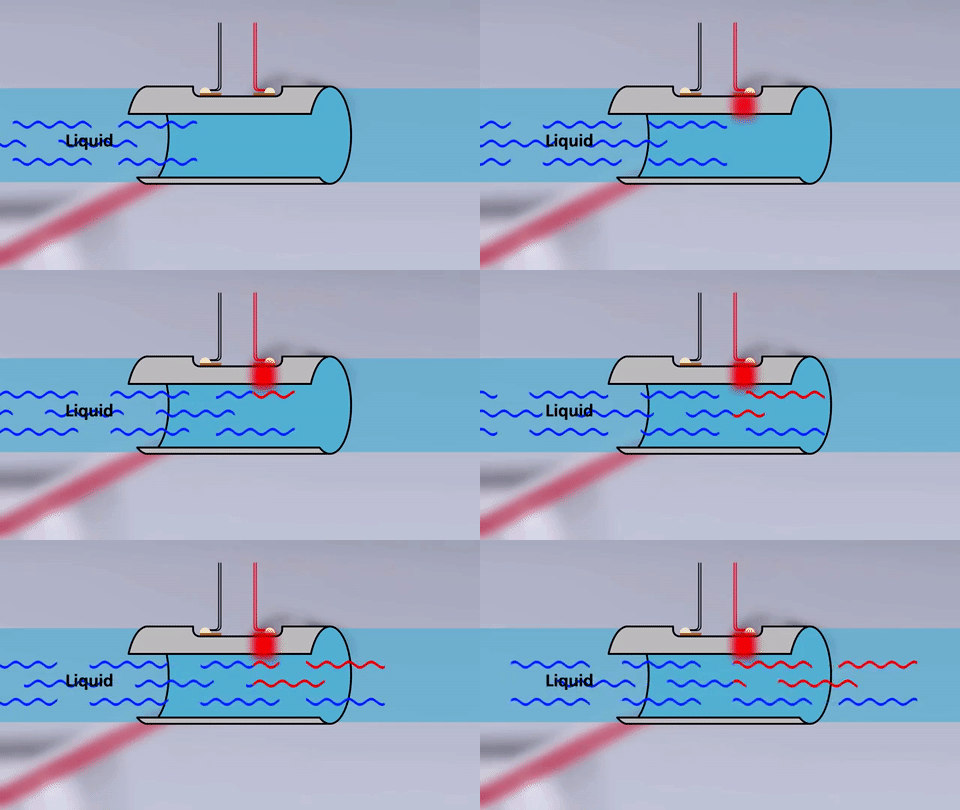
The fundamental difference between the Out Of Liquid sensor is that the thermistors do not fit into the environment, as in the case of FS7, but are soldered to the outer wall of the pipe through which the stream flows. Good thermal contact between the thermal resistance and the medium is achieved due to the small thickness of the pipe wall and due to the design of the Pt50 and Pt1000 elements. These platinum thermal resistances, firstly, are made using thin-film technology, and therefore have a small size (2.3 x 2 mm) and a flat shape, and secondly, the lower side of both elements is covered with an additional metal layer.
The Out Of Liquid tube is made of stainless steel, its length is 40 mm, the outer diameter is 4 mm, the inner diameter is 3.8 mm. The tube either cuts into the main pipe or is diverted from it as a shunt, it all depends on the final task.
The choice of components for the sensor switching circuit depends on the final task (pipe dimensions, composition and temperature of the medium, etc.). For this reason, the manufacturer does not provide detailed instructions for the use of Out Of Liquid.
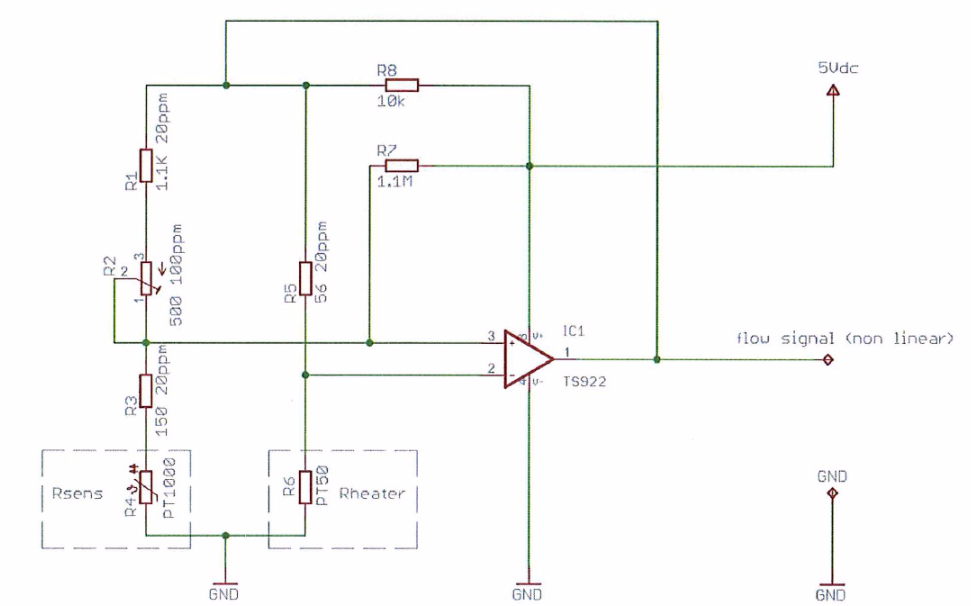
The Out Of Liquid circuitry follows the circuitry of any other hot-wire anemometer. The Pt50 and Pt1000 act as the lower arms of the measuring bridge, the unbalance signal of which is fed to the amplifier, and from there back to the bridge. Thus, in the presence of flow, the feedback signal gives the heater a higher temperature and the measuring bridge is balanced again. The signal at the output of the amplifier, as mentioned above, is also used as the output signal. The magnitude of the output voltage non-linearly depends on the flow rate passing through Out Of Liiquid.
An example of a switching circuit:
An example of the dependence of the output voltage on the flow rate [photo from the documentation]:

Out Of Liquid has four outputs, two for each thermal resistance. The Pt50 element has red wires, the Pt1000 has white wires. It is easy to guess that the flow should go from Pt1000 to Pt50, and not vice versa, otherwise the heat from the heater will go to the temperature sensor and affect its resistance.
By the way, at the FS7 element, the heater and the temperature sensor are located under each other, i.e. the flow can be directed in both directions relative to the sensitive element.
The Out Of Liquid sensor can measure flow rates from 0 to 3000 ml / min (≈4 m / s). The operating temperature range of the sensor is from -50 to + 180 ° C, the response time does not exceed 300 ms.
To familiarize yourself with the Out Of Liquid module, but not for use in the finished product, a debug board is available.
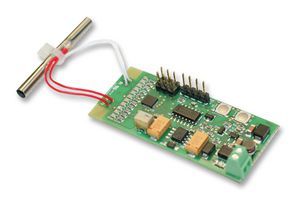
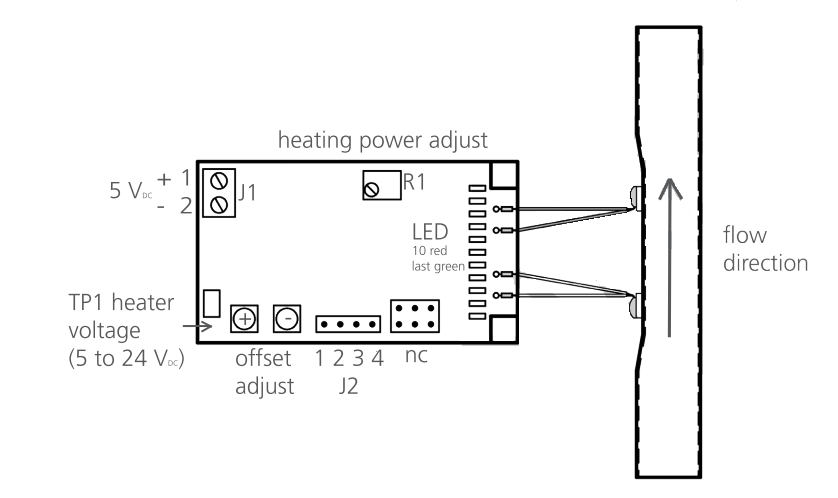
In addition to the sensor switching circuit, it contains power control circuits, a potentiometer and two buttons for adjusting the resistor R1 (upper arm of the measuring bridge), LEDs for indicating the flow rate, and also contact pads, most of which for some reason hang in the air.
The simple process of turning on the board is shown in the video.
We sell Out Of Liquid sensors at a retail price of 24 euros, meaning retail quantities of up to 50 pieces. For bulk purchases, the price naturally decreases, for example, when ordering 100 pieces, the price of an element will be already 15 euros. By the way, the official name of the Out Of Liquid sensor is the unpronounceable P1K0 / 050.232.2K.C.050.MUS.
I take this opportunity to provide a link to the recently launched site efo-sensor.ru , dedicated to sensors manufactured by IST-AG and other manufacturers.
In conclusion, I traditionally thank the reader for your attention and remind you that questions about the use of the products that we write about on the Habr can also be sent to the email address specified in my profile.
The element is a small stainless steel tube and is suitable for both water and aggressive liquids and gases.
Digression (About FS7 Sensor)
Recently, an article was published about the FS7 hot-wire anemometric sensor ; today's text can be called its continuation.
Let me remind you that FS7 is a miniature ceramic plate measuring 6.9 by 2.4 mm, on which two platinum thermal resistors (RTD) are applied. One of them has a nominal resistance of 45 Ohms and is used as a heater, the other has a nominal resistance of 1200 Ohms and serves as a temperature sensor. The first element, respectively, is denoted by Pt45, the second by Pt1200.
The sensor is placed in the pipe through which the flow passes, and the Pt45 and Pt1200 elements are included in the bridge circuit. In the absence of a flow of resistance, the heater and the temperature sensor do not change, the bridge is balanced. However, when the medium begins to move “past” the sensor, part of the heater’s heat is transferred to the flow, i.e. the resistance of the heater (Pt45 element) is reduced. At the same time, the resistance of the Pt1200 element remains the same, which means the bridge will be unbalanced. The imbalance signal depends on the amount of heat given to the flow, which in turn depends on the flow rate.
However, all this is described in much more detail in the previous article , today we will consider the sensor for conditions in which the use of FS7 is not recommended.
About Out Of Liquid
The FS7 sensors are designed for gases and are also suitable for certain liquid media, such as oils. However, for aggressive liquids, for liquids containing water, as well as for aggressive gases, an Out Of Liquid sensor is designed.
Out Of Liquid is the same hot-wire anemometer consisting of two platinum RTDs with a nominal resistance of 50 and 1000 Ohms. The Pt50 element acts as a heater, and the Pt1000 element acts as a medium temperature sensor.
The fundamental difference between the Out Of Liquid sensor is that the thermistors do not fit into the environment, as in the case of FS7, but are soldered to the outer wall of the pipe through which the stream flows. Good thermal contact between the thermal resistance and the medium is achieved due to the small thickness of the pipe wall and due to the design of the Pt50 and Pt1000 elements. These platinum thermal resistances, firstly, are made using thin-film technology, and therefore have a small size (2.3 x 2 mm) and a flat shape, and secondly, the lower side of both elements is covered with an additional metal layer.
Such metallized thermistors are also used separately as temperature sensors. They are in demand in applications where good contact with the surface of the measurement object is required.
The production of various platinum thin-film thermal resistances is the subject of the article Thermal Resistance: Production Process .
The Out Of Liquid tube is made of stainless steel, its length is 40 mm, the outer diameter is 4 mm, the inner diameter is 3.8 mm. The tube either cuts into the main pipe or is diverted from it as a shunt, it all depends on the final task.
The choice of components for the sensor switching circuit depends on the final task (pipe dimensions, composition and temperature of the medium, etc.). For this reason, the manufacturer does not provide detailed instructions for the use of Out Of Liquid.
The Out Of Liquid circuitry follows the circuitry of any other hot-wire anemometer. The Pt50 and Pt1000 act as the lower arms of the measuring bridge, the unbalance signal of which is fed to the amplifier, and from there back to the bridge. Thus, in the presence of flow, the feedback signal gives the heater a higher temperature and the measuring bridge is balanced again. The signal at the output of the amplifier, as mentioned above, is also used as the output signal. The magnitude of the output voltage non-linearly depends on the flow rate passing through Out Of Liiquid.
An example of a switching circuit:
An example of the dependence of the output voltage on the flow rate [photo from the documentation]:
Out Of Liquid has four outputs, two for each thermal resistance. The Pt50 element has red wires, the Pt1000 has white wires. It is easy to guess that the flow should go from Pt1000 to Pt50, and not vice versa, otherwise the heat from the heater will go to the temperature sensor and affect its resistance.
By the way, at the FS7 element, the heater and the temperature sensor are located under each other, i.e. the flow can be directed in both directions relative to the sensitive element.
The Out Of Liquid sensor can measure flow rates from 0 to 3000 ml / min (≈4 m / s). The operating temperature range of the sensor is from -50 to + 180 ° C, the response time does not exceed 300 ms.
To familiarize yourself with the Out Of Liquid module, but not for use in the finished product, a debug board is available.
In addition to the sensor switching circuit, it contains power control circuits, a potentiometer and two buttons for adjusting the resistor R1 (upper arm of the measuring bridge), LEDs for indicating the flow rate, and also contact pads, most of which for some reason hang in the air.
The simple process of turning on the board is shown in the video.
About pricing
We sell Out Of Liquid sensors at a retail price of 24 euros, meaning retail quantities of up to 50 pieces. For bulk purchases, the price naturally decreases, for example, when ordering 100 pieces, the price of an element will be already 15 euros. By the way, the official name of the Out Of Liquid sensor is the unpronounceable P1K0 / 050.232.2K.C.050.MUS.
I take this opportunity to provide a link to the recently launched site efo-sensor.ru , dedicated to sensors manufactured by IST-AG and other manufacturers.
Conclusion
In conclusion, I traditionally thank the reader for your attention and remind you that questions about the use of the products that we write about on the Habr can also be sent to the email address specified in my profile.