Again, February seventeenth, we are preparing a revolutionary gun for satellite navigation

Today, the emerging industries of airborne and ground-based unmanned aerial vehicles require reliable, high-precision positioning. Mobile applications also require higher positioning accuracy. These funds should be small-sized, low-consumption and cheap. Until today, there has been a gap between these new requirements and product features and prices. The giants of the navigation industry did not want or could not offer products with the required properties.
Now the situation is beginning to change rapidly.
Roughly speaking, positioning accurate to centimeters is called high-precision. This problem can be solved in the local zone, that is, relying on some base stations, or maybe without relying, that is, on a global scale. Each of these tasks can be solved in real time or by recording, that is, in deferred mode. The main problem that is overcome on the way to accuracy, the physical one is the instability of the delay of the electromagnetic wave in the ionosphere . To compensate for the ionospheric error, which reaches two meters, use either the simultaneous reception of a satellite signal at different frequencies , or corrections from base stations when receiving at a single frequency. The main advantage of a dual frequency receiver is that there is no need for a network of base stations. It is naturally possible to mix technologies, that is, for example, a two-frequency system using corrections from the base station, where the two-frequency is used to accelerate the convergence of the navigation solution and to increase its reliability when changing the availability of satellite signals.
The hardware of high-precision receivers, including multi-frequency and multi-system, has been practiced for decades and its cost is low. Large kilobacks, which are dual-frequency receivers from market leaders today, are mainly obtained for spent software.
Despite the fact that the main complexity of high-precision equipment lies in the software plane, it all started with hardware simplification. The NTLab Minsk company has developed and launched into serial production the NT1065 microchip, a multi-system multi-frequency radio receiver. Roughly speaking, this thing turns signals from one or more antennas, up to four, into digital readings. It covers all existing and planned frequency ranges of satellite navigation systems. These systems and frequencies are detailed here .
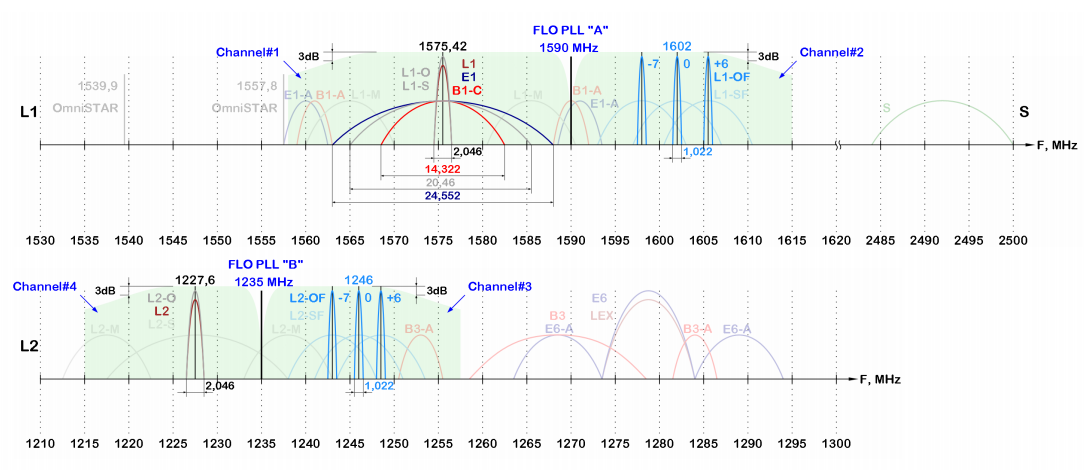
Variant of the NT1065 frequency plan
After the introductory part about examples of new tools for high-precision positioning, I will talk about the experience of designing a device on NT1065.
This part about different companies may seem boring. Caution, there are no pictures.
Как водится, сначала в эту авантюру полезли начинающие компании. Я не знаю, кто точно был первым из этих двух, назову в порядке, в котором заметил их анонсы. Первая — Swift Navigation, компания начинающая, но уже изрядно подрощенная. Она занимается RTK-решениями ( RTK — это высокоточная система позиционирования в реальном времени с использованием базовых станций), начинала на Кикстартере с open-source одночастотным устройством RTK. Сегодня они предлагают устройство Piksi Multi, которое работает в диапазонах L1 и L2 и обеспечивает сантиметровую точность всего за 595 долларов. За сумму менее 2000 долларов можно взять два комплекта с RTK-антеннами и системой связи для передачи поправок. Я думаю, это очень беспокоит гигантов рынка.
Вторая компания — Tersus GNSS. Платы приемников на вид не отличаются от плат Swift Navigation, просматривается тот же FPGA Zync. Также есть наборы с антеннами и системой связи. Здесь больше красочных описаний новых возможностей, которые предоставляет оборудование для беспилотных тракторов и коптеров. У них есть вариант приемника с двумя антеннами для построения угломерных высокоточных приемников. Такие приемники точно вычисляют истинный курс транспортного средства, что не всегда нужно, но вычислить его другими средствами очень непросто.
Таким образом эти две компании потихоньку отъедают кусок пирога гигантов отрасли, а те пока почивают на лаврах. Обе фирмы не раскрывают радио-микросхему, примененную в технике и сделавшую возможным такое быстрое вхождение на рынки гигантов, но по габаритам устройств можно понять, что это именно NT1065.
Спустя несколько месяцев до гигантов отрасли дошло, что, если они уже и разрабатывают что-то революционное, то настало время это все анонсировать, иначе все просто станут считать, что они выбыли в неизвестном направлении и перестанут заглядывать на их сайт.
Компания Trimble анонсировала изделие Catalyst. Они сразу ухватили суть революционного процесса — возможностей получать прибыли на железе будет все меньше. Поэтому они сделали точность позиционирования службой, сервисом. Пользователю достаточно будет купить за 350 долларов железяку и платить месячную плату за точность тогда, когда это нужно. От метровой точности за 40 баксов с месяц до сантиметровой за 350. При этом их железяка уже содержит антенну и подключается прямо к мобильному устройству по USB. Якобы железяка только передает оцифрованный сигнал, а смартфон или планшет выполняет программный приемник (SDR — software defined receiver). Непонятно, как они это делают, большой комп затыкается от навигационного SDR. Они пишут про некие особенные мобильные устройства, на которых должен работать их софт. Один знаток средств вычислений на GPU сказал, что это может быть OpenCL на мобильных устройствах (я не нашел много информации, если кто-то знает, прошу поделиться). Но это уже настоящая революция! Они хоть и не первые, но шансов получить первенство у них с такой штукой гораздо больше, чем у первых двух.
У Trimble наверняка есть свои решения для радиоприемной микросхемы, но вполне возможно, что им было выгоднее тоже поставить NT1065. Хотя есть посчитать деньги, то получится, что сделать такой РПУ на рассыпухе будет дешевле. Но лень — двигатель прогресса. Все стояло на месте, пока не появился чип, который очень просто запрячь в телегу.
Вторая компания — Tersus GNSS. Платы приемников на вид не отличаются от плат Swift Navigation, просматривается тот же FPGA Zync. Также есть наборы с антеннами и системой связи. Здесь больше красочных описаний новых возможностей, которые предоставляет оборудование для беспилотных тракторов и коптеров. У них есть вариант приемника с двумя антеннами для построения угломерных высокоточных приемников. Такие приемники точно вычисляют истинный курс транспортного средства, что не всегда нужно, но вычислить его другими средствами очень непросто.
Таким образом эти две компании потихоньку отъедают кусок пирога гигантов отрасли, а те пока почивают на лаврах. Обе фирмы не раскрывают радио-микросхему, примененную в технике и сделавшую возможным такое быстрое вхождение на рынки гигантов, но по габаритам устройств можно понять, что это именно NT1065.
Спустя несколько месяцев до гигантов отрасли дошло, что, если они уже и разрабатывают что-то революционное, то настало время это все анонсировать, иначе все просто станут считать, что они выбыли в неизвестном направлении и перестанут заглядывать на их сайт.
Компания Trimble анонсировала изделие Catalyst. Они сразу ухватили суть революционного процесса — возможностей получать прибыли на железе будет все меньше. Поэтому они сделали точность позиционирования службой, сервисом. Пользователю достаточно будет купить за 350 долларов железяку и платить месячную плату за точность тогда, когда это нужно. От метровой точности за 40 баксов с месяц до сантиметровой за 350. При этом их железяка уже содержит антенну и подключается прямо к мобильному устройству по USB. Якобы железяка только передает оцифрованный сигнал, а смартфон или планшет выполняет программный приемник (SDR — software defined receiver). Непонятно, как они это делают, большой комп затыкается от навигационного SDR. Они пишут про некие особенные мобильные устройства, на которых должен работать их софт. Один знаток средств вычислений на GPU сказал, что это может быть OpenCL на мобильных устройствах (я не нашел много информации, если кто-то знает, прошу поделиться). Но это уже настоящая революция! Они хоть и не первые, но шансов получить первенство у них с такой штукой гораздо больше, чем у первых двух.
У Trimble наверняка есть свои решения для радиоприемной микросхемы, но вполне возможно, что им было выгоднее тоже поставить NT1065. Хотя есть посчитать деньги, то получится, что сделать такой РПУ на рассыпухе будет дешевле. Но лень — двигатель прогресса. Все стояло на месте, пока не появился чип, который очень просто запрячь в телегу.
We proceed to the manufacture of the main weapon of the revolution. The main ingredients are two -
Consider what kind of beast - NT1065? What horizons does a developer discover for himself with such a thing? How easy is it to learn?
In general, this is such a thing:
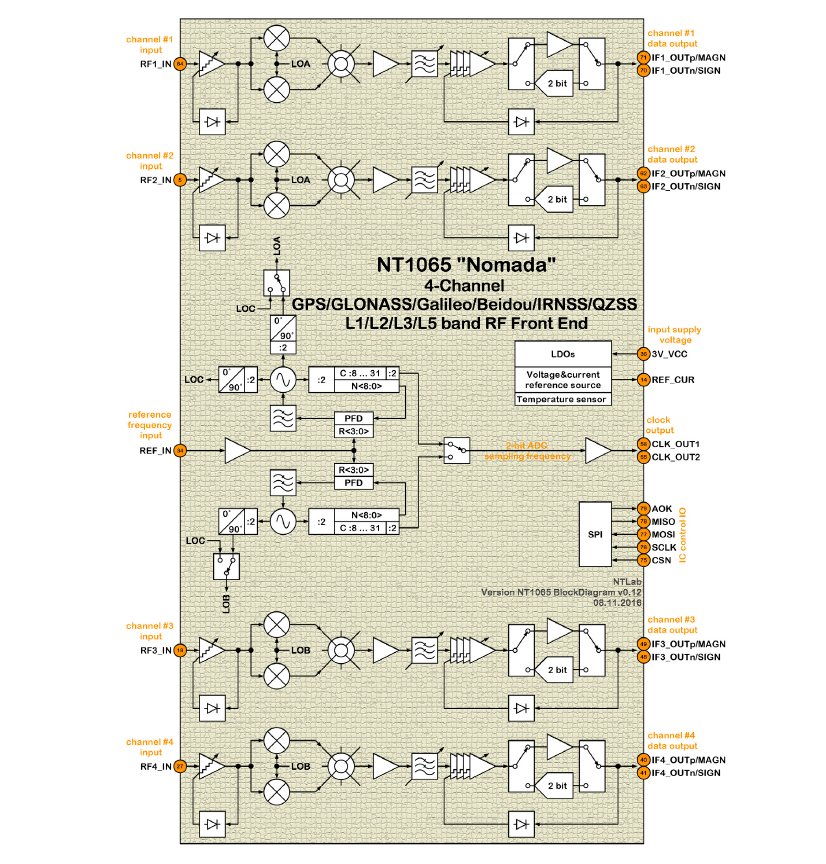
Four receive channels with separate inputs and two local oscillators with which you can flexibly record channel mixers. You can output signals in digital and analog form. Thus, it is possible to implement both the tuning of each channel to its own signal (with some limitations), and the synchronous reception of one signal to spaced antennas or antenna array.
Now let's go through the details. At first glance, a power supply is strangely made - only one foot of the microcircuit. But when wiring this oddity turned into a pumpkin advantage. Although these guys recommend four layers in a datasheet, I easily fit in two! With any more or less legged bourgeois chip, this did not work out for me.
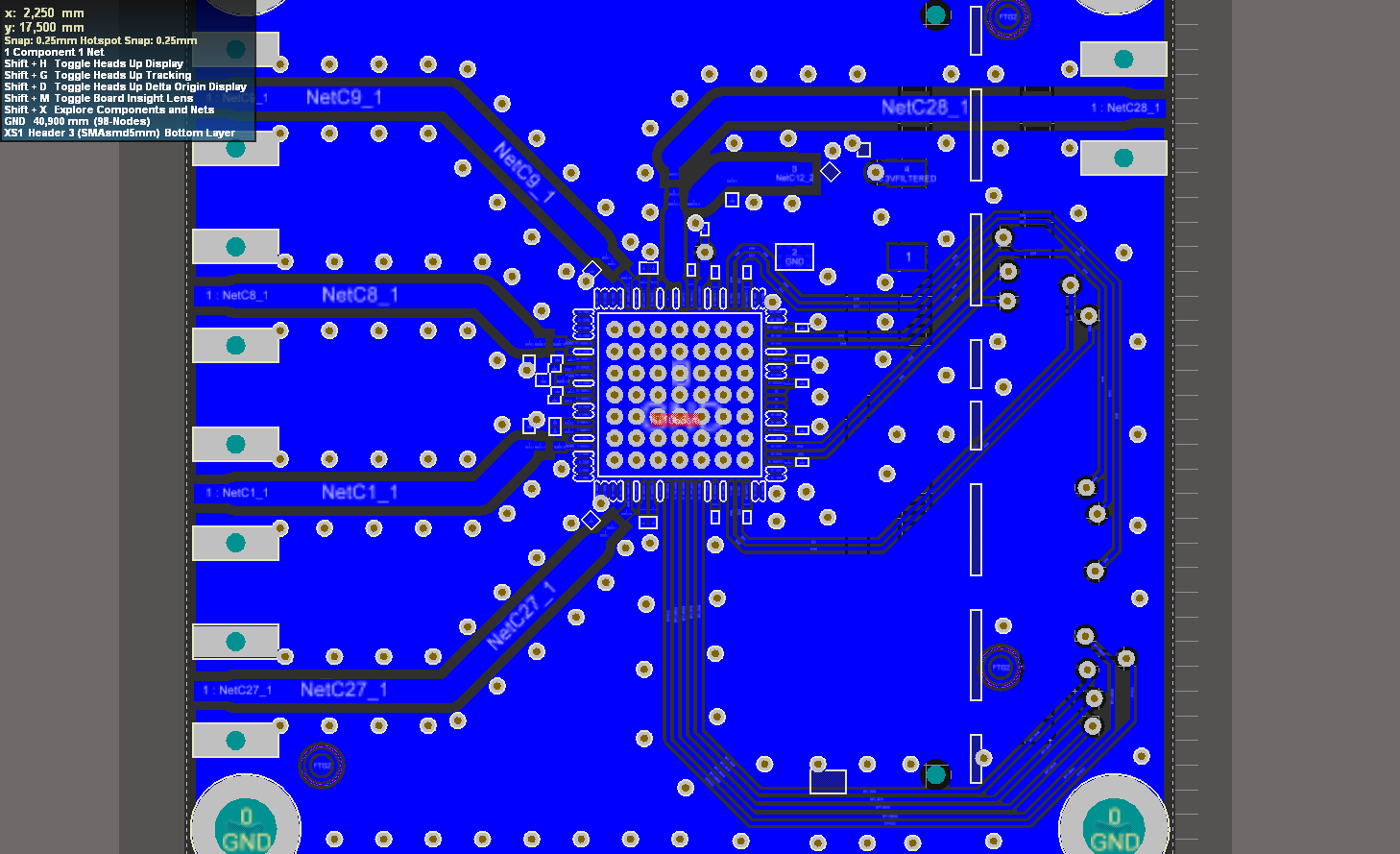
Further, they in the datasheet recommend dividing the lands of each channel so that the transient attenuation is greater. I even almost killed myself and made such an option, but I did not see a significant increase in the isolation of the channels. Either measured wrong, or did wrong. In general, the best enemy of the good.
So, the power is from 2.8 to 3.3 Volts, the current is only 100 mA maximum. True, you need to choose a power source with low noise. DCDC is not suitable here. The reference generator also needs low noise, with good frequency stability and temperature-compensated. Standard settings support 10 MHz and 24.84 MHz. To use a different nominal frequency of the opornik, you need to contact the developers.
The output interface is also very simple - clocks and data. There are only two ADC discharges in each channel, a sign and a magnitude, which brought me into a state of swagger for a short time (I got used to 16 categories at my last job), but this turned out to be quite enough. But the sampling rate is up to 100 MHz. We start clock cycles on the clock input of the GPIFII interface of the CYUSB3014 controller, and data on the data input. We also need to get SPI to control and carefully, under the guidance of the datasheet, make the wiring and coordination of impedances at the input of the RPU and the gun is ready.

NTLab has a full scheme of such a board on the site.
With software, it’s even easier to accept a stream from Cypress FX3 on any OS is very simple: you can use libusb for both Windows and Linux. Under Windows, you can also use the native driver from Cypress - no difference.
At the moment I have a set of software (posted on GitHub, search by the word NT1065).
The main tool is a couple of programs. One of them is able to reliably record a continuous signal from the chip to the disk, and the second is suitable for diagnostics and demonstrations.
It is possible to see the spectrum of the input signal (you can send a signal from the generator, who has it).
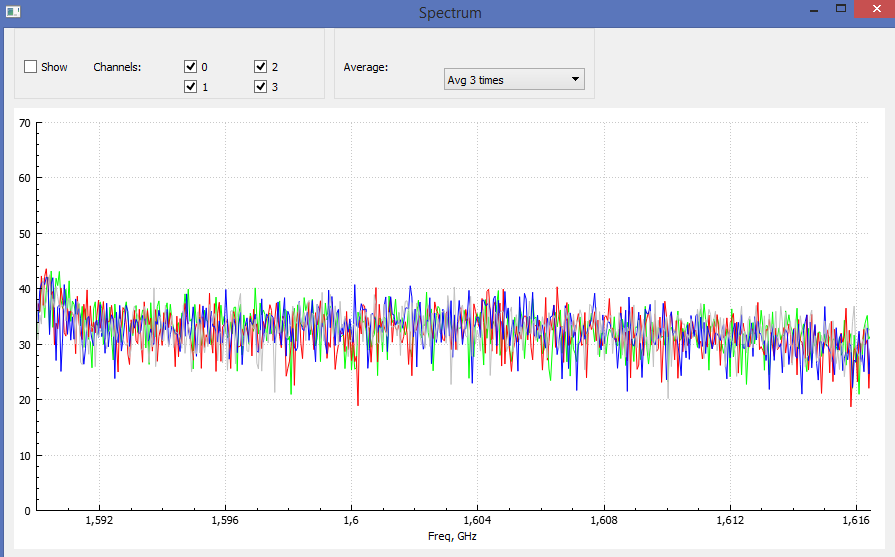
After connecting the antenna with simple methods, you can detect satellite signals.
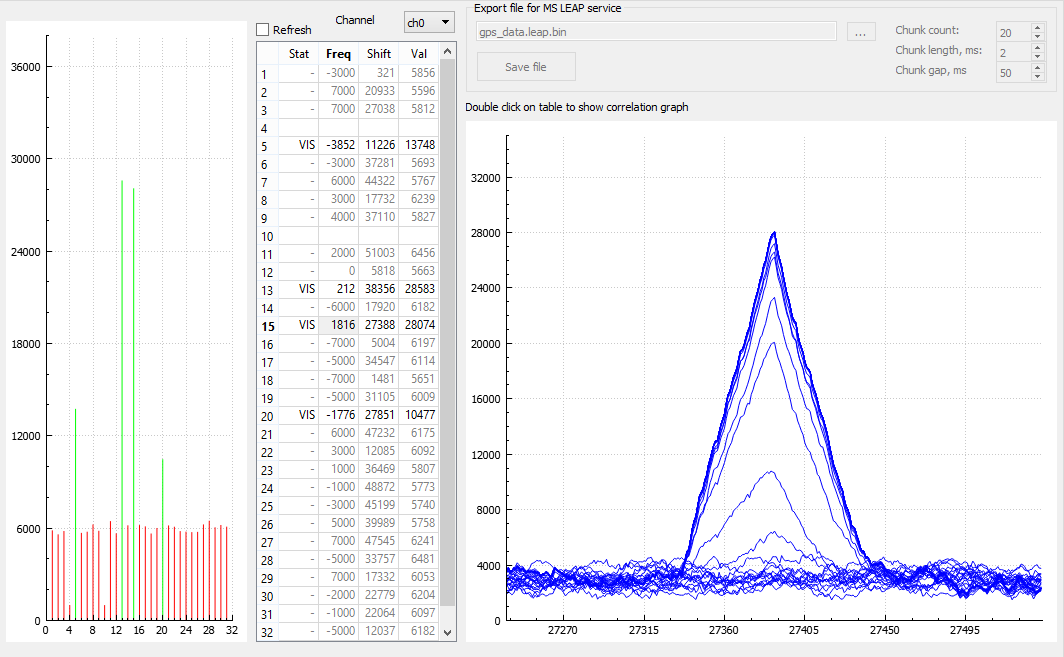
And not only GPS, but also GLONASS at a frequency of L1. And even GLONASS at a frequency of L2! Unlike the Americans, ours transmit open-source code of standard accuracy to L2 too.
So that directly from the program you can select GPS / GLONASS L1 / L2 and see the correlation - I’ll build it in a few days ago, there’s half an hour affairs (now I correct the code with pens for each case).
Now we are working on the Android version.
Now your ability to conquer the world is limited only by your ability to come up with and implement a revolutionary device for satellite navigation!
PS
This article is a continuation of the previous one in the sense that it considers the means that will be used to combat interference with navigation receivers, which I hope to write soon on Habré.
What remains unclear to me personally: how does Trimble do navigation SDR on a mobile phone? At first I thought it was unbelievable, but then they sent me a signwhere the performance of modern calculators of mobile devices is indicated. Therefore, I want to ask people about OpenCL-like technologies for mobile devices. Is there anyone who used them? I found theoretical performance in parrots, but are there any tests of mobile GPUs in tasks such as, for example, FFT?
I apologize, the previous paragraph about Trimble and OpenCL may not be clear, because the text about Trimble is higher under the spoiler, as boring as possible. If anyone is interested, read the above.
Well, the poster is quite aggressive and does not exactly correspond to the period of the history of Russia indicated in the title. What can’t you do for a red word?
Only registered users can participate in the survey. Please come in.