January 27, 2017 at 12:37
How to make a new Trello and sell it for 425 million dollars: why did Atlassian put such an amount
- Transfer
Atlassian, an Australian software development management company, acquired Trello for $ 425 million. Reason: Further promotion of Trello led to the death of Atlassian.
So how to make a new Trello and get rich on it? But of course, without creating a Trello clone. Why? Trello is a classic example of disruptive innovation. When it comes to disruptive innovation, the initiator gets everything. Atlassian acquired Trello for $ 425 million, not because of the brand or user base of this service, but because of the danger that Trello created for the future of this company. For the same reason, Google and other companies are making similar acquisitions. If you want to make a $ 400 million startup, design something simple . This article will explain why!
Fog Creek launched Trello in 2011 and six years later sold it for $ 425 million. It turned out, in general, the largest acquisition of Atlassian. But why did Atlassian pay so much for Trello? Because Trello's service has undermined the project tracking area. Disruptive technology products are usually cheaper, simpler, smaller and more convenient to use.
Trello brought a different view of value in the market. The components of its values are collaboration and simplicity. Atlassian's idea of value in the JIRA system is different. Atlassian appears to be a well-run company. Its leaders did everything in accordance with the requirements. They listened to their customers and created an increasingly good and more complex product.By adding new features, they sought to gain new customers. Their product has become elite.
As the company's revenue grew, its product became increasingly complex and difficult to maintain. Moving towards "elitism", Atlassian created a kind of "vacuum" in the low price range , which could include competitors with disruptive technologies. This is exactly what Trello did.
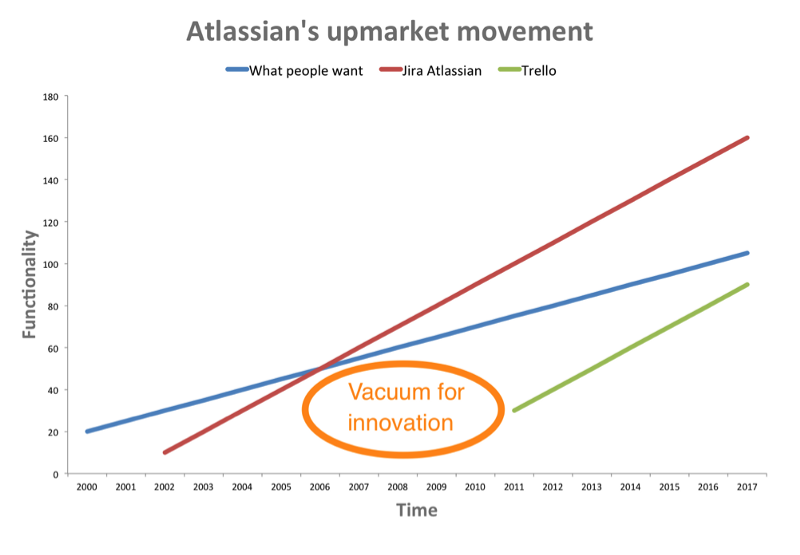
The Trello service is a cheaper, simpler and smaller version of the JIRA system. It is intended for customers such as marketers, developers, and managers that Atlassian did not focus on. In 2011, Trello had no competitors, and this service filled the vacuum created by Atlassian. Atlassian has gone too far moving in this market.
Example Trello panel:
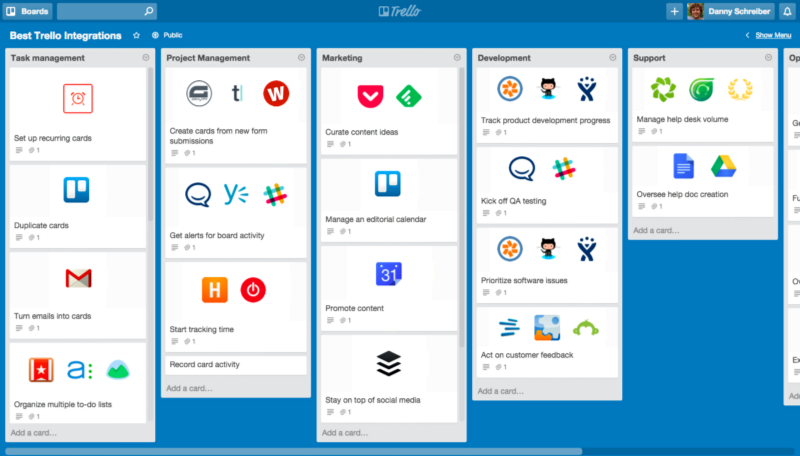
Zapier.com
JIRA Panel Example:

Atlassian.com
At the same time, the JIRA system has become expensive. But its main consumers were willing to get fewer options at a more suitable price. As a result, Atlassian has become vulnerable to competitors with cheaper, simpler and more convenient products.
By adding new features, Trello will also move up towards higher-quality products and reach the level of demand of the main part of the market (blue line). When he crosses the blue line, the main clients of the JIRA system will switch to Trello. So disruptive innovation eliminates a market-established product. This happened with other products, such as, for example, disk drives and mainframes. The same thing will happen in the field of project tracking.
Now it’s clear why Trello has become the biggest threat to Atlassian’s future. Trello went on the attack. This product had fewer features. He was simple. And he was shockingly cheap. He was disruptive!
I do not work for Atlassian. I have no contact with her staff. But I know what people feel when disruptive technology crashes into a company that has been successfully operating on the market for more than 15 years. This is, to say the least, unpleasant in every way!
Atlassian's CEO did the right thing. Instead of fighting disruptive technology, he accepted it and bought the Trello service. In an interview, he said:
I am sure that many Atlassian employees do not understand this solution. It does not make sense to them. In their opinion, Trello is a very poor product compared to JIRA. But Atlassian CEO Trello retained a job for his employees and their salary. Because the further advancement of Trello led to the death of Atlassian!
The reaction of the market was positive. Atlassian shares rose from $ 25.03 on January 9 (the date of the announcement of the purchase) to $ 28.03 on January 23.
According to Clayton Christensen, leadership in disruptive technology is very important. The companies that entered this market first were six times more likely to succeed than those that entered later. Therefore, if Atlassian even created its own version of the Trello service, there is no reason to believe that the product would be successful. Atlassian would not be the initiator.
But there is a more serious reason than the missed advantage of the initiator. Atlassian is an open joint stock company. Such a company requires an increase of 30% per year. Thus, every person in the company must make money. Much money. And to make a lot of money, you need large customers.
Atlassian revenue in 2016 was $ 458 million. To grow by 30% in 2017, you need to earn an additional 137 million dollars. The company in its appeal to shareholders predicted total revenue in the range of 597-603 million dollars.
Trello, according to Forbes.com, has a regular income of about $ 10 million. Clone Trello could not help Atlassian achieve its goal. Atlassian seems to have a lot of good executives. Good executives will never devote resources to creating yet another Trello, as this will not solve the company's main problem: how to raise revenue. Instead, they will do whatever is necessary to satisfy the needs of their largest customers.
Over time, they have formed a certain set of values. They are not worried about a possible income growth of $ 10 million. They need an increase of 137 million dollars. Therefore, everyone at Atlassian is focused on large customers and their needs. And such customers need a larger, higher quality and more complex product.
As we already learned, products based on disruptive technologies are usually cheaper, simpler, smaller in volume and more convenient. And this is the opposite of what Atlassian does. There is no room for Trello's disruptive innovation in the Atlassian value set.
I remember how Google bought Android. Android operations were not fully integrated into Google’s core business. Moreover, Google employees did not have access to Android offices. As you can see, this was one of Google’s best acquisitions. But why didn’t Google integrate Android into its core business? Simply. Because Google’s processes, values, and culture would kill Android. This is one of the main reasons because of which newly acquired companies do not integrate into the core business.
Atlassian has been operating on the market for more than 15 years. The company has established processes, values and culture. She works with clients other than Trello. Atlassian has over 1,700 employees. Its leaders must now decide:should or not a company integrate Trello into its business.
If Atlassian executives are smart enough, they won’t build Trello. Advice to Trello employees: if you find out that embedding is on the way, then start looking for a new job. Embedding means the beginning of the end. This is because Trello's values are not part of Atlassian's values. If something is not part of the company's value, then there will be no move for this “something”!
Trello has created a new emerging market. There are no $ 800 million emerging markets. When emerging markets are small, they attract little big companies. Therefore, Trello will not receive enough money and resources inside Atlassian.
Atlassian's CEO wrote on his blog: “Trello will be an important part of Atlassian's product range.” I guess that means it's too early to tell the truth. It will be just the opposite.
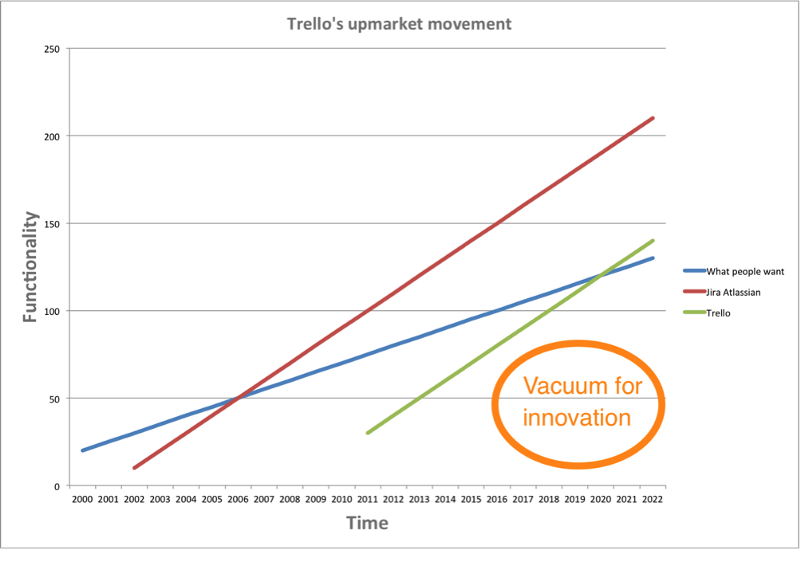
A few years later, Trello will cross the blue line. Everything that major customers want to have will be available at Trello. This will be a turning point for JIRA users. They will begin to move to Trello.

After crossing the blue line, Trello will enter the main market. Trello will start to make huge profits for Atlassian. Revenues from Trello will exceed those from JIRA. This is precisely the simple reason why Trello will become the new JIRA system!
Of course, many of you will think that I do not understand the situation well. But that’s how disruptive innovation works. Trello's weak service today will be his strength tomorrow.
The Zapier platform has published statistics on the fastest growing applications. In the first place was Airtable with a growth rate of 682%. I had not heard anything about Airtable, and I was interested to know what it was doing. I looked at his site and found out that he, in principle, is a cheaper and simpler version of Microsoft Access. As we already learned, products based on disruptive technologies are usually cheaper, simpler, smaller in volume and more convenient to use.

What about the Quip application, a cloud-based word processor? It was created in 2012 and sold to Salesforce for $ 750 million. Quip is similar to Trello. Both are simple in terms of functionality. Quip is a disruptive innovation for Google Docs and Google Sheets. It is very similar to how Google recently undermined Microsoft Office.
While some companies are moving toward high-quality and sophisticated products, others are using the emerging empty field for innovation as an entry point. If you look carefully, such a vacuum can be found in many industries. Filling it with simple and cheap technology, you can create a startup for $ 400 million.
There are some interesting industries waiting for disruptive innovation. One of them is the marketing automation industry, valued at almost $ 4 billion. Many years ago, leaders in marketing automation software slipped too far into this market. The same thing happened in the accounting software market.
Create something new, but simpler and cheaper. Do something that the main market does not want now, but very much later. The weakness of today will be the strength of tomorrow.
If you need ideas for your startups for $ 400 million, subscribe to my newsletter at http://tarasowski.co
Note. This article is posted on Medium. Medium is a disruptive innovation for Wordpress. Wordpress has slipped too far in the market and as a result has created a vacuum for innovation.
So how to make a new Trello and get rich on it? But of course, without creating a Trello clone. Why? Trello is a classic example of disruptive innovation. When it comes to disruptive innovation, the initiator gets everything. Atlassian acquired Trello for $ 425 million, not because of the brand or user base of this service, but because of the danger that Trello created for the future of this company. For the same reason, Google and other companies are making similar acquisitions. If you want to make a $ 400 million startup, design something simple . This article will explain why!
The Rational Reason for Acquiring Trello
Fog Creek launched Trello in 2011 and six years later sold it for $ 425 million. It turned out, in general, the largest acquisition of Atlassian. But why did Atlassian pay so much for Trello? Because Trello's service has undermined the project tracking area. Disruptive technology products are usually cheaper, simpler, smaller and more convenient to use.
Trello brought a different view of value in the market. The components of its values are collaboration and simplicity. Atlassian's idea of value in the JIRA system is different. Atlassian appears to be a well-run company. Its leaders did everything in accordance with the requirements. They listened to their customers and created an increasingly good and more complex product.By adding new features, they sought to gain new customers. Their product has become elite.
As the company's revenue grew, its product became increasingly complex and difficult to maintain. Moving towards "elitism", Atlassian created a kind of "vacuum" in the low price range , which could include competitors with disruptive technologies. This is exactly what Trello did.
The Trello service is a cheaper, simpler and smaller version of the JIRA system. It is intended for customers such as marketers, developers, and managers that Atlassian did not focus on. In 2011, Trello had no competitors, and this service filled the vacuum created by Atlassian. Atlassian has gone too far moving in this market.
In their efforts to maintain leadership in the development of competitive, high-quality products, many companies are not aware of the speed with which they move to the highest echelons of the market. They do not recognize that their offer far exceeds the needs of their original customers, as they focus on high-performance, highly profitable markets. And they don’t see that they create a void (vacuum) in the low price range, which competitors with disruptive technologies can enter. (See Clayton Christensen's book, The Innovator’s Dilemma.)
Example Trello panel:
Zapier.com
JIRA Panel Example:
Atlassian.com
At the same time, the JIRA system has become expensive. But its main consumers were willing to get fewer options at a more suitable price. As a result, Atlassian has become vulnerable to competitors with cheaper, simpler and more convenient products.
By adding new features, Trello will also move up towards higher-quality products and reach the level of demand of the main part of the market (blue line). When he crosses the blue line, the main clients of the JIRA system will switch to Trello. So disruptive innovation eliminates a market-established product. This happened with other products, such as, for example, disk drives and mainframes. The same thing will happen in the field of project tracking.
Now it’s clear why Trello has become the biggest threat to Atlassian’s future. Trello went on the attack. This product had fewer features. He was simple. And he was shockingly cheap. He was disruptive!
I do not work for Atlassian. I have no contact with her staff. But I know what people feel when disruptive technology crashes into a company that has been successfully operating on the market for more than 15 years. This is, to say the least, unpleasant in every way!
Atlassian's CEO did the right thing. Instead of fighting disruptive technology, he accepted it and bought the Trello service. In an interview, he said:
All companies fall into one of two baskets: either become a software development company, or be destroyed by one of these companies. Any industry is fundamentally changing under the influence of software.
I am sure that many Atlassian employees do not understand this solution. It does not make sense to them. In their opinion, Trello is a very poor product compared to JIRA. But Atlassian CEO Trello retained a job for his employees and their salary. Because the further advancement of Trello led to the death of Atlassian!
The reaction of the market was positive. Atlassian shares rose from $ 25.03 on January 9 (the date of the announcement of the purchase) to $ 28.03 on January 23.
Atlassian is unable to create its own Trello service.
According to Clayton Christensen, leadership in disruptive technology is very important. The companies that entered this market first were six times more likely to succeed than those that entered later. Therefore, if Atlassian even created its own version of the Trello service, there is no reason to believe that the product would be successful. Atlassian would not be the initiator.
But there is a more serious reason than the missed advantage of the initiator. Atlassian is an open joint stock company. Such a company requires an increase of 30% per year. Thus, every person in the company must make money. Much money. And to make a lot of money, you need large customers.
Atlassian revenue in 2016 was $ 458 million. To grow by 30% in 2017, you need to earn an additional 137 million dollars. The company in its appeal to shareholders predicted total revenue in the range of 597-603 million dollars.
Trello, according to Forbes.com, has a regular income of about $ 10 million. Clone Trello could not help Atlassian achieve its goal. Atlassian seems to have a lot of good executives. Good executives will never devote resources to creating yet another Trello, as this will not solve the company's main problem: how to raise revenue. Instead, they will do whatever is necessary to satisfy the needs of their largest customers.
Over time, they have formed a certain set of values. They are not worried about a possible income growth of $ 10 million. They need an increase of 137 million dollars. Therefore, everyone at Atlassian is focused on large customers and their needs. And such customers need a larger, higher quality and more complex product.
As we already learned, products based on disruptive technologies are usually cheaper, simpler, smaller in volume and more convenient. And this is the opposite of what Atlassian does. There is no room for Trello's disruptive innovation in the Atlassian value set.
So what will happen after the acquisition of Trello?
I remember how Google bought Android. Android operations were not fully integrated into Google’s core business. Moreover, Google employees did not have access to Android offices. As you can see, this was one of Google’s best acquisitions. But why didn’t Google integrate Android into its core business? Simply. Because Google’s processes, values, and culture would kill Android. This is one of the main reasons because of which newly acquired companies do not integrate into the core business.
Atlassian has been operating on the market for more than 15 years. The company has established processes, values and culture. She works with clients other than Trello. Atlassian has over 1,700 employees. Its leaders must now decide:should or not a company integrate Trello into its business.
If Atlassian executives are smart enough, they won’t build Trello. Advice to Trello employees: if you find out that embedding is on the way, then start looking for a new job. Embedding means the beginning of the end. This is because Trello's values are not part of Atlassian's values. If something is not part of the company's value, then there will be no move for this “something”!
The values of an organization are those criteria according to which decisions are made on priorities, and the setting of priorities affects employees at all levels. Values of successful firms tend to evolve in a predictable way in at least two dimensions. The first of these relates to acceptable gross margin. The second dimension, in which values are predictably changing, relates to how big a business must be in order to remain attractive. (See Clayton Christensen’s thoughts in The Innovator’s Dilemma again.)
Trello has created a new emerging market. There are no $ 800 million emerging markets. When emerging markets are small, they attract little big companies. Therefore, Trello will not receive enough money and resources inside Atlassian.
Trello will become the new JIRA system!
Atlassian's CEO wrote on his blog: “Trello will be an important part of Atlassian's product range.” I guess that means it's too early to tell the truth. It will be just the opposite.
A few years later, Trello will cross the blue line. Everything that major customers want to have will be available at Trello. This will be a turning point for JIRA users. They will begin to move to Trello.
After crossing the blue line, Trello will enter the main market. Trello will start to make huge profits for Atlassian. Revenues from Trello will exceed those from JIRA. This is precisely the simple reason why Trello will become the new JIRA system!
Of course, many of you will think that I do not understand the situation well. But that’s how disruptive innovation works. Trello's weak service today will be his strength tomorrow.
Here are the next startups worth $ 400 million.
The Zapier platform has published statistics on the fastest growing applications. In the first place was Airtable with a growth rate of 682%. I had not heard anything about Airtable, and I was interested to know what it was doing. I looked at his site and found out that he, in principle, is a cheaper and simpler version of Microsoft Access. As we already learned, products based on disruptive technologies are usually cheaper, simpler, smaller in volume and more convenient to use.
What about the Quip application, a cloud-based word processor? It was created in 2012 and sold to Salesforce for $ 750 million. Quip is similar to Trello. Both are simple in terms of functionality. Quip is a disruptive innovation for Google Docs and Google Sheets. It is very similar to how Google recently undermined Microsoft Office.
While some companies are moving toward high-quality and sophisticated products, others are using the emerging empty field for innovation as an entry point. If you look carefully, such a vacuum can be found in many industries. Filling it with simple and cheap technology, you can create a startup for $ 400 million.
There are some interesting industries waiting for disruptive innovation. One of them is the marketing automation industry, valued at almost $ 4 billion. Many years ago, leaders in marketing automation software slipped too far into this market. The same thing happened in the accounting software market.
Scott Cook, founder of Intuit, decided that accounting software developers for small businesses went too far in the functionality required by this market, thus creating the opportunity for disruptive software technology that would provide adequate, but not overly redundant functionality ( and which would be simple and convenient to use). The Quickbooks Small Business Accounting Program has captured 70% of the market within two years of its release (Christensen).
Create something new, but simpler and cheaper. Do something that the main market does not want now, but very much later. The weakness of today will be the strength of tomorrow.
If you need ideas for your startups for $ 400 million, subscribe to my newsletter at http://tarasowski.co
Note. This article is posted on Medium. Medium is a disruptive innovation for Wordpress. Wordpress has slipped too far in the market and as a result has created a vacuum for innovation.