September 13, 2016 at 12:32
Five types of game crafting systems
- Transfer
In recent years, crafting has evolved from the rarely applied mechanics of role-playing games to the almost universal addition to all the latest industry innovations. Today it is used not only in almost any RPG, but also in first-person shooters, action games, driving simulators and even in the system of assigning badges to Steam users.
Apparently, there is something attractive in the process of processing basic resources into useful objects, and players are happy to accept the strategy and choice provided by this mechanic. But, despite the widespread use of crafting systems, there are a number of significant differences in their design and implementation. In this article, I tried to break down these systems into five conditional categories, emphasize their strengths and weaknesses, and briefly outline the optimal application.

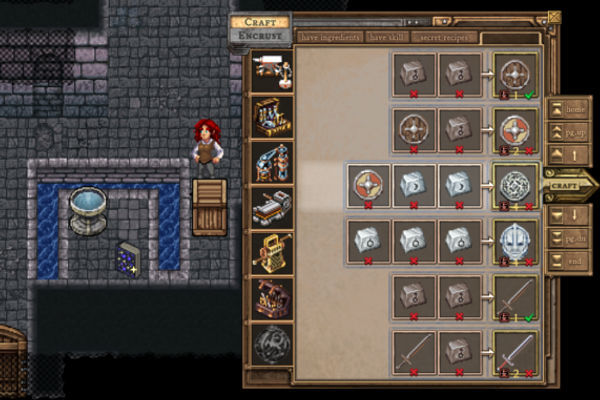
Dungeons of Dredmor crafting
Applies to Dragon Age: Origins, The Elder Scrolls V: Skyrim (Blacksmithing), The Legend of Zelda: Skyward Sword, XCOM: Enemy Unknown, Assassin's Creed III, Terraria, Dungeons of Dredmor, Kingdom of Loathing, Bioshock and others.
This is the most common version of game crafting, although, in fact, it is only in a conceptual sense. In this case, the player pays for the necessary item or update with the collected resources, and the exchange takes place in a fixed and transparent scenario. Thus, this is not crafting in the literal sense, but only an abstraction: you take a certain amount of wood, go to a craftsman or a machine tool - and in the end you get a wooden shield.
In principle, this system is inseparable from the main in-game economy, but instead of using some thematic monetary resource like gold coins, we use thematic raw materials, such as iron ingots, logs or wolf skins.
Benefits
Due to its simplicity, this type of crafting is intuitive and instantly perceived. The costs and results of production within such a system are clearly defined, because the player needs a minimum of explanation or not at all. Since this type of crafting works at the expense of existing game systems, it is very easy to implement, especially if the same interface is suitable for it as for ordinary trading. It is also an effective way to give the gaming economy additional depth, since the very idea of turning raw materials into finished products is much richer than simply purchasing them for money.
Among other things, this system will help to balance the game, providing additional control over those resources that are available to the player. Making any resource necessary for exchange rarer or opening access to it only at a certain stage, the designer is able to mask the true value of objects. Suppose the game has a cool sword for 1000 gold. The player can either collect it for a long time and hard, or completely refuse an expensive purchase. But if the cost of the sword is, say, 50 bars of steel, it might seem that accumulating on it is much easier, even if it takes no less effort than collecting 1000 gold.
disadvantages
The main drawback of the system is its simplicity. As a rule, the capabilities of such a system are not quite enough for games designed for deep immersion. In this case, it is also difficult to maintain the right balance between a small but neat addition and a bulky and taut system. In addition, when using a large number of resources, the system can become too complicated and tedious.
For example, the crafting system in Assassin's Creed III has dozens of components. To create one unit of firearms, which except for sale is worthless, you need a hilt (made from maple wood), iron ore and flint (made from limestone, lead ore and iron ore). Such a number of trifles quickly tires the player, especially if the reward for all efforts is rather modest.
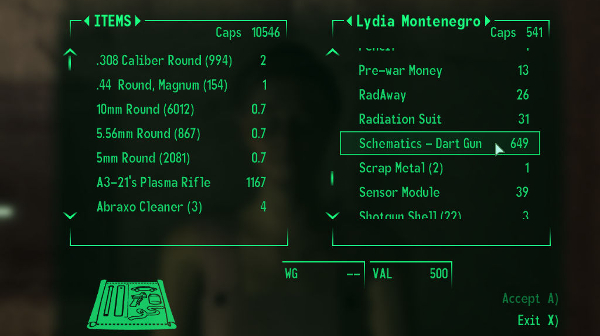
Recipe for Fallout 3
Applies to Dragon Age: Inquisition, Diablo III, World of Warcraft, Dead Island, Fall Out 3 / New Vegas, The Witcher 2, Arcanum: Of Steamworks, and Magick Obscura.
In this system, creating an item is not possible until a recipe, sketch, or drawing is found that opens the item. Such recipes can be found, bought or given as a reward for completed tasks.
As soon as the player receives the necessary recipe, the crafting process continues according to the same scenario as in the “Resources instead of money” model - through the established exchange of resources for the finished product. The difference is that here the player needs not only to have all the resources necessary for the exchange, but also to know that such an exchange is possible in principle. In rare cases, the recipe opens up a new, more highly customizable form of crafting, as in Dragon Age: Inquisition.
Benefits
This system can give the crafting process an additional shade, since its idea is that it is not enough just to have the necessary resources, you still need to know how to combine them. In addition, adding an additional step to the crafting process, you thereby increase the variety of awards provided to the player without increasing the total number of items. In addition, collecting the recipes and drawings themselves can be turned into fascinating tasks.
This also maintains the intrigue in the game, because, unlike systems with monetary exchange, the player does not know in advance which items will be revealed to him in the future. Finally, such a system provides the designer with an additional deterrent mechanism that allows players to be restricted from prematurely gaining access to certain content, even if they already have the necessary resources.
Disadvantages
It is necessary to correctly balance the complexity of the extraction of any recipe and the necessary resources with the value of the item produced as a result. If the reward for the item is insignificant, the entire system will be ignored in favor of other methods of obtaining items (purchase, robbery). On the other hand, with too good a reward, all other production methods can also be supplanted.
As in the case of the “Resources instead of money” type, there is a risk of abuse of this system due to the simplicity of its implementation, as a result of which collecting all the drawings can turn into a chore for the player. For example, in the game Dragon Age: Inquisition, there are about 200 sketches of armor and weapons, each of which is acquired or sought separately.
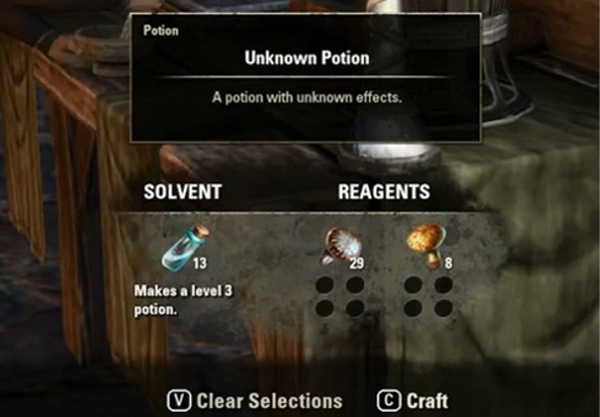
Create a potion in The Elder Scrolls Online
Used in Minecraft, Kingdoms of Amalur: Reckoning (Alchemy), The Secret World, The Elder Scrolls V: Skyrim (Alchemy), The Elder Scrolls Online (Alchemy) and Diablo II (Horadric Cube).
With this system, there are no initially known recipes for crafting, nor those that can be obtained. Instead, the player must independently open recipes through trial and error. The user is provided with an interface for crafting, where you can combine and combine all the collected resources and components in order to obtain the desired result.
The complexity of such crafting can vary from simply choosing the right ingredients (as in Skyrim) to specifying their quantity or the order of addition (as in Minecraft). This approach makes the resource combination system not an abstract mechanism for discovering new objects, but literally a recipe that needs to be studied. Due to the ingredient-oriented nature of this system, it is most often used in games where crafting is expressed as alchemy or culinary preparation.
Advantages
Unlike the previous two types, where the results of crafting are either known in advance or available, this system gives the player a sense of true discovery. Instead of blindly following the instructions given, the player can explore and improvise, revealing a wide variety of objects.
And although in a sense, crafting here is still an abstraction, the search for the right combinations brings the whole process closer to a real scientific experiment. Moreover, this type requires more involvement from the player, which will help to emphasize the advantages of mechanics and its significance for the design of the game as a whole. Since all the resources available for experiments are limited, the game, as in the previous examples, will receive an additional restraining and balancing mechanism.
disadvantages
If the system punishes players too harshly for unsuccessful attempts (for example, the consumption of rare resources), this may discourage the desire to conduct further experiments. If the right combinations of ingredients look too arbitrary, you may get the impression that the whole process of crafting is not based on the study of properties, but rather on blind guessing. One way or another, in conditions of too strict or complex system, the player will invariably become inclined to dishonest ways to find the correct answers. In this case, the system will be similar to the type “Resources instead of money”, but with some disappointment for the player.
This type also risks becoming overly time-consuming (with the need to attract external resources) if the player has to memorize too many recipes or if the correct answers are not saved in the game.
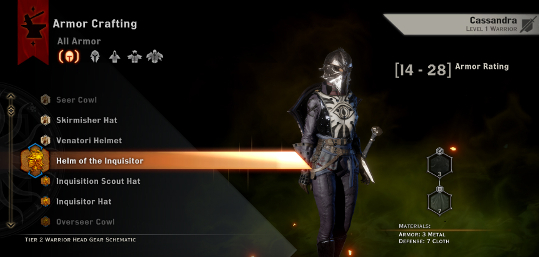
Armor Creation in Dragon Age Inquisition
Applies to Assassin's Creed: Revelations, Dragon Age: Inquisition, Dead Space 3, The Elder Scrolls V: Skyrim (Enchantment), The Elder Scrolls IV: Oblivion, Mass Effect 3, Monster Hunter Tri , Kingdoms of Amalur: Reckoning (Jewelcrafting) and Mercenary Kings.
This system can be attributed to any system with modular or dynamic crafting instead of creating objects strictly according to the formula or by established exchange. In this case, the player can make an item to his taste, choosing a number of options.
In Assassin's Creed: Revelations, players can produce bombs, and depending on the type of body, fuse and ingredients for the filling, various types of explosives are produced with their purpose and effect. Unlike the previous type of crafting, where the player’s choice is limited by two possible development options - the right and the wrong result, here the player can strategically choose from a number of known results. In fact, it may look like a choice of various materials, design elements, improvements, or even purely aesthetic additions to the subject.
Benefits
This type provides an in-depth system of user enhancements that can truly reward players and give static items or equipment additional functionality. Since the player has a direct influence on the product of crafting, the freedom of choice in this system is greater than when buying or discovering a new item. And if the available products have a clear application, as well as their advantages and disadvantages, all this can create an additional level of strategic choice within the game.
Improved flexibility and depth of this system will not only diversify the methods of creating objects, but will help make the crafting process an integral part of the basic mechanics of the game.
disadvantages
First of all, the increased complexity of the system compared to the above types and the resulting difficulty in its implementation. The increased complexity, in addition, requires more attention from the player, which can greatly distract him from the main storyline if crafting is not a key element of the game. On the other hand, if we simplify the system, it will give too little choice of options and its depth will assume a superficial character. Providing a choice of only a few "correct" options, the system will negate the advantage of its own use.
In general, with an unsuccessful amount of available crafting products, you may have difficulty trying to establish a balance in the game between the created items and those that were obtained from other sources.
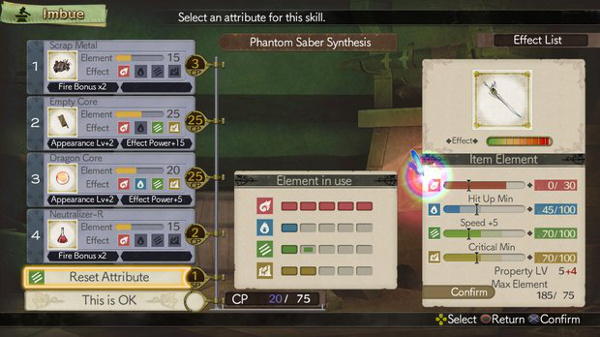
Alchemy in the game Atelier Escha Logy Alchemists of the Dusk Sky
Used in Vagrant Story, The Legend of Mana, Treasure of the Rudra (Kotodama), Breath of Fire III (Dragon Genes), the Atelier Series and The Elder Scrolls III: Morrowind (Creation spells).
This is a broad category, to which any real crafting system belongs, where various input components can produce a whole host of possible results. The result is a truly dynamic process with a wide strategic choice. For example, the Vagrant Story combination of blade and hilt system allows you to create thousands of weapons. Under such circumstances, crafting can become the basic mechanics of the game, as in the Atelier series of the JRPG genre. Usually, the “Everything is possible” system becomes the only source for obtaining items in games where it is presented, because otherwise it would be difficult to maintain a balance between the created items and those that are easier to get in other ways.
For a complete study of systems of such complexity, players may need a lot of time. For example, in The Legend of Mana, the crafting system is so extensive (and barely described in the game) that even 15 years after the release, players continue to discover useful recipes.
Advantages
This system is able to incredibly reward the most persistent researchers. Having so many dynamic features, the user can have a significant impact on the gameplay. The depth of such systems will significantly improve gameplay or increase replay value. In turn, the difficulty of calculating all the possible results of crafting will help the game withstand optimization and stagnant gameplay.
Perhaps this is the least abstract form of crafting, since the infinite variety of the system allows you to create many valuable items, and the ability to test them with further improvements distinguishes this mechanics from the simple conduct of scientific experiments, as in the "Only improvisation" system.
Disadvantages
Such systems with their depth and diversity are extremely difficult to think through and implement, since they require much more planning and testing. In addition, their complexity will be inappropriate for most games, where crafting acts, rather, in the role of additional mechanics, rather than the main feature.
Since such systems often offer an unlimited number of possible results, there is a high probability of the appearance of super-powerful combinations of ingredients (giving too good items) that you, as a developer, will not easily find out in advance.
Conclusion
Crafting can serve many purposes in the game. Due to the variety of forms, it gives the player rich opportunities for creating objects in various settings, whether it's forging armor in a fantasy game or a high-tech modification of weapons in a game of the sci-fi genre. Crafting can also play a key regulatory role in the system of in-game upgrades, while being a more elegant solution than less-covered restrictions. Moreover, having sufficient depth, this mechanics is able to give the gameplay a strategic bias.
Anyway, crafting is not suitable for any game. If implemented incorrectly, it will become an inappropriate and distracting appendage of the game, and if at the same time make it unreasonably difficult, the game risks becoming boring and depressing. Crafting systems are structural mechanics, and therefore they bring the best result when applied to maintain the original goals of game development.
Apparently, there is something attractive in the process of processing basic resources into useful objects, and players are happy to accept the strategy and choice provided by this mechanic. But, despite the widespread use of crafting systems, there are a number of significant differences in their design and implementation. In this article, I tried to break down these systems into five conditional categories, emphasize their strengths and weaknesses, and briefly outline the optimal application.
Type 1: “Resources instead of money”
Dungeons of Dredmor crafting
Applies to Dragon Age: Origins, The Elder Scrolls V: Skyrim (Blacksmithing), The Legend of Zelda: Skyward Sword, XCOM: Enemy Unknown, Assassin's Creed III, Terraria, Dungeons of Dredmor, Kingdom of Loathing, Bioshock and others.
This is the most common version of game crafting, although, in fact, it is only in a conceptual sense. In this case, the player pays for the necessary item or update with the collected resources, and the exchange takes place in a fixed and transparent scenario. Thus, this is not crafting in the literal sense, but only an abstraction: you take a certain amount of wood, go to a craftsman or a machine tool - and in the end you get a wooden shield.
In principle, this system is inseparable from the main in-game economy, but instead of using some thematic monetary resource like gold coins, we use thematic raw materials, such as iron ingots, logs or wolf skins.
Benefits
Due to its simplicity, this type of crafting is intuitive and instantly perceived. The costs and results of production within such a system are clearly defined, because the player needs a minimum of explanation or not at all. Since this type of crafting works at the expense of existing game systems, it is very easy to implement, especially if the same interface is suitable for it as for ordinary trading. It is also an effective way to give the gaming economy additional depth, since the very idea of turning raw materials into finished products is much richer than simply purchasing them for money.
Among other things, this system will help to balance the game, providing additional control over those resources that are available to the player. Making any resource necessary for exchange rarer or opening access to it only at a certain stage, the designer is able to mask the true value of objects. Suppose the game has a cool sword for 1000 gold. The player can either collect it for a long time and hard, or completely refuse an expensive purchase. But if the cost of the sword is, say, 50 bars of steel, it might seem that accumulating on it is much easier, even if it takes no less effort than collecting 1000 gold.
disadvantages
The main drawback of the system is its simplicity. As a rule, the capabilities of such a system are not quite enough for games designed for deep immersion. In this case, it is also difficult to maintain the right balance between a small but neat addition and a bulky and taut system. In addition, when using a large number of resources, the system can become too complicated and tedious.
For example, the crafting system in Assassin's Creed III has dozens of components. To create one unit of firearms, which except for sale is worthless, you need a hilt (made from maple wood), iron ore and flint (made from limestone, lead ore and iron ore). Such a number of trifles quickly tires the player, especially if the reward for all efforts is rather modest.
Type 2: Find the Recipe
Recipe for Fallout 3
Applies to Dragon Age: Inquisition, Diablo III, World of Warcraft, Dead Island, Fall Out 3 / New Vegas, The Witcher 2, Arcanum: Of Steamworks, and Magick Obscura.
In this system, creating an item is not possible until a recipe, sketch, or drawing is found that opens the item. Such recipes can be found, bought or given as a reward for completed tasks.
As soon as the player receives the necessary recipe, the crafting process continues according to the same scenario as in the “Resources instead of money” model - through the established exchange of resources for the finished product. The difference is that here the player needs not only to have all the resources necessary for the exchange, but also to know that such an exchange is possible in principle. In rare cases, the recipe opens up a new, more highly customizable form of crafting, as in Dragon Age: Inquisition.
Benefits
This system can give the crafting process an additional shade, since its idea is that it is not enough just to have the necessary resources, you still need to know how to combine them. In addition, adding an additional step to the crafting process, you thereby increase the variety of awards provided to the player without increasing the total number of items. In addition, collecting the recipes and drawings themselves can be turned into fascinating tasks.
This also maintains the intrigue in the game, because, unlike systems with monetary exchange, the player does not know in advance which items will be revealed to him in the future. Finally, such a system provides the designer with an additional deterrent mechanism that allows players to be restricted from prematurely gaining access to certain content, even if they already have the necessary resources.
Disadvantages
It is necessary to correctly balance the complexity of the extraction of any recipe and the necessary resources with the value of the item produced as a result. If the reward for the item is insignificant, the entire system will be ignored in favor of other methods of obtaining items (purchase, robbery). On the other hand, with too good a reward, all other production methods can also be supplanted.
As in the case of the “Resources instead of money” type, there is a risk of abuse of this system due to the simplicity of its implementation, as a result of which collecting all the drawings can turn into a chore for the player. For example, in the game Dragon Age: Inquisition, there are about 200 sketches of armor and weapons, each of which is acquired or sought separately.
Type 3: “Improvisation Only”
Create a potion in The Elder Scrolls Online
Used in Minecraft, Kingdoms of Amalur: Reckoning (Alchemy), The Secret World, The Elder Scrolls V: Skyrim (Alchemy), The Elder Scrolls Online (Alchemy) and Diablo II (Horadric Cube).
With this system, there are no initially known recipes for crafting, nor those that can be obtained. Instead, the player must independently open recipes through trial and error. The user is provided with an interface for crafting, where you can combine and combine all the collected resources and components in order to obtain the desired result.
The complexity of such crafting can vary from simply choosing the right ingredients (as in Skyrim) to specifying their quantity or the order of addition (as in Minecraft). This approach makes the resource combination system not an abstract mechanism for discovering new objects, but literally a recipe that needs to be studied. Due to the ingredient-oriented nature of this system, it is most often used in games where crafting is expressed as alchemy or culinary preparation.
Advantages
Unlike the previous two types, where the results of crafting are either known in advance or available, this system gives the player a sense of true discovery. Instead of blindly following the instructions given, the player can explore and improvise, revealing a wide variety of objects.
And although in a sense, crafting here is still an abstraction, the search for the right combinations brings the whole process closer to a real scientific experiment. Moreover, this type requires more involvement from the player, which will help to emphasize the advantages of mechanics and its significance for the design of the game as a whole. Since all the resources available for experiments are limited, the game, as in the previous examples, will receive an additional restraining and balancing mechanism.
disadvantages
If the system punishes players too harshly for unsuccessful attempts (for example, the consumption of rare resources), this may discourage the desire to conduct further experiments. If the right combinations of ingredients look too arbitrary, you may get the impression that the whole process of crafting is not based on the study of properties, but rather on blind guessing. One way or another, in conditions of too strict or complex system, the player will invariably become inclined to dishonest ways to find the correct answers. In this case, the system will be similar to the type “Resources instead of money”, but with some disappointment for the player.
This type also risks becoming overly time-consuming (with the need to attract external resources) if the player has to memorize too many recipes or if the correct answers are not saved in the game.
Type 4: “Improvements to your taste”
Armor Creation in Dragon Age Inquisition
Applies to Assassin's Creed: Revelations, Dragon Age: Inquisition, Dead Space 3, The Elder Scrolls V: Skyrim (Enchantment), The Elder Scrolls IV: Oblivion, Mass Effect 3, Monster Hunter Tri , Kingdoms of Amalur: Reckoning (Jewelcrafting) and Mercenary Kings.
This system can be attributed to any system with modular or dynamic crafting instead of creating objects strictly according to the formula or by established exchange. In this case, the player can make an item to his taste, choosing a number of options.
In Assassin's Creed: Revelations, players can produce bombs, and depending on the type of body, fuse and ingredients for the filling, various types of explosives are produced with their purpose and effect. Unlike the previous type of crafting, where the player’s choice is limited by two possible development options - the right and the wrong result, here the player can strategically choose from a number of known results. In fact, it may look like a choice of various materials, design elements, improvements, or even purely aesthetic additions to the subject.
Benefits
This type provides an in-depth system of user enhancements that can truly reward players and give static items or equipment additional functionality. Since the player has a direct influence on the product of crafting, the freedom of choice in this system is greater than when buying or discovering a new item. And if the available products have a clear application, as well as their advantages and disadvantages, all this can create an additional level of strategic choice within the game.
Improved flexibility and depth of this system will not only diversify the methods of creating objects, but will help make the crafting process an integral part of the basic mechanics of the game.
disadvantages
First of all, the increased complexity of the system compared to the above types and the resulting difficulty in its implementation. The increased complexity, in addition, requires more attention from the player, which can greatly distract him from the main storyline if crafting is not a key element of the game. On the other hand, if we simplify the system, it will give too little choice of options and its depth will assume a superficial character. Providing a choice of only a few "correct" options, the system will negate the advantage of its own use.
In general, with an unsuccessful amount of available crafting products, you may have difficulty trying to establish a balance in the game between the created items and those that were obtained from other sources.
Type 5: “Everything is possible”
Alchemy in the game Atelier Escha Logy Alchemists of the Dusk Sky
Used in Vagrant Story, The Legend of Mana, Treasure of the Rudra (Kotodama), Breath of Fire III (Dragon Genes), the Atelier Series and The Elder Scrolls III: Morrowind (Creation spells).
This is a broad category, to which any real crafting system belongs, where various input components can produce a whole host of possible results. The result is a truly dynamic process with a wide strategic choice. For example, the Vagrant Story combination of blade and hilt system allows you to create thousands of weapons. Under such circumstances, crafting can become the basic mechanics of the game, as in the Atelier series of the JRPG genre. Usually, the “Everything is possible” system becomes the only source for obtaining items in games where it is presented, because otherwise it would be difficult to maintain a balance between the created items and those that are easier to get in other ways.
For a complete study of systems of such complexity, players may need a lot of time. For example, in The Legend of Mana, the crafting system is so extensive (and barely described in the game) that even 15 years after the release, players continue to discover useful recipes.
Advantages
This system is able to incredibly reward the most persistent researchers. Having so many dynamic features, the user can have a significant impact on the gameplay. The depth of such systems will significantly improve gameplay or increase replay value. In turn, the difficulty of calculating all the possible results of crafting will help the game withstand optimization and stagnant gameplay.
Perhaps this is the least abstract form of crafting, since the infinite variety of the system allows you to create many valuable items, and the ability to test them with further improvements distinguishes this mechanics from the simple conduct of scientific experiments, as in the "Only improvisation" system.
Disadvantages
Such systems with their depth and diversity are extremely difficult to think through and implement, since they require much more planning and testing. In addition, their complexity will be inappropriate for most games, where crafting acts, rather, in the role of additional mechanics, rather than the main feature.
Since such systems often offer an unlimited number of possible results, there is a high probability of the appearance of super-powerful combinations of ingredients (giving too good items) that you, as a developer, will not easily find out in advance.
Conclusion
Crafting can serve many purposes in the game. Due to the variety of forms, it gives the player rich opportunities for creating objects in various settings, whether it's forging armor in a fantasy game or a high-tech modification of weapons in a game of the sci-fi genre. Crafting can also play a key regulatory role in the system of in-game upgrades, while being a more elegant solution than less-covered restrictions. Moreover, having sufficient depth, this mechanics is able to give the gameplay a strategic bias.
Anyway, crafting is not suitable for any game. If implemented incorrectly, it will become an inappropriate and distracting appendage of the game, and if at the same time make it unreasonably difficult, the game risks becoming boring and depressing. Crafting systems are structural mechanics, and therefore they bring the best result when applied to maintain the original goals of game development.