August 31, 2016 at 11:58
Top 10 technologies for Internet of Things: what will happen in the next two years?
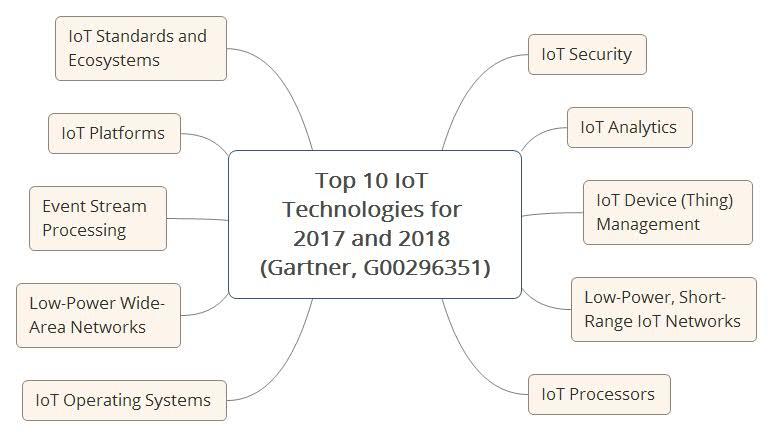
In January 2016, the notorious company Gartner published a forecast for IoT for 2017-2018. As a matter of fact, since we are talking about the next two years, this is not even a forecast, but our realities. The Top 10 IoT Technologies for 2017 and 2018 (G00296351) is currently available on ComputerWeelkly.com.
I suggest looking at the main ideas of this forecast report. The title picture contains a list of ten core technologies (they could also be called problems) for Gartner's IoT.
1. IoT Security
Everything seems to be clear with information security: the explosive growth in the number of connected devices (20+ billion by 2020), by definition, leads to an increase in vulnerabilities.
However, there are interesting trends for IoT in this area. For example, no mention of functional safety(in the sense of safety, not security). Does this mean that developers and users of IoT are not interested in the correct and safe functioning of human devices devices? Most likely, we see the process of merging safety and security into a single meta-property. For IoT, it depends on the implementation of security functions whether the attacker will gain access to data (classical information security) or to control functions by physical devices (classical functional security). Therefore, functional security is not considered as a separate property, but various types of threats and attacks are considered. At the same time, a significant part of the IoT functions is related to ensuring information security, for example, data encryption or authentication.
At the same time, it must be remembered that there may be certain contradictions between safety and security. A classic example: a fire occurred in the room, what should I do? From the point of view of safety (saving people and property) the door to the room should be open, and from the point of view of security (restriction of access to information stored in the room) the door should be closed. How is this contradiction resolved? By prioritizing (for example, people's lives are an absolute value) or by optimizing (for example, which is more valuable, property that can be saved, or information that may fall into the wrong hands and needs to be protected).
Obviously, in the IoT sphere, developers and users will solve the problem of optimizing the risks of data compromising (security) and physical damage (safety).
2. IoT Analytics
The challenges in the field of IoT data analysis are related to the increase in data volume and the need to take into account the data of the realities of the physical world.
A typical approach in the field of big data, as a rule, is associated with the collection and storage of data, and only this is analyzed. In the field of IoT, many data must be analyzed on the fly using distributed processing and taking into account the confidentiality of information.
3. IoT Device (Thing) Management
This item is associated with an increase in the dimensionality of operating technical systems. Services with scales of millions of connected devices require new maintenance algorithms. Optimization is expedient from the point of view of distribution of service services between the cloud and terminal part.
4. Low-Power, Short-Range IoT Networks
The power consumption of the devices critically affects the cost of installation and maintenance. A short range network is understood as a range of tens and hundreds of meters, that is, it is, first of all, about wireless technologies that are used by devices. In the proposed solutions, energy is extracted from all possible sources, for example, from stationary wifi transmitters. Here, questions arise such as pairing into a single network of various protocols, as well as electromagnetic compatibility.
5. IoT Processors
There are a number of typical functions that should be implemented in computing for IoT, for example, data encryption, power saving, etc. This leads to the development and implementation of typical computing cores.
In terms of bit depth, Gartner predicts the dominance of 8-bit processors until 2021, after which the 32-bit line will win, and 16-bit processors in IoT will never dominate.
6. IoT Operating Systems
Embedded “lightweight” systems for IoT will continue to evolve. There are already several solutions for which you need only 5 to 50 kilobytes of memory (for example, Contiki, TinyOS, RIOT, Yottos). The optimization issue is the choice between reducing the used hardware resources and the provided capabilities of the software development environment.
7. Low-Power Wide-Area Networks
Market requirements for such networks are:
- transmission speed of tens of kilobits per second;
- coverage of the country's scale;
- Skok battery life for devices from 10 years and above;
- The cost of the terminal device (device layer) up to 5 US dollars;
- Support for several thousand devices connected to the base station.
-
An example of a solution available in the market in this area is NarrowBand IoT (NB-IoT), further development of technologies is expected.
8. Event Stream Processing
This problem is closely related to the already discussed IoT Analytics regarding event processing. The technology here is developing towards the creation of DSCP (Distributed Stream Computing Platforms) in the form of many distributed computing nodes for processing events, as specific types of big data. Currently available on the market, for example, Apache Spark, Google Cloud Dataflow, IBM InfoSphere Streams and other technologies.
9. IoT Platforms
Available platforms exist, however, their further development is expected.
10. IoT Standards and Ecosystems
The reference (typical) architecture for IoT (IoT-RA) is in its infancy, you can read about this in the article “Architecture standards for Internet of Things” .
The problem is the presence of industrial alliances that develop standards in related fields, the requirements of which often overlap and contradict each other (the so-called “war of standards”).
conclusions
Today, the IoT market is characterized by rapid development and, as a result, immaturity, which manifests itself in the rapid emergence (sometimes disappearance) of new players. Portability between platforms is not yet available, and this increases the risks of implementing large-scale solutions.
This situation is typical for technical solutions in the field of platforms, network technologies, operating systems, processor architectures, specialized under IoT. Standardization in the field of IoT is also in full swing.
From the point of view of human resources, a steady gap is formed in the IoT labor market between supply and demand. Such a situation, on the one hand, requires companies to invest in employee training. On the other hand, interested IT specialists can take advantage of this situation when choosing their specialization by investing in themselves.
In the field of scientific research (Research and Development, R&D), the existing challenges make it possible to pragmatically form a portfolio of scientific and technical projects, from a large-scale research program to individual areas.
In the field of information and functional securitythere is a paradigm shift to which you must be prepared. Today, in the field of IoT, information security (security), in fact, has absorbed functional security (safety). However, it is important to remember that many conceptual provisions (e.g. risk assessment, reliability analysis, life cycle management) have historically come to security from safety. Therefore, security for IoT should include not only the information component, but also the provision of the RAMS (Reliability-Availability-Safety-Maintainability) group of properties, also referred to as Dependability.
In the near future, the formation of a market for certification and licensing of platforms and applications based on IoT, important for safety (safety and security critical), is expected.
Turning to an article-inspired reportTop 10 IoT Technologies for 2017 and 2018 (G00296351) , I want to note that, in my opinion, the structuring of problems for IoT was not performed in the most successful way, since some of the areas (technologies) are quite close to each other. In conclusion, an author's view of this issue is presented (see Mind Map below).
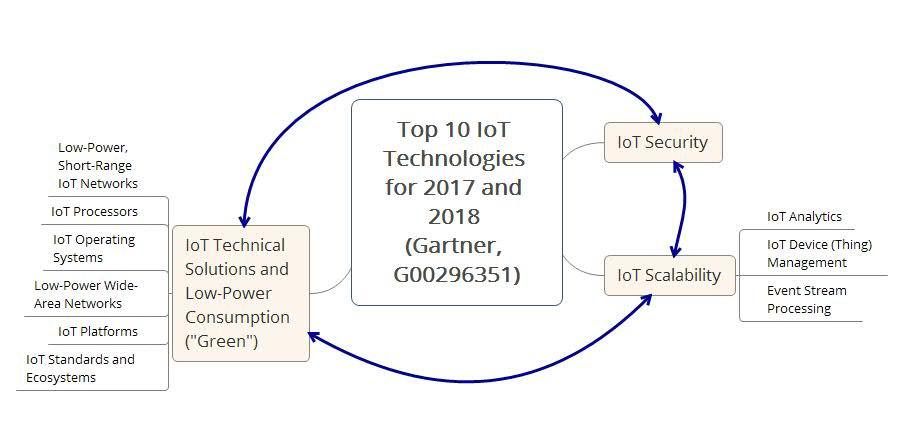
In fact, in the field of technologies for IoT there are three basic problems between which there are close ties:
- ensuring information security (IoT Security);
- scaling of the increasing volume of technical devices and data (IoT Scalability);
- The direct development of technology, taking into account the primary requirement to reduce energy consumption (IoT Technical Solutions and Low-Power Consumption).
The rest of the private technological areas in one way or another tend to solve one of the three basic problems.
I consider it important to say that this article is not a direct translation of the Top 10 IoT Technologies for 2017 and 2018 (G00296351) , but contains only the main points of this Gartner report with the author's presentation of thoughts “on the topic”. To get a more complete picture, of course, it would be useful to look at the source.