August 4, 2016 at 18:20
4 virtual reality helmets that you can buy now
In this article, you will find a comparative analysis of four popular virtual reality helmets that you can purchase and try now: HTC Vive , Oculus Rift , Samsung Gear VR and Google Cardboard . We prepared this review with Maxim Chizhov, co-founder of the Virtuality Club . We did this on the eve of the launch of a new course in the framework of educational programs in the game industry of VSBI - " VR Development Methodology". The training will begin in October, and those who wish to register must already now, as the number of places is limited. This educational program will teach you how to create game content for virtual reality helmets, but in today's article we’ll talk in detail about these helmets.

Virtual reality is one of the most popular technologies of 2016. We already see its visual application, and in the future we will find even more interesting things! What can we say about helmets of virtual reality, which is becoming more and more. After so many years of waiting, the Oculus Rift has finally arrived at its lucky owners. At the same time, it is possible to buy a more affordable virtual reality mobile helmet - Samsung Gear VR. And, of course, let's not forget about the most expensive PC helmet with cool HTC Vive controllers and the most budget virtual card glasses Google Cardboard . These gadgets were created for different target audiences, but we hope that everyone will be interested to compare them and find out the strengths and weaknesses of each.
So, let's look into the wallet and see how much money an ordinary user will have to pay for flagship devices. In the first place is HTC Vive and its record $ 799 for a helmet , but it’s worth it to be noted that controllers are included in this price. Next up is the Oculus Rift with the bar slightly lower at $ 599 . Following them are Samsung Gear VR and a request for $ 99.99 for their mobile VR helmet (but there are discounts and promotions and you can buy cheaper), and closes the Google Cardboard four with its record low price of ($ 9 (V1.0) / $ 14.99 (V2. 0) + mount ($ 2) per set .

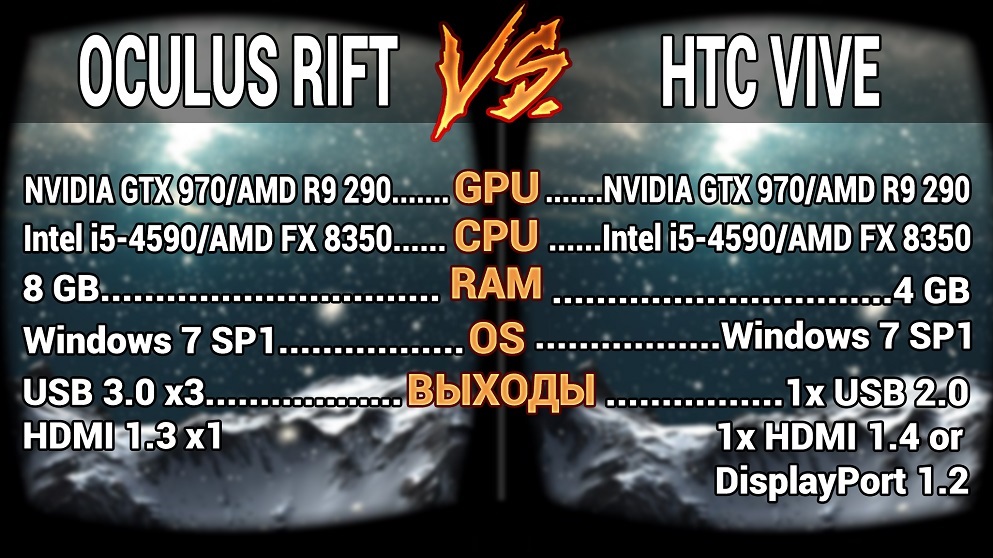
We turn to the analysis of system requirements. HTC Vive can overclock only on good hardware , it will need an NVIDIA GeForce GTX 970 or AMD Radeon R9 290 or higher, Intel i5-4590 or AMD FX 8350 or higher, 4GB RAM or higher, HDMI 1.4 or DisplayPort 1.2 or later, USB port 2.0 or higher, Windows 7 SP1, which will cost about $ 1000 .
Next in line is the Oculus Rift , which is not far from its direct competitor. The helmet will work stably on NVIDIA GTX 970 / AMD R9 290 or higher, Intel i5-4590 or higher, 8GB RAM or more, output compatible with HDMI 1.3, 3 USB 3.0 ports and 1 USB 2.0 port, Windows 7 Sp1 64 bit or newer. The approximate cost of a PC with these characteristics is also about $ 1000. So you are very lucky if you want one of these helmets and already have a powerful PC, otherwise it may take more money to buy new or upgrade old iron than to the helmet itself.
Now for mobile VR: everything is somewhat simpler here, because the basis for gadgets is a smartphone. Samsung Gear VR is compatible with its own line: Galaxy S7, Galaxy S7 Edge, Galaxy Note 5, Galaxy S6 Edge +, Galaxy S6, Galaxy S6 Edge, prices for which range from $ 629 - $ 800 . As for Google Cardboard , the device will work with any smartphone running Android 4.1 and above, or on iPhone 4/5/6.
Of course, the amount of content in application stores is one of the important factors that influence the decision-making in favor of buying a particular device. The number of software and games in the Oculus store is approaching the mark of 200 units, but in Steam VR under HTC Vive there are already more than 400 VR applications. But of course, in the budget segment of Google Cardboard, the abundance of applications is maximum - all mobile VR-applications come with it.

Talking about design in the field of VR is still difficult, since there are no established standards yet. Definitely, the appearance of HTC Vive and Oculus Rift attracts attention with futurism. These two helmets are not similar to each other, but each of them has its own "highlight". Rift looks strict and minimalistic, which gives it a certain elegance. In turn, Vive boasts an extraterrestrial design that mentally sends us to alien films. Both helmets look spectacular and expensive, which corresponds to their price.
Next on the list are Samsung Gear VR and Google Cardboard. Gear VR look very nice and stylish, has a high-quality plastic of white and gray colors, which is pleasant not only to the eye, but also to the skin during use. Cardboard has a solid cardboard case. But, given the price the developers want for it, you should not pay attention to it. Moreover, cardboard is not very unpleasant to the skin and does not have sharp corners, which allows you to use it in the same way as Gear VR, without serious inconvenience.
And here everything becomes more interesting. Oculus Rift and HTC Vive have two built-in OLED displays with a resolution of 2160x1200 pixels. And here Gear VR is not far behind, you need to understand that the smartphone software can not always be compared in terms of graphics quality with a PC. But the difference between HTC Vive and Oculus Rift is almost imperceptible - everything depends on content developed specifically for a certain helmet, taking into account the features of its use. The performance of Google Cardboard is completely dependent on the smartphone itself.

PC helmets HTC Vive and Oculus Rift are not inferior to each other either in functionality or design, and their price range is about the same. A significant difference between the brainchild of HTC Vive and the development of Palmer Lucky - the first helmet immediately at the start of sales allows the player to interact with objects through controllers, and the second only to prepare to release Oculus Touch controllers.
For mobile VR, portability and price are still important. Google Cardboard is primarily aimed at starting to get acquainted with the world of virtual reality, while Samsung Gear VR is more suitable for active use. In October 2016, the Sony PSVR virtual reality console helmet is also coming out and it plans to surpass its competitors in terms of price / quality ratio. It can not yet be tried in the public domain, so it remains only to believe the optimistic forecasts of analysts. By the way, their forecast for 2016 by the number of pieces sold
Well, now decide for yourself which helmet is right for you, and join the world of virtual reality!
Virtual reality is one of the most popular technologies of 2016. We already see its visual application, and in the future we will find even more interesting things! What can we say about helmets of virtual reality, which is becoming more and more. After so many years of waiting, the Oculus Rift has finally arrived at its lucky owners. At the same time, it is possible to buy a more affordable virtual reality mobile helmet - Samsung Gear VR. And, of course, let's not forget about the most expensive PC helmet with cool HTC Vive controllers and the most budget virtual card glasses Google Cardboard . These gadgets were created for different target audiences, but we hope that everyone will be interested to compare them and find out the strengths and weaknesses of each.
Price
So, let's look into the wallet and see how much money an ordinary user will have to pay for flagship devices. In the first place is HTC Vive and its record $ 799 for a helmet , but it’s worth it to be noted that controllers are included in this price. Next up is the Oculus Rift with the bar slightly lower at $ 599 . Following them are Samsung Gear VR and a request for $ 99.99 for their mobile VR helmet (but there are discounts and promotions and you can buy cheaper), and closes the Google Cardboard four with its record low price of ($ 9 (V1.0) / $ 14.99 (V2. 0) + mount ($ 2) per set .
System requirements
We turn to the analysis of system requirements. HTC Vive can overclock only on good hardware , it will need an NVIDIA GeForce GTX 970 or AMD Radeon R9 290 or higher, Intel i5-4590 or AMD FX 8350 or higher, 4GB RAM or higher, HDMI 1.4 or DisplayPort 1.2 or later, USB port 2.0 or higher, Windows 7 SP1, which will cost about $ 1000 .
Next in line is the Oculus Rift , which is not far from its direct competitor. The helmet will work stably on NVIDIA GTX 970 / AMD R9 290 or higher, Intel i5-4590 or higher, 8GB RAM or more, output compatible with HDMI 1.3, 3 USB 3.0 ports and 1 USB 2.0 port, Windows 7 Sp1 64 bit or newer. The approximate cost of a PC with these characteristics is also about $ 1000. So you are very lucky if you want one of these helmets and already have a powerful PC, otherwise it may take more money to buy new or upgrade old iron than to the helmet itself.
Now for mobile VR: everything is somewhat simpler here, because the basis for gadgets is a smartphone. Samsung Gear VR is compatible with its own line: Galaxy S7, Galaxy S7 Edge, Galaxy Note 5, Galaxy S6 Edge +, Galaxy S6, Galaxy S6 Edge, prices for which range from $ 629 - $ 800 . As for Google Cardboard , the device will work with any smartphone running Android 4.1 and above, or on iPhone 4/5/6.
The next pressing question: “What to play?”
Of course, the amount of content in application stores is one of the important factors that influence the decision-making in favor of buying a particular device. The number of software and games in the Oculus store is approaching the mark of 200 units, but in Steam VR under HTC Vive there are already more than 400 VR applications. But of course, in the budget segment of Google Cardboard, the abundance of applications is maximum - all mobile VR-applications come with it.
Design
Talking about design in the field of VR is still difficult, since there are no established standards yet. Definitely, the appearance of HTC Vive and Oculus Rift attracts attention with futurism. These two helmets are not similar to each other, but each of them has its own "highlight". Rift looks strict and minimalistic, which gives it a certain elegance. In turn, Vive boasts an extraterrestrial design that mentally sends us to alien films. Both helmets look spectacular and expensive, which corresponds to their price.
Next on the list are Samsung Gear VR and Google Cardboard. Gear VR look very nice and stylish, has a high-quality plastic of white and gray colors, which is pleasant not only to the eye, but also to the skin during use. Cardboard has a solid cardboard case. But, given the price the developers want for it, you should not pay attention to it. Moreover, cardboard is not very unpleasant to the skin and does not have sharp corners, which allows you to use it in the same way as Gear VR, without serious inconvenience.
Performance
And here everything becomes more interesting. Oculus Rift and HTC Vive have two built-in OLED displays with a resolution of 2160x1200 pixels. And here Gear VR is not far behind, you need to understand that the smartphone software can not always be compared in terms of graphics quality with a PC. But the difference between HTC Vive and Oculus Rift is almost imperceptible - everything depends on content developed specifically for a certain helmet, taking into account the features of its use. The performance of Google Cardboard is completely dependent on the smartphone itself.
Pros and cons
| . | pros | Minuses |
| 1 | Oculus can be called a really high-quality product, which has decent characteristics, a comfortable shape, with good packaging. Game graphics are on top, especially when compared to the development version of the DK2 helmet. High speed frame updates without delays allows you to completely immerse yourself in the gameplay and sometimes even forget that you are physically in the real world. | Of the minuses, we note that for many budget PCs this helmet will be "too tough". The device requires high performance from the computer. Moreover, interaction with objects in games is performed using the controller from the Xbox, and the player really wants to touch and poke everything yourself! It is also worth considering that at the moment almost all the games in Oculus Rift will have to play while sitting. |
| 2 | The great advantage of HTC Vive is the ability to “get away with your hands” in a different reality, allowing the user to contact objects with the help of two controllers. What could be better than tactile activity? Also, thanks to an advanced system for monitoring human actions, the helmet allows you to move in the game "on your own", physically moving around a real room without the help of a gamepad. Full immersion is enhanced by the ability to physically move around a given territory. The minimum area required to install tracking sensors is 1.5x2 meters, and the placement height is 2 meters. The maximum permissible distance between the sensors is 5 meters. | As in the case of competitors HTC, the player will need a serious iron in order to enjoy the miracle of engineering. And the presence of wires can make you think while moving about how not to get confused in them, and not what is happening in the game. Everything else for a comfortable game in a helmet requires a sufficiently large free area and the ability to hang cameras on the sides of the playing area. HTC Vive is currently the most expensive helmet, and besides, it's rather complicated to set up. |
| 3 | Price and portability are the key benefits of the Samsung Gear VR . Unlike the Oculus Rift and HTC Vive, it is much more affordable and gives decent gaming performance. The user is not chained to the computer and can use the device wherever convenient for him. Lack of cords is a big plus. | The phone’s resources are limited and it cannot compare with the performance of a cool PC, so you should not expect the same immersion as from PC helmets. Games on Gear VR sometimes slow down, and the quality of games on Gear VR is for the most part inferior to games on Oculus Rift and HTC Vive. |
| 4 | The advantage of Google Cardboard glasses , in addition to its low price, is compatibility with most devices, including the iPhone. Quality, respectively, depends on the smartphone. Google Cardboard is not the end product, but a set of diagrams and drawings from Google, using which anyone can collect their own virtual reality glasses. To do this, you need a pair of lenses, a piece of cardboard and a little savvy. | The disadvantages of the glasses are the lack of softening nozzles and a strap for fixing on the head, poor quality of the device as a whole. |
conclusions
PC helmets HTC Vive and Oculus Rift are not inferior to each other either in functionality or design, and their price range is about the same. A significant difference between the brainchild of HTC Vive and the development of Palmer Lucky - the first helmet immediately at the start of sales allows the player to interact with objects through controllers, and the second only to prepare to release Oculus Touch controllers.
For mobile VR, portability and price are still important. Google Cardboard is primarily aimed at starting to get acquainted with the world of virtual reality, while Samsung Gear VR is more suitable for active use. In October 2016, the Sony PSVR virtual reality console helmet is also coming out and it plans to surpass its competitors in terms of price / quality ratio. It can not yet be tried in the public domain, so it remains only to believe the optimistic forecasts of analysts. By the way, their forecast for 2016 by the number of pieces sold
| | Google cardboard | Gear VR | Oculus + vive | Sony VR |
| Superdata | 27 million | 3.5 million | 0.7 + 0.4 million | 2.6 million |
| Piper jaffray | - | 5 million | 3.6 + 2.1 million | 1.4 million |
Well, now decide for yourself which helmet is right for you, and join the world of virtual reality!
Only registered users can participate in the survey. Please come in.
What helmet do you plan to purchase or have already purchased?
- 27.4% Oculus Rift 85
- 40.3% HTC Vive 125
- 5.1% Samsung Gear VR 16
- 27% Google Cardboard 84
- 9% Another mobile VR helmet 28
- 7% Other PC Helmet 22