June 20, 2016 at 10:08
Let's talk about piracy and free information.

I think that the concept of free information in itself is the best thing that has happened to our civilization since the invention of the thermos. Yes, and, perhaps, too. Unless dairy farming can argue.
Open source is a phenomenon that became possible just a few years ago. Now you can see how open source software is effectively pushing some proprietary features out of the market, and people around do not consider this to be anything special. Both in that and in another market there are companies that earn money from their “brainchildren”. In the proprietary segment - because they wrote and sold, and in the open source segment - because they wrote and supported.
And it seems that pretty soon it will affect generally all sectors where intellectual property is possible. Why do I think so? I'll explain now. Perhaps, of course, I’m wrong, but my feelings suggest that the usual models will soon depart, as many physical media have left in due time.
Films and cartoons. This topic is very close to me, since the secondary licensing market is familiar in detail. The development team, roughly speaking, makes a modern cartoon more often than not for the TV channel to pay for the content. And even vice versa, cunning TV channels can ask authors for a prime time show.
The task is to get a license for toys based on the cartoon, sell the rights to all kinds of notebooks with heroes and other merchandise. Money is collected on this space, often one or two orders of magnitude higher than the budget of the cartoon. The situation is similar with films, but there is still a large organic source of income - box office cinemas. Outside of these camps, there is also a hellish amount of merchandise - from toy swords from Star Wars to the most terrible board game, 50 Shades of Gray. The other day, I saw a child riding in an Auchan truck and spreading snot on his face: "Yaaa woooooooooooooooooo!".
In electronic games , there is also a lot of merchandising. The same "Angry Birds" at the peak were sold even in the form of school bags and soda.
But still the main story with games is not in this, but in the fact that they are really bought. The first call for me was the Vanger, which I liked so much that I started looking for a large licensed box of them. I found it 7 years after the release of the game, when I could afford it - yet in 1998, I did not have the financial ability to do it. I happily bought it, now the box is gathering dust on the cabinet and makes me madly happy. Although it did not have the coveted rug with Lipuring. I definitely had no rational reasons for doing this.
The second call was the counter-strike server purchased by Dima on Mosigra back in 2011. More precisely, the server service - you connect, enter the password, play along with all of your own. Buying a service was the most convenient way to solve this important corporate task. Actually, this is probably the first of the social package that we had :). A friend told about WoW policy - they say, pirate as much as you like, but anyway then you will get bored with the crooked game, go to the official servers. I didn’t play it myself, but it seems to be true.
Business software?The best model for Rapid Miner is sophisticated professional software, and such that almost always if you need it, you have money (you're a business!). The penultimate version is in open source, the last is 30 days of trial and as much as you like until a task is loaded that eats up more gig of RAM to grind the base. It vividly resembles Photoshop - if it weren’t for the disks from the 90s, then I would hardly have spent hundreds of hours learning how to use it. And now I have a skill fixed at the level of motility patterns, and of all the brands in this market, I have only one left to choose from.
Books?
Here is more fun. Here I stuck my head into the market when I wrote my book. I can say that until this time I talked with authors who inhumanly complained about pirates and the low circulations because of them. You had to feel it yourself to draw conclusions. The conclusions are sad for these authors.
I will explain why. The book has two simple metrics: reach and sales. Books are written for three main reasons: for reach, for sales, and for PR. If you are making a recipe book in Central Asia, this is an unambiguous sale. If you write about how you have fun dash your business and want to share useful stories - this is coverage. If you work as a scriptwriter, copywriter or know a lot about MS products - you write a book (two, three) and become a recognized expert. By the way, that’s why copywriting, advertising and other media industries have so many perfect dead ends.
You can’t earn money from selling books. Humble yourself, that's a fact. Medium runs of publishers barely cover printing and marketing costs. Publishers make money by “firing” and continue to sell bestsellers without spending money on developing a project, but simply letting out print runs in an additional print.
The average coverage of a book is 5,000. Best seller (less than 1% of the market) - 20 thousand per year. Coverage of the same post on Habr - from 10 to 40 thousand on average (previously it was from 20 to 100 thousand approximately). Coverage of a post in LiveJournal - 5 thousand people easy for 25 bucks. Writing a book in the era of the Internet is simply irrational if you are working on coverage according to the standard model.
If you write for self-promotion, then neither coverage nor sales are of concern to you - it is important for you to only put the project in your portfolio. In principle, there are comrades who themselves pay for the circulation of their book, just to later have a reputation as an author and, for example, sell trainings. At the heart of this scheme is a bubble that seems somewhat, let's say, unnatural.
But this whole scheme is easily broken by free access to the text of the book. And no, I'm not talking about Filibusta even (though about her either), but about any service that makes it possible to read for free and easily.
Want an example of a successful project? The guys from our Ridero were telling - please, the book market of Poland, the model “liked it - pay”. At the end of reading on one of the popular services you are asked how to book, asked for an assessment - and immediately offered to pay the author (the service takes a commission). Now a surprise. The average payment for a free e-book was higher than for a paper copy. This is in a world where the author rarely gets more than 5% of the price of a shelf on paper, rather 2-3%. At the same time, of course, they basically pay only 20% of the books, and the border is very sharp: either everything or nothing. If you don’t fall into “audience sympathy”, then you will get a few translation units.
The same kickstarter with books and other things is the second example of good luck: do you want to continue? Buy up the circulation, and the author will write it with pleasure.
In my case, the story is this: only 50 pre-orders, frantic sales of the first days (the first print run), then the second peak at the time of the release of the electronic version (it had to be on paper, because many wrote reviews and reviews - it took half the second circulation), then a smooth decline and access to stable sales. The classic product curve, familiar from the curves of the sale of new phones (only we where, much more modest). At the time the book became a bestseller on Ozone, we had a short surge in sales. At the moment when the cunning pirate scanned and laid out the book on Flibusta, we did not see anything on the chart (approximately 536 downloads and readings in the first three days on Flibusta). All my friends, the authors, assured me as one that the appearance on Flibust was immediately a sharp decline in both the electronic and paper versions. True, during my experience the library was already blocked (when they saw their downturns, there was no block), so the experiment is not clean.
But often such Vkontakte posts often appear. Pay attention to the very bottom of the screenshot, this is completely normal, I would even say the natural behavior of the user:
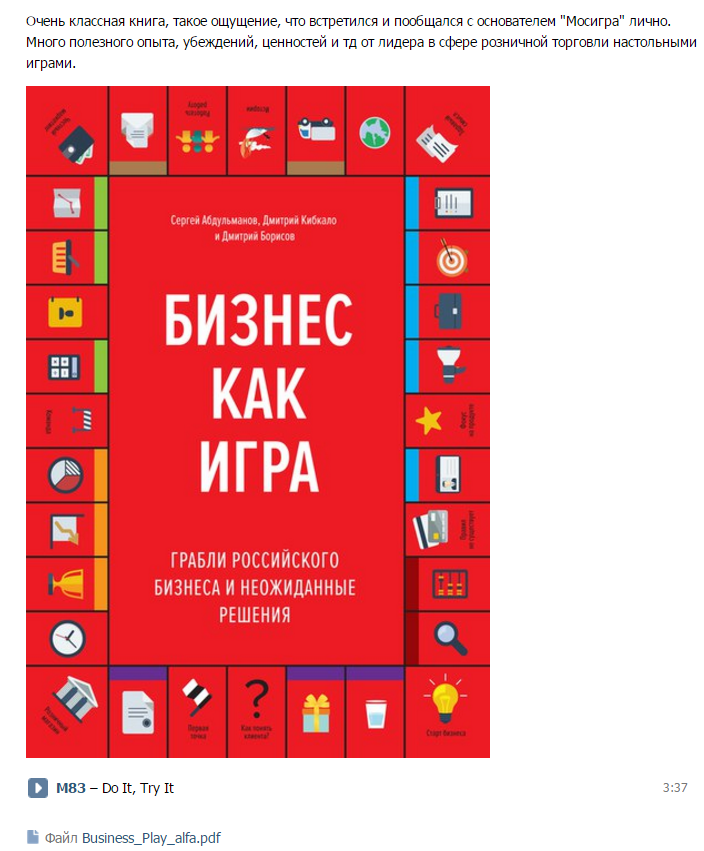
Or here's a great tip: “Hello! You have a great book, I bought three, presented two to my friends, then I got tired of going to the store and sent ten more letters with a file, excuse me ”. From the point of view of the publisher, 10 sales of the electronic version are clearly missed. From my point of view, it is a good gain - so that the buyer would not reach the store at all, and nothing would change. And here he sent 10 friends a file (and they can also forward it further, since he found it and highlighted it in a letter). I think at least 3-4 people in the chain will like the book, and they will buy paper at least as a souvenir. Well, again, do not forget that our interest is in coverage, unlike the publisher, whose interest is in sales. But all parties win anyway.
So piracy works, and it works awesome. The main point is to understand that if a book is bought easier than swings from a tracker, Flibusta or Kontakt - it will be bought by those who can afford it. The usual "Starbucks" price differentiation.
And yes. For the book they gave the prize “Business Book of the Year in Russia” at the International Economic Forum the other day (this is just a holiday). So, taking this opportunity, I want to thank the company mail.ru - guys, you made the coolest, largest and most working exchanger "Vkontakte" in the country, and thanks to it the book became really popular.
So what remains?
In the new environment, skill comes first. Skill is more important than information. It used to be hard to learn, because the main problem was the dissemination of information. Now the main problem is your own desire to highlight something in the information flow, raise your ass and learn. Acquire specialization by transforming someone else’s experience into your own, and then gaining practice.
So welcome to the world where you can always start from scratch.