Not all hyper-converged solutions are equally useful, or what about the flow of troubled marketing “we also have HCI”
It was inspired by today's letter from a colleague from one of the largest Russian companies, which is under a massive “clone attack” (c).
We heard the opinion that it would be time to conduct some public educational program, especially for those who have not yet encountered SDI (Software Defined Infrastructure), Webscale and other progressive approaches to building IT infrastructures.
As they say - The devil is in the detail.

Almost any modern vendor has launched hyper-convergent solutions, most often in their infancy, and as a result a giant pasta factory has been launched.
In particular, we will try to help deal with the very flow of marketing, as well as the “nuances” that are worth paying attention to.
Today we’ll talk about one of the most exemplary (not technologically) vendors, in fact an example of what the dominance of marketers instead of engineers leads to.
Unfortunately, this behavior discredits the very concepts of WebScale / hyperconvergence.
To begin with - I will ask some questions "from the opposite."
In your opinion, is this technology really “software-defined solution of the new generation”:
1) Using a closed (“proprietary”) (giant in size — fits only in 2U server) hardware PCI adapter for operation — in particular, compression and deduplication. What is happening inside this adapter does not know anyone except the developer (and possibly special services of a number of interested countries), it goes without saying thatAll your data goes through this device.
At the same time, the adapter is SPOF (Single Point Of Failure, a single point of failure), it requires a complete stop of the equipment to update its firmware (which is required for example when upgrading VMware), and only the official engineer of the company can do the firmware.
The actual approach - instead of using the capabilities of modern Intel processors (for deduplication - counting sha256 as a single instruction, with a performance drawdown close to zero) - creating "fancy" PCI cards with limited performance, but a lot of problems.
Positioning such a (extremely strange) solution as the only advantage over competitors (more about that later).
2) Lack of own control interface.
Integration into third-party software, in particular VMware vCenter, with the corresponding problems, including the classic "bit itself by the tail" - in case of failure, vCenter running on the same equipment loses control over the equipment ...
What will prevent vCenter from starting back without a lot of "ridiculous body movements. "
3) The use of archaic RAID technologies inside the solution (RAID 5 and 6 to protect data on the internal drives of the servers)
4) Lack of full clustering, to hide which the term “federation” was coined, with support for only 4 nodes (servers) per data center.
5) Long-term promises of support for other hypervisors except ESXi, with lots of announcements and zero results.

6) Mass loss of data on tests (according to reviews of colleagues from the largest companies of the Russian Federation).
7) Using more than 100 gigabytes of RAM on each server for the virtual controller to work (despite the fact that propietary hardware acceleration is used). There is, therefore, very little left for guest VMs to work.
8) The lack of localization of I / O, which is already critical in 2016 and will be ultra-critical in 2017.
Several SSD drives can completely “clog” the bandwidth of a 10-gigabit network, and NVMe can easily do the same even for 40 gigabits.
9) Lack of flexible functional management - for example, deduplication cannot be turned off (which, as most engineers know, can be harmful instead of useful in a fairly large number of cases).
10) Lack of support for “stretched” (Stretch / Metro) clusters.
11) No supportErasure Code .
What is an EC? This is an extremely effective technology for saving disk space, combining (in our case) the advantage of unlimited scalable systems with the most effective usable capacity of the data storage system.
Works for any data, unlike deduplication.
12) Lack of distributed “tiering” between the SSD and the “cold” level.
13) No support for All Flash.
14) There is no support for file access (built-in, unlimitedly scalable, as the webscale solution should be, file server)
15) There is no support for block guard functionality (in fact, the real use of tier-1 applications such as Oracle RAC is impossible)
16) Lack of intellectual "cloning" of master images of operating systems on local SSDs , i.e. Infrastructure susceptibility to boot storm.
What does this mean? With the simultaneous launch of the VM mass (from hundreds or more), massive problems are observed due to the emphasis on the input-output interfaces (in this case, the network). The Shadow Disk technology on Nutanix fundamentally eliminates this problem - it will automatically make a copy of the VM master image on the local host, allowing the virtual machine to boot from the local SSD.
17) The inability to update software without stopping the service.
18) The lack of the possibility of self-updating without contacting technical support.
19) The inability to update with one click, a lot of dangerous operations are required (this is why it is necessary to contact the technical center)
20) The inability to automatically update the server firmware (BIOS, BMC, controllers, disks, etc.)
21) The inability to automatically update the hypervisors.
22) The inability to "attach" the VM to the flash (SSD level).
23) DRS support for only 2 servers.
24) Lack of data consistency support when creating snapshots.
25) An actual attempt to position the solution for the SMB market (small and medium-sized businesses) as an IT platform for corporate use.
26) Reporting false information to customers (more on this below).
...
Probably enough for a start. Do you like this solution? Will you call it software-defined?
If so, you can safely contact Simplivity. Just remember to make backups. :)
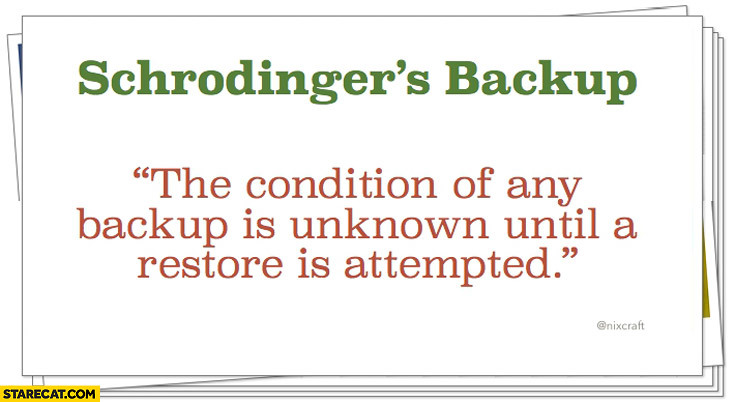
If it seems to you that the real WebScale is about something else, then welcome to us.
Usually we don’t spend time on “spreading” lagging technological solutions (especially - so lagging behind ), but we could not help but respond to constant attempts to deliver incorrect information to our customers.
The idea is simple - "in any incomprehensible situation, we must talk about deduplication" (c) Simpliviti.
In short, we are talking about these couple of pictures with which Simpliviti tries to “compete” and shows them to the right and left:
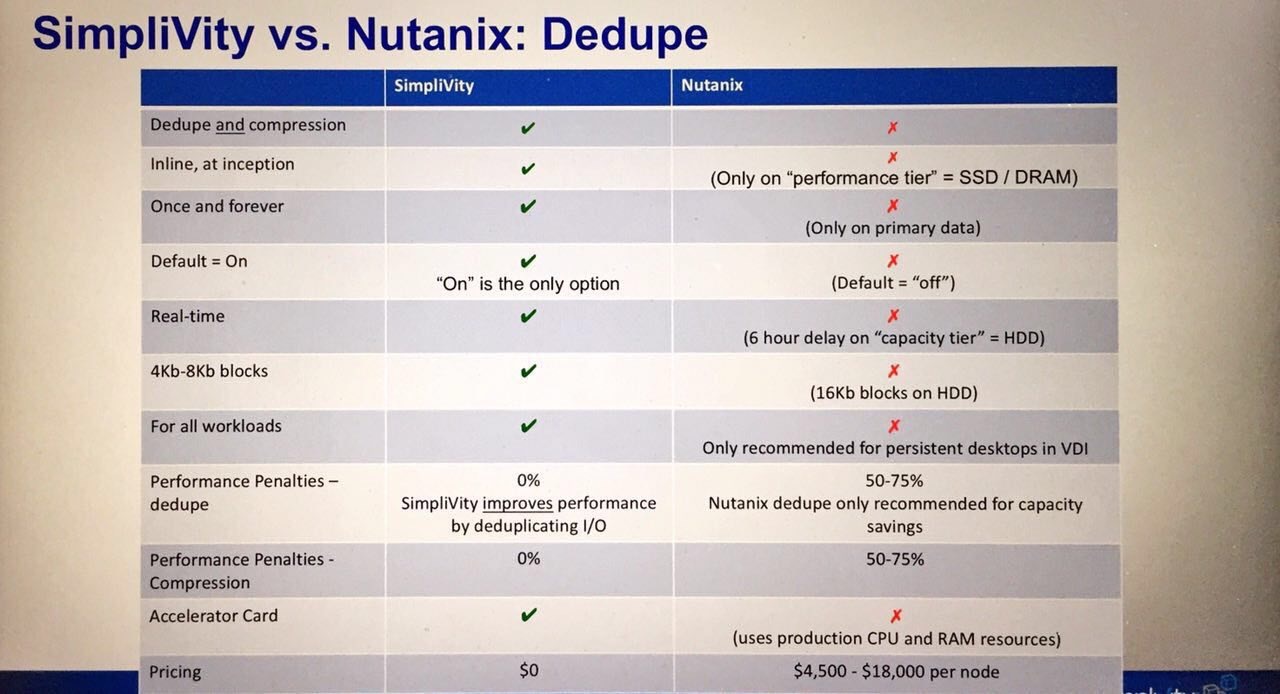

Let’s take a look at this muddy stream.
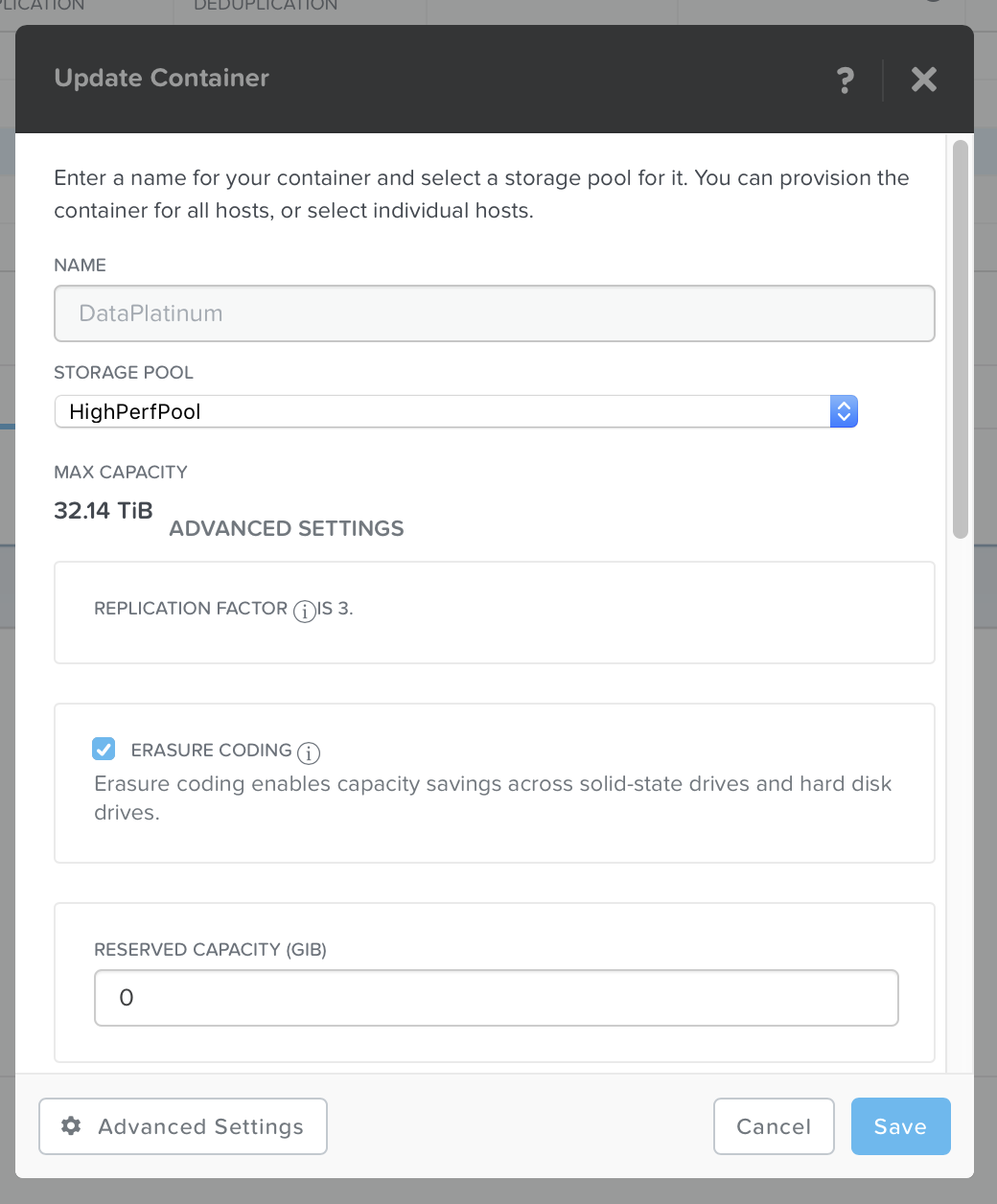
To begin with, the Nutanix virtual datastore settings shown in the screenshots. This is important enough, since they (for the attentive reader) already show that most of the information provided by Simpliviti is a distortion of facts or a direct lie.

Go!

1) Dedupe and compression - false application, simultaneous compression and deduplication are fully supported, but we do even better - simultaneous EC-X (Erasure Code) and compression are possible, and with zero performance drawdown (delayed map-reduce processes in the background).
By the way, Nutanix can even do deduplication of the RAM cache (used when reading data) - this is generally unique.
2) Once and forever - false information, we can do EC-X / compression / dedupe (!) In deferred mode, and throughout the cluster. This is much more efficient than on-the-fly deduplication using a proprietary 2-unit PCI board with limited performance.
3) Default = on is a huge minus of Simpliviti, there is no way to fine-tune the solution for specific tasks. For example, for linked clones (with which there are huge problems with Simpliviti itself) - deduplication is almost completely useless.
4) Real-time - false information, Nutanics can do it on the fly (due to Intel hardware instructions and calculating SHA256 checksums) and in delayed mode, and the delay can be precisely configured (from minutes to many hours).
5) 4kb-8Kb - false information, on Nutanix you can adjust the block size for deduplication
6) For all workloads - incorrectly, deduplication in the mass of scenarios does not bring any benefits but at the same time (in case of inline, even hardware) introduces increased delays. Nutanix, due to the possibility of "deferred" deduplication, does not have such problems.
7) Performance Penalties - false information, performance drawdown is almost zero for inline (due to the use of processor hardware instructions) and generally zero for delayed distributed deduplication.
Do not forget that Simpliviti has to use both a software controller (the first “layer”) and a hardware adapter (additional layer).
8) Accelerator Card - here is the full truth, a giant proprietary board, with a lot of problems (described above), which is the point of failure.
Our solution is 100% software defined, while showing outstanding performance results (4 nodes All Flash easily give more than 600 thousand IOPS).
It seems that here someone does not know how to program.
An additional “highlight” is given by the fact that the Simplivity controller requires much more hardware resources (memory and processor) than Nutanix, while a hardware accelerator is also required.
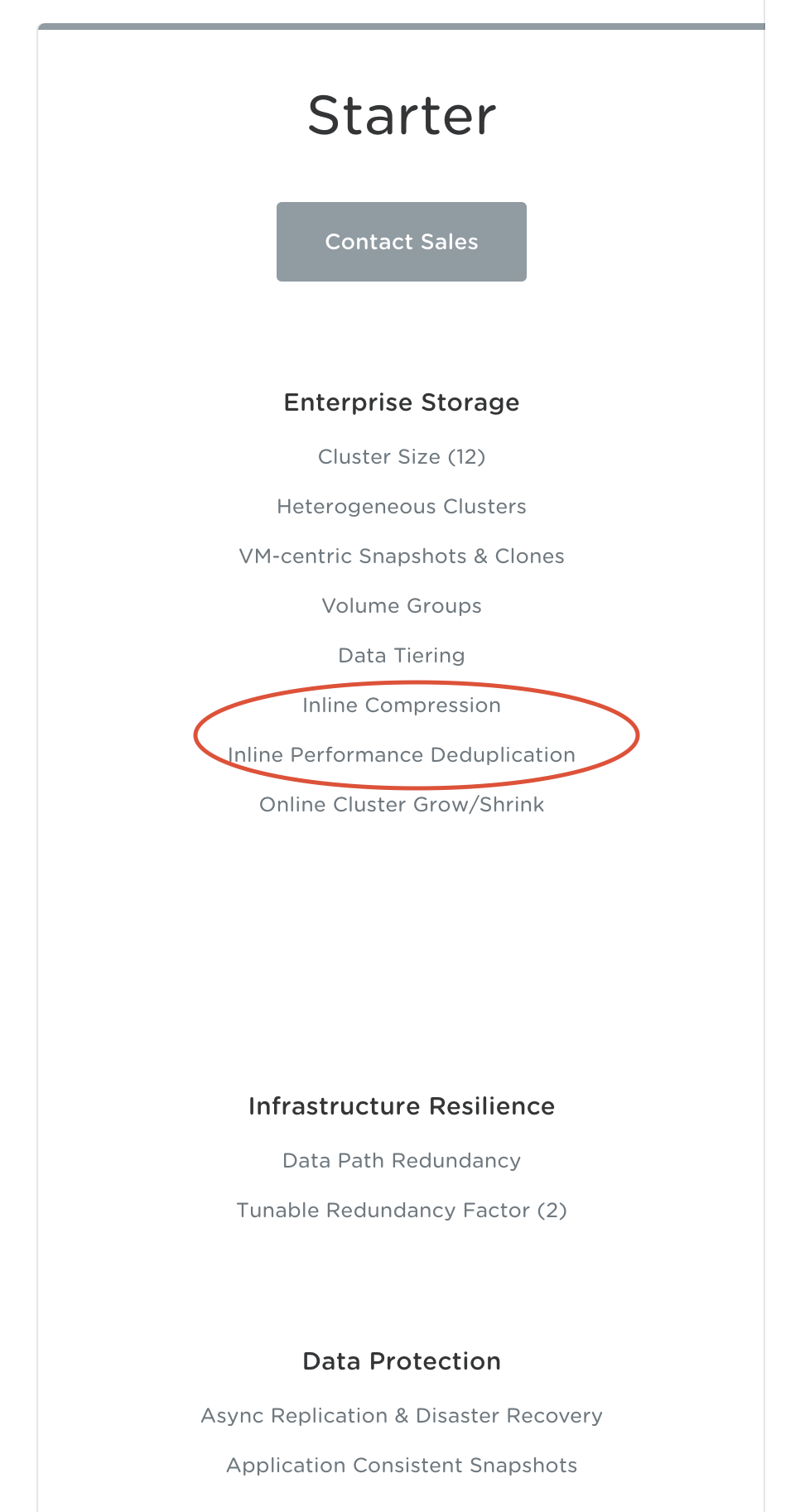
9) Pricing - false information, it is easy to see - deduplication (and backups) are even built into the basic starter edition, as well as our SMB (Nutanix Express) solution and the completely free Community Edition.
To paraphrase, deduplication and backups for all clients are free and built into all versions of licenses.
www.nutanix.com/products/software-editions
10) Simple VM-level Backup - a distortion of facts, on Nutanix it is not tied to vCenter, which in itself is a bottleneck.
Works for any hypervisor (including ESXi), data consistency is maintained (which Simplivity cannot do).
File-by-file recovery is possible (which Symplivity generally claims to be the only ones in the world to do this, which of course is a hoax).
11) No need for protection domain - really, Simpliviti is not able to operate with groups of virtual machines (as we can), which does not allow creating VM protection groups (for example, describing your application).
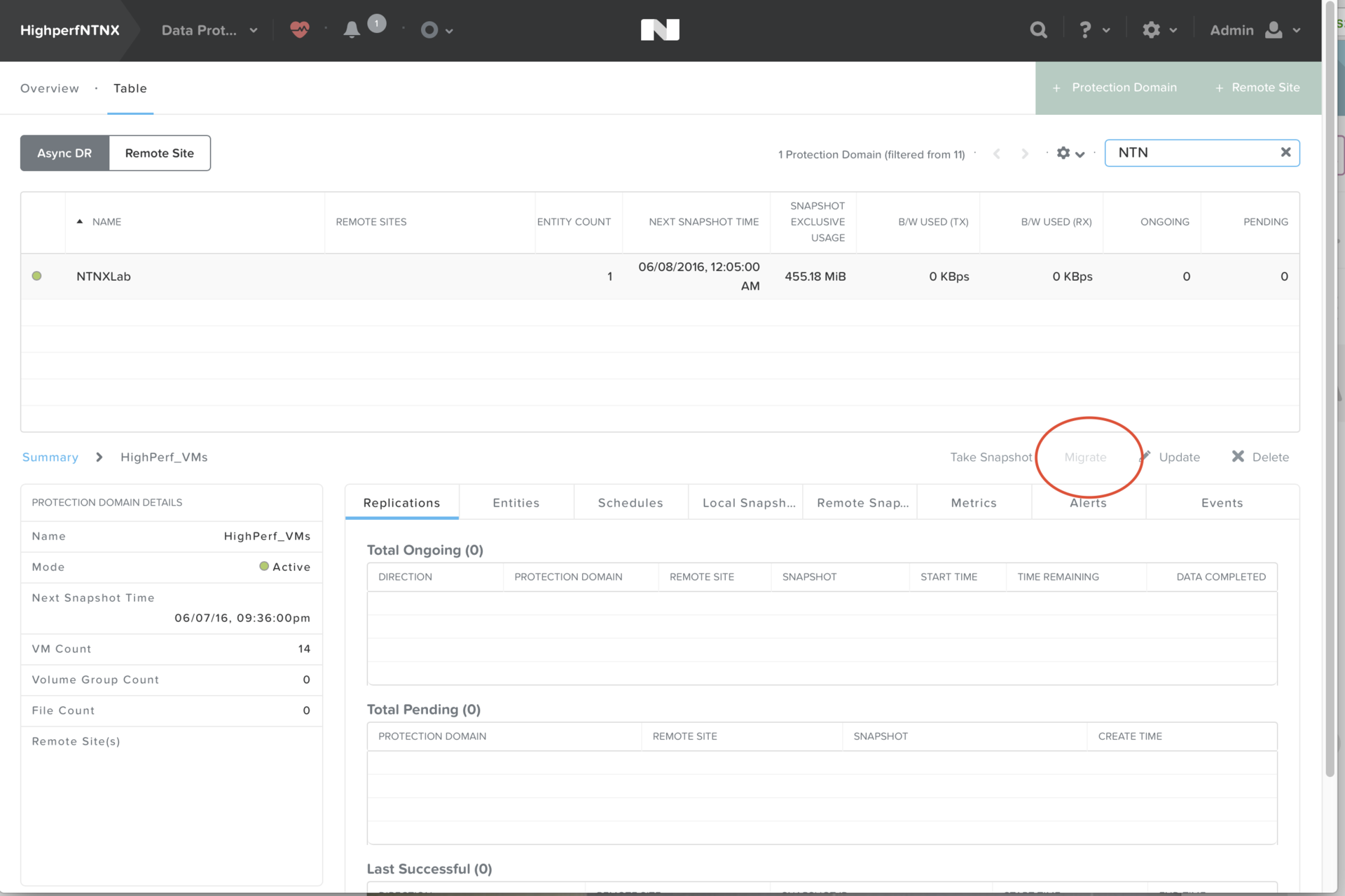
12) Single Click Data Migration - it’s not very clear what the gentlemen wanted to say, but it seems like a hoax again. On Nutanix, data migration is performed by pressing a single “Migrate” button, and unlike Simplivity, it can migrate tens / hundreds / thousands / millions of virtual machines (the same protection groups)
13) No need for external backup applications - false information, in Nutanics as powerful backup capabilities are built-in (including the ability to backup to Azure and AWS clouds), there is also integration with leading market players (for example, Commvault natively supports Nutanix, including our AHV virtualization stack.
Moreover, we made it possible to restore data at the guest VM level - the user of the virtual machine can independently recover the information he needs (Nutanix Guest Tools). Of course, Simpliviti does not know how.
14) 10 minutes RPO - false information, data snapshots can be done with overlapping schedules and much more often than once per hour.
...
What is the outcome? Our recommendation is to independently study the materials (in our case, Nutanix Bible will help to understand the solution in detail), not to give the opportunity to “focus away” (when the vendor tries to pass off unimportant functionality as a “breakthrough”), ask questions.
Nothing complicated, right? :)
We heard the opinion that it would be time to conduct some public educational program, especially for those who have not yet encountered SDI (Software Defined Infrastructure), Webscale and other progressive approaches to building IT infrastructures.
As they say - The devil is in the detail.
Almost any modern vendor has launched hyper-convergent solutions, most often in their infancy, and as a result a giant pasta factory has been launched.
In particular, we will try to help deal with the very flow of marketing, as well as the “nuances” that are worth paying attention to.
Today we’ll talk about one of the most exemplary (not technologically) vendors, in fact an example of what the dominance of marketers instead of engineers leads to.
Unfortunately, this behavior discredits the very concepts of WebScale / hyperconvergence.
To begin with - I will ask some questions "from the opposite."
In your opinion, is this technology really “software-defined solution of the new generation”:
1) Using a closed (“proprietary”) (giant in size — fits only in 2U server) hardware PCI adapter for operation — in particular, compression and deduplication. What is happening inside this adapter does not know anyone except the developer (and possibly special services of a number of interested countries), it goes without saying thatAll your data goes through this device.
At the same time, the adapter is SPOF (Single Point Of Failure, a single point of failure), it requires a complete stop of the equipment to update its firmware (which is required for example when upgrading VMware), and only the official engineer of the company can do the firmware.
The actual approach - instead of using the capabilities of modern Intel processors (for deduplication - counting sha256 as a single instruction, with a performance drawdown close to zero) - creating "fancy" PCI cards with limited performance, but a lot of problems.
Positioning such a (extremely strange) solution as the only advantage over competitors (more about that later).
2) Lack of own control interface.
Integration into third-party software, in particular VMware vCenter, with the corresponding problems, including the classic "bit itself by the tail" - in case of failure, vCenter running on the same equipment loses control over the equipment ...
What will prevent vCenter from starting back without a lot of "ridiculous body movements. "
3) The use of archaic RAID technologies inside the solution (RAID 5 and 6 to protect data on the internal drives of the servers)
4) Lack of full clustering, to hide which the term “federation” was coined, with support for only 4 nodes (servers) per data center.
5) Long-term promises of support for other hypervisors except ESXi, with lots of announcements and zero results.
6) Mass loss of data on tests (according to reviews of colleagues from the largest companies of the Russian Federation).
7) Using more than 100 gigabytes of RAM on each server for the virtual controller to work (despite the fact that propietary hardware acceleration is used). There is, therefore, very little left for guest VMs to work.
8) The lack of localization of I / O, which is already critical in 2016 and will be ultra-critical in 2017.
Several SSD drives can completely “clog” the bandwidth of a 10-gigabit network, and NVMe can easily do the same even for 40 gigabits.
9) Lack of flexible functional management - for example, deduplication cannot be turned off (which, as most engineers know, can be harmful instead of useful in a fairly large number of cases).
10) Lack of support for “stretched” (Stretch / Metro) clusters.
11) No supportErasure Code .
What is an EC? This is an extremely effective technology for saving disk space, combining (in our case) the advantage of unlimited scalable systems with the most effective usable capacity of the data storage system.
Works for any data, unlike deduplication.
12) Lack of distributed “tiering” between the SSD and the “cold” level.
13) No support for All Flash.
14) There is no support for file access (built-in, unlimitedly scalable, as the webscale solution should be, file server)
15) There is no support for block guard functionality (in fact, the real use of tier-1 applications such as Oracle RAC is impossible)
16) Lack of intellectual "cloning" of master images of operating systems on local SSDs , i.e. Infrastructure susceptibility to boot storm.
What does this mean? With the simultaneous launch of the VM mass (from hundreds or more), massive problems are observed due to the emphasis on the input-output interfaces (in this case, the network). The Shadow Disk technology on Nutanix fundamentally eliminates this problem - it will automatically make a copy of the VM master image on the local host, allowing the virtual machine to boot from the local SSD.
17) The inability to update software without stopping the service.
18) The lack of the possibility of self-updating without contacting technical support.
19) The inability to update with one click, a lot of dangerous operations are required (this is why it is necessary to contact the technical center)
20) The inability to automatically update the server firmware (BIOS, BMC, controllers, disks, etc.)
21) The inability to automatically update the hypervisors.
22) The inability to "attach" the VM to the flash (SSD level).
23) DRS support for only 2 servers.
24) Lack of data consistency support when creating snapshots.
25) An actual attempt to position the solution for the SMB market (small and medium-sized businesses) as an IT platform for corporate use.
26) Reporting false information to customers (more on this below).
...
Probably enough for a start. Do you like this solution? Will you call it software-defined?
If so, you can safely contact Simplivity. Just remember to make backups. :)
If it seems to you that the real WebScale is about something else, then welcome to us.
Usually we don’t spend time on “spreading” lagging technological solutions (especially - so lagging behind ), but we could not help but respond to constant attempts to deliver incorrect information to our customers.
The idea is simple - "in any incomprehensible situation, we must talk about deduplication" (c) Simpliviti.
In short, we are talking about these couple of pictures with which Simpliviti tries to “compete” and shows them to the right and left:
Let’s take a look at this muddy stream.
To begin with, the Nutanix virtual datastore settings shown in the screenshots. This is important enough, since they (for the attentive reader) already show that most of the information provided by Simpliviti is a distortion of facts or a direct lie.
Go!
1) Dedupe and compression - false application, simultaneous compression and deduplication are fully supported, but we do even better - simultaneous EC-X (Erasure Code) and compression are possible, and with zero performance drawdown (delayed map-reduce processes in the background).
By the way, Nutanix can even do deduplication of the RAM cache (used when reading data) - this is generally unique.
2) Once and forever - false information, we can do EC-X / compression / dedupe (!) In deferred mode, and throughout the cluster. This is much more efficient than on-the-fly deduplication using a proprietary 2-unit PCI board with limited performance.
3) Default = on is a huge minus of Simpliviti, there is no way to fine-tune the solution for specific tasks. For example, for linked clones (with which there are huge problems with Simpliviti itself) - deduplication is almost completely useless.
4) Real-time - false information, Nutanics can do it on the fly (due to Intel hardware instructions and calculating SHA256 checksums) and in delayed mode, and the delay can be precisely configured (from minutes to many hours).
5) 4kb-8Kb - false information, on Nutanix you can adjust the block size for deduplication
6) For all workloads - incorrectly, deduplication in the mass of scenarios does not bring any benefits but at the same time (in case of inline, even hardware) introduces increased delays. Nutanix, due to the possibility of "deferred" deduplication, does not have such problems.
7) Performance Penalties - false information, performance drawdown is almost zero for inline (due to the use of processor hardware instructions) and generally zero for delayed distributed deduplication.
Do not forget that Simpliviti has to use both a software controller (the first “layer”) and a hardware adapter (additional layer).
8) Accelerator Card - here is the full truth, a giant proprietary board, with a lot of problems (described above), which is the point of failure.
Our solution is 100% software defined, while showing outstanding performance results (4 nodes All Flash easily give more than 600 thousand IOPS).
It seems that here someone does not know how to program.
An additional “highlight” is given by the fact that the Simplivity controller requires much more hardware resources (memory and processor) than Nutanix, while a hardware accelerator is also required.
9) Pricing - false information, it is easy to see - deduplication (and backups) are even built into the basic starter edition, as well as our SMB (Nutanix Express) solution and the completely free Community Edition.
To paraphrase, deduplication and backups for all clients are free and built into all versions of licenses.
www.nutanix.com/products/software-editions
10) Simple VM-level Backup - a distortion of facts, on Nutanix it is not tied to vCenter, which in itself is a bottleneck.
Works for any hypervisor (including ESXi), data consistency is maintained (which Simplivity cannot do).
File-by-file recovery is possible (which Symplivity generally claims to be the only ones in the world to do this, which of course is a hoax).
11) No need for protection domain - really, Simpliviti is not able to operate with groups of virtual machines (as we can), which does not allow creating VM protection groups (for example, describing your application).
12) Single Click Data Migration - it’s not very clear what the gentlemen wanted to say, but it seems like a hoax again. On Nutanix, data migration is performed by pressing a single “Migrate” button, and unlike Simplivity, it can migrate tens / hundreds / thousands / millions of virtual machines (the same protection groups)
13) No need for external backup applications - false information, in Nutanics as powerful backup capabilities are built-in (including the ability to backup to Azure and AWS clouds), there is also integration with leading market players (for example, Commvault natively supports Nutanix, including our AHV virtualization stack.
Moreover, we made it possible to restore data at the guest VM level - the user of the virtual machine can independently recover the information he needs (Nutanix Guest Tools). Of course, Simpliviti does not know how.
14) 10 minutes RPO - false information, data snapshots can be done with overlapping schedules and much more often than once per hour.
...
What is the outcome? Our recommendation is to independently study the materials (in our case, Nutanix Bible will help to understand the solution in detail), not to give the opportunity to “focus away” (when the vendor tries to pass off unimportant functionality as a “breakthrough”), ask questions.
Nothing complicated, right? :)