May 29, 2016 at 18:08
Gchat was the messenger of the future, but Google did not understand this
- Transfer
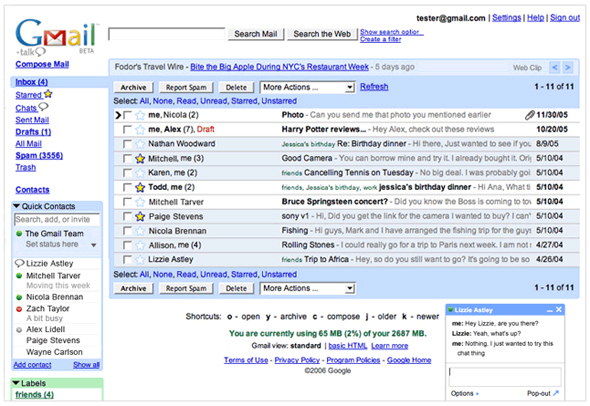
Oh, good old days
. Recently, everyone has been talking about Slack . A chat application that focuses primarily on office use and productivity , simple, well-designed, easy to use and powerful . Slack is also a company where everyone went crazy in 2015 (the company of the year according to Inc. magazine). Whether you like their program or not, it's time to admit one thing: Slack is exactly Gchat.
Just ten years ago, people didn’t always realize that they could use Gchat the way we use Slack today. This was supposed to be a messenger for a lazy discussion with friends, and not for business conversations with colleagues. But Gmail had an archive of chats, full-text search worked on them, there were group chats and media transfer was allowed. This is Slack, and Google (in a simplified form) had it back in 2005, although the company did not understand this.
Of course, Google did not invent instant messaging. To deny the importance of AOL Instant Messenger (AIM) or ICQ is to deny the formative experience of an entire generation (don't forget about MSN Messenger and Yahoo! Messenger users as well). But Google set Gchat as the main goal of maximum compatibility with all platforms, they implemented integration with AIM, for example, at the end of 2007. As Gmail grew in popularity and as Gchat supported more and more third-party IM services, this product became an increasingly attractive choice.
The first sign that Google did not like Gchat in the same way that users loved it was in the very name of this service. We can talk about Gchat all day, but Google never recognized the word . Despite its prevalence in spoken language, Google stubbornly resisted the name “Gchat” without explaining the reasons. The company steadfastly kept its line, calling the Google Talk application released in 2005, and the integrated service in Gmail (2006) - Google Chat or just Chat.
To cope with the situation, I had to use creative linguistics. Mashable Editiondescribed a service with the "official name Google Talk, but unofficially known as Gchat." Newspaper The Telegraph tried this passage: «Google Talk, colloquially known as Google Chat or Gchat». Such a mess! And the loyal users of Gchat had the impression that loving Gchat — both the name and the community that had formed around them — was like something illegal.
In 2011, Google began experimenting with the Hangouts communications service on Google+, and by 2013, Google wanted to make Hangouts the new Gchat. He had the function of advanced video calls, location sharing and support for animated GIFs. Overall, Hangouts has been a product of natural evolution. But many users of Gchat were outraged by this transition, they criticized the new product and clung to the classic Gchat interface. “Well, I just did an“ upgrade ”on Hangouts and now the chat column in my Gmail has become addictive,” wrote one of the Gchat users on the Google tech support forum in 2013, when Google increased the pressure on users to switch to Hangouts .
Two years later, John Brownlee published a passionate speech in defense of the classic Gchat in the Fast Company column :
There is a reason professionals like Gchat. In the world of online messengers, similar to delusions of delusions, Gchat proudly kept the text interface. Putting functionality as the top priority, he coexisted with Gmail, not trying to come to the forefront ... When you click on someone else’s name, you can send him a text message, and later start a video conference, and that’s all ... He proudly, even defiantly didn’t allow any freaks, but nevertheless possessed some beautiful not conspicuous touches ".
The release of the new version to replace the old one with a different name seemed to confirm the suspicion that Google did not really like Gchat in the way that users loved it. And it was also the moment when the vision of the future development of instant messengers at Google lost its meaning. In its official corporate history, Google writes that the Hangouts released in May 2013 should become "Google’s unified communications system, replacing Google Talk, Google+ Hangouts and Messenger." Still, Google Messenger still exists in parallel with Hangouts. And even so far, there have been the last people who have not changed the old Gchat.
But hey, that's not all.
Last week, Google announcedAllo messenger and Duo video chat application. They implement personalization using machine learning. A week earlier, the company also released a small group collaboration application called Spaces, which combines sharing multimedia content and browsing the web within a program with chat.
These are many ways to communicate. A Google employee told me in a comment: “With Allo and Duo, we focus on starting from scratch, making purely mobile applications with specific clear functions. Hangouts, on the other hand, is a powerful multi-platform application for users who need features for group work chats and productivity. ” It looks like Google is adding new brands whenever it releases new products, even if their functionality is duplicated.
From the point of view of the company, it makes sense to start from scratch and then show an amazing and innovative development. "We did not want to burden programmers with solutions from previous products," saidErik Kay, CTO of communications software at Google. But from the point of view of users, these name changes seem unnecessary and disrespectful to your favorite products that could be improved instead of being destroyed ( RIP Google Reader ).
The reflections on Digital TrendsAndy Boxall writes about the overabundance of communication programs from Google that Google “spewed out three new messengers ... Which one should we use? If you're not sure, then don’t look at Google. Judging by her confused approach to communication services, she herself does not know. ” The same can be said about the situation with Gchat: the company did not realize then that it possesses something valuable. In 2005 and 2006, the company had in its hands what would eventually turn into the next big trend. Gchat was simple, elegant and, most importantly, focused. All this has now disappeared.
And it's not just about Slack, because Google was five or six years ahead of WhatsApp, GroupMe and Facebook Messenger, offering a simple, functional chat with many options. A company could win significantly if it realized the value it has. In fact, you can still often hear how people call any communication service from Google - Gchat . This is an incredibly powerful brand. Especially considering that he never existed.