Who are all these people? New study of the active audience of VK, Fb, Twi, Inst, OK, MM and LJ
Brand Analytics presented the data of a regular study of an active audience of social networks in Russia, winter 2015-2016.
The study presents data on the audience, age, gender and regional distribution of the authors of social networks in Russia. The study includes data on the most popular authors and groups for each social network.
The main focus of the study is focused on the active (writing) audience, since we study social networks as a means of public communication and their influence on the formation of public opinion.
The main data are presented below, the presentation of the full version of the study “Social networks in Russia, winter 2015-2016”, including the Top 20 authors and groups in social networks, is available here .
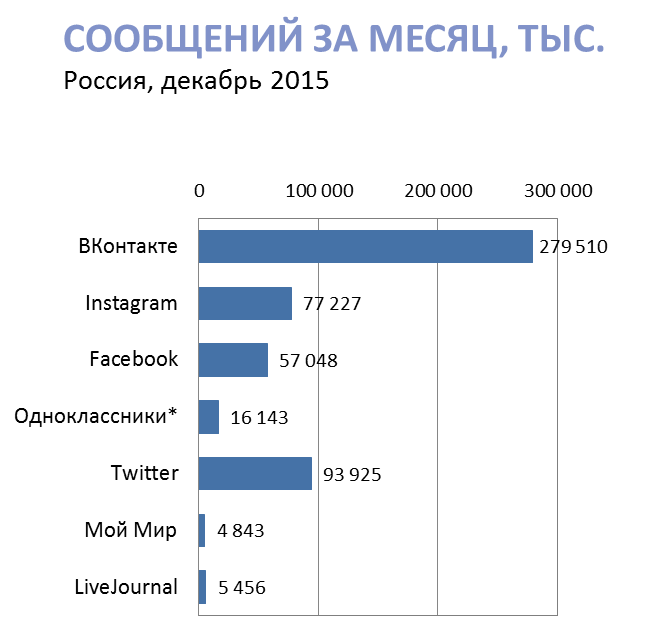
One of the key indicators of the “vital activity” of a social network is the number of “talking” users who openly express their position by public messages on social media. In December 2015, there were about 37 million such active authors in Russia ; they generated 588 million posts per month. Active authors creating public content make social networks an actual indicator of public moods, allowing them to catch “live” social problems at the very beginning of the formation of significant trends.
By the number of "writing" Russian authors, VKontakte is the leader - 18.8 million unique authors. The next in second place Instagram has incredible growth rates; in December, 10.6 million were recorded on this network .authors, almost 5 times more than in the spring of 2015. Third place - Twitter - the number of active authors here continues to decline, in December a little more than 1 million people were recorded .

As for the number of posts posted daily on social networks, there are no such drastic changes. In the first place, as before, Vkontakte, in the second - Twitter, then - Instagram and Facebook.
Twitter is traditionally the leader in terms of engagement, although the average number of posts has become slightly lower in the winter - an average of 90 posts per month per active author on this network. Second place - LiveJournal - on average, 49 posts per author, third - Facebook - 39 posts per author. VKontakte and Odnoklassniki are very close in this indicator - 15 and 14 posts to the author, respectively.
According to TNS, the monthly audience of most social networks has declined slightly, but there are sources that have shown growth. So, the VKontakte audience stopped at 46.6 million people, the second place - at Odnoklassniki ( 31.5 million people). The Facebook audience in December 2015 amounted to 21.7 million people, My World was located next - 16.6 million people and LiveJournal, with an audience of 15.2 million people. Instagram audience by December 2015 increased by 2 million and amounted to 12.3 million people. Twitter audience remained virtually unchanged at 7.7 million people.

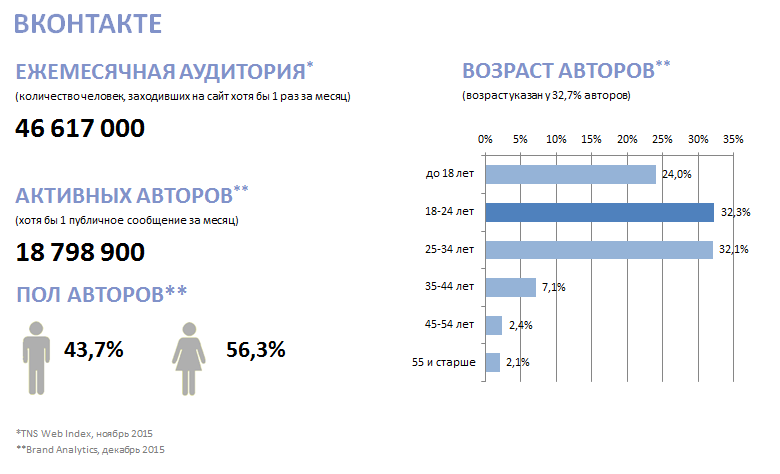
The monthly audience is 46.6 million people, 40% of which - 18.8 million - showed public activity.
The gender structure of VKontakte authors is fairly stable, 43.7 % of authors are men, the proportion of the weaker sex is 56.3 %.
As for the age structure of VKontakte authors, one can note an increase in the number of authors 25-34 years old, their share was 32.1%, slightly higher was the percentage of authors aged 18-24 years old - 32.3%, authors under 18 years old - 24%, over 35 years, only 11.6% of active authors.
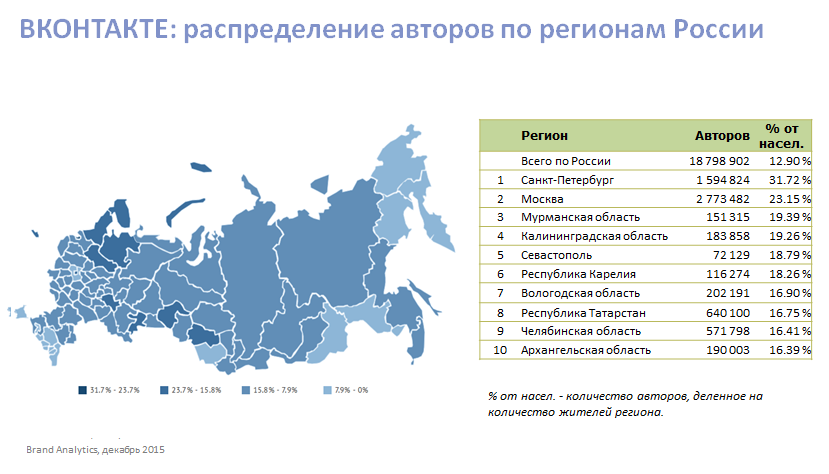 The geographical distribution of VKontakte authors is smoothly redistributing towards a more uniform regional penetration - St. Petersburg is in first place with a network penetration rate of 31.7%in the second - Moscow with 23% of the registered population, then Murmansk and Kaliningrad regions and Sevastopol - 19.4%, 19.3% and 18.8% of the population’s activity, respectively.
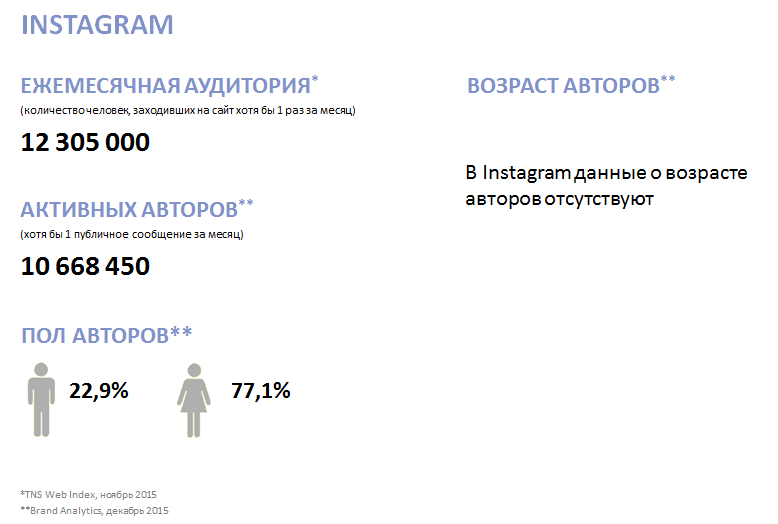
The monthly Instagram audience in November 2015 amounted to 12.3 million people , and the number of active authors - 10.7 million people.
Instagram remains the most female of all social networks in Russia, in the winter of 2015-16, among active authors, 77.1% are women.
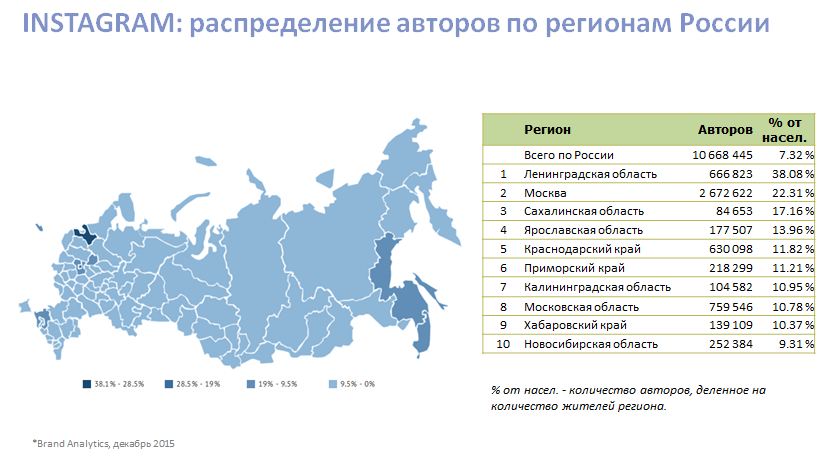
The penetration rate on Instagram has not changed much - the Leningrad region - 38% of the population, Moscow - 22.3% of the population and Sakhalin region - 17.2% are still leading .
The geographical distribution of VKontakte authors is smoothly redistributing towards a more uniform regional penetration - St. Petersburg is in first place with a network penetration rate of 31.7%in the second - Moscow with 23% of the registered population, then Murmansk and Kaliningrad regions and Sevastopol - 19.4%, 19.3% and 18.8% of the population’s activity, respectively.
The monthly Instagram audience in November 2015 amounted to 12.3 million people , and the number of active authors - 10.7 million people.
Instagram remains the most female of all social networks in Russia, in the winter of 2015-16, among active authors, 77.1% are women.
The penetration rate on Instagram has not changed much - the Leningrad region - 38% of the population, Moscow - 22.3% of the population and Sakhalin region - 17.2% are still leading .
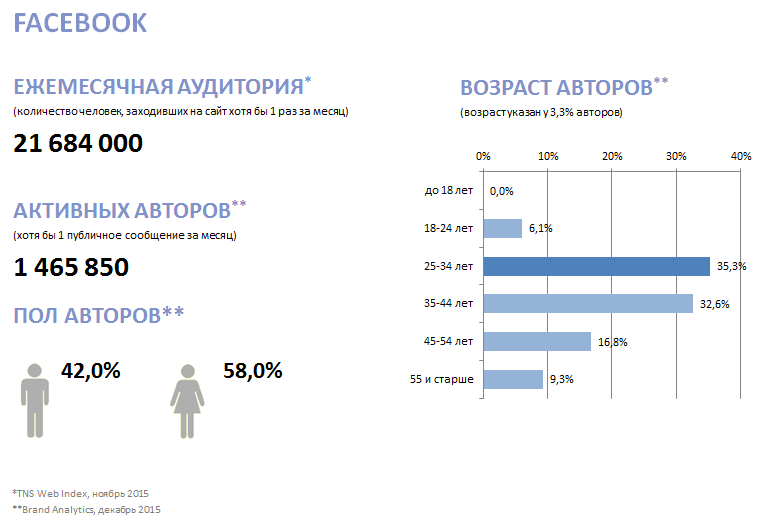
On Facebook, the proportion of writing authors in the general audience continues to grow: in November 2015, the monthly audience of the network amounted to 21.7 million people , of which 1.5 million people showed publication activity .
In the age structure of Facebook, categories from 25 to 34 years old and 35-44 years are still leading - their share was 35.3% and 32.6%, respectively. 6.1% of authors under the age of 24, and authors over 44, a total of 26.1%.
It is worth noting that Facebook remains a unique social network in the Russian Federation both in terms of age structure of authors - more than 65% of whom are aged 25-44 years, and in terms of public content - this is a network focused primarily on business contacts and business.
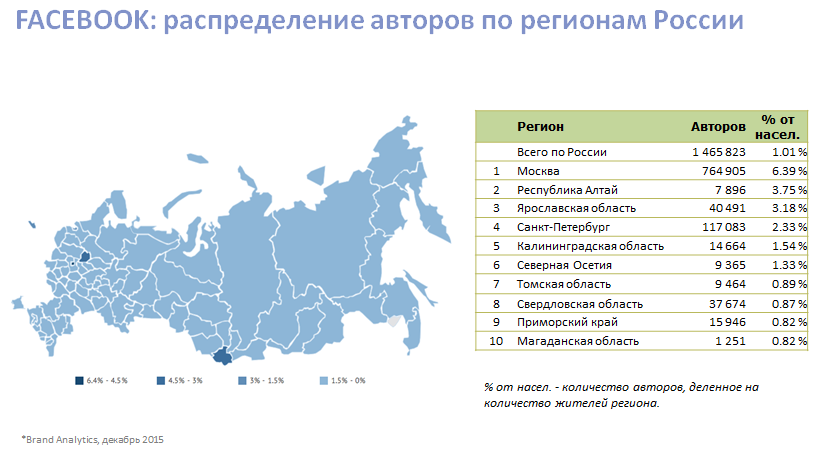
The gender distribution of the Russian-speaking part of Facebook continues to shift towards the weaker sex (58 % of authors). The geographic section demonstrates stability - most regions retained their positions: Moscow - 6.4% of the population, Altai - 3.75%, Yaroslavl Oblast - 3.2%. Classmates, as before, remain mainly a platform for interpersonal communication. The network’s monthly audience is 31.5 million people , while only 1.1 million authors demonstrate public activity in groups . The gender distribution in the social network is also stable - 69% of authors are female classmates.
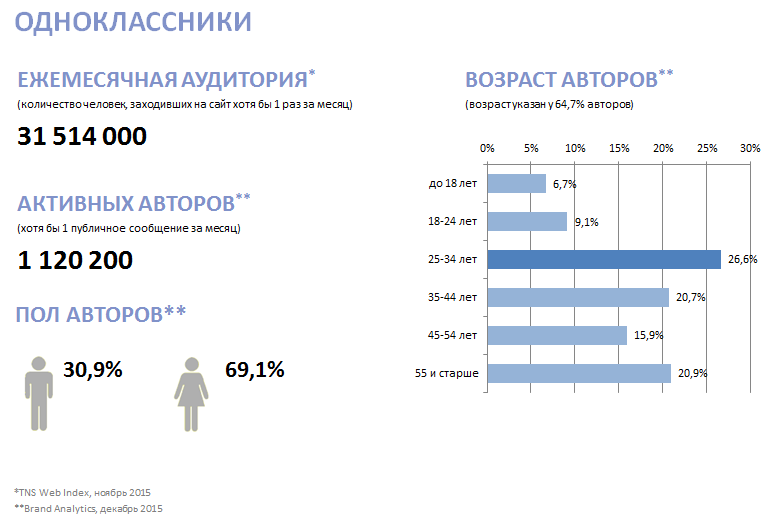
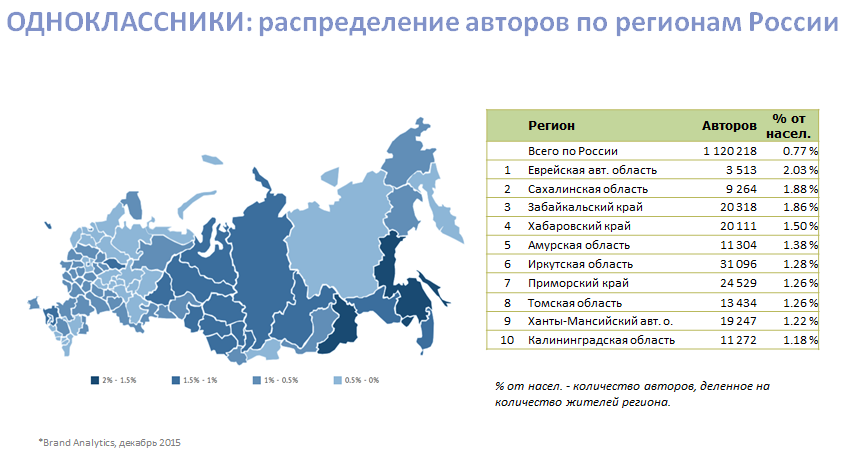
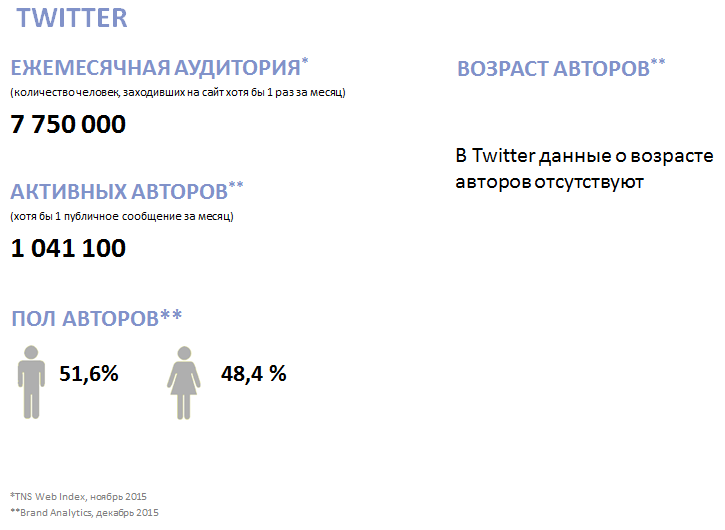
In Odnoklassniki, as before, the main share of active authors is in the age group of 24-34 years old - 26.6%. Almost equal shares fall on groups of 35-44 and 55 and older - 20.7% and 20.9%, respectively. Active authors under 24 years old only 15.8%. Classmates remain the "regional" social network of Russia: the first place in terms of network penetration is the Jewish Autonomous Region - 2% of the population, then the Sakhalin Region and the Trans-Baikal Territory - 1.88% and 1.86%. In November 2015, Twitter audience was 7.7 million people , and the number of active authors - 1 million people . On Twitter, the proportion of men among authors continues to grow; in December 2015, the share is already 51.6%. A year ago, in December 2014, there were 45.6% of men on Twitter, and in the spring of 2015 - already 50.6%.
 In terms of Twitter penetration, leadership remained in St. Petersburg -2.1%. Almost the same penetration was recorded in Moscow - 2% of the population. The third place was occupied by the Novosibirsk region, penetration in it amounted to 1%.
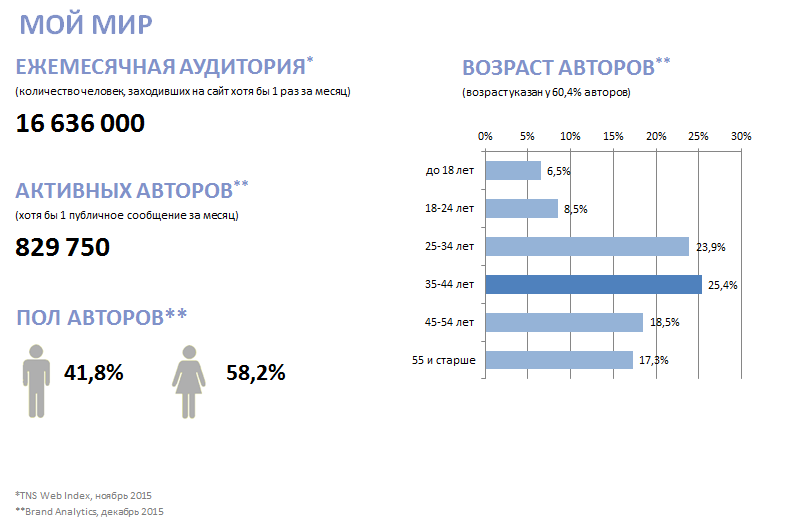
The monthly network audience decreased by 10 million people and amounted to 16.6 million , and the number of active authors - 830 thousand people .
The gender structure of My World has not changed, 41.8 % of men and 58.2 % of women.
In the age distribution of the authors of the My Mir network, the strengthening of middle age groups continued: the share of the category from 35 to 44 years old was 25.4%, and 25-23 - 23.9%.
In terms of Twitter penetration, leadership remained in St. Petersburg -2.1%. Almost the same penetration was recorded in Moscow - 2% of the population. The third place was occupied by the Novosibirsk region, penetration in it amounted to 1%.
The monthly network audience decreased by 10 million people and amounted to 16.6 million , and the number of active authors - 830 thousand people .
The gender structure of My World has not changed, 41.8 % of men and 58.2 % of women.
In the age distribution of the authors of the My Mir network, the strengthening of middle age groups continued: the share of the category from 35 to 44 years old was 25.4%, and 25-23 - 23.9%.
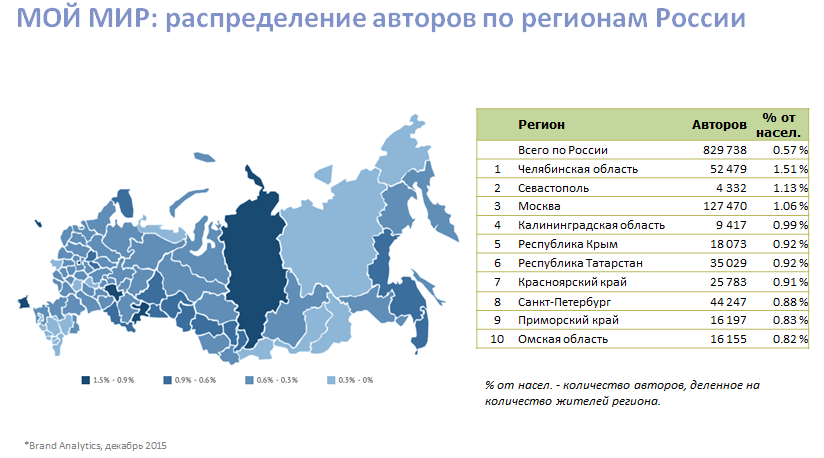
The leader in the ranking of regions in terms of penetration of the My World network, as before, is the Chelyabinsk Region - 1.5% of the population, second place - Sevastopol - 1.1%, then Moscow - 1% of the population. LiveJournal remains a platform for fans to "read, not talk": out of 15 million people a monthly audience, only 111 thousand authors are active . In LiveJournal, the predominance of male authors remains - 55.9%. LiveJournal can rightfully be called the most male social network in Russia: the blogs also have the highest percentage of meaningful discussions. The age structure of the LiveJournal is stable, the largest share of authors is in the groups of 18-24 years old - 37.2% and 25-34 years old - 35.8%.


Over the past half-year, social media has grown up, the proportion of authors under 18 has decreased, authors 18-24 and 25-24 years prevail in LiveJournal and VKontakte, and authors 25-34 and 35-44 years old in other networks.
For Twitter and Instagram, age data for active authors is not available. Women predominate in the gender structure of social networks, their role is especially great on Instagram (77.1% of the active audience) and Odnoklassniki (69.1% of the authors). The predominance of men among active authors is observed only on LJ and Twitter.

Author - a user who has written at least 1 public message per month.
Message - any open (public) post - in status, on the wall, in groups, comments, etc. Messages in personal correspondence or in the "only for friends" mode are not taken into account.
Audience - the number of people who visited the site at least 1 time per month.
The study presents data on the audience, age, gender and regional distribution of the authors of social networks in Russia. The study includes data on the most popular authors and groups for each social network.
The main focus of the study is focused on the active (writing) audience, since we study social networks as a means of public communication and their influence on the formation of public opinion.
The main data are presented below, the presentation of the full version of the study “Social networks in Russia, winter 2015-2016”, including the Top 20 authors and groups in social networks, is available here .
Social Activity
One of the key indicators of the “vital activity” of a social network is the number of “talking” users who openly express their position by public messages on social media. In December 2015, there were about 37 million such active authors in Russia ; they generated 588 million posts per month. Active authors creating public content make social networks an actual indicator of public moods, allowing them to catch “live” social problems at the very beginning of the formation of significant trends.
By the number of "writing" Russian authors, VKontakte is the leader - 18.8 million unique authors. The next in second place Instagram has incredible growth rates; in December, 10.6 million were recorded on this network .authors, almost 5 times more than in the spring of 2015. Third place - Twitter - the number of active authors here continues to decline, in December a little more than 1 million people were recorded .
As for the number of posts posted daily on social networks, there are no such drastic changes. In the first place, as before, Vkontakte, in the second - Twitter, then - Instagram and Facebook.
Twitter is traditionally the leader in terms of engagement, although the average number of posts has become slightly lower in the winter - an average of 90 posts per month per active author on this network. Second place - LiveJournal - on average, 49 posts per author, third - Facebook - 39 posts per author. VKontakte and Odnoklassniki are very close in this indicator - 15 and 14 posts to the author, respectively.
Social Network Audience
According to TNS, the monthly audience of most social networks has declined slightly, but there are sources that have shown growth. So, the VKontakte audience stopped at 46.6 million people, the second place - at Odnoklassniki ( 31.5 million people). The Facebook audience in December 2015 amounted to 21.7 million people, My World was located next - 16.6 million people and LiveJournal, with an audience of 15.2 million people. Instagram audience by December 2015 increased by 2 million and amounted to 12.3 million people. Twitter audience remained virtually unchanged at 7.7 million people.
Statistics for Russia for each social network
The monthly audience is 46.6 million people, 40% of which - 18.8 million - showed public activity.
The gender structure of VKontakte authors is fairly stable, 43.7 % of authors are men, the proportion of the weaker sex is 56.3 %.
As for the age structure of VKontakte authors, one can note an increase in the number of authors 25-34 years old, their share was 32.1%, slightly higher was the percentage of authors aged 18-24 years old - 32.3%, authors under 18 years old - 24%, over 35 years, only 11.6% of active authors.
The geographical distribution of VKontakte authors is smoothly redistributing towards a more uniform regional penetration - St. Petersburg is in first place with a network penetration rate of 31.7%in the second - Moscow with 23% of the registered population, then Murmansk and Kaliningrad regions and Sevastopol - 19.4%, 19.3% and 18.8% of the population’s activity, respectively.
The monthly Instagram audience in November 2015 amounted to 12.3 million people , and the number of active authors - 10.7 million people.
Instagram remains the most female of all social networks in Russia, in the winter of 2015-16, among active authors, 77.1% are women.
The penetration rate on Instagram has not changed much - the Leningrad region - 38% of the population, Moscow - 22.3% of the population and Sakhalin region - 17.2% are still leading .On Facebook, the proportion of writing authors in the general audience continues to grow: in November 2015, the monthly audience of the network amounted to 21.7 million people , of which 1.5 million people showed publication activity .
In the age structure of Facebook, categories from 25 to 34 years old and 35-44 years are still leading - their share was 35.3% and 32.6%, respectively. 6.1% of authors under the age of 24, and authors over 44, a total of 26.1%.
It is worth noting that Facebook remains a unique social network in the Russian Federation both in terms of age structure of authors - more than 65% of whom are aged 25-44 years, and in terms of public content - this is a network focused primarily on business contacts and business.
The gender distribution of the Russian-speaking part of Facebook continues to shift towards the weaker sex (58 % of authors). The geographic section demonstrates stability - most regions retained their positions: Moscow - 6.4% of the population, Altai - 3.75%, Yaroslavl Oblast - 3.2%. Classmates, as before, remain mainly a platform for interpersonal communication. The network’s monthly audience is 31.5 million people , while only 1.1 million authors demonstrate public activity in groups . The gender distribution in the social network is also stable - 69% of authors are female classmates.
In Odnoklassniki, as before, the main share of active authors is in the age group of 24-34 years old - 26.6%. Almost equal shares fall on groups of 35-44 and 55 and older - 20.7% and 20.9%, respectively. Active authors under 24 years old only 15.8%. Classmates remain the "regional" social network of Russia: the first place in terms of network penetration is the Jewish Autonomous Region - 2% of the population, then the Sakhalin Region and the Trans-Baikal Territory - 1.88% and 1.86%. In November 2015, Twitter audience was 7.7 million people , and the number of active authors - 1 million people . On Twitter, the proportion of men among authors continues to grow; in December 2015, the share is already 51.6%. A year ago, in December 2014, there were 45.6% of men on Twitter, and in the spring of 2015 - already 50.6%.
In terms of Twitter penetration, leadership remained in St. Petersburg -2.1%. Almost the same penetration was recorded in Moscow - 2% of the population. The third place was occupied by the Novosibirsk region, penetration in it amounted to 1%.
The monthly network audience decreased by 10 million people and amounted to 16.6 million , and the number of active authors - 830 thousand people .
The gender structure of My World has not changed, 41.8 % of men and 58.2 % of women.
In the age distribution of the authors of the My Mir network, the strengthening of middle age groups continued: the share of the category from 35 to 44 years old was 25.4%, and 25-23 - 23.9%.The leader in the ranking of regions in terms of penetration of the My World network, as before, is the Chelyabinsk Region - 1.5% of the population, second place - Sevastopol - 1.1%, then Moscow - 1% of the population. LiveJournal remains a platform for fans to "read, not talk": out of 15 million people a monthly audience, only 111 thousand authors are active . In LiveJournal, the predominance of male authors remains - 55.9%. LiveJournal can rightfully be called the most male social network in Russia: the blogs also have the highest percentage of meaningful discussions. The age structure of the LiveJournal is stable, the largest share of authors is in the groups of 18-24 years old - 37.2% and 25-34 years old - 35.8%.
Comparison of the socio-demographic characteristics of the authors
Over the past half-year, social media has grown up, the proportion of authors under 18 has decreased, authors 18-24 and 25-24 years prevail in LiveJournal and VKontakte, and authors 25-34 and 35-44 years old in other networks.
For Twitter and Instagram, age data for active authors is not available. Women predominate in the gender structure of social networks, their role is especially great on Instagram (77.1% of the active audience) and Odnoklassniki (69.1% of the authors). The predominance of men among active authors is observed only on LJ and Twitter.
Trends and forecasts
- There is a significant increase in the activity of the Russian Instagram segment . Moreover, most Instagram authors are active users of other social networks - the share of cross-posting from Instagram to other social networks exceeds 50% of the messages.
- The growth of the Russian part of Facebook continues . Moreover, this growth is observed primarily in the field of business contacts and business. The share of Facebook in the analysis of business topics often accounts for more than 30% of the total volume of social media data on the topic.
- Active growth of sites with reviews continues - both in the number of new reviews and in attendance.
- The Russian part of Twitter is slowly losing activity . At the same time, the activity of spambots decreases on Twitter, but nevertheless it still makes up more than 30% of the flow.
Key research terms:
Author - a user who has written at least 1 public message per month.
Message - any open (public) post - in status, on the wall, in groups, comments, etc. Messages in personal correspondence or in the "only for friends" mode are not taken into account.
Audience - the number of people who visited the site at least 1 time per month.