September 20, 2016 at 14:38
NetApp ONTAP Cloud: Amazon & Azure
The advantage of any cloud service is that it is a service itself. You do not bother where the equipment lives, who services it, etc. But this is also its dark side: who has access to your data, how many copies of your data are stored in backups and backup data centers, and where? All these issues have long been pushed by some large companies and government agencies.
By resolving these issues, many companies could start using cloud services. To solve this problem, the cloud storage system ONTAP Cloud was developed - a virtual machine living in a public cloud of Amazon or Azure with built-in encryption. Now you own and manage your data and only you. More on the official NetApp websiteand official product documentation and OnCommand Cloud Manager .
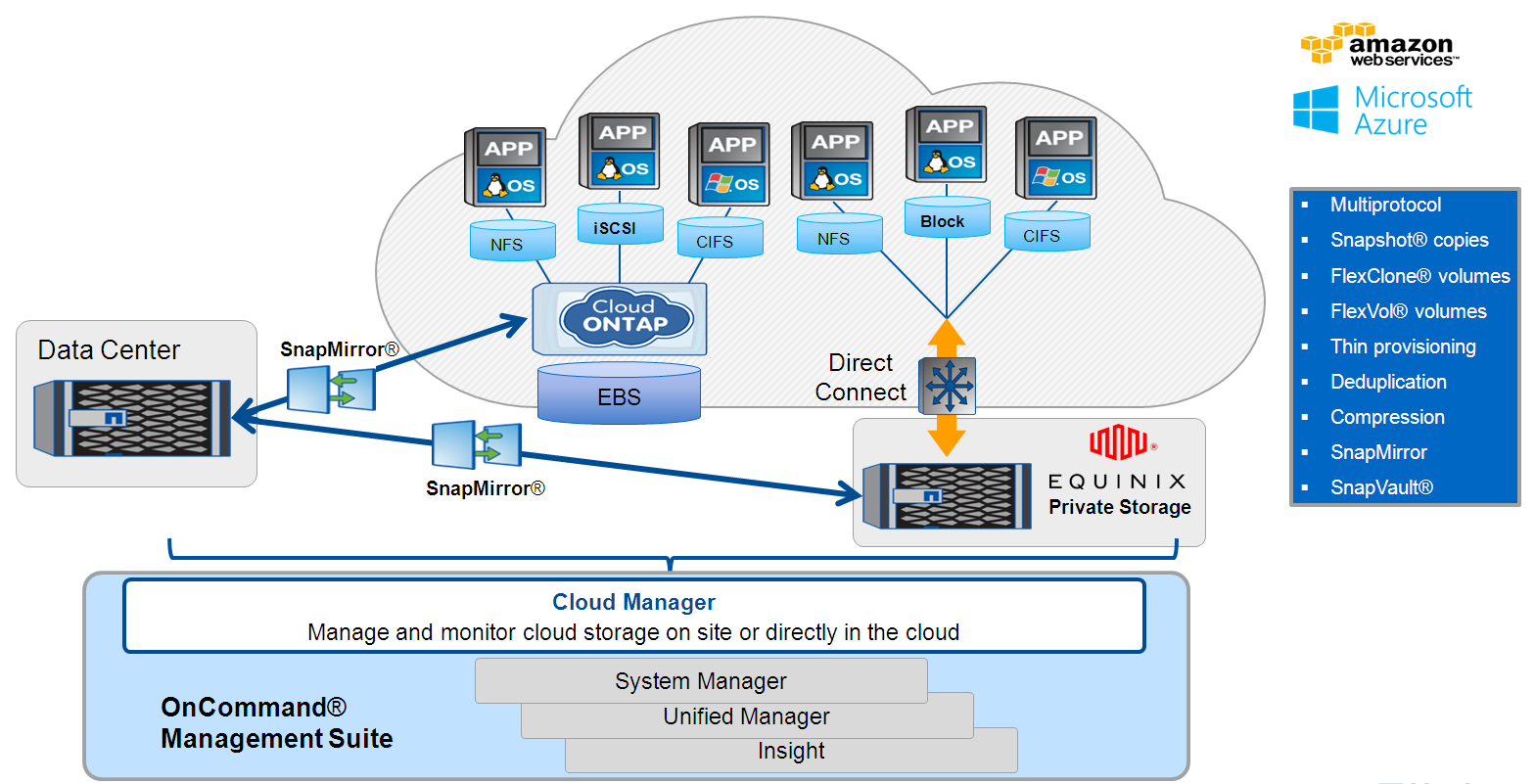
In terms of management and interface, this is a normal ONTAP with a few restrictions, as the twin brothers ONTAP Edge and ONTAP Select in ONTAP Cloud do not have RAID-DP and FCP. But the rest is full-fledged storage, just living in the cloud. You can replicate your data from a productive FAS system to the cloud to create a DR site and development environment. And in the event of an accident, switch to the backup site and start all or at least the most important services.
This is very convenient from a financial point of view: after the accident, you simply re-order the necessary resources in the cloud and start your services, there is no need to buy equipment and maintain it on the second backup site.
ONTAP Cloud supports both single-mode and HA modes, when two applications are located in different Availability zones to provide fault tolerance within the cloud. Despite the fact that almost all cloud providers assure their customers of the high availability of their data centers, multiple paths, duplication of components, etc. all decent cloud providers also highly recommend regular backups. Somehow it does not fit with one another, right? The fact is that all the same, no matter how you twist inside the cloud, there are accidents. And there are such accidents when customers either temporarily do not have access to their data or lose all or part of the data for a certain period of time. There are examples of this, it is precisely because of this that cloud providers recommend backing up to the cloud.
The High Availability feature allows for high data availability in the cloud by placing two HA nodes in two different Availability zones, which will allow you to survive in the event of an entire data center failure, automatically transparently switch and provide data access for applications that use this data.
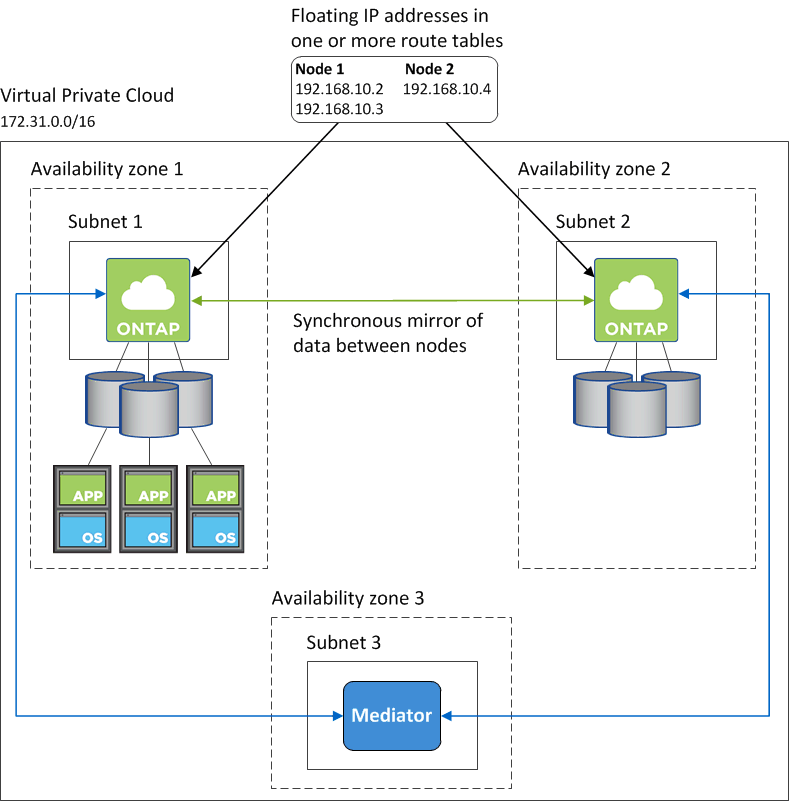
The work of a DR site is necessary only when a replica is running and when it is necessary to switch to a DR site, the rest of the time, ONTAP can be off and save you money, because in public AWS / Azure clouds payment is hourly. Schedules can be configured with ONTAP for Cloud to save budget.
With SnapMirror technology, you can replicate data from ONTAP for Cloud to ONTAP Select , FAS and NPS , as well as between multiple ONTAP for Cloud within one or even several public providers.

Another useful feature of ONTAP is the ability to fine-tune data cloning without any impact on cloud storage performance. This will allow you to deploy in a public cloud, in seconds, a lot of duplicates of your data for tasks such as testing, development, analytics, verification and cataloging of backups, regardless of their size.

Allows you to manage such ONTAP Cloud features:

Two types of Data-at-Rest encryption are supported: AWS or ONTAP. In the second case, you can store the encryption key at home, which allows you to increase the security of your data and unlock data in the cloud using the KMIP protocol at the time of launching ONTAP.
This is a service that is related to the ONTAP Cloud product, but does not necessarily go with it, I want to say a few words about it, since it is also a near-cloud product. Yes, yes, it’s about a cloud. This is essentially a service colocation ( in Equinix data centers), where you can place your own or temporarily rented FAS “next to the cloud”. “Near the cloud” means that the cloud provider has a direct connection to your storage: applications that use your storage are running and running in the cloud, i.e. from a cloud provider, only a computing service is rented and paid. The data itself is located on your storage system, and not in the cloud, i.e. you and only you own and manage the data. And since ONTAP software (operating system) is used on this system, using SnapMirror or SnapVault you can replicate data both “to it” and “from it” with any other system / platform using ONTAP: ONTAP Select (VSA SDS), NPS , FAS, AFF, another ONTAP Cloud.

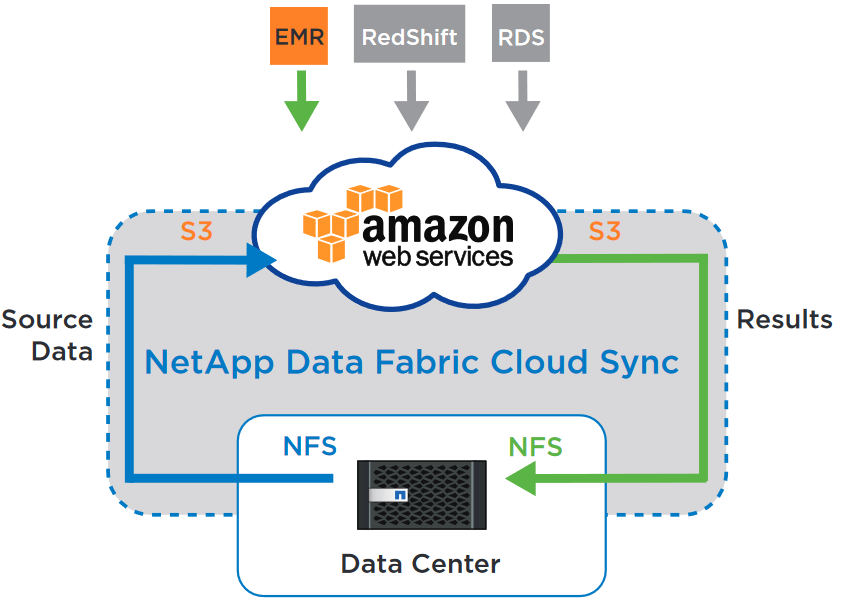
Data Fabric is NetApp's development strategy and vision, and Cloud Sync is part of this strategy. Cloud Sync service is also related to ONTAP Cloud, as well as to any other platform based on ONTAP software. Data Fabric Cloud Sync enables you to synchronize NFS file balloon data in Amazon S3. The service can serve as a data archive that can be used for analytical processing inside Amazon. Data lying on an NFS ball on one of the platforms with ONTAP software is converted into objects and sent to Amazon S3 storage. Further, data in Amazon S3 can be processed by analytical algorithms to extract reports (such as MapReduce, RedShift).
I will give examples of the application of this service and data types for which analytical processing may be required:
CIFS (SMB) v2 / 3, NFS 3/4 / 4.1, pNFS, iSCSI are supported.
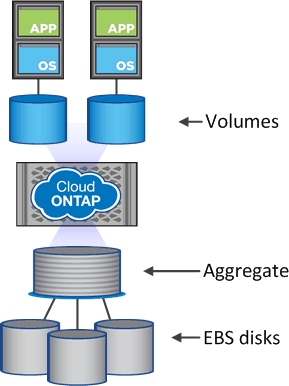
Like ONTAP Select, the ONTAP Cloud product has many useful features and integrations.
There are two licensing schemes: when a customer pays for all services in Amazon / Azure. The second scheme, when a customer buys from a provider only computing and a place for data storage, and a license for ONTAP Cloud software is purchased through NetApp.
With ONTAP Cloud, you yourself own and manage your data in the cloud and get the opportunity to replicate your data to other data centers and the rich ONTAP functionality. Deploying a backup data center will cost less in the cloud due to the fact that there is no need to maintain a backup site. Based on replicated data, development and testing can be deployed with thin data cloning functionality. Thin replication to the cloud will less load network channels and is a simple way to migrate your infrastructure to a public cloud.
" Messages about errors in the text, please send to the PM
" Comments, additions and questions on the opposite article, please comment
By resolving these issues, many companies could start using cloud services. To solve this problem, the cloud storage system ONTAP Cloud was developed - a virtual machine living in a public cloud of Amazon or Azure with built-in encryption. Now you own and manage your data and only you. More on the official NetApp websiteand official product documentation and OnCommand Cloud Manager .
In terms of management and interface, this is a normal ONTAP with a few restrictions, as the twin brothers ONTAP Edge and ONTAP Select in ONTAP Cloud do not have RAID-DP and FCP. But the rest is full-fledged storage, just living in the cloud. You can replicate your data from a productive FAS system to the cloud to create a DR site and development environment. And in the event of an accident, switch to the backup site and start all or at least the most important services.
This is very convenient from a financial point of view: after the accident, you simply re-order the necessary resources in the cloud and start your services, there is no need to buy equipment and maintain it on the second backup site.
High availability
ONTAP Cloud supports both single-mode and HA modes, when two applications are located in different Availability zones to provide fault tolerance within the cloud. Despite the fact that almost all cloud providers assure their customers of the high availability of their data centers, multiple paths, duplication of components, etc. all decent cloud providers also highly recommend regular backups. Somehow it does not fit with one another, right? The fact is that all the same, no matter how you twist inside the cloud, there are accidents. And there are such accidents when customers either temporarily do not have access to their data or lose all or part of the data for a certain period of time. There are examples of this, it is precisely because of this that cloud providers recommend backing up to the cloud.
The High Availability feature allows for high data availability in the cloud by placing two HA nodes in two different Availability zones, which will allow you to survive in the event of an entire data center failure, automatically transparently switch and provide data access for applications that use this data.
Disaster Recovery website in the cloud
The work of a DR site is necessary only when a replica is running and when it is necessary to switch to a DR site, the rest of the time, ONTAP can be off and save you money, because in public AWS / Azure clouds payment is hourly. Schedules can be configured with ONTAP for Cloud to save budget.
Intra & Inter Cloud Replication
With SnapMirror technology, you can replicate data from ONTAP for Cloud to ONTAP Select , FAS and NPS , as well as between multiple ONTAP for Cloud within one or even several public providers.
Cloning
Another useful feature of ONTAP is the ability to fine-tune data cloning without any impact on cloud storage performance. This will allow you to deploy in a public cloud, in seconds, a lot of duplicates of your data for tasks such as testing, development, analytics, verification and cataloging of backups, regardless of their size.
Cloud manager
Allows you to manage such ONTAP Cloud features:
- Replicas between FAS, NPS , ONTAP Select and ONTAP for Cloud
- Manages encryption keys for ONTAP Cloud
- Displays the amount of computing and storage resources consumed in Amazon & Azure
- Manage storage space: Create volumes, aggregates, moons, file balls
- Update ONTAP Version
Encryption
Two types of Data-at-Rest encryption are supported: AWS or ONTAP. In the second case, you can store the encryption key at home, which allows you to increase the security of your data and unlock data in the cloud using the KMIP protocol at the time of launching ONTAP.
NetApp Private Storage (NPS)
This is a service that is related to the ONTAP Cloud product, but does not necessarily go with it, I want to say a few words about it, since it is also a near-cloud product. Yes, yes, it’s about a cloud. This is essentially a service colocation ( in Equinix data centers), where you can place your own or temporarily rented FAS “next to the cloud”. “Near the cloud” means that the cloud provider has a direct connection to your storage: applications that use your storage are running and running in the cloud, i.e. from a cloud provider, only a computing service is rented and paid. The data itself is located on your storage system, and not in the cloud, i.e. you and only you own and manage the data. And since ONTAP software (operating system) is used on this system, using SnapMirror or SnapVault you can replicate data both “to it” and “from it” with any other system / platform using ONTAP: ONTAP Select (VSA SDS), NPS , FAS, AFF, another ONTAP Cloud.
Data Fabric Cloud Sync
Data Fabric is NetApp's development strategy and vision, and Cloud Sync is part of this strategy. Cloud Sync service is also related to ONTAP Cloud, as well as to any other platform based on ONTAP software. Data Fabric Cloud Sync enables you to synchronize NFS file balloon data in Amazon S3. The service can serve as a data archive that can be used for analytical processing inside Amazon. Data lying on an NFS ball on one of the platforms with ONTAP software is converted into objects and sent to Amazon S3 storage. Further, data in Amazon S3 can be processed by analytical algorithms to extract reports (such as MapReduce, RedShift).
I will give examples of the application of this service and data types for which analytical processing may be required:
- Healthcare: Genomics, Pharmaceutical Manufacturing, Patient Records, Disease Analytics;
- Oil and gas: Seismic analytics, machine analysis, forecasting the demand for goods and services;
- Finances: Trading performance, loans and market risk management, fraud detection;
- Automotive: Behavioral analytics, supply chain management systems, predictive analytics.
Protocols
CIFS (SMB) v2 / 3, NFS 3/4 / 4.1, pNFS, iSCSI are supported.
Like ONTAP Select, the ONTAP Cloud product has many useful features and integrations.
Licensing
There are two licensing schemes: when a customer pays for all services in Amazon / Azure. The second scheme, when a customer buys from a provider only computing and a place for data storage, and a license for ONTAP Cloud software is purchased through NetApp.
conclusions
With ONTAP Cloud, you yourself own and manage your data in the cloud and get the opportunity to replicate your data to other data centers and the rich ONTAP functionality. Deploying a backup data center will cost less in the cloud due to the fact that there is no need to maintain a backup site. Based on replicated data, development and testing can be deployed with thin data cloning functionality. Thin replication to the cloud will less load network channels and is a simple way to migrate your infrastructure to a public cloud.
" Messages about errors in the text, please send to the PM
" Comments, additions and questions on the opposite article, please comment