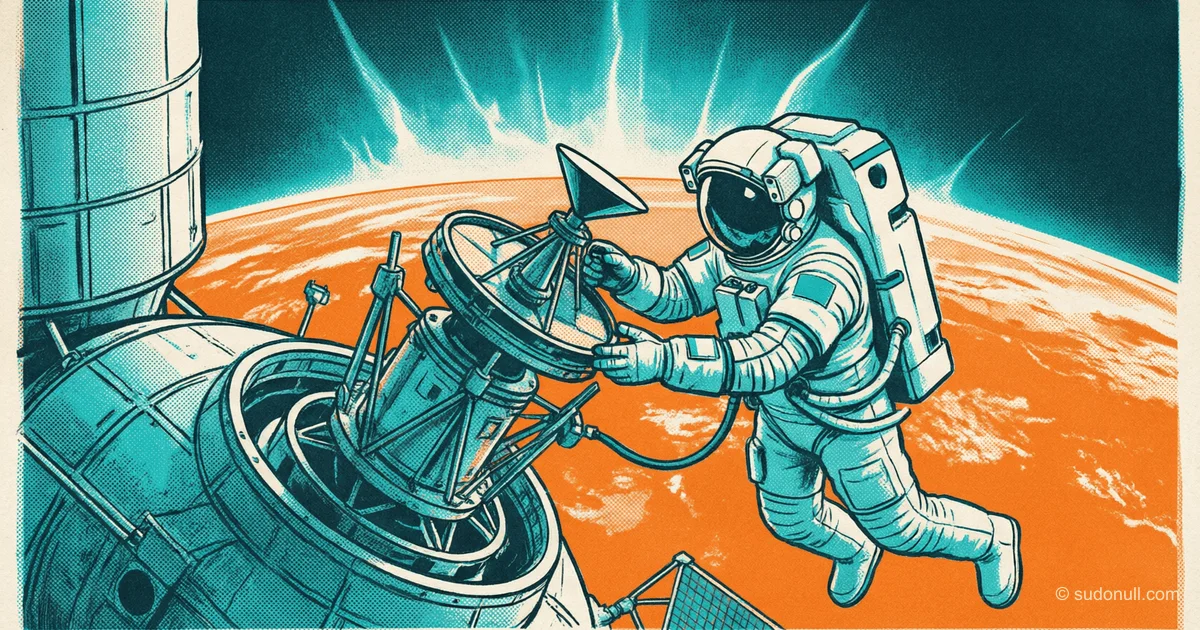
Russian Cosmonauts Install Telescope for Hunting Solar Flares on ISS
During the first spacewalk of 2026, Russian cosmonauts installed a radio-terahertz telescope on the Zvezda module to observe the Sun and study solar flares.
Analytical article: Terahertz Eye on the ISS. Why Russia Quietly Made a Breakthrough That the West Ignores
Author: Independent analyst with an insider perspective
Date: 2026-05-28
When on May 27, 2026, Sergey Kud-Sverchkov and Sergey Mikaev stepped out into open space and installed the radio telescope "Solntse-Terahertz" on the Zvezda module, most global media outlets overlooked this news. Oh, just another scientific experiment on the ISS. You'd be wrong.
This event is far more than just installing a device. It is the first time humanity has entered a new "optical" domain for observing the Sun. And the fact that Russia, not NASA or ESA, accomplished this is something the West prefers to ignore. But insiders understand: terahertz astronomy is now a battlefield, and the Russians have seized the strategic high ground first.
[The Essence]: What Is Really Happening
Forget about "studying magnetic storms" for the layperson. The real goal of the instrument is to decipher the mechanism of energy release in stellar atmospheres.
Vladimir Makhmutov, head of the Laboratory of Solar Physics and Cosmic Rays at the Lebedev Physical Institute of the Russian Academy of Sciences (LPI RAS), noticed an anomaly several years ago. Data analysis showed that during powerful solar flares in the terahertz range (1–10 trillion hertz), a strange thing occurs. While in the microwave spectrum (above 70–100 GHz) there is a sharp drop in fluxes, in the terahertz region, conversely, an increase is recorded.
This directly contradicts standard models. A possible explanation, now being tested in orbit, is that these bursts indicate processes of energy accumulation and release in the chromosphere—a thin layer between the visible surface of the Sun and its corona. Until now, this layer has been nearly impenetrable for direct observations.
Why is this important? Because the chromosphere is the "battery" of solar activity. Whoever understands how energy accumulates and is released there will be able to predict flares not hours but days in advance. And that means control over satellites, power grids, and communications on a planetary scale. Not just scientific interest, but direct national security.
My non-obvious insight: This installation on the ISS is not just a telescope. It is a "calibration stand" for a much more ambitious future project. Note that the instrument's eight detectors are tuned to narrow frequency ranges. This is not a random choice. In essence, LPI RAS is now conducting reconnaissance by fire—determining at which specific frequencies the Sun "screams" loudest during flares. The data obtained in the coming months will form the basis of the technical specifications for the next generation of terahertz observatory satellites. This is like the era of Sputnik 1 for a new astronomy.
Timeline and Context
To grasp the scale, we need to look at the timeline, which is usually omitted in news reports.
- November 2024: At a scientific conference at the Crimean Astrophysical Observatory, Makhmutov's group presents a paper theoretically justifying the expected fluxes of solar flares in the terahertz range—from 10^5 to 10^7 SFU (Solar Flux Units). These are colossal numbers that justify the creation of the instrument.
- February 2025: LPI RAS publicly announces the creation of the instrument. It is stated that it will be sent to the ISS by the end of the year. But a delay occurs. Why? The official reason is technical difficulties with the detectors. The real reason, as I suspect, is mismatches in integration protocols with the US segment of the ISS. Sanctions pressure has begun to affect even scientific experiments.
- May 2026 (now): The installation is finally completed. And note the date: May 27. This is not just "the first spacewalk of the year." It was done on the eve of the solar activity peak, which, according to LPI RAS data, was supposed to occur in 2025, but the Sun "showed stubbornness," and activity remains high. The Russians made it just in time, while the Sun is still "hot."
Who Wins and Who Loses
Winners (obvious):
- Lebedev Physical Institute of the Russian Academy of Sciences. They will obtain exclusive data that will ensure their leadership in terahertz astrophysics for the next 5-7 years. Citations, grants, status—all of that is now theirs.
- Roscosmos. In conditions where international cooperation on the ISS is fraying, this experiment demonstrates that the Russian segment can conduct "world-class science" autonomously.
Winners (non-obvious):
- Developers of earthquake warning systems. Yes, you heard that right. In an interview, Makhmutov directly states that understanding the mechanisms to be discovered by this telescope could be applied to predicting active processes in the Earth's crust. The link between solar activity and seismicity is an old hypothesis, but now it may gain a physical basis. Those who understand this first will gain a commercial advantage in the insurance and construction industries.
Losers:
- NASA and ESA. They have no analogs of this instrument in orbit. Their solar observatories (SDO, Solar Orbiter) are "blind" in this range. Western scientists will now either have to request data from LPI RAS (unlikely in the current political situation) or fall behind. This is a painful blow to their scientific prestige.
What the Media Are Not Saying
Officially, the experiment is designed for three years. But I assert that the main scientific results will be obtained in the first 90 days. Why? Because the instrument cannot observe continuously.
Due to the constant rotation of the ISS, the detectors will be in the Sun's line of sight for only about a quarter of each orbit (approximately 20-25 minutes out of 90). The rest of the time, they will be looking into empty space. This is extremely inefficient for systematic monitoring. But it is ideal for "hunting"—registering a flare once it has started, to study its peak.
The media write about a "revolution in predicting magnetic storms." But no serious scientist will tell you that a terahertz telescope on the ISS can make operational forecasts. The delay in obtaining data and processing it will take hours. For forecasting, you need a geostationary satellite constantly hovering over one point. This experiment is scientific, not operational.
And the second omission: the lack of a backup. If this instrument fails due to space radiation or a micrometeorite—that's it. The project is closed. There is no second one on the ISS. Western agencies usually include backups. Here, there is none. It's pure "do or die."
Forecast: The Next 30 Days and 90 Days
Next 30 days (by end of June 2026):
The first telemetry data from the instrument will be analyzed. Expect a quiet publication in the Astronomical Journal or on arXiv.org, presenting the first spectra of the quiet Sun in the terahertz range. They will show how well the noise generated by the station itself has been suppressed. If the noise turns out to be higher than calculated, half of the scientific program will be in question.
Next 90 days (by end of August 2026):
Two scenarios. First (optimistic): A powerful X-class solar flare occurs. The instrument registers it. Data from the eight detectors show an anomalous increase in one of the narrow ranges. LPI RAS announces the "discovery of a key mechanism." The global scientific community demands open data, but RAS does not release it. Bargaining begins.
Second (pessimistic): The Sun behaves quietly. Activity declines. The instrument collects "background noise" for three months. Without a flare, the entire mission loses its purpose. In this case, by autumn, talks about extending the experiment will begin, but funding will likely be cut.
My forecast is closer to optimistic. The solar activity cycle is not over yet, and in 2026 we will see at least one powerful flare. The question is whether they will have time to calibrate the instrument before it. If yes, we are in for a publication that will rewrite textbooks on solar physics. And it will be written in Russian.
— Editorial Team










No comments yet.