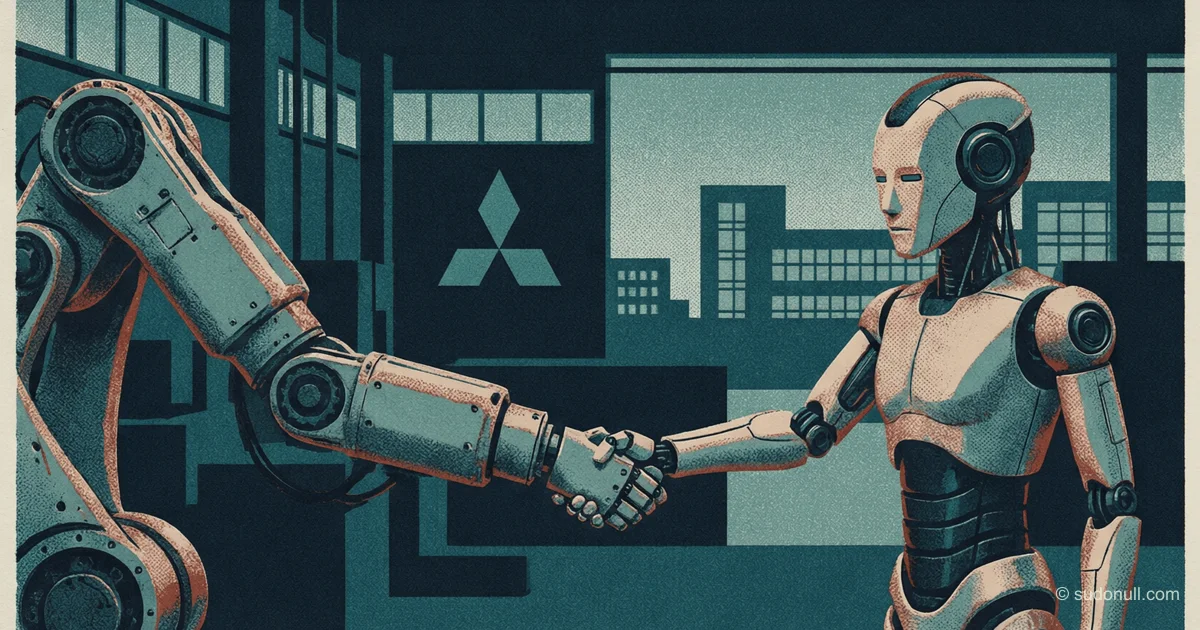
Mitsubishi Electric and Chiba Institute of Technology Establish Center for Commercializing Physical AI
Mitsubishi Electric and Chiba Institute of Technology have signed an agreement to establish a joint development center for research and commercialization of physical AI solutions, including humanoid, multi-legged, and drone robots.
Analytical Article: The Deal of the Century or Another Japanese Alliance? A Breakdown of the Mitsubishi Electric Deal
Author: Independent Analyst with Insider Perspective
Date: 2026-05-28
When I saw the news that Mitsubishi Electric and Chiba Institute of Technology had signed an agreement to create a co-evolution center for physical AI, my first reaction was not excitement, but déjà vu. In the industry over the past six months, this is already the third major attempt by Japan to "regain its throne" in robotics through the creation of giant alliances.
But if you dig deeper, this particular case is not just another press release. It is a quiet panic inside an industrial giant that has realized its classic FA (Factory Automation) business is living its last years. Let's break down what is really happening.
[The Core]: What Is Really Happening
The formal reason is aging infrastructure and labor shortages in Japan. The real reason is fear of losing the production management market.
Mainstream media miss that current automation systems (SCADA) are under threat of a complete overhaul. American and Chinese startups (like Figure AI or Unitree) build "physical AI" as a single neural network that controls the robot's body. Traditional Japanese giants like Mitsubishi built "smart" machines and conveyors. These are two different philosophies.
But the breakthrough of generative VLA (Vision-Language-Action) models has made classic proprietary PLCs (Programmable Logic Controllers) and industrial protocols vulnerable. Simply put, why buy a complex Japanese robot that needs to be programmed through an engineer interface when you can buy a cheap Chinese robot from AliExpress that understands voice commands in natural language?
Chiba Institute of Technology was chosen for a reason. It is one of the few labs with experience in extreme conditions (Fukushima nuclear plant). Mitsubishi is not taking them for "innovation," but for highly specific data on navigation in GPS-denied and high-radiation environments. This data is a goldmine that cannot be bought with money; it can only be obtained through partnership with specific people. There is no public equivalent of this dataset.
Timeline and Context
Many forget that Japan arrived late to this race by a full cycle. If you look at the report from the Kyoto Humanoid Association (KyoHA), formed back in 2025, their goal was mass production by 2027. But now it's mid-2026. China's Agibot has already shipped 10,000 units, and America's Tesla Optimus is being tested in factories.
Mitsubishi Electric, with its experience in MELFA robots, realized it cannot keep up alone. So they are taking a three-year timeout (until April 2029). This is a conscious admission of defeat in the sprint and a bet on the marathon, even though physical AI is developing exponentially. Three years at this pace is an eternity.
Who Wins and Who Loses
Losers (obvious):
- Toyota and Hitachi. They have their own internal humanoid robot developments, but the lack of a unified "physical AI" standard in Japan will cost them market share.
- Siemens and Rockwell Automation. German and American industrial automation vendors currently dominate, but if Mitsubishi creates an "operating system for factories" (which is precisely the alliance's goal), old PLCs will start to be displaced.
Winners (non-obvious):
- NVIDIA. Yes, they are not mentioned in the deal. But "physical AI" requires massive edge computing power. Mitsubishi does not have its own advanced GPUs. The alliance with Chiba will train models either on American cloud capabilities or on their Jetson. NVIDIA will earn billions of dollars over these years just by selling "shovels" to Japanese prospectors.
- Cybersecurity startups. This is my main insight. When you connect physical infrastructure (water supply, power grids) to a single neural network, the attack surface increases exponentially. While everyone talks about robot efficiency, they forget that hacking such a co-evolution center means paralyzing an entire city.
What the Media Isn't Saying
Japanese media are trumpeting a "revival." But they are silent about the main problem: resource allocation.
Parallel to this project, there is a consortium led by SoftBank (including Sony, NEC, Honda) that is also building "physical AI" with a budget of 1 trillion yen (~$6.5 billion). Now Mitsubishi is launching its own.
Japan simply does not have enough qualified deep learning engineers to support two competing "national champions" simultaneously.
This is a classic trap: large corporations cannot agree on a single standard (remember the fate of Betamax vs VHS or the loss of the smartphone market). They will prefer to create two weak alliances rather than one strong one under someone else's leadership. Mitsubishi will never hand over control of its "brain" to a SoftBank company that has Arm in its pocket and IPO plans.
Forecast: Next 30 Days and 90 Days
Next 30 days:
Leaks will emerge that Chiba Institute engineers are facing incompatibility between Mitsubishi's old industrial protocols (CC-Link IE) and new physical AI frameworks (ROS 2 + transformers). There is no way out; they will have to write "crutches" — hellish middleware. Expect news of Mitsubishi purchasing supercomputing capacity from AWS or Google, as their own servers cannot handle the volume of simulation data.
Next 90 days (by August 2026):
There is a high probability that the alliance will announce an external chip partner. Most likely, it will be Renesas Electronics. Why? Renesas has controllers but no software. Mitsubishi will provide them with specifications to create the "ideal physical AI chip." If this does not happen by autumn, bureaucracy will bury the project.
However, my forecast is pessimistic. The experience of RAPIDUS (a failed attempt to make a 2nm chip in Japan for 92 billion yen) shows that such "co-evolution centers" turn into black holes for budgets and resumes for laid-off managers. By 2029, when this project is supposed to end, the market will already be divided between the Chinese with their low cost and the Americans with their software. Japan will be left as a supplier of high-precision motors and reducers. Which, by the way, is not a bad business model, but it is not a "technological breakthrough."
— Editorial Team









No comments yet.