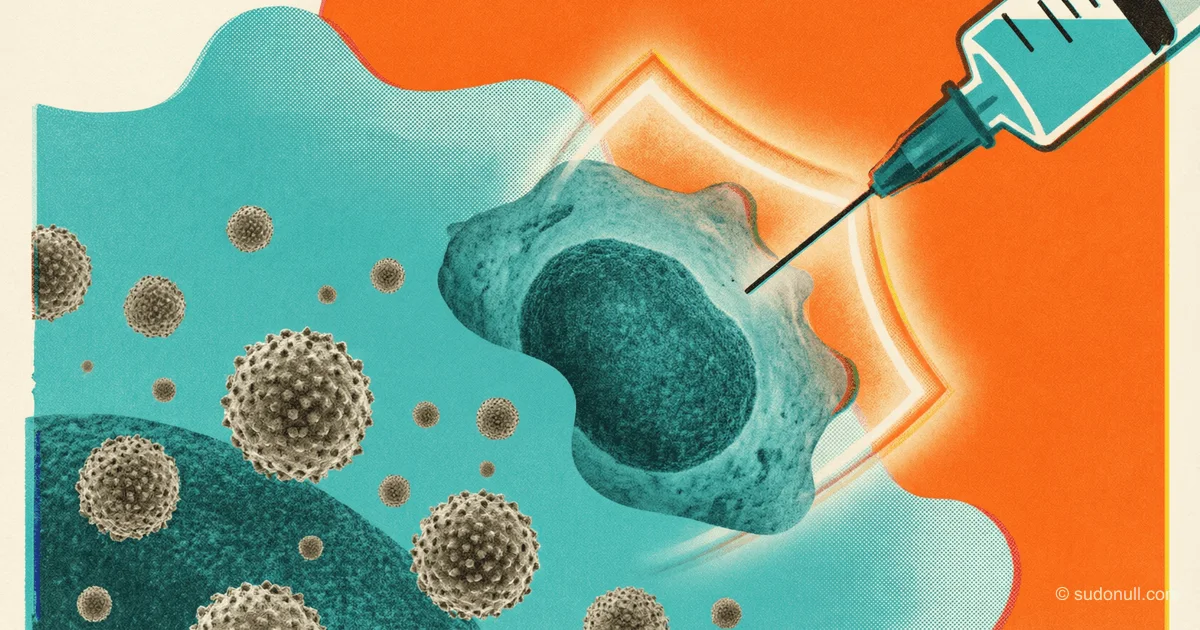
Russian Scientists Create Birch Allergy Vaccine in Just 3-5 Injections
A new development from the Institute of Immunology, presented at the Russian Academy of Sciences, is designed for the prevention and treatment of birch pollen allergy and cross-reactive food allergy.
A three-billion-ruble deal in 3 shots: why Allergarda is more frightening for pharma giants than for pollen
The Gist: What's Really Happening
On May 25, 2026, at the General Meeting of the Russian Academy of Sciences, RAS President Gennady Krasnikov officially presented the Allergarda vaccine — a drug that reduces the course of treatment for birch pollen allergy from 30 injections to 3-5. The official description: "a fundamentally new molecular recombinant allergy vaccine for the prevention and treatment of allergy to birch pollen and cross-reactive food allergy."
But here's what lies behind that description. This is the world's first drug that treats allergies without containing a whole allergen. The technology, developed by the Institute of Immunology of the FMBA under the leadership of Academician Musa Khaitov together with the Medical University of Vienna and the company Generium, uses an allergen mapping method — isolating only those fragments responsible for forming humoral immunity.
The key word is safety. Traditional allergen-specific immunotherapy (ASIT) introduces a whole allergen into the body, which always carries a risk of anaphylactic reaction. Allergarda is completely devoid of allergenicity, selectively activating only the B-cell response without affecting the T-cell arm of immunity.
FMBA head Veronika Skvortsova explained the mechanism at a meeting with the president: "We took only the identifying marks from the allergen — the epitopes — to teach the immune system to recognize the allergen, but removed everything that causes sneezing, swelling, and itching."
Timeline and Context
Development of the vaccine began in 2023. October 2024 — start of the first phase of clinical trials. 2025 — successful completion of the second phase.
Key moment: the 2025 flowering season was anomalous — pollen particle density was five times higher than normal. Allergarda passed this test: 25% of vaccinated individuals had no signs of allergy at all, symptom intensity decreased sixfold in all others, and there were no cases of severe forms.
The drug is now in the third phase of clinical trials, involving about 1,305 volunteers. Temporary registration is expected in the second quarter of 2026 (April-June), with permanent registration at the end of 2026. Industrial production is planned to launch in 2027.
The optimal dose is 80 mcg. The vaccination course consists of five injections at one-month intervals, planned to start in October and finish by March-April.
Who Wins and Who Loses
Russia wins — and not only medically. This is about creating a full production cycle for a critically important drug. In 2025, Russian pharmacies faced a shortage of the French drug Staloral, the only available ASIT treatment for birch pollen. This situation clearly demonstrated dependence on imported supplies. Allergarda eliminates this dependence and could be included in the National Immunization Schedule.
FMBA and the Institute of Immunology win. This is their biggest scientific and political success in recent years. FMBA head Veronika Skvortsova and Academician Musa Khaitov gain a powerful argument for increasing the agency's budget over the next 5-7 years.
Allergy patients win. Between 30% and 75% of all allergy sufferers in the northern hemisphere suffer from birch pollen hay fever. In Russia, according to doctors, every second person on the planet has experienced allergic reactions at least once in their life. Instead of 3-5 years of traditional ASIT — two treatment seasons. Instead of 30 shots — 5. And crucially — protection not only from pollen but also from cross-reactive food allergies to apples, peaches, nuts, which develop in 60% of patients with birch allergy.
Generium wins — the Russian pharma company that obtained rights to produce the drug. The ASIT market in Russia is estimated at tens of billions of rubles, and Allergarda could capture a significant share.
French Stallergenes Greer (manufacturer of Staloral) loses. The Russian market was significant for them. After 2027, it will be closed. Losses — at least 20-30 million EUR annually.
Manufacturers of classic antihistamines (Zyrtec, Claritin, Erius and their generics) lose. If Allergarda truly eliminates allergies at the root rather than suppressing symptoms, millions of patients will stop buying pills every season. The antihistamine market in Russia is several hundred million dollars annually. Part of that money will go to the vaccine.
Traditional ASIT as a treatment method loses. 30 injections vs. 5 — the economics don't favor the old approach. Even if Allergarda costs more per course (which is likely), patients save time, stress, and the risk of side effects.
What the Media Isn't Saying
The main non-obvious insight: Allergarda is not a vaccine in the classic (preventive) sense, but a therapeutic drug, yet it is built on a platform that allows creating true preventive allergy vaccines.
The difference is huge. A classic vaccine is given to healthy people to prevent disease. Allergarda is given to already sick people to cure an established allergy. This is a therapeutic vaccine, like cancer vaccines, not a preventive one like measles.
But the technological platform itself (recombinant allergy vaccines based on mapped epitopes) allows for creating preventive allergy vaccines for at-risk children in the future. Imagine: a 2-3-year-old child with both allergic parents gets 3 shots and never experiences birch sneezing in their life. That's the next level.
Second point: Allergarda's success is largely due to Viennese scientists, but this is downplayed. The development was done jointly with the Medical University of Vienna. After 2022, Russia's international scientific cooperation became much more complicated. That the project was launched before this and managed to survive is a stroke of luck. But the next vaccine (against ragweed, currently in preclinical stage) will have to be developed without Western partners. Will it succeed?
Third: the cost of the course has not been announced, and that's a worrying sign. In the context of import substitution and the Staloral shortage, the price may be regulated by the state rather than market-driven. This is good for patients but bad for the manufacturer and for scaling the technology to other allergens. If the state sets the price too low, Generium will have no incentive to invest in developing a vaccine for ragweed or cat dander.
Forecast: Next 30 Days and 90 Days
30 days:
In mid-to-late June 2026, expect an official announcement of temporary registration for Allergarda. Temporary registration was planned for Q2 2026, i.e., by the end of June. This will allow limited use of the drug before permanent registration.
Also likely are publications in Russian and international journals with detailed results from the third phase of clinical trials. If the numbers confirm the second phase data (sixfold reduction in symptoms compared to placebo), this will be big news in global allergology.
90 days:
By the end of August 2026, after the flowering season ends, the first real-world data on the vaccine's efficacy in third-phase patients will emerge. This will be the moment of truth: will the effect hold up in the real summer of 2026 (which is also forecast to be warm), or were the lab results too optimistic?
If efficacy is confirmed, Generium will begin preparations for industrial production. Production volumes will become known. Expect the first batches of Allergarda to appear in pharmacies in fall 2026 — just in time for the start of the vaccination course, so patients can get 5 shots before the 2027 flowering season.
For investors: there are no direct public assets — Generium is a private company. But there is an indirect signal. If they announce expansion of production capacity and the start of preclinical trials for a ragweed vaccine with specific timelines, it means the platform works and the state is ready to fund the next step.
Allergarda is not just a cold medicine. It is the world's first commercial product on a new-generation recombinant allergy vaccine platform. If it reaches patients and shows the claimed efficacy, Russia will gain not only import substitution but also export potential. Birch allergy is a global problem in the northern hemisphere. Americans, Canadians, Germans, Scandinavians — they all sneeze at birch every spring. And if Allergarda is registered outside Russia, that's a whole different scale. Not a $30 million market, but $300 million.
— Editorial Team









No comments yet.