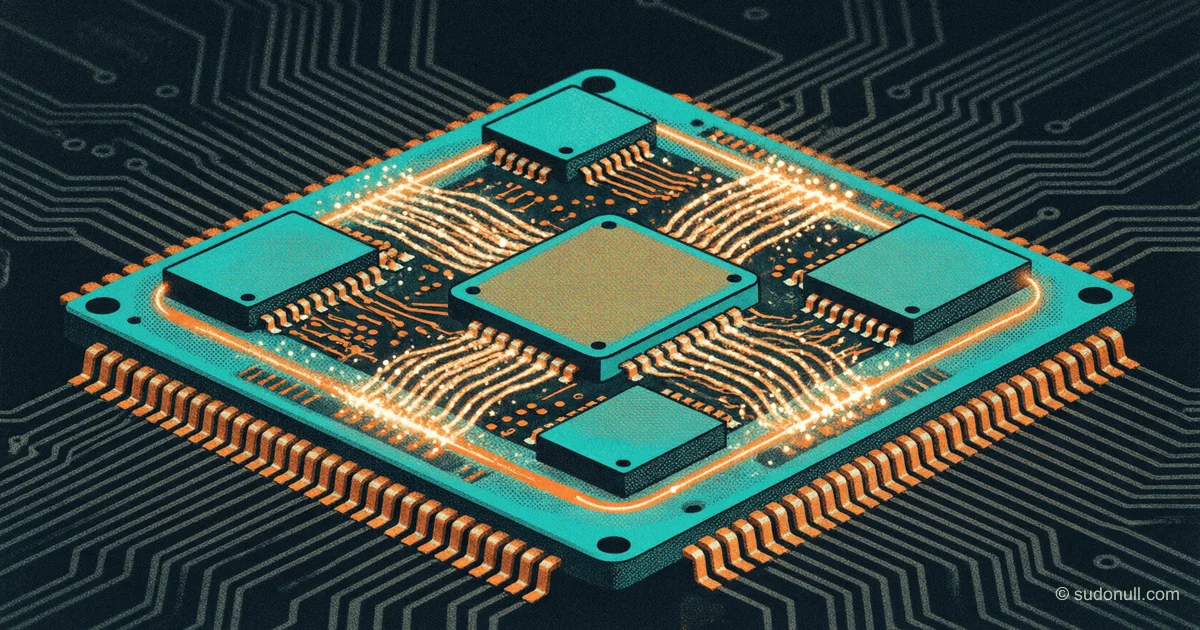
Kopin and Fabric.AI Develop Chip to Replace Copper Wires with MicroLED Optical Interconnects
The startup placed a $15 million order to create Neural I/O chips that use photons instead of electrons to transfer data between GPUs, which should drastically reduce energy consumption in data centers.
Kopin's Optical Revolution: Why Fabric.AI's $15M Changes AI Data Center Architecture
[The Gist]: What's Really Happening
Kopin, a company known for the last 40 years exclusively for microdisplays used in military helmets and AR glasses, has unexpectedly emerged as a player in AI infrastructure. Together with Fabric.AI, they are developing the Neural I/O chip, which transmits data between GPUs using photons instead of electrons.
The news from April 27, 2026 — Fabric.AI placed a $15 million order to create a demonstration chipset. Kopin received 19.9% of Fabric.AI's shares and exclusive manufacturing rights for these chips. The goal is to replace copper interconnects with optical ones at three levels: chip-to-chip, board-to-board, and rack-to-rack.
But the main point here is not the technical detail. The main point is the strategic pivot of a company with a market cap of around $200 million at the time of the announcement into a multi-billion dollar market. And doing so through a structure that allows them to avoid bearing development risks alone.
Timeline and Context
Kopin has one unique competency: it remains the only manufacturer of MicroLED displays in the United States. This has earned the company government contracts (including $15.4 million under the Industrial Base Analysis and Sustainment Act) and a protected niche in defense.
But MicroLED is not just about displays. Each pixel in a MicroLED array is an independent light source that can be switched on and off at gigahertz speeds. It is this property that Kopin and Fabric.AI decided to use not for forming images, but for data transmission.
The idea: take a MicroLED array, program each pixel as a separate optical transmitter, direct the light onto a photodetector on a neighboring chip — and you get a communication channel with speed comparable to copper, but without Joule heating. No lasers, no complex modulators — just an array of LEDs working as a parallel optical bus.
Key date: the demonstration chipset is expected to be ready by the end of 2026. This means engineering samples will appear in 7-8 months. The timeline is aggressive but not fantastical — the technological foundation already exists.
Who Wins and Who Loses
Kopin wins. Before this deal, analysts estimated Kopin's addressable market at $500 million to $1 billion (military and industrial displays). Neural I/O opens access to the AI infrastructure market, which Moor Insights & Strategy estimates as "multi-billion-dollar." Moreover, Kopin is not investing its own money in development — the $15 million from Fabric.AI covers direct costs, and the 19.9% stake in the partner provides upside.
Fabric.AI wins. It is a little-known player to the general public, but now it has exclusive access to the only MicroLED manufacturer in the US. And judging by the deal structure (Kopin owns a stake in Fabric.AI, not the other way around), Fabric.AI is the leader in this pairing. They get the technology and manufacturing without needing to build their own fab.
The U.S. Department of Defense wins. All Neural I/O chips for government customers will be produced on Kopin's American line. This means the next generation of military AI systems (intelligence analysis, autonomous battlefield systems) will get optical interconnects without the risk of technology falling into competitors' hands.
Ayar Labs and Lightmatter lose. These are startups that have been developing optical interconnects for chips for several years, attracting hundreds of millions of dollars from venture capital funds. Ayar Labs uses silicon photonics technology with lasers. Kopin's approach uses MicroLED without lasers. If Neural I/O works as claimed, laser-based solutions will be more expensive and harder to integrate. And crucially, Kopin has US manufacturing, which the startups lack.
NVIDIA loses (in the long term). Today, NVIDIA sells not only GPUs but also NVLink — proprietary copper interconnects between its chips that provide 1.8 TB/s per connection. A cheap and energy-efficient optical alternative independent of NVIDIA would undermine the barrier to entry for competitors. If AMD or a startup like Cerebras gains access to cheap optical interconnects, the NVIDIA+NVLink combination will lose some of its advantage.
What the Media Isn't Saying
The main non-obvious insight: the company making this chip is currently losing money on production.
In the first quarter of 2026, Kopin's product cost of goods sold was 103% of product revenue. That is, every display sold generates a loss. The reason is low capacity utilization.
CEO Michael Murray directly stated on an investor call on May 12 that the loss is due to the utilization rate.
What does this mean for the Fabric.AI deal? Kopin needs large orders to load its fab. The $15 million from Fabric.AI is not just an R&D contract; it is an anchor order that allows Kopin to increase production volume and reduce unit cost. If Neural I/O goes into series production, Kopin will finally achieve positive product margin.
Second: Kopin is a microcap company with a market capitalization of about $200 million. For comparison, one funding round for Ayar Labs in 2024 was $155 million. Kopin is trying to compete with well-capitalized startups while having a balance sheet with $25.3 million in restricted cash due to a lawsuit from BlueRadios. Their hands are tied, and they cannot afford to lose.
Third: Fabric.AI trades on NASDAQ under the ticker SBLX. It is the former company SilverBox Corp — a SPAC that merged with Fabric.AI. So this is a classic SPAC listing story followed by a search for real technology to monetize. Market discipline in such structures is usually stricter: results must be shown, not endless R&D.
Forecast: Next 30 Days and 90 Days
30 days:
Kopin will present a more detailed roadmap for Neural I/O at one of the industry conferences (likely at a technology conference in June 2026). Expect specific numbers for target bandwidth per channel. Currently, "ultra-high speed" is stated without figures — investors and customers will demand specifications.
Also likely, KOPN shares will receive increased attention from retail investors who see the "MicroLED + AI" connection and will start positioning themselves ahead of the chip demonstration at the end of the year. This could create short-term volatile growth.
90 days:
The key moment is the intermediate results of the chipset development. If Kopin and Fabric.AI announce by August-September that they have created a working prototype (even on separate components without full integration), it will be a strong signal to the market. If silence — it means problems have arisen with synchronizing thousands of parallel optical channels, which is technically extremely challenging.
A second factor is new defense contracts. Kopin has already received $21.5 million for thermal imaging assemblies. If the Department of Defense includes Neural I/O in its programs for edge AI (for drones or wearable systems), it will be a confirmation of the technology outside data centers.
My forecast: Neural I/O is not a "NVLink killer" in this generation. It is a proof of concept that MicroLED can work as an optical interconnect. Real series production will begin no earlier than 2028. But the stakes are huge: if the technology is confirmed, Kopin will transform from a semiconductor dwarf into a strategic supplier for the entire Western AI infrastructure. If not, it will remain a niche display manufacturer for military helmets. Right now, the company is going all in.
— Editorial Team










No comments yet.