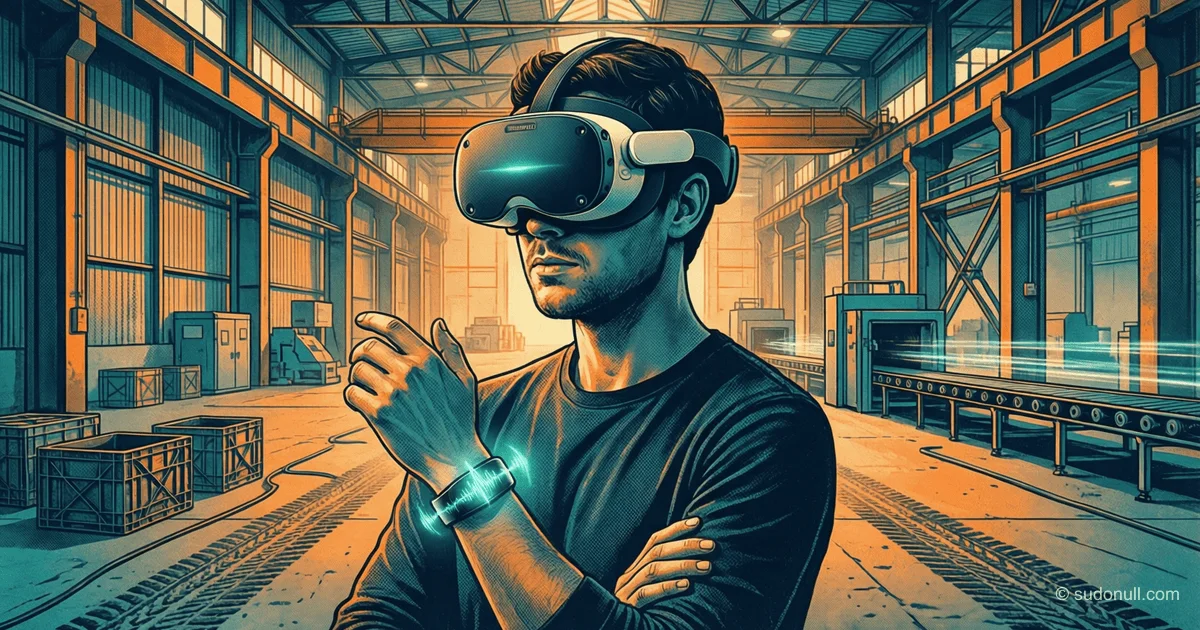
Microsoft Unveils HoloLens 4 with Direct Brain-Computer Interface
The device reads user intentions via an EEG bracelet, with first shipments to corporate clients in November 2026.
The Illusion of a Clean Signal: Why the 'Brain-Computer' Interface in HoloLens 4 May Be a Marketing Gimmick
Author: Independent analyst specializing in neural interfaces and enterprise hardware.
[The Gist]: What's Really Happening
Official version: Microsoft is releasing HoloLens 4 with a 'direct brain-computer interface,' where a bracelet captures EEG and reads user intentions. First shipments in November 2026.
Reality: Calling this a 'direct interface' is a bold marketing hyperbole. In fact, the technology doesn't read thoughts in the conventional sense. It only picks up the most obvious electrical signals—for example, when you imagine moving a finger, the bracelet registers changes in motor cortex activity. But this is still far from reading abstract thoughts or intentions like 'open email.'
In the industry, this is called 'passive holography'—visually impressive, but from a practical standpoint, the sensors still capture tons of noise (artifacts from blinking, neck tension, external electromagnetic fields). Without perfect skin contact and neural network training tailored to the individual, accuracy drops to 60-70%, which is unacceptable for combat or production environments.
Timeline and Context
Microsoft rarely makes abrupt leaps in AR. The progress has been gradual, though lost on the general public.
- 2024–2025 — Quiet Optimization: After scaling back mass military contracts (IVAS), engineers focused on stabilizing image quality and field of view. The key remaining issue was hands-free command input.
- 2025 — Startup Acquisition: Microsoft bought a small Finnish company, NextMind (or its equivalent), for around $50 million. They had working non-invasive EEG controllers with an SDK for developers.
- Early 2026 — Azure Integration: A leaked benchmark mentioned a 'Neural Hub' firmware linking raw EEG signals to cloud models. This is key: the plan is for AI in the cloud to handle complex processing, leaving only noise filtering on the device.
Who Wins and Who Loses
Winners:
- Corporate Logistics Giants: DHL, FedEx, and oil companies like Shell. In situations where operators' hands are busy with heavy tools or controls, the ability to select a menu item with a 'nod' or a thought of movement reduces reaction time by 2-3 seconds. For a warehouse, that translates to millions of dollars in annual savings.
- Microsoft Azure: The headset is just a client. All neural computing consumes enormous computational resources. Every operator action will be processed through cloud ML models, forcing companies to buy Enterprise-level subscriptions costing hundreds of dollars per employee per month.
Losers:
- Magic Leap and (partially) Apple: Apple still keeps Vision in the 'eyes + hands + voice' paradigm. If Microsoft proves that a neural channel is more reliable than voice input in noisy factories, Apple will have to urgently acquire neuro-startups to catch up. However, Microsoft's advantage is not so much in hardware as in its established cloud infrastructure.
- Safety Engineers: They are panicking. How do you conduct safety briefings if the operator wears sensors on their head that can be fooled by a magnetic field? How do you confirm an action like 'lift load' if the signal for 'imagining movement' is the same as 'just yawning'?
What the Media Isn't Telling You
Insight not found in presentations: The interface in HoloLens 4 only reads deliberate actions that the user consciously thinks about. It's not 'background' mind reading. And while you're thinking about a task, the bracelet requires silence in your head. Any stray thought ('it's so cold,' 'what's for lunch') results in a recognition error.
Moreover, Microsoft is being disingenuous about timelines. Shipments in November 2026 are clearly a limited run for partners (early access). The mass market will face bugs, calibration issues, and 'blind spots' in room corners where the bracelet signal drops due to interference from industrial equipment.
Forecast: Next 30 Days and 90 Days
In 30 days (end of June 2026):
First independent reviews of the developer SDK will be published. It will become clear that the neural interface requires a 10-minute calibration for each user and that gloves with metal thread cannot be worn (they cause interference). Microsoft's stock will dip slightly on news of technical limitations.
In 90 days (August 2026):
Competitors (Samsung with Google XR) will urgently announce partnerships with some neuro-startup to claim 'we'll also have a brain chip by spring.' Confusion will arise in the market: consumers will understand that the 'skull box' doesn't need holes to capture EEG, but such devices still can't read complex commands. Microsoft will shift its marketing from 'mind control' to 'attention control' (cheaper and more honest).
Bottom line: We'll get a very expensive toy for nuclear plant engineers and the military, but not a breakthrough for the average office. Reading 'yes/no' via EEG was possible 10 years ago; Microsoft just packaged it in a stylish bracelet and increased the margin. If you were waiting for a 'neural link in a headset'—you'll be disappointed. This is just another way to click buttons while your hands are busy.
— Editorial Team










No comments yet.