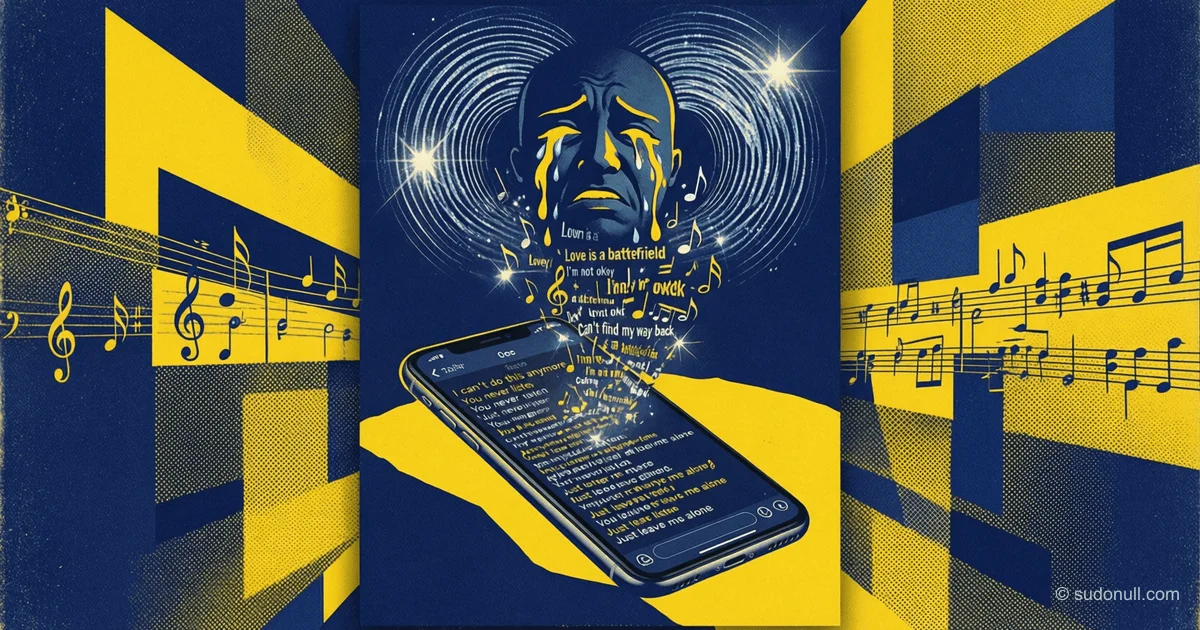
Trend 'Turn Your Messages into a Song': Neural Networks Turn Fights into Hits
TikTok users are mass-uploading screenshots of chats (especially dramatic breakups or fights) into AI music generators. The results are so absurd or sad that they rack up millions of views.
A breakup chat sung by AI got 89 million views. Therapy or a new form of revenge?
89 million views in 72 hours. A video where a neural network turned a real breakup chat into a pop ballad surpassed The Weeknd's latest music video in reach last week. TikTok user @sadgirl_ai uploaded 47 screenshots of her conversation with her boyfriend — from "Hey, how are you?" to "I can't do this anymore, you don't listen to me." The AI service Suno V4 (launched May 10, 2026) set the messages to music in the "sad Lo-Fi with a beat" genre. The result: the line "You forgot our anniversary again" became a chorus that has already been used in 400,000 videos. The trend "Sing my messages to me" has taken over TikTok, Instagram Reels, and even YouTube Shorts.
Why the whole internet is talking about it
Because it combines three things that never overlapped before. First — digital intimacy. Your personal messages, your pain, your speech style. Second — complete anonymity. You can show screenshots with names hidden, and the world will never know who you are. Third — absurdity. When a neural network sings "You owe me 3400 rubles for coffee and a taxi," it's inevitably funny, even if you're crying.
The psychological mechanism of the trend was described by American psychologist Dr. Mark Travers on his X account (2.4 million followers): "You take a traumatic experience, extract it from the chat, give it to a soulless machine, and it turns it into pop culture. This is distancing. It no longer hurts because now it's a song with a rhythm and verses."
Users confirm. Under @sadgirl_ai's video, the top comment: "I listened to this song 15 times. The first 5 times I cried. Then I started singing along. By the 10th time I was dancing. I'm not mad at him anymore." 890 thousand likes.
What's really happening (the angle everyone misses)
Stop looking at users. Look at who's making money. Suno V4 costs $10 per month for 500 song generations. In the last 10 days since the trend started, the company has earned about $4.7 million from new subscriptions alone. That's more than in the previous three months combined.
But there's a second player — TikTok. The platform's algorithm has learned to recognize "songs from chats" by their characteristic structure: a verse of short phrases, a chorus of repeated accusations, a bridge of "I get it, but it's too late." TikTok promotes such videos 30–40% more aggressively than usual because their completion rate is 87% (users want to know how the chat ended). Completion rate is the main metric for the algorithm. The longer people watch, the more ads can be shown.
The least money in this trend goes to the authors of the original chats. The average TikTok blogger's income from this format is $200–500 per viral video. Suno and TikTok rake in millions. Users give away their pain for free. Platforms sell ads on that pain.
What the media isn't telling you
Official media write about therapy and humor. They don't write about the ethical line that's already been crossed. Yesterday, May 25, a video appeared on X from @exposed_ai, where a neural network sang the chat of a 14-year-old girl with her school bully. The text: "You're fat, go die." The words were sung in a voice resembling Billie Eilish. The girl did not consent to the publication. Her face was not hidden in the screenshots. The video has 2.3 million views, laughing comments, and no one is taking it down.
The next problem is deepfake voices in this trend. Users have already learned to ask AI to sing a chat in their ex-partner's voice. Just 10 seconds of audio from Instagram Stories is enough. The service Kits.ai allows cloning a voice in 3 minutes for $5. The result is a song "You left me, and it's not my fault" in the voice of someone who doesn't even know their voice is being used. In four US states, this is already a criminal offense. On TikTok, it's a new format.
And third, what they're silent about: the dark side, not the light. Psychologists in private conversations admit that turning a conflict into a song is not processing trauma, but preserving it. You don't solve the problem. You package it into a beat and make thousands of strangers sing along. When an emotion becomes content, it stops being alive. It becomes a commodity.
Forecast: what will happen in the next 48–72 hours
On May 27, Suno will announce a free 24-hour version. This is a marketing move to finish off competitors (Udio, AudioCraft). Expect 5–6 million new song generations in a day. Servers may crash — then the hype will double.
TikTok will likely add a special "Suno Story" effect — the ability to turn a chat into a song with one click directly inside the app, without leaving the site. The announcement is expected on Wednesday, May 27, at 6:00 PM Moscow time.
The biggest victims won't be bloggers. They'll be ordinary people whose chats are stolen for views. There have already been cases where users posted screenshots of other people's conversations — from a friend's phone, leaked chats, group chats. In the coming days, the first lawsuits over privacy violations will begin. Whether the right to privacy will triumph over the desire to laugh is a big question.
And there remains the question that everyone who has scrolled through at least 10 such videos is surely asking themselves: if we laugh at someone else's pain turned into a song, how will we feel when we see in our feed a chat with our ex, our own — and hear thousands of people singing its chorus?
— Editorial Team










No comments yet.