Terahertz Telescope to Be Installed on ISS for Solar Flare Hunting
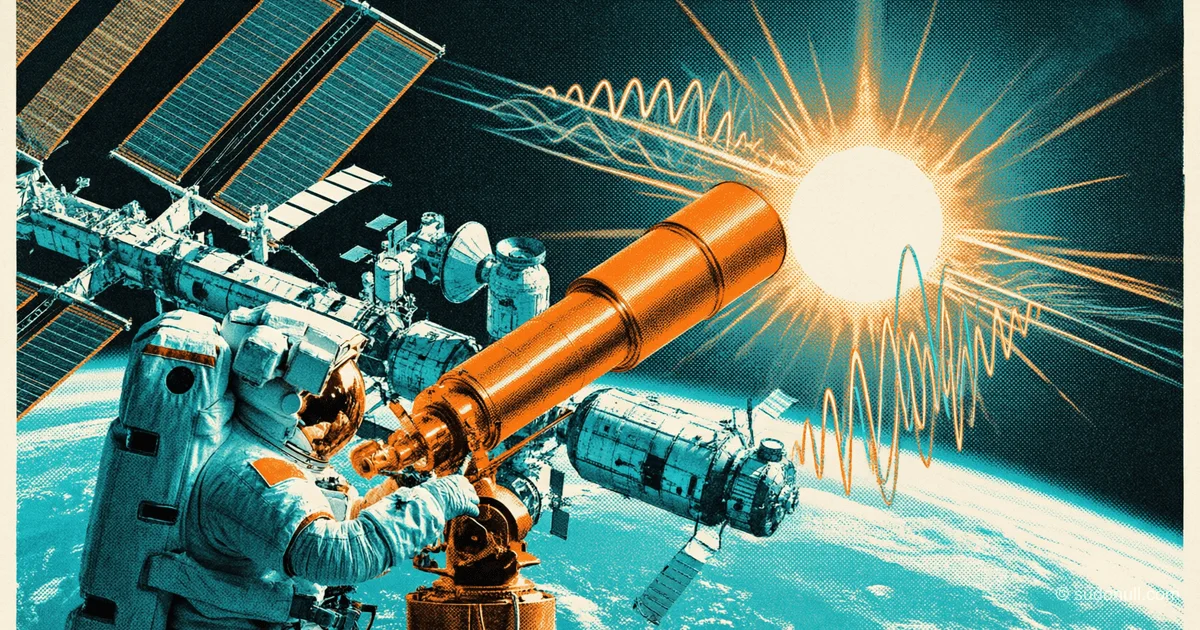
On May 27, cosmonauts will install the "Solnze-Terahertz" telescope, which will peer into previously inaccessible layers of the Sun's atmosphere for accurate space weather forecasting.
[The Gist]: What's Really Happening
On May 27, 2026, at 17:15 Moscow time, cosmonauts Sergey Kud-Sverchkov and Sergey Mikaev will perform a spacewalk to install the "Solnze-Terahertz" radio telescope on the Zvezda module. The official description is "studying previously inaccessible layers of the Sun's atmosphere for space weather forecasting."
But beneath this academic veneer lies something far more pragmatic. It's about closing a critical gap in the global early warning system for space storms—a gap that all spacefaring nations have exploited for years to calibrate their spy satellites.
A simple fact the media glosses over: the terahertz range (0.4–12 THz) is the only window in the electromagnetic spectrum through which processes at altitudes of 300–1000 km above the Sun's photosphere can be observed. This is where coronal mass ejections originate, which, 15–30 minutes after a flare, bombard Earth with charged particles. These particles destroy electronics on low-orbit satellites, blind sensors, and render optical reconnaissance useless for 2–6 hours.
No one wants to admit that "Solnze-Terahertz" is not so much a scientific instrument as an intelligence-meteorological tool. Accurate space weather forecasts allow timely switching of satellites to protective mode, preserving their combat capability. Whoever has such a forecast wins the space war before it even begins.
Timeline and Context
The 47 kg device with eight frequency channels was developed over more than a decade at the Lebedev Physical Institute of the Russian Academy of Sciences (RAS) under the leadership of Dr. Vladimir Makhmutov. The equipment was delivered to the ISS by the Progress MS-33 cargo ship in March 2026.
Throughout April, cosmonauts conducted tests inside the station, running cables connecting the equipment to a two-axis pointing platform on the Zvezda module. The delay of several months compared to initial plans was due to the postponement of the Progress launch from December 2025. But today the spacewalk is happening, and the telescope will begin automatic operation immediately after installation.
Also important: along with "Solnze-Terahertz," cosmonauts will dismantle the cassette from the "Ekran-M" experiment containing gallium arsenide crystals grown in microgravity. This is no coincidence. Gallium arsenide is the foundation of next-generation radar systems operating at frequencies up to 300 GHz. Crystals grown in microgravity have 30–40% fewer lattice defects than terrestrial ones. Their study will provide a quantum leap in creating ground-based terahertz receivers, currently the main bottleneck in building a complete solar monitoring system (orbital telescope + ground calibration stations).
Who Wins and Who Loses
Russia wins—and not just in terms of prestige. After installing "Solnze-Terahertz" on the ISS, Russia will have a unique spectral channel for solar observation that neither the US (the PUNCH mission is launched but lacks terahertz sensors) nor China (ASO-S "Xihe" operates in X-ray and UV) possesses. According to Yuri Yasyukevich, Deputy Director of the Institute of Solar-Terrestrial Physics SB RAS, telescope data will be cross-referenced with information from the Siberian Radioheliograph and RATAN-600, enabling reconstruction of the three-dimensional structure of solar flares with unprecedented accuracy.
FIAN (Lebedev Physical Institute) and Russian academic science win. The decade-long project is finally yielding results. For the institute, this is a powerful argument in budget allocations for the next 5–7 years.
RSC Energia and the manufacturers of Orlan-MKS spacesuits win. The May 27 spacewalk is the first in 2026, the second in Kud-Sverchkov's career, and the debut for Mikaev. Experience with real extravehicular work with new equipment is an invaluable asset.
NASA loses—not directly, but indirectly. The US space agency has no similar instrument on the ISS. The only terahertz solar telescope in history (STIX on ESA's Solar Orbiter) has a much narrower range and operates from a heliocentric orbit, not low Earth orbit. The Russian segment of the ISS is becoming not just a living module but a strategic observation platform.
Commercial satellite operators (SpaceX Starlink, OneWeb, Iridium) lose. They are the primary customers for space weather forecasts. A coronal mass ejection of 1 billion tons of plasma can destroy the electronics of dozens of satellites in a single pass. Today, the accuracy of predicting such events is about 60–70%. Data from "Solnze-Terahertz" could raise this to 85–90%, saving hundreds of millions of dollars in equipment. But this won't happen until 12–18 months of statistical data accumulation.
What the Media Isn't Saying
The key non-obvious insight: the maximum effectiveness of "Solnze-Terahertz" is achieved not alone, but in conjunction with ground infrastructure, and Russia is the only country that has this combination.
Earth's atmosphere completely absorbs terahertz radiation. That's why the telescope is being placed in space. But there is one anomaly: high-altitude deserts with extremely dry air transmit part of the signal.
One such location is the Khulugaisha peak in Buryatia, where the Institute of Solar-Terrestrial Physics SB RAS has operated a cosmic ray station for many years. Nearby, a ground-based terahertz telescope is being built, which will be calibrated against the orbital "Solnze-Terahertz." There are two other potential sites for such a combination: the Atacama Desert in Chile (home to the ALMA array, but it operates in millimeter, not terahertz, range) and the Tibetan Plateau (where China currently lacks developed infrastructure).
Thus, Russia is not just creating a single instrument on the ISS, but a ground-space terahertz interferometer, unparalleled in the world. This will allow not only seeing solar flares but also localizing them in three-dimensional space within the Sun's atmosphere with accuracy down to tens of kilometers. This, in turn, will enable forecasting not just the fact of a flare, but its power, direction, and arrival time of plasma at Earth with an accuracy of 10–15 minutes.
Second point: the experiment is designed for 2–3 years. This means that by 2028–2029, Russia will have a ready-for-industrial-use space weather forecasting algorithm. Commercialization of this product through Roshydromet or export contracts could generate tens of millions of dollars annually.
Forecast: Next 30 Days and 90 Days
30 days:
In mid-June 2026, "Solnze-Terahertz" will transmit its first spectral data to Earth. This will be the moment of truth: will all eight detectors operate normally, will the optics avoid blinding when exposed to direct sunlight (a problem some X-ray telescopes faced at startup), and will the signal-to-noise ratio be sufficient for scientific conclusions?
Expect publications in journals like the Astronomical Journal or even Nature with the first spectral curves of the solar corona in the terahertz range. For institute scientists, this will be the most cited result in the last five years.
Also, an interagency agreement between RAS and the Ministry of Defense is likely, regarding regular provision of "Solnze-Terahertz" data for the needs of the Space Forces. Formally—for "ensuring the safety of military spacecraft." In practice—for creating Russia's first combat warning system for space attacks (not missile, but electromagnetic).
90 days:
By the end of August 2026, the first powerful X-class solar flare (the highest category) is expected to be recorded by the instrument at its inception stage, 15–20 minutes before traditional GOES or SOHO satellites detect it. This will be a triumph for Russian astrophysicists and a source of envy for Western competitors.
If this happens, political consequences will follow: NASA will request additional funding from the US Congress for its own terahertz telescope on the ISS. But such a decision will take at least 18 months, and building the telescope 5–7 years. All that time, Russia's "Solnze-Terahertz" will remain unique in its class.
If no strong flares occur in the next three months, scientists will focus on accumulating background data, and the breakthrough will be delayed until the peak of solar activity (expected in 2028–2029). But May 27, 2026, is the day Russia quietly, without fanfare, but strategically surged ahead in the space weather race. And that is far more important than any Starship or Chinese quantum computer.
— Editorial Team










No comments yet.