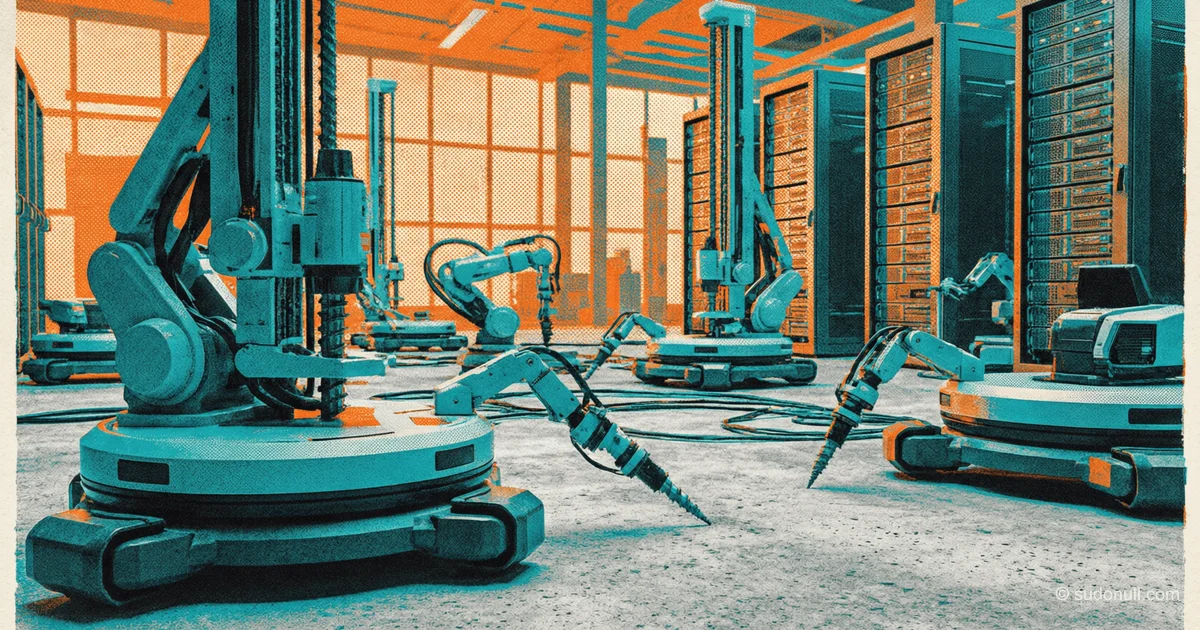
August Robotics Raises €30M to Build AI Data Centers with Robots
The company develops autonomous fleets for construction sites and has formed a strategic partnership with DEWALT to enter the US and European markets.
Robots vs. the Bottleneck: Why August Robotics' €30M Is a Bet on Concrete Shortage
[The Gist]: What's Really Happening
On May 26, 2026, Australian company August Robotics announced the close of a $30 million Series B round (approximately €27.6 million). The round was led by Greek venture capital firm Big Pi Ventures, with participation from Blackbird, Skip Capital, Tanarra, Future Family Office, and new US investor GS Futures. The funds will be used to scale production of autonomous drilling robots for data center construction and to open new hubs in Athens and Melbourne.
The official story: the company is accelerating AI infrastructure construction.
But here's what's behind that phrasing. This isn't just about "smart robots." It's about eliminating the bottleneck that holds back the entire AI market. Today, building a data center isn't constrained by servers or chips. It's constrained by concrete floors and millions of holes for racks, cooling systems, and cable trays.
A single hyperscale data center requires 40,000 to 150,000 precisely drilled holes in the concrete slab. Each hole must be of a specific depth, diameter, and at a precise coordinate with a tolerance of no more than 1-2 mm. Manual drilling at this scale takes weeks and suffers from human error. A tired driller misses a coordinate by 5 mm — the rack can't be installed — redo it. That's millions of dollars in delays.
August Robotics' technology, developed in partnership with DEWALT (a Stanley Black & Decker brand), solves this problem radically.
Timeline and Context
On January 20, 2026, at the World of Concrete trade show in Las Vegas, DEWALT officially unveiled the drilling robot co-developed with August Robotics. The robot had already undergone pilot operation at 10 sites of one of the largest hyperscale operators (presumably Amazon, Microsoft, or Google).
Pilot results, released in January:
- Drilling speed — up to 10 times faster than manual labor
- 99.97% positioning and depth accuracy across over 90,000 holes
- Construction time reduced by 80 weeks total across 10 projects
Now, in May 2026, August Robotics is raising $30 million to scale up. This means the pilot was deemed successful and it's time to move to industrial volumes.
Key date: commercial availability of the robot is expected in mid-2026. That is, 1-2 months from the publication of this article.
Who Wins and Who Loses
August Robotics wins. Founded in 2017 by Alex Wyatt (who has Greek roots from the island of Kastellorizo), the company is transforming from a niche manufacturer of the Lionel marking robot (300 million sq ft of markings on five continents) into a key supplier for AI infrastructure construction. The company's valuation post-round is undisclosed, but given the $30 million raise with participation from Blackbird (one of Australia's top funds), we're talking about hundreds of millions post-money.
Big Pi Ventures wins. The Greek fund didn't just invest money — it tied the company to Greece. Part of the funds will go toward creating a hub in Athens, which will become August Robotics' second European center after Düsseldorf. For the Greek startup ecosystem, this is a major success story.
DEWALT and Stanley Black & Decker win. They now have not just a power tool, but a robotic platform that sells as a service or as equipment. The commercial launch in mid-2026 means their competitive advantage over other tool manufacturers (Bosch, Makita, Hilti) in the data center construction segment becomes enormous.
Hyperscale operators win. Accelerating data center construction by 30-40% means new AI capacity can be brought online a quarter or two faster. In a world where a 6-month delay means losing market share, this is invaluable.
The construction industry as a whole wins. August Robotics' robots are the first mass application of autonomous fleets on real construction sites. If the technology proves itself on data centers, the next step will be residential complexes, logistics centers, factories. This opens the path to automating the entire construction process.
Construction contractors who don't invest in automation lose. In 2-3 years, a competitor using robots will deliver projects twice as fast and cheap. Manual drilling will become a competitive disadvantage.
Traditional manufacturers of industrial drilling equipment lose. They don't have a robotic platform. They only have a tool. And in a world where customers don't need drills, but finished holes at specified coordinates, a tool without automation loses value.
Migrant workers employed in manual drilling lose. That's hundreds of thousands of jobs worldwide. Their labor becomes uncompetitive in speed and accuracy. The retraining question will become acute as early as 2027-2028.
What the Media Isn't Saying
First and foremost insight: the $30 million round is not about R&D. It's about scaling production that's already underway.
Most articles talk about "raising investments for development." But the reality is that the product already exists and has been battle-tested on 10 sites. The $30 million will go toward producing not 10 robots a month, but 100. Opening a hub in Athens is not about science, but about servicing the fleet in EMEA. Robots break down, need repairs, software updates, and customer staff training.
Second: August Robotics has a second product that hardly anyone writes about — vertical drilling (the Boris robot).
Greek publication Kathimerini mentions that the company recently launched Boris — a fleet of autonomous robots for vertical drilling. So far, media attention has focused on "downward drilling" in partnership with DEWALT. But vertical drilling is a separate huge niche: installing anchors in walls, mounting engineering systems, preparing for cladding. If Boris scales as successfully as the floor driller, August Robotics' market doubles.
Third: the partnership with DEWALT is not exclusive — and that's a risk.
DEWALT is a Stanley Black & Decker brand. They announced the robot in January 2026 as a joint development. But the press release about the round in May 2026 makes no mention of expanded exclusivity. This means August Robotics could theoretically strike a similar partnership with Hilti or Bosch. Or it might not, if DEWALT wants to develop the technology on its own. The relationship is strategic, but not a marriage.
Fourth: $30 million is not a huge sum for a hardware startup.
For comparison: Boston Dynamics has raised about $2.5 billion in its history. Figure AI — about $1.5 billion. $30 million is a scaling round, not a growth round. August Robotics won't become a "unicorn" after this round. But it doesn't need to. Its goal is profitability through sales and leasing of robots to construction companies, not a valuation race.
Forecast: Next 30 Days and 90 Days
30 days:
In mid-June 2026, the company will announce first major orders from construction contractors working on hyperscale projects. The pilot is complete, commercial availability is mid-2026. The next 30 days are time to sign contracts with Turner Construction, DPR Construction, or similar players.
Also expect details about the Athens hub: how many people will be hired, what service contracts have already been signed in EMEA, whether there will be manufacturing in Greece or just R&D and service.
90 days:
By August 2026, the company will present operational results from commercial, not pilot, sites. If the numbers are close to pilot (10x speed, 99.97% accuracy), this will be a catalyst for the next round (or for an IPO in 12-18 months).
Also likely is an announcement of a new robot — either a modification for another type of construction work (e.g., for laying cable trays), or a next-generation driller with improved specs.
For investors: August Robotics is a private company, no shares on the stock exchange. But there is an indirect way to play the growth: Stanley Black & Decker (NYSE: SWK) is a public partner of August Robotics. If drilling robots go mainstream, SWK gets an additional growth driver in the Tools & Outdoor segment.
But the main takeaway isn't about investments. The main takeaway is that we are witnessing data center construction transition from "heavy manual labor" to "automated industrial production." And August Robotics, with partner DEWALT, is at the forefront of this transition. The question isn't whether robots will drill concrete on all construction sites worldwide. The question is how fast it will happen. $30 million is the answer: very fast.
— Editorial Team









No comments yet.