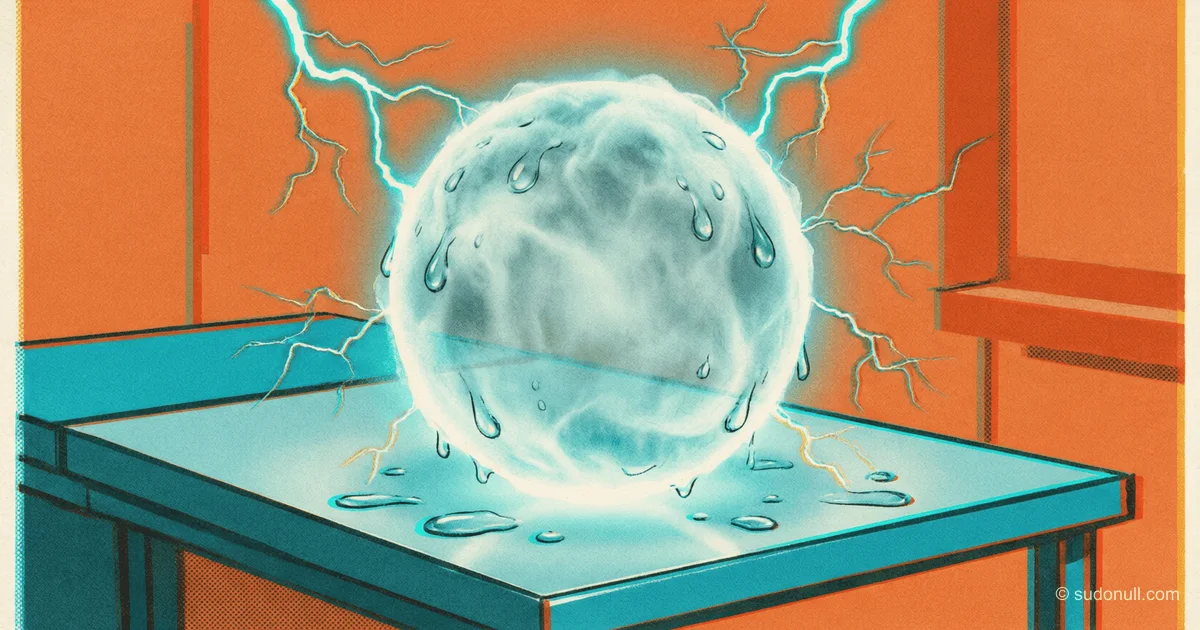
Russian Scientists Unravel the Mystery of Ball Lightning, Proving Its Aerosol Nature
Researchers at the Boreskov Institute of Catalysis SB RAS have experimentally determined that this natural phenomenon is a water aerosol containing hydrogen, not plasma as previously thought.
Aerosol Revolution: Why Ball Lightning Transformed from Plasma to Hydrogen Fog
[The Gist]: What's Really Happening
At the General Meeting of the Russian Academy of Sciences on May 25, 2026, Chairman of the Siberian Branch (SB RAS) Academician Valentin Parmon officially announced that Siberian scientists had completed a research phase confirming that natural ball lightning is a water aerosol filled with hydrogen.
These data fundamentally refute the concept of ball lightning as a high-temperature plasma object, which has dominated physics for the last 150 years.
At first glance, this is purely a fundamental discovery, interesting only to a handful of atmospheric physicists. But behind it lies something far more practical.
Key non-obvious insight that everyone misses: the technology for producing aerosol "ball lightning" in the laboratory was developed back at the Petersburg Institute of Nuclear Physics (NRC "Kurchatov Institute") in Gatchina. There, they learned to create long-lasting, upward-floating luminous formations using a special electric discharge in the presence of water.
In other words, Russian scientists didn't just explain a natural phenomenon. They created a working laboratory analogue. This means we can now study the object's properties not in rare natural conditions (ball lightning is observed only a few times a year worldwide), but in a controlled laboratory setup.
And the main question that arises after this discovery is: what else can be done with a hydrogen aerosol that glows and moves against gravity? The answer may lie in a completely unexpected direction.
Timeline and Context
Research into the nature of ball lightning has been conducted at the Boreskov Institute of Catalysis SB RAS for several years. 2025 was a key year—it was then that a "very important phase" of research was completed, confirming the aerosol-hydrogen nature of the phenomenon.
May 25, 2026—presentation of results at the General Meeting of the Russian Academy of Sciences. Academician Valentin Parmon, presenting the discovery, emphasized that the data explain not only the glow, but also ball lightning's ability to float in the air (due to hydrogen's low density) and its explosiveness upon contact with objects (ignition of hydrogen).
Importantly, the discovery has two independent branches. Physicists from Gatchina created an analogue, while Siberian scientists from Novosibirsk explained the nature. The convergence of these two results occurred only in 2025–2026, when it became clear that the Gatchina laboratory object and natural ball lightning share the same aerosol nature.
Who Wins and Who Loses
Winner: Boreskov Institute of Catalysis SB RAS. For an institute traditionally focused on industrial catalysis (oil refining, polymer chemistry), branching into fundamental atmospheric physics expands its scientific profile. Academician Parmon, as Chairman of SB RAS, gains an additional argument in the fight for budget funding.
Winner: NRC "Kurchatov Institute" (Gatchina). Their laboratory setup is now recognized as "the closest analogue to natural ball lightning." This boosts the institution's status and opens access to grants for further study of aerosol discharge phenomena.
Winner: Russian fundamental science as a whole. Refuting a 150-year-old paradigm is an event worthy of publication in Nature or Physical Review Letters. This is a significant plus for the image of Russian physics on the world stage.
Loser: The "plasma theory" of ball lightning. For decades, it was believed that ball lightning is high-temperature plasma (ionized gas) with temperatures of thousands of degrees. It is now proven to be a cold aerosol at near-room temperature. This means hundreds of articles, defended dissertations, and proposed technical solutions (e.g., plasma reactors simulating ball lightning) were built on a false premise.
Loser: Western researchers who failed to reproduce a stable laboratory analogue. The success of the Gatchina setup in creating long-lived luminous objects that float upward (indicating low density—i.e., hydrogen) has proven unique. No analogues with such stability and lifetime have yet been created in the USA, Europe, or Japan.
What the Media Isn't Saying
First: The discovery does not answer the most important practical question—how to protect against ball lightning.
Yes, we now know it's a hydrogen aerosol. But knowing the chemical composition does not automatically provide a way to predict where and when it will appear. Ball lightning occurs during thunderstorms, but not every thunderstorm. The conditions for its generation are still unclear. The aerosol theory explains what it consists of, but not why it appears in some places and not others.
Second, and most importantly. The laboratory analogue from Gatchina requires a high-voltage electric discharge in the presence of water. This means that producing "man-made ball lightning" requires industrial setups, not household outlets. No practical application in energy or defense is foreseeable in the near future—unless someone figures out how to use a hydrogen aerosol with prolonged glow for something useful.
Third: Academician Parmon directly stated that "ball lightning appears at relatively low temperatures." This clarification is important. That is, the phenomenon does not occur in hot, humid climates—specific temperature conditions are needed. This imposes constraints on the geography of research and on possible natural disasters associated with ball lightning.
Fourth, and this is especially important. Ball lightning is a water aerosol with hydrogen. Hydrogen ignites easily. When ball lightning explodes, it releases energy equivalent to a small amount of TNT (up to several hundred grams). But press releases omit this to avoid panic. In practice, knowing the composition allows the development of neutralization methods—for example, spraying hydrogen recombination catalysts (ironically, this is exactly what the Boreskov Institute of Catalysis SB RAS does). That is, the institute that made the discovery has the technological base to also create an antidote.
Forecast: Next 30 Days and 90 Days
30 days:
Expect a publication in a peer-reviewed scientific journal (most likely in the Russian Journal of Experimental and Theoretical Physics or the international Physical Review E). It will present experimental data—glow spectra, density measurements, gas analysis results. If the journal is high-impact, the discovery will gain international resonance.
Also likely are inquiries from the Ministry of Emergency Situations and the Ministry of Defense. If the aerosol nature is confirmed, the question arises: can ball lightning be generated artificially (for military purposes—as a blinding or distracting device) or, conversely, suppressed (to protect critical infrastructure). Scientists at the Kurchatov Institute will likely receive additional funding for these studies.
90 days:
By August 2026, Japanese, Chinese, and American laboratories will attempt to replicate the Gatchina experiment. If they succeed, the aerosol theory will become universally accepted. If not, doubts will arise about whether the laboratory object is truly identical to the natural one.
For investors: there are no direct assets here. But there is an indirect signal. If the Boreskov Institute of Catalysis SB RAS or the Kurchatov Institute announce the creation of a technology to neutralize ball lightning (e.g., by spraying a catalyst into the air), it could be in demand by insurance companies and critical infrastructure operators (power lines, airports, oil storage facilities). The market for such protection is potentially hundreds of millions of dollars.
For now, we have witnessed one of physics' most mysterious puzzles receive a simple and elegant explanation. Ball lightning turned out to be not plasma, but an ordinary (well, almost ordinary) hydrogen-laced fog. This is an achievement of Russian science that will enter the physics textbooks of the next generation. But the path to practical application is no shorter than from the discovery of the electron to the creation of the computer.
— Editorial Team









No comments yet.